
VWRA ETF Guide: How Singapore investors can invest in global stocks
ETFs
By Beansprout • 10 Sep 2026
Why trust Beansprout? We’ve been awarded Best Investment Website at the SIAS Investors’ Choice Awards 2025
'%3e%3cpath%20fill-rule='evenodd'%20clip-rule='evenodd'%20d='M17.64%209.20455C17.64%208.56637%2017.5827%207.95273%2017.4764%207.36364H9V10.845H13.8436C13.635%2011.97%2013.0009%2012.9232%2012.0477%2013.5614V15.8195H14.9564C16.6582%2014.2527%2017.64%2011.9455%2017.64%209.20455V9.20455Z'%20fill='%234285F4'/%3e%3cpath%20fill-rule='evenodd'%20clip-rule='evenodd'%20d='M9%2018C11.43%2018%2013.4673%2017.1941%2014.9564%2015.8195L12.0477%2013.5614C11.2418%2014.1014%2010.2109%2014.4205%209%2014.4205C6.65591%2014.4205%204.67182%2012.8373%203.96409%2010.71H0.957275V13.0418C2.43818%2015.9832%205.48182%2018%209%2018V18Z'%20fill='%2334A853'/%3e%3cpath%20fill-rule='evenodd'%20clip-rule='evenodd'%20d='M3.96409%2010.71C3.78409%2010.17%203.68182%209.59318%203.68182%209C3.68182%208.40682%203.78409%207.83%203.96409%207.29V4.95818H0.957273C0.347727%206.17318%200%207.54773%200%209C0%2010.4523%200.347727%2011.8268%200.957273%2013.0418L3.96409%2010.71V10.71Z'%20fill='%23FBBC05'/%3e%3cpath%20fill-rule='evenodd'%20clip-rule='evenodd'%20d='M9%203.57955C10.3214%203.57955%2011.5077%204.03364%2012.4405%204.92545L15.0218%202.34409C13.4632%200.891818%2011.4259%200%209%200C5.48182%200%202.43818%202.01682%200.957275%204.95818L3.96409%207.29C4.67182%205.16273%206.65591%203.57955%209%203.57955V3.57955Z'%20fill='%23EA4335'/%3e%3c/g%3e%3cdefs%3e%3cclipPath%20id='clip0_0_2849'%3e%3crect%20width='18'%20height='18'%20fill='white'/%3e%3c/clipPath%3e%3c/defs%3e%3c/svg%3e)
Make Beansprout your preferred source on Google
Add us on Google to see more of our insights in your search results
Learn how the VWRA ETF works, its fees, dividend policy, tax considerations and risks, and how to invest in the global equity market
What happened?
For many investors, getting started with investing can feel complicated.
There are individual stocks to research, different markets to choose from, and hundreds of options covering everything from Singapore blue chips to US technology companies.
One common approach is to simplify the process by using a broad-market global equity ETF, which holds a basket of stocks across multiple countries through a single fund, instead of picking individual stocks to invest in.
The Vanguard FTSE All-World UCITS ETF, better known as VWRA, is one option available to investors looking for global equity exposure.
With a single ETF, investors can gain exposure to thousands of companies across developed and emerging markets. VWRA is also Ireland-domiciled and accumulating, which gives it some structural advantages for investors based in Singapore.
In this article, we look at what VWRA invests in, its fees, dividend policy and and risks, and how it compares with other alternatives like VALL, CSPX, and VOO.
What is the VWRA ETF?
VWRA is the ticker for the Vanguard FTSE All-World UCITS ETF (USD) Accumulating on the London Stock Exchange, trading in US Dollars.
It passively tracks the FTSE All-World Index, an index of large and medium-sized companies across developed and emerging markets.
For investors unfamiliar with ETFs, think of it as a basket of investments that can be bought and sold on an exchange. Our guide to choosing your first ETF explains how to compare these baskets by exposure, costs, investment objectives, and so on in more detail.
VWRA at a glance
| Feature | Details |
| Benchmark | FTSE All-World Index |
| Investment exposure | Large and mid-sized companies in developed and emerging markets |
| Fund domicile | Ireland |
| Exchange | London Stock Exchange |
| Trading ticker | VWRA |
| Assets under management | US$85 billion |
| Base currency | USD |
| Dividend policy | Accumulating |
| Expense Ratio | 0.14% per year |
| Inception date | July 2019 |
| ISIN | IE00BK5BQT80 |
| Source: VWRA ETF website, Vanguard, as at 31 August 2026. For the purpose of this article, we are looking at the LSE-listed ticker. VWRA is also offered in other exchanges including the SIX Swiss Exchange, Euronext Amsterdam, and so on. | |
What does VWRA invest in?
VWRA passively tracks the FTSE All-World Index, and so the companies that it invests in are those that are within the benchmark index.
The FTSE All-World index covers large and mid-sized companies in both developed and emerging markets, representing around 90-95% of the world's investable market capitalisation after screening for free float and liquidity according to FTSE Russell.
It’s worth noting that it is not an index of every listed company worldwide, and it does not provide comprehensive small-company exposure.
VWRA also uses physical sampling whereby it owns a representative selection of the index’s securities rather than necessarily holding every constituent.
As at 31 July 2026, the fund held 3,782 stocks, compared with 4,264 stocks in its benchmark, but kept the average financial ratios almost identical to its benchmark.
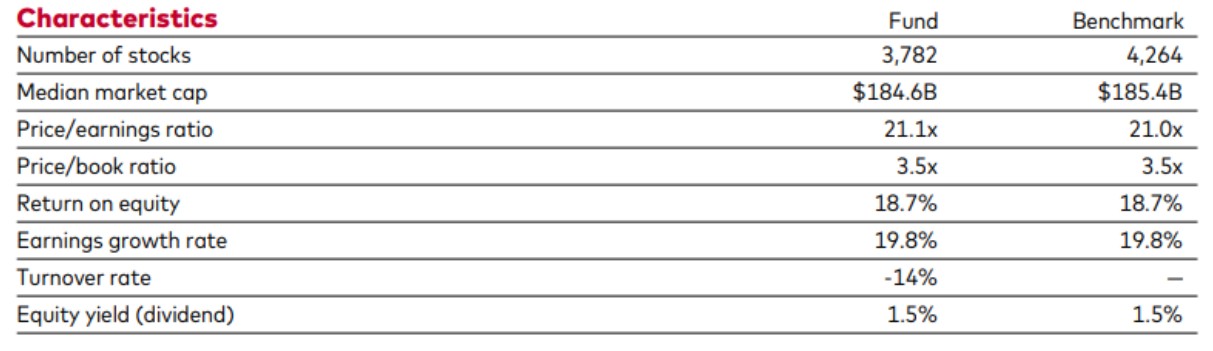
This gives investors broad exposure, but the allocation is not evenly divided between countries.
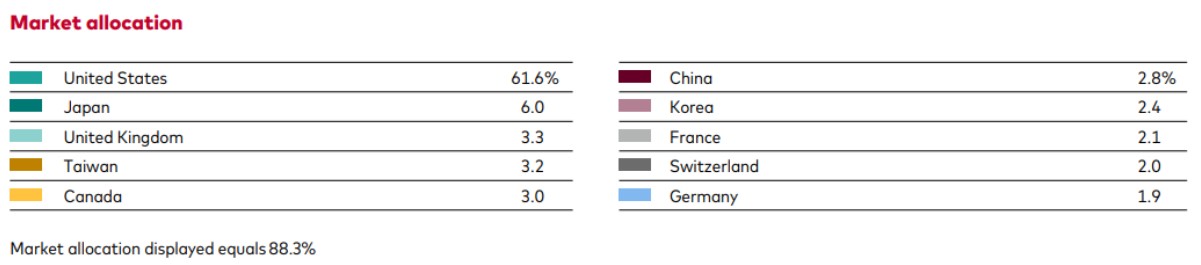
Geographically, the US accounted for 61.6% of the fund, followed by Japan at 6.0% and the UK at 3.3%.
Its top holdings include well-known names such as NVIDIA, Apple, Alphabet, Microsoft, and Amazon.
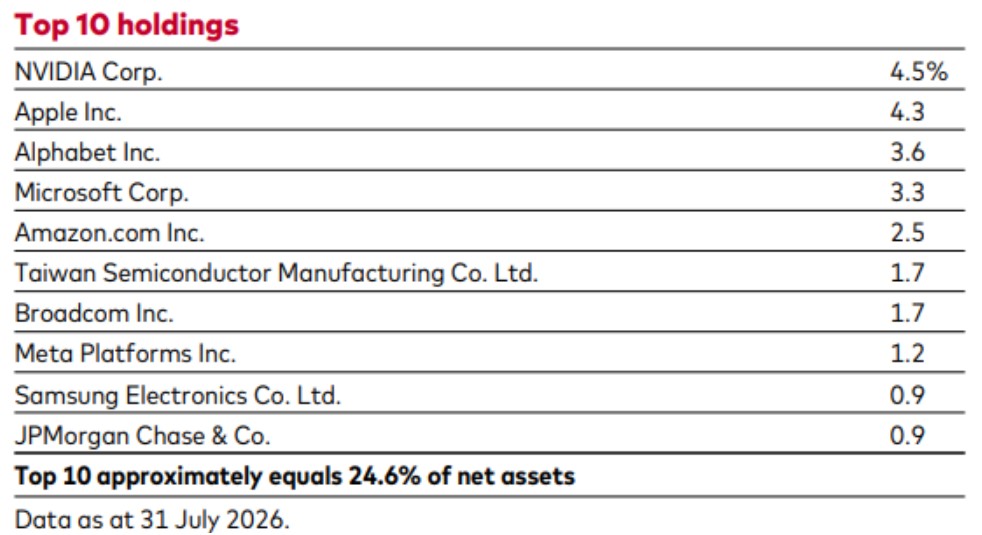
Because the index is weighted by market capitalisation, companies with larger market capitalisations receive larger weightages within the fund.
Nevertheless, VWRA will go through a rebalancing on a semiannual basis. So, companies which perform well will get a higher weightage in the fund while companies which continue to underperform will eventually get replaced by new ones automatically.
In other words, VWRA is globally diversified, but still has significant exposure to the large US technology companies and has many overlaps with S&P 500 ETFs which track the largest 500 US-listed companies. Hence, movements in the US market and the world's largest companies can still have a significant impact on its performance.
Does VWRA pay dividends?
VWRA does not pay cash dividends into your brokerage account because it is an accumulating ETF. Any dividends the fund receives from its holdings will be automatically reinvested into the fund.
This will be reflected in the net asset value (NAV) of the fund.
For an investor who wants to reinvest dividends, this means there is no need to manually use cash distributions to buy more units.
However, investors who are looking for cash payments into their account would need to explore distributing ETFs instead such as VWRD which is the distributing class ETF of the same fund.
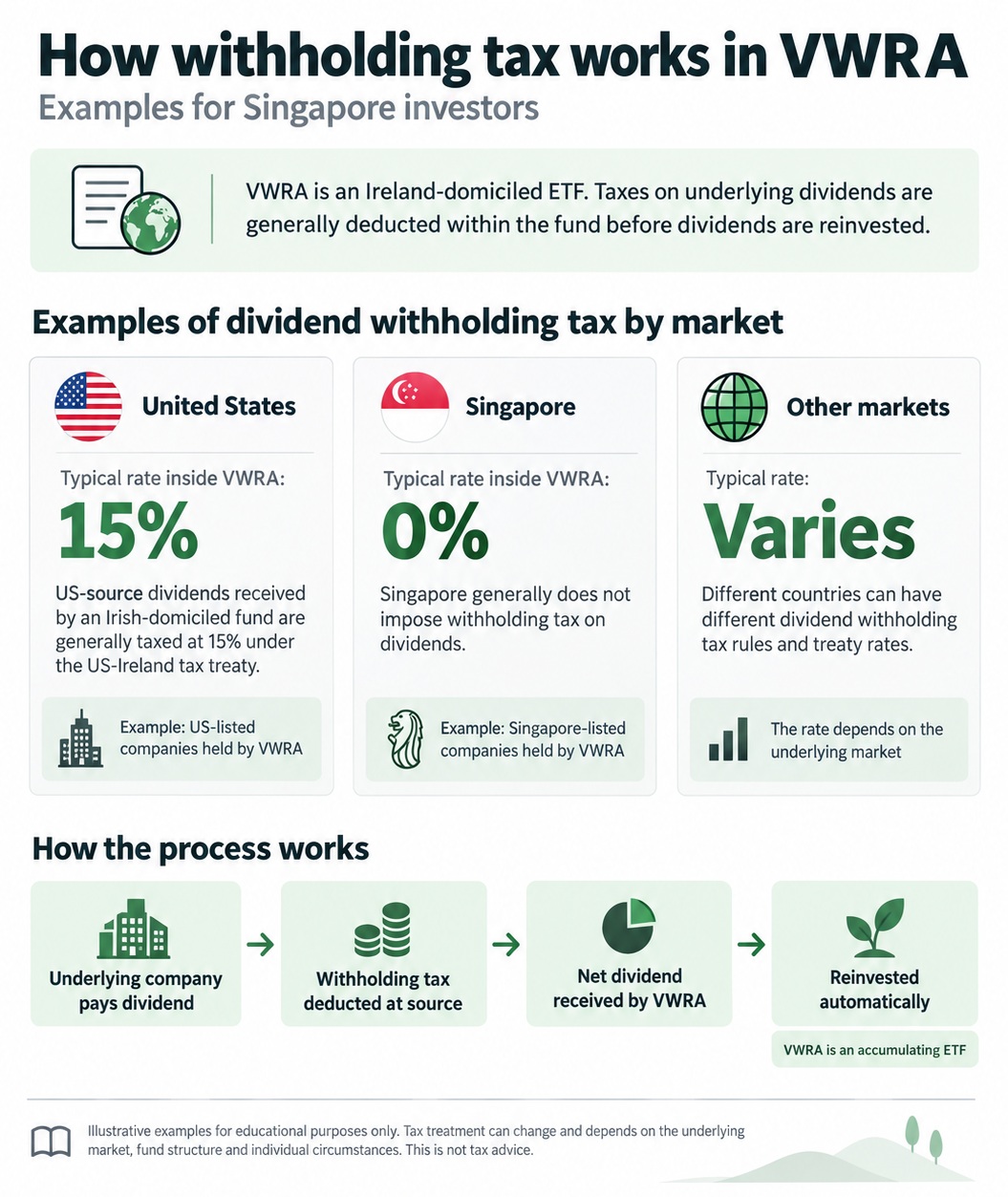
It’s also important to mention that VWRA will still incur any relevant withholding taxes on the dividends it receives from the companies that it invests in. However, the tax is automatically deducted inside the fund itself, so investors do not need to do anything about it.
What are the key features of VWRA?
#1 - Broad diversification in a single ETF
VWRA provides exposure to thousands of companies through a single ETF.
Rather than buying individual shares in the US, Japan, the UK, Europe, China, Taiwan and other markets, investors can gain exposure to companies in the whole world through just one ETF.
Diversification does not eliminate market risk, but it reduces the extent to which the portfolio depends on any one company.
This is one reason broad-market ETFs like VWRA are often discussed as a starting point for investors who are new to investing, as its broad diversification provides exposure to the growth of the global economy without relying on a single company to outperform.
However, diversification does not prevent losses when global stock markets fall. VWRA remains an equity investment, so its value can fluctuate significantly over time.
#2 - It covers both developed and emerging markets
Unlike an S&P 500 ETF, which focuses on US large-cap companies, VWRA invests across both developed and emerging markets.
This gives investors exposure to markets such as China, India, Taiwan and other emerging economies alongside developed markets such as the US, Japan and the UK.
This means an investor does not have to decide in advance which country will outperform.
At the same time, the allocation is determined by market capitalisation rather than being evenly spread between countries.
#3 - It is passively managed
VWRA tracks an index rather than relying on a fund manager to actively select stocks.
The objective is to replicate the performance of the FTSE All-World Index rather than outperform it.
This keeps the investment process relatively simple.
Investors do not need to monitor a fund manager's individual stock picks or worry about whether the manager will change strategies which may impact the performance of the fund.
#4 - The ETF has an annual fund cost of 0.14%
VWRA currently has a total expense ratio of 0.14% a year which covers fees and expenses incurred in managing a global portfolio across multiple countries.
That works out to about US$14 a year for every US$10,000 invested, before considering brokerage costs and any other charges.
Lower fees can have a larger impact over a long investment horizon because the less money paid in fees means more money available to compound and grow.
#5 - Dividends are automatically reinvested
VWRA is an accumulating ETF.
Instead of paying dividends to investors in cash, the dividends received from the underlying holdings are reinvested within the fund.
This means investors do not have to manually reinvest dividends.
It can also make the ETF more convenient for someone who is focused on long-term wealth accumulation rather than generating regular cash flow.
What are VWRA’s fees?
VWRA has a total expense ratio of 0.14% per year.
This means that for every US$10,000 invested, the annual fund expense works out to about US$14.
The fee is already deducted within the fund, so you will not need to make any separate payments to anyone to continue to hold the ETF.
However, besides the ETF’s expense ratio, you may incur brokerage fees, platform fees, and currency conversion charges whenever you buy or sell units in the ETF.
These frictional charges can be significant if you are investing small amounts frequently. You can utilize a well-planned Dollar-cost averaging strategy to help reduce transaction costs by varying the scheduled investment amount and frequency that fits your portfolio.
Check out our beginner's guide to dollar-cost averaging (DCA) to learn how to use this strategy to build a disciplined habit of investing over the long term.
You can also refer to our review of the best online brokerage & trading platform in Singapore to find the pros and cons of the available brokers and find the most suitable one for you.
What are the tax considerations for Singapore investors before investing in VWRA?
VWRA is domiciled in Ireland, even though it trades in US dollars on the London Stock Exchange.
This can affect how dividends from the underlying investments are taxed.
For example, under the US-Ireland tax treaty, US-source dividends received by an eligible Irish resident are generally subject to a maximum withholding tax rate of 15%, compared with the standard 30% US withholding rate that can apply to US-source dividends paid to non-US investors where no lower treaty rate applies.
This tax is incurred within VWRA before dividends are reinvested, so investors do not receive a separate tax bill for these distributions.
Different markets held by VWRA can have different withholding tax treatments.
Fund domicile can also matter for estate tax.
US estate tax rules can apply to US-situated assets held by non-US citizens and non-US residents. The IRS states that a US estate tax return may be required when a nonresident non-citizen's US-situated assets exceed US$60,000 at death.
An Ireland-domiciled ETF such as VWRA is therefore structured differently from directly owning a US-domiciled ETF such as Vanguard S&P 500 ETF (VOO).
Tax treatment can depend on individual circumstances, so investors with significant overseas assets may want to seek professional tax or estate-planning advice.
What are the risks of investing in VWRA?
#1 - Global diversification does not prevent losses
Even though VWRA is diversified across thousands of companies, it is still a stock market investment and has risk of capital loss.
Stock markets can rise or fall depending on many factors. During a bear market, the value of the stocks may fall and remain low for extended periods.
For example, VWRA had a negative return for the full year of 2022 as the US Federal Reserve aggressively raised interest rates to curb high inflation.
Markets subsequently recovered, but there is no guarantee that a future downturn will recover within a particular timeframe.
Therefore, investors who need to liquidate their portfolio during the downturn may realise permanent capital losses.
A long investment horizon can give you more time to navigate market fluctuations, but it does not guarantee a profit or recovery by a particular date.
#2 - VWRA is still heavily exposed to the US
Holding thousands of companies does not mean that each has an equal impact on returns.
Because VWRA is market-capitalisation weighted and many of the largest companies in the world are listed in the US, VWRA is heavily exposed to US-listed companies.
VWRA’s substantial US allocation and exposure to large technology companies mean that developments affecting these parts of the market can still have a significant impact.
#3 - VWRA does not include comprehensive small-cap exposure
VWRA tracks the FTSE All-World Index, which focuses on large and mid-sized companies.
Investors who want exposure to smaller companies would need to consider whether this matters for the portfolio they are building.
A global all-cap ETF is one alternative that includes large, mid and small-cap companies.
#4 - Foreign currency movements can affect SGD returns
VWRA trades in US dollars on the London Stock Exchange, but its underlying investments span several currencies and it is not hedged to the Singapore dollar. Therefore, currency movements can affect investment returns when measured in Singapore dollars terms.
For Singapore investors, this means the return measured in Singapore dollars can differ from the return measured in US dollars.
Even if the underlying shares perform well, a strengthening Singapore dollar could reduce the return in SGD terms.
This matters especially if we eventually want to sell the ETF and convert the money back into SGD.
VWRA vs VALL vs CSPX vs VOO: What is the difference?
The most important difference is what each ETF invests in, rather than simply which has the lowest fee.
The Vanguard FTSE Global All-Cap UCITS ETF, using the ticker VALL, is a global etf that passively tracks the FTSE Global All-Cap ETF.
VWRA and VALL both provide global exposure across developed and emerging markets. The key difference is that VALL also includes smaller companies in its investment universe while VWRA only invests in mid and large cap companies.
It’s worth noting that smaller cap exposure does not guarantee nor imply better returns or lower risk.
VALL was also just launched on 18 August 2026, so it is the newest ETF in the list and has very little track record to go by.
CSPX and VOO are both ETFs that track the S&P 500 index instead, which invests in the 500 largest US-listed companies. The main difference between these two ETFs is that CSPX is an accumulating ETF domiciled in Ireland, while VOO is a distributing ETF domiciled in the US. This has meaningful tax implications, which we covered in our CSPX article.
Generally speaking, Ireland-domiciled ETFs have more favourable tax treatment compared to US-domiciled ETFs for Singapore investors with lower withholding tax and no US estate tax.
You can also check out our guide on S&P 500 ETFs to find out more about the many alternatives to get exposure to the S&P 500 index.
| ETF Ticker | VWRA | VALL | CSPX | VOO |
| Fund name | Vanguard FTSE All-World UCITS ETF | Vanguard FTSE Global All-Cap UCITS ETF | iShares Core S&P 500 UCITS ETF | Vanguard S&P 500 ETF |
| Benchmark | FTSE All-World Index | FTSE Global All Cap Index | S&P 500 Index | S&P 500 Index |
| Markets covered | Developed and emerging markets | Developed and emerging markets | United States | United States |
| Company sizes covered | Large and mid-cap | Large, mid and small-cap | Large-cap | Large-cap |
| Fund domicile | Ireland | Ireland | Ireland | United States |
| Dividend policy | Accumulating | Accumulating | Accumulating | Distributing, with quarterly payments |
| Annual expense ratio | 0.14% | 0.07% | 0.07% | 0.03% |
| Inception Year | 2019 | 2026 | 2010 | 2010 |
| Source: Respective Fund Factsheets, August 2026. | ||||
VWRA and VALL provide exposure beyond the US within one ETF. CSPX and VOO focus on the S&P 500, so they represent a more concentrated geographical choice.
A lower expense ratio does not automatically make an ETF the better choice. The funds have different exposures and domiciles which may be more impactful than slightly cheaper fees.
A common question is then whether it is better to invest in a global ETF like VWRA or an S&P 500 ETF.
The main difference is geographical exposure.
An S&P 500 ETF focuses on the largest US companies, while VWRA invests across developed and emerging markets.
For example, investors buying an S&P 500 ETF are taking a view on the long term growth of the US market. Meanwhile, VWRA still has substantial US exposure, but it also includes Europe, Japan, Canada, emerging markets and other countries.
The more important question is whether you want global diversification or a more concentrated exposure to US large-cap companies.
Investors should also be careful when combining VWRA and an S&P 500 ETF.
Because VWRA already holds many of the world's largest US companies, adding a large S&P 500 position increases exposure to the same companies rather than creating purely new diversification.
How to buy VWRA in Singapore
To buy VWRA, you will need a brokerage account that provides access to the London Stock Exchange.
If you have not yet opened your own brokerage account, find out the best online brokerage & trading platform in Singapore to find the pros and cons of the available brokers.
Next, fund your account and convert your Singapore dollars into US dollars if required.
You can then search for VWRA and check that the ISIN is IE00BK5BQT80 before placing your order.
What would Beansprout do?
If I wanted simple, long-term exposure to the global stock market, a global ETF could form part of my Growth Pot within the Four Pots of Wealth framework.
This allows me to build diversified exposure to the world's largest companies through regular investments over time, rather than trying to pick the next winning stock
When choosing an ETF, I would pay close attention to costs and tax efficiency. While the differences in expense ratios may seem small, they can compound over many years.
Likewise, choosing an Ireland-domiciled ETF may help reduce dividend withholding taxes and avoid potential US estate tax considerations.
Vanguard FTSE All-World UCITS ETF (VWRA) is a low-cost ETF that passively tracks the FTSE All-World Index. It invests in thousands of large and mid cap companies across the developed and emerging economies of the world.
As an accumulating ETF, it will automatically reinvest any dividends it receives back into the fund which may be convenient to make long term compounding more seamless.
Since VWRA is domiciled in Ireland, the dividends it receives from US-listed companies are taxed at 15% withholding tax rate compared to ETFs that are domiciled in the US. Investors from Singapore may also be able avoid US estate taxes when investing in Irish-domiciled ETFs compared to US-domiciled ones.
Ultimately, I would choose a low-cost ETF that fits my investment preferences and that I am comfortable holding for the long term, rather than frequently switching funds to chase small differences in fees or performance.
Once I decide on the the ETF to invest in, I may use dollar-cost averaging to invest regularly in broad-market index funds rather than trying to time short-term movements in the market.
Finally, I would remember that a global ETF is just one part of a diversified portfolio.
If you want to invest in an ETF that has a heavier weightage towards the largest US-listed companies only, take a look at our best S&P 500 ETF for Singapore investors.
We continue to see Singapore as a core portfolio holding. This is why I may consider holding both STI ETFs and global ETFs as part of a diversified long-term portfolio.
If you're new to ETFs, find out more about Exchange Traded Funds (ETFs) here.
Which ETFs are you considering? Leave a comment below or share with us in the Beansprout telegram group.
Planning to invest in global ETFs? Compare the best Singapore brokerages to find the right trading platform, and see the latest promotions and sign-up rewards available.
Follow Beansprout on YouTube, Facebook and Instagram, and add Beansprout as your preferred source on Google so you never miss an update.
Read also
Gain financial insights in minutes
Subscribe to our free weekly newsletter for more insights to grow your wealth
Most Popular

Comments
0 comments