
The top investing mistake beginners make and how to avoid it
Brokerage Account
By Gerald Wong, CFA • 16 Dec 2025
Why trust Beansprout? We’ve been awarded Best Investment Website at the SIAS Investors’ Choice Awards 2025
'%3e%3cpath%20fill-rule='evenodd'%20clip-rule='evenodd'%20d='M17.64%209.20455C17.64%208.56637%2017.5827%207.95273%2017.4764%207.36364H9V10.845H13.8436C13.635%2011.97%2013.0009%2012.9232%2012.0477%2013.5614V15.8195H14.9564C16.6582%2014.2527%2017.64%2011.9455%2017.64%209.20455V9.20455Z'%20fill='%234285F4'/%3e%3cpath%20fill-rule='evenodd'%20clip-rule='evenodd'%20d='M9%2018C11.43%2018%2013.4673%2017.1941%2014.9564%2015.8195L12.0477%2013.5614C11.2418%2014.1014%2010.2109%2014.4205%209%2014.4205C6.65591%2014.4205%204.67182%2012.8373%203.96409%2010.71H0.957275V13.0418C2.43818%2015.9832%205.48182%2018%209%2018V18Z'%20fill='%2334A853'/%3e%3cpath%20fill-rule='evenodd'%20clip-rule='evenodd'%20d='M3.96409%2010.71C3.78409%2010.17%203.68182%209.59318%203.68182%209C3.68182%208.40682%203.78409%207.83%203.96409%207.29V4.95818H0.957273C0.347727%206.17318%200%207.54773%200%209C0%2010.4523%200.347727%2011.8268%200.957273%2013.0418L3.96409%2010.71V10.71Z'%20fill='%23FBBC05'/%3e%3cpath%20fill-rule='evenodd'%20clip-rule='evenodd'%20d='M9%203.57955C10.3214%203.57955%2011.5077%204.03364%2012.4405%204.92545L15.0218%202.34409C13.4632%200.891818%2011.4259%200%209%200C5.48182%200%202.43818%202.01682%200.957275%204.95818L3.96409%207.29C4.67182%205.16273%206.65591%203.57955%209%203.57955V3.57955Z'%20fill='%23EA4335'/%3e%3c/g%3e%3cdefs%3e%3cclipPath%20id='clip0_0_2849'%3e%3crect%20width='18'%20height='18'%20fill='white'/%3e%3c/clipPath%3e%3c/defs%3e%3c/svg%3e)
Make Beansprout your preferred source on Google
Add us on Google to see more of our insights in your search results
Learn the top investing mistake beginners make, why it happens, and practical steps to avoid it, from real investing lessons shared on the Beansprout podcast.
What happened?
In Singapore, investing success is often judged by outcomes. Higher returns, faster gains, bigger portfolios.
But what happens when markets fall and emotions take over?
In this Beansprout podcast, we explore why the biggest investing mistakes beginners make are rarely about picking the wrong stock, and more about being unprepared for volatility and uncertainty.
The conversation highlights why starting early gives you room to learn from mistakes, how investing without an emergency fund magnifies fear, and why volatility tests emotional discipline more than technical knowledge.
We also discuss how research builds conviction during downturns, why your investment goals should shape your risk appetite, and how diversification and position sizing help protect against costly mistakes.
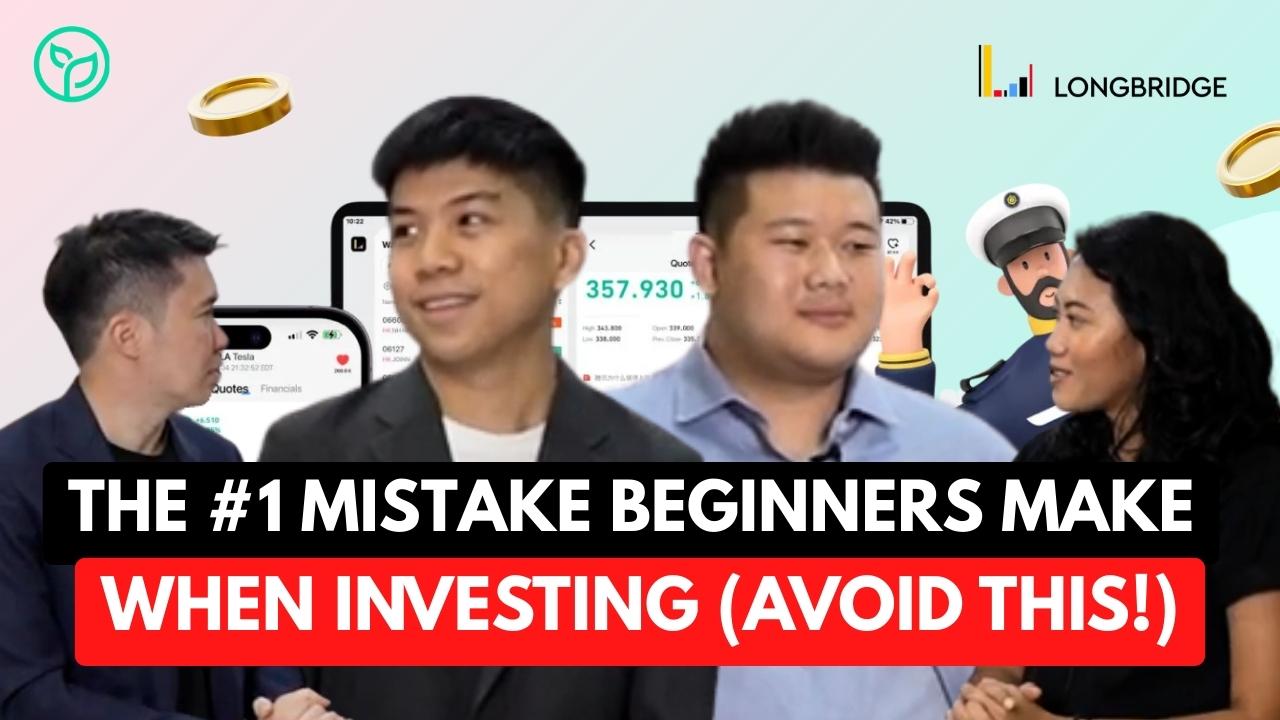
In this episode, we speak with Jaeden and Canyon from Longbridge Singapore, who share the lessons from their own investing journeys and how those experiences reshaped their approach to risk, discipline and long-term financial freedom.
Catch the full conversation in the video below.
Key takeaways for investors from the interview with Jaeden and Canyon from Longbridge Singapore: The top investing mistake beginners make and how to avoid it.
1. Starting early gives you room to learn — and make mistakes safely
Jaeden started investing at just 18 years old, encouraged by his parents to save and invest early. His early gains built confidence, but also led to overconfidence when markets were rising.
When the market crashed in 2020, he almost lost half of his portfolio. While painful, this experience became a turning point.
Starting early gave him something many investors don’t have — time. Time to recover, time to learn, and time to refine his strategy. The key insight is this: mistakes made early in your investing journey are often less costly and far more educational than mistakes made later in life.
2. Investing without an emergency fund magnifies fear
Kenyan’s biggest early mistake was investing without setting aside an emergency fund. He invested a large portion of his savings, including money he might need in case of emergencies.
When markets moved sharply, every price swing felt stressful, even though no actual emergency occurred. This emotional pressure made volatility feel far worse than it needed to be.
Both Jaeden and Kenyan emphasised the same principle: having at least three to six months of living expenses set aside provides peace of mind. An emergency fund acts as emotional insurance, allowing you to stay invested when markets turn volatile.
3. Volatility exposes emotional weaknesses, not just bad stock picks
Jaeden shared that the biggest change in his investing journey was not the stocks he bought, but how he reacted emotionally to market movements.
Early on, falling prices caused panic. Over time, he learned to slow down, create an investment plan and stick to it. This included setting clear entry and exit points, defining investment goals and following a disciplined process.
Kenyan experienced something similar when a stock he believed in dropped about 20% shortly after he invested. Instead of panic selling, he held on because he had done the research. The stock eventually recovered.
The lesson is clear. Volatility tests your emotional discipline far more than your technical knowledge.
4. Research builds conviction during market downturns
Both speakers highlighted the importance of doing proper research before investing. Understanding a company’s fundamentals, valuation metrics and business model makes it easier to stay calm when prices fall.
When you know why you invested in a company, short-term price movements become easier to tolerate. Without that understanding, every dip feels like a mistake.
Research does not eliminate risk, but it builds conviction. That conviction helps investors avoid panic selling and emotional decisions when markets turn against them.
5. Your investment goal should shape your risk appetite
Jaeden’s investment approach evolved as his goals became clearer. Early on, he focused on short-term trading and high-risk penny stocks. Today, his goal is to build a long-term portfolio that could support retirement before age 50.
As a result, he shifted towards dividend-paying and blue-chip companies with more stable returns. Lower volatility made it easier for him to stay invested through market cycles.
Kenyan’s goal is financial freedom — having the flexibility to choose how he spends his time without being tied to a single income source. For him, investing is not about chasing the highest returns, but about creating long-term optionality in life.
6. Diversification and position sizing protect you from big mistakes
Both Jaeden and Kenyan stressed the importance of diversification and sensible position sizing, especially for beginners.
Kenyan shared a simple guideline: avoid putting more than 20% of your portfolio into a single stock. Diversification should also extend across sectors, not just individual names.
For those with limited capital or confidence, starting with lower-risk options such as broad-based ETFs or money market funds can help reduce volatility while building investing habits.
7. Start small, but start with intention
When asked how they would invest $1,000 today as beginners, both gave realistic answers.
Jaeden said he would prioritise parking the money in a low-risk option first, especially if an emergency fund is not fully built. Kenyan suggested a mix — allocating most of it to a broad ETF, and a smaller portion to a stock he has researched and believes in.
The common theme is this: investing is not about the size of your first investment, but about building discipline, consistency and clarity over time.
8. Stick to your plan. Emotions come and go
Their final advice was simple but powerful. Start early, protect your downside with an emergency fund, and always invest with a clear plan.
Market volatility, fear and greed are inevitable. What matters is having a framework that helps you stay invested when emotions run high. Over time, patience and consistency tend to matter far more than chasing short-term gains.
💡 Thinking of joining Longbridge, sign up via Beansprout to get S$50 Fairprice voucher.
Transcript
0:00 to 2:20 – The motivation to start investing
Jaeden and Kenyon share their personal stories of how they began their investing journeys. They discuss being driven by curiosity and the necessity of beating inflation, as well as the influence of family encouragement to start saving and investing at a young age.
2:20 to 6:00 – The #1 mistake: Investing without a safety net
The guests reveal their biggest early investing pitfalls, such as getting greedy during bull markets and the critical error of investing their emergency funds. They describe the emotional stress of significant portfolio losses during market crashes and the lesson that liquidity is essential before entering the market.
6:00 to 9:30 – Overcoming emotions and market volatility
A discussion on how to manage anxiety when the market dips. They emphasize the importance of having a clear execution plan (entry and exit points), conducting Fundamental (FA) and Technical Analysis (TA), and maintaining conviction in solid companies rather than panic selling.
9:30 to 13:15 – Long-term goals and leveraging technology
Jaeden explains his shift from high-risk short-term trading to building a stable retirement fund, while Kenyon highlights the goal of financial freedom. They introduce "PortAI," a tool designed to help investors save time by summarizing news and providing personalized market reports.
13:15 to 16:30 – Building a beginner-friendly portfolio
Advice on avoiding volatile penny stocks in favor of blue-chip companies or low-risk money market funds (like Cash Plus). They explain how beginners can use these instruments to earn returns with lower risk while they learn to analyze company fundamentals and earnings.
16:30 to 20:15 – Sector selection and position sizing
Strategies for picking sectors (such as Financials or EVs) and using metrics like 52-week highs/lows. They stress the importance of position sizing—recommending that no single stock exceed 20% of a portfolio—and suggest ETFs as a diversified alternative for those with limited capital.
20:15 to 22:00 – How to invest your first $1,000
Practical advice on how to deploy a small starting capital. Suggestions include parking funds in money market instruments to generate yield while waiting for opportunities, or using a 70/30 split between a broad market ETF and a specific high-conviction stock.
22:00 to 25:03 – Advice to a younger self
Final reflections on the advantages of starting early to benefit from compound interest and the room to make affordable mistakes. They reiterate the three key takeaways: build an emergency fund first, start as early as possible, and stick to a disciplined financial plan.
💡Thinking of signing up for a Longbridge account? See how I stacked S$230 in rewards with Longbridge promo.
Follow us on Telegram, Youtube, Facebook and Instagram to get the latest financial insights.
Read also
Gain financial insights in minutes
Subscribe to our free weekly newsletter for more insights to grow your wealth
Most Popular

Comments
0 comments