
6 investing lessons from someone who nearly lost everything to a health crisis
By Julian Wong • 23 Feb 2026
Why trust Beansprout? We’ve been awarded Best Investment Website at the SIAS Investors’ Choice Awards 2025
'%3e%3cpath%20fill-rule='evenodd'%20clip-rule='evenodd'%20d='M17.64%209.20455C17.64%208.56637%2017.5827%207.95273%2017.4764%207.36364H9V10.845H13.8436C13.635%2011.97%2013.0009%2012.9232%2012.0477%2013.5614V15.8195H14.9564C16.6582%2014.2527%2017.64%2011.9455%2017.64%209.20455V9.20455Z'%20fill='%234285F4'/%3e%3cpath%20fill-rule='evenodd'%20clip-rule='evenodd'%20d='M9%2018C11.43%2018%2013.4673%2017.1941%2014.9564%2015.8195L12.0477%2013.5614C11.2418%2014.1014%2010.2109%2014.4205%209%2014.4205C6.65591%2014.4205%204.67182%2012.8373%203.96409%2010.71H0.957275V13.0418C2.43818%2015.9832%205.48182%2018%209%2018V18Z'%20fill='%2334A853'/%3e%3cpath%20fill-rule='evenodd'%20clip-rule='evenodd'%20d='M3.96409%2010.71C3.78409%2010.17%203.68182%209.59318%203.68182%209C3.68182%208.40682%203.78409%207.83%203.96409%207.29V4.95818H0.957273C0.347727%206.17318%200%207.54773%200%209C0%2010.4523%200.347727%2011.8268%200.957273%2013.0418L3.96409%2010.71V10.71Z'%20fill='%23FBBC05'/%3e%3cpath%20fill-rule='evenodd'%20clip-rule='evenodd'%20d='M9%203.57955C10.3214%203.57955%2011.5077%204.03364%2012.4405%204.92545L15.0218%202.34409C13.4632%200.891818%2011.4259%200%209%200C5.48182%200%202.43818%202.01682%200.957275%204.95818L3.96409%207.29C4.67182%205.16273%206.65591%203.57955%209%203.57955V3.57955Z'%20fill='%23EA4335'/%3e%3c/g%3e%3cdefs%3e%3cclipPath%20id='clip0_0_2849'%3e%3crect%20width='18'%20height='18'%20fill='white'/%3e%3c/clipPath%3e%3c/defs%3e%3c/svg%3e)
Make Beansprout your preferred source on Google
Add us on Google to see more of our insights in your search results
When your income stops, your portfolio becomes your lifeline. We unpack Howie Tan’s battle with kidney failure, how he structured his finances for survival, and why emotional discipline matters more than picking the right stock on the Beansprout Podcast.
What happened?
For many of us, financial success is closely tied to how hard we work.
The more hours we put in, the more we earn. Promotions, commissions, and bigger paychecks reinforce the belief that if we simply grind harder, we will get ahead.
But what happens when your ability to work is suddenly taken away?
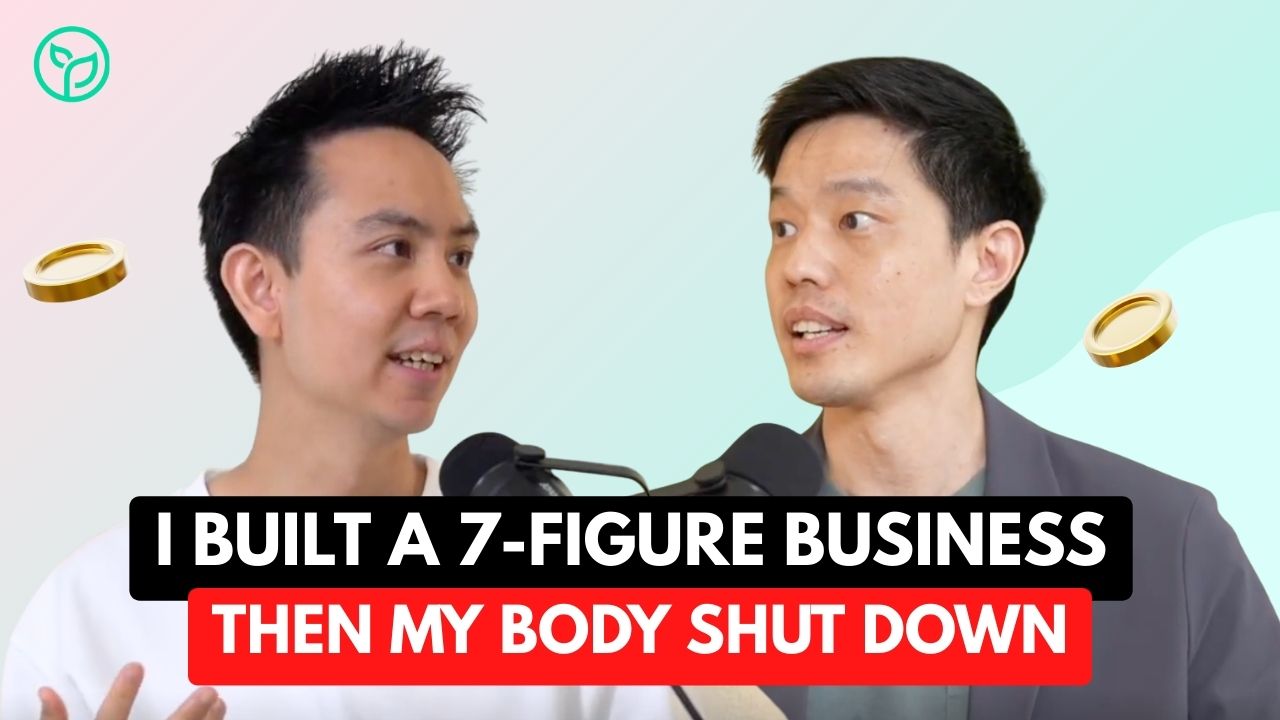
In this week’s Beansprout podcast, I spoke with Howie Tan, co-founder of Kintsugi Investing, about how a diagnosis of end-stage kidney failure forced him to completely rethink his life, identity, and approach to investing.
At the peak of his career, Howie was earning a six-figure annual income after starting out as an apprentice making just $1,000 a month. His financial goals were clear and numbers-driven: hit certain income milestones, grow net worth to seven figures, and pursue financial independence.
By conventional standards, he was on track.
Then his energy disappeared. Dialysis sessions left him exhausted. At one point, he could only manage one productive hour a day. If he spent that hour in a meeting, he needed the rest of the day to recover. His insurance covered hospital bills, but daily expenses still had to be paid.
Rather than focusing on returns or optimisation, this episode explores financial resilience — and how to structure your finances so they can support you through uncertainty, illness, or major life disruptions.
We dive into:
- Why most financial plans fail when life goes off-script
- The emotional impact of losing health, income, and identity
- How Howie shifted from hustle-driven income to a more resilient portfolio approach
- What “financial independence” really means when you can’t work at full capacity
- The role of emergency savings, insurance, and long-term planning in real life
- How to think about money when your priority is recovery, not productivity
Howie brings hard-earned perspective from navigating both financial success and a life-altering health crisis, and shares why resilience may be the most important investment principle of all.
Catch the full conversation in the video below.
Key takeaways for investors from interview with Howie Tan, Co-founder of Kintsugi Investing
1. Portfolio as a Lifeline
For many, career success is tied to a linear correlation between effort and reward. Howie’s experience showed that when a health crisis strikes, this model breaks down completely. With only one hour of energy per day, he could no longer rely on active labor to solve financial problems or cover daily expenses.
He realized that while business cycles and personal health are volatile, a well-structured portfolio provides a resilient foundation. His investments shifted from being a wealth-building tool to a source of stability and peace of mind. It became the system that sustained him when his physical ability to work vanished.
The lesson is that investments are not just for a distant retirement; they are a critical buffer against life’s inherent unpredictability. Building a portfolio early ensures that your financial well-being isn't solely dependent on your ability to "grind." It transforms your capital into a silent partner that works when you cannot.
2. Resilience Over Big Wins
Before his crisis, Howie’s strategy focused on concentrated individual stocks, which often resulted in lumpy and unpredictable returns. While this can lead to big wins, it lacks the consistency required during a personal emergency. When he needed a steady stream of funds, the volatility of single stocks became a significant liability.
To fix this, he integrated ETFs to diversify and smooth out his returns across different market conditions. This shift allowed for a more predictable recovery after market selloffs compared to single-stock volatility. He also leveraged his existing knowledge to use simple options strategies, generating income more efficiently without requiring more of his limited time.
The takeaway is that a resilient portfolio doesn't necessarily aim for the highest possible return. Instead, it prioritizes a structure that can withstand downturns and provide liquidity when life demands it. Flexibility and consistency are often more valuable than chasing the next market outlier.
3. The 80/20 Psychology Rule
Howie emphasizes that investing is 20% skill and 80% psychology. While technical knowledge is important, the ability to control one’s emotions during market cycles is what ultimately determines success. Most investors fail not because of a lack of data, but because fear or euphoria leads them to make irrational decisions at the wrong time.
He references Howard Marks to highlight that the best opportunities arise when fear is widespread and valuations disconnect from fundamentals. Staying rational while others panic is what separates long-term winners from short-term traders. However, this emotional discipline is only possible if your financial house is already in order.
Emotional mastery is a byproduct of preparation. When you aren't desperate for immediate cash, you can afford to be patient and wait for the market to recover. By mastering the psychological side, you prevent yourself from making permanent mistakes during temporary market corrections.
4. Prioritizing "Boring" Fundamentals
Many investors jump straight into chasing high returns while skipping the essential basics: emergency funds, insurance, and short-term savings. Howie stresses that these "boring" foundations are exactly what allow you to stay calm when the market gets turbulent. They provide a safety net that prevents forced selling.
If immediate needs like a child’s education or daily bills are fully exposed to market volatility, every dip feels like an existential crisis. By matching your investments to appropriate time horizons, you can stomach market swings. Money needed within five years should generally not face the same risks as money earmarked for a 30-year horizon.
Clarity of purpose is the starting point of financial resilience. Taking care of insurance and liquidity first "earns" you the right to take risks with your long-term capital. This structural clarity ensures that volatility remains a statistic to be managed, rather than a threat to your survival.
5. Identity Beyond the Grind
One of the hardest lessons Howie faced was realizing his identity was deeply tied to his paycheck and professional title. When his health took those away, he struggled with guilt, self-blame, and a fear of being forgotten by society. He had to learn that the "hustle" mentality is a hindrance to recovery and that rest is not a failure.
He advises anyone in a major transition to lean into their social support networks and accept their current reality before trying to evolve. Focusing on survival and recovery is more important than maintaining outward ambition. His journey was as much about mental and emotional healing as it was about physical health.
Ultimately, you cannot "grind" your way out of a health crisis. Accepting a new reality allows for a more intentional use of time and energy. It forces a shift from valuing yourself based on productivity to valuing yourself based on your presence and your purpose.
6. The Beauty of Kintsugi
Howie’s company name is inspired by Kintsugi, the Japanese art of repairing broken pottery with gold. Rather than hiding the cracks, Kintsugi highlights them, making the object more valuable than it was before. He believes a crisis can either define you by what you lost or refine you into something stronger.
Being limited to one hour of work a day forced Howie to focus on leverage and systems. He could no longer waste energy on low-impact tasks, so he invested more deeply in relationships and refined his portfolio to be truly hands-off. The constraint itself became the catalyst for a more efficient and meaningful life.
The philosophy of Kintsugi teaches that repair is part of history, not something to be ashamed of. By embracing his limitations, Howie built a life that is more intentional and resilient than his pre-crisis existence. He proved that even when life breaks, the pieces can be put back together with gold.
Transcript
0:00 to 3:40 – From hustle to health crisis
Host Julian introduces Howie Tan, co-founder of Kintsugi Investing. Howie shares his rise from a $1,000 apprentice wage to a six figure income through sheer grit in sales and marketing. This early success reinforced a dangerous belief that hard work alone dictates financial outcomes, leading him to chase arbitrary net worth targets without regard for his health.
3:40 to 7:50 – When income becomes identity
Howie discusses how his growing paycheck warped his sense of self. He began gravitating toward social circles defined by material status symbols like luxury cars and watches. He admits that tying his identity to his income created a fragile self-worth that crumbled the moment his ability to earn high wages was threatened.
7:50 to 11:10 – The diagnosis that changed everything
Howie recounts the shock of his doctor’s expression shifting while reviewing blood test results. Despite no family history, he was diagnosed with end stage kidney failure. He realizes in hindsight that he had dismissed severe warning signs, such as extreme fatigue, as nothing more than the cost of a successful career.
11:10 to 16:05 – Living with one productive hour a day
Kidney failure and dialysis left Howie with only one hour of energy per day. He describes the painful choice between working or spending a brief moment with his wife before needing to rest. The reality of his condition hit home when his four year old son began asking about hospitals, forcing Howie to confront his physical limitations.
16:05 to 19:05 – Guilt, self blame and slowing down
Howie struggled with intense guilt over losing his role as the family provider. He reflects on how "hustle culture" had convinced him that resting was a failure. Being forced to slow down revealed that constant busyness had clouded his judgment, preventing him from enjoying the life he was working so hard to build.
19:05 to 23:50 – Rethinking financial success and portfolio construction
With his hustle gone, Howie completely rethought his income strategy. He shifted from risky, concentrated stocks to a resilient portfolio of ETFs and options. This change provided consistent cash flow and transformed his investments from a wealth building tool into a necessary lifeline of stability.
23:50 to 27:40 – Why investing is 20% skill and 80% psychology
Howie argues that investing is mostly emotional, not technical. He cites examples of experienced investors panic selling during market dips. Referencing Howard Marks, he emphasizes that the true skill is remaining rational when others are driven by fear or euphoria, a discipline that is impossible without emotional control.
27:40 to 31:25 – The importance of financial foundations
The discussion turns to the "boring" basics of personal finance. Howie stresses that emergency savings and insurance must be in place before chasing high returns. Without these safety nets, investors are forced to make emotional decisions with essential money, whereas a solid foundation allows for discipline during volatility.
31:25 to 34:10 – Advice for those facing a major life transition
Howie advises anyone in a crisis to lean on support networks and accept help. He urges focusing on survival rather than ambition and learning to rest without guilt. He emphasizes that you cannot "grind" your way out of a health crisis; you must first accept reality to begin recovery.
34:10 to 37:10 – Borrowed time and long term planning
Following a kidney transplant from his mother, Howie views his life as "borrowed time." Acknowledging that the transplant is not a permanent cure, he plans for future uncertainty. This perspective drives him to prioritize the relationships that sustained him and ensure his portfolio can support him if his health fluctuates again.
37:10 to 39:40 – The philosophy of kintsugi and rebuilding stronger
The episode closes with the concept of kintsugi, repairing broken pottery with gold. Howie explains that crises do not have to define us negatively but can refine us. Investing is about building financial and emotional structures that help us weather life’s unpredictability and emerge stronger from the broken pieces.
Follow us on Telegram, Youtube, Facebook and Instagram to get the latest financial insights.
Read also
Gain financial insights in minutes
Subscribe to our free weekly newsletter for more insights to grow your wealth
Most Popular

Comments
0 comments