
Singapore Savings Bonds (SSB) complete guide: How they work and how to buy
bonds-101
By Beansprout • 25 Aug 2026
Why trust Beansprout? We’ve been awarded Best Investment Website at the SIAS Investors’ Choice Awards 2025
'%3e%3cpath%20fill-rule='evenodd'%20clip-rule='evenodd'%20d='M17.64%209.20455C17.64%208.56637%2017.5827%207.95273%2017.4764%207.36364H9V10.845H13.8436C13.635%2011.97%2013.0009%2012.9232%2012.0477%2013.5614V15.8195H14.9564C16.6582%2014.2527%2017.64%2011.9455%2017.64%209.20455V9.20455Z'%20fill='%234285F4'/%3e%3cpath%20fill-rule='evenodd'%20clip-rule='evenodd'%20d='M9%2018C11.43%2018%2013.4673%2017.1941%2014.9564%2015.8195L12.0477%2013.5614C11.2418%2014.1014%2010.2109%2014.4205%209%2014.4205C6.65591%2014.4205%204.67182%2012.8373%203.96409%2010.71H0.957275V13.0418C2.43818%2015.9832%205.48182%2018%209%2018V18Z'%20fill='%2334A853'/%3e%3cpath%20fill-rule='evenodd'%20clip-rule='evenodd'%20d='M3.96409%2010.71C3.78409%2010.17%203.68182%209.59318%203.68182%209C3.68182%208.40682%203.78409%207.83%203.96409%207.29V4.95818H0.957273C0.347727%206.17318%200%207.54773%200%209C0%2010.4523%200.347727%2011.8268%200.957273%2013.0418L3.96409%2010.71V10.71Z'%20fill='%23FBBC05'/%3e%3cpath%20fill-rule='evenodd'%20clip-rule='evenodd'%20d='M9%203.57955C10.3214%203.57955%2011.5077%204.03364%2012.4405%204.92545L15.0218%202.34409C13.4632%200.891818%2011.4259%200%209%200C5.48182%200%202.43818%202.01682%200.957275%204.95818L3.96409%207.29C4.67182%205.16273%206.65591%203.57955%209%203.57955V3.57955Z'%20fill='%23EA4335'/%3e%3c/g%3e%3cdefs%3e%3cclipPath%20id='clip0_0_2849'%3e%3crect%20width='18'%20height='18'%20fill='white'/%3e%3c/clipPath%3e%3c/defs%3e%3c/svg%3e)
Make Beansprout your preferred source on Google
Add us on Google to see more of our insights in your search results
Learn how Singapore Savings Bonds work, how interest is calculated, how to buy and redeem SSBs, and how they compare with T-bills and fixed deposits.
What happened?
Singapore Savings Bonds (SSB) have been a popular way for Singaporeans to earn interest on their savings while keeping some flexibility.
Unlike a T-bill or fixed deposit, you do not have to decide upfront exactly how long you want to keep your money in an SSB.
You can hold an SSB for up to 10 years, while having the option to redeem it in any month and get back your original investment amount together with accrued interest.
In this guide, we explain how Singapore Savings Bonds work, how you can apply and redeem them, and how they compare with T-bills, SGS bonds and fixed deposits.
What are Singapore Savings Bonds (SSBs)?
SSBs are government-backed savings products launched by MAS in 2015 to give everyday savers a safe, low-cost and flexible way to grow their money.

Think of them as a safe, long-term savings option:
- You lend your money to the Singapore Government for up to 10 years
- In return, you receive interest every six months
- You can redeem your money anytime with no penalty
The minimum investment is S$500, with subsequent investments in multiples of S$500.
You can hold a maximum of S$200,000 in SSBs at any one time. The limit applies across your combined cash and SRS holdings.
Because they’re backed by the government, SSBs are considered one of the safest investment products available in Singapore.
You can buy SSBs if you are at least 18 years old, whether you are a Singapore Citizen, Permanent Resident or foreigner.
However, you must have a CDP account, a bank account linked to CDP (DCS), and internet banking access with DBS/POSB, OCBC or UOB.
Also, CPF funds cannot be used, but SRS funds are allowed.
How Singapore Savings Bonds (SSBs) earns interest
Singapore Savings Bonds (SSBs) work differently from a normal savings account or fixed deposit.
Instead of paying a flat interest rate every year, they use a step-up interest system — this means the interest rate increases the longer you hold the bond.
When you buy an SSB, the Monetary Authority of Singapore (MAS) gives you a fixed 10-year interest schedule upfront.
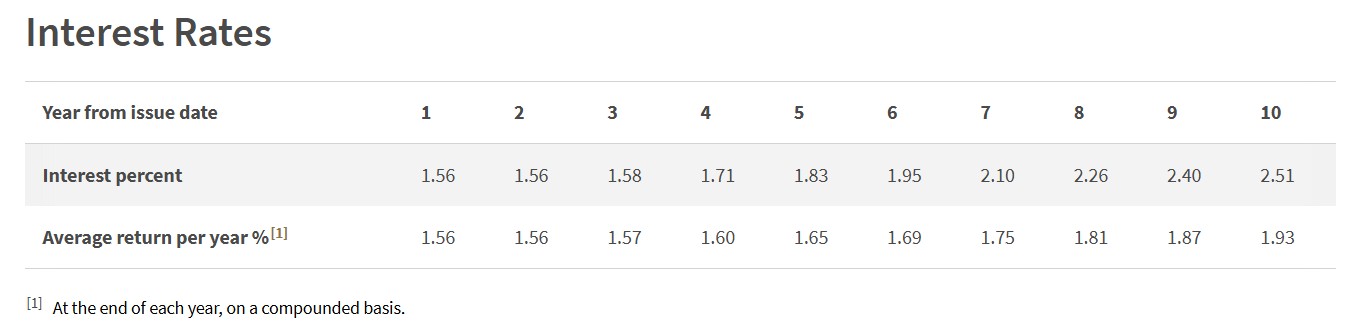
The schedule shows the exact rate you will earn each year from Year 1 to Year 10.
The interest rate is lower at the start and increases each year you hold the bond.
Interest is paid every six months directly into your bank account.
Even if you redeem your SSB early, you will still receive all the interest you have earned up to that point, and your full principal will be returned.
SSB interest rates change every month and are based on the market yields of Singapore Government Securities (SGS) which are longer-term government bonds.
MAS sets SSB rates so that:
- The average return over 5 or 10 years is close to the return of SGS with similar maturity periods
- You still get flexibility to redeem anytime without losing your principal or past interest
Because SSB interest rates change from month to month, you can use our SSB interest rate projection tool to find out the projected returns for upcoming SSB issues.
How to read the SSB Issue Details on the MAS Website
Each month’s SSB has an Issue Details page on the MAS website.
This page lists all the key information about that particular SSB issue.
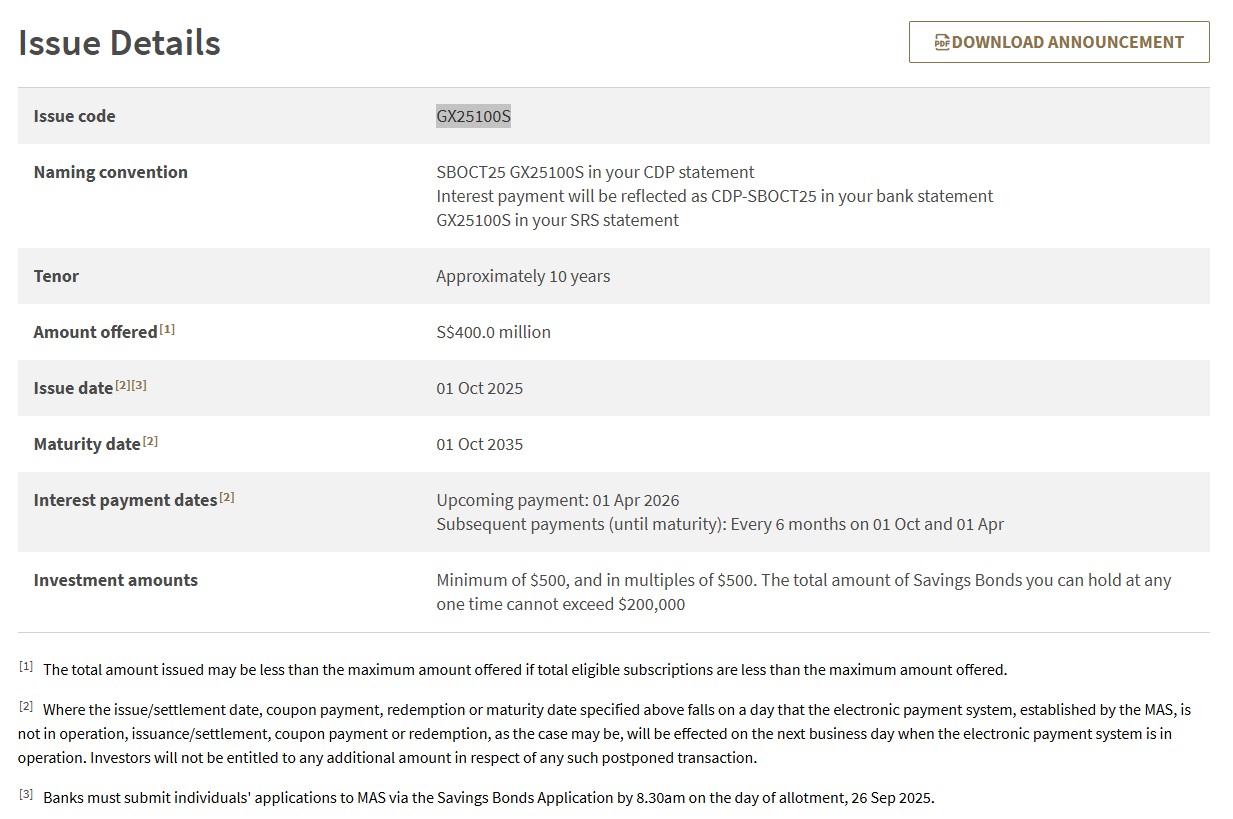
Here’s how to understand it (example values shown):
- The Issue Code (e.g. GX25100S) is the unique code for that bond. You’ll see it in your CDP, bank and SRS statements.
- The Tenor is 10 years, which is how long the bond lasts if held to maturity.
- The Amount Offered shows how much is available that month (e.g. S$400 million). If demand is high, MAS may give everyone a smaller allocation.
- The Issue Date is when your bond starts, and the Maturity Date is when it ends if you hold it for 10 years.
- The Interest Payment Dates show when you’ll be paid. Payments come every six months starting about six months from the issue date.
The thing to keep in mind is that you can redeem any month before maturity.
This means you don’t have to hold it for 10 years.
How to read the 10-year interest rates schedule
As mentioned, each SSB issue comes with a 10-year interest schedule.
This shows the exact interest you’ll get each year as well as averagely over the years on an annual basis if you keep your money in the bond.
You’ll see two rows:
Year-by-year interest percent
These are the actual rates for each year.
They are fixed when you buy and usually increase (“step up”) over time.
You’ll be paid twice a year, with each payment equal to half that year’s rate.
Average return per year (% p.a.)
This is shown at the bottom of the table.
It tells you the average annual return if you hold the bond for all 10 years.
This is shown as a compounded annual rate to help compare with other products like fixed deposits or T-bills.
But, it is important to remember that although this figure is shown, SSB interest does not actually compound automatically.
This is because the interest payments are paid out to your bank account every six months and are not added back to your SSB balance.
What this means is that your future interest is always calculated based only on your original amount.
For example, if you invest S$10,000 and receive S$80 every six months, the S$80 goes into your bank account. It won’t earn further interest unless you manually reinvest it into new SSBs, which may have different rates.
It is helpful to think of SSBs as an income-style product that pays you regular interest, not a compounding savings account where your interest grows on itself.
You can use our SSB Swap Calculator to find out if you can earn more by swapping your previous Singapore Savings Bonds with the upcoming ones.
Source: MAS
How much interest will I earn from an SSB?
Here’s the easiest way to figure out how much you’ll earn:
Step 1: Get the 10-year schedule
Go to the MAS SSB website and look at the 10-year table for that month’s bond. Note the yearly rates (Year 1, Year 2, … Year 10).
Step 2: Choose how long you plan to hold it
Decide how many years you’ll keep your money inside — for example, 1, 3, 5, or 10 years.
Step 3: Calculate total interest by adding the yearly rates and multiply by your amount
Example: S$10,000 × (1.56% + 1.56% + 1.58%) = S$10,000 × 4.7% = S$470 total interest earned if you redeem after 3 years.
Step 4: Understand payout timing
Remember that the interest is paid twice a year.
So if Year 3’s rate is 1.58%, you’ll get S$158 in total interest for Year 3, which is S$79 every six months.
For cash investments, the interest is automatically credited to the DCS-linked bank account connected to your CDP account.
For SRS investments, the interest is credited to your SRS account.
How to buy Singapore Savings Bonds (SSB)?
Buying SSBs is simple once you know the process. Here’s exactly how I did it:
Step 1: Open a CDP Account
You need a Central Depository (CDP) account to hold your SSBs.
Find out how to open a CDP account here.
You can apply online via SGX using Singpass/MyInfo. It usually takes a few days to be approved.
This is where your SSB holdings will be stored electronically.
Step 2: Link your bank account to CDP (DCS)
Set up Direct Crediting Service (DCS) so your interest payments and redemption proceeds go directly to your bank account.
Then, Log in to CDP Internet to activate or update DCS. The supported banks include DBS/POSB, OCBC, and UOB
Step 3: Apply for SSB during the monthly window via your bank
Once your CDP account is ready, you can apply via internet banking or ATMs from DBS/POSB, OCBC, or UOB during the monthly issue window:
- Application opens: 6:00pm on the 1st business day of the month
- Closes: 9:00pm on the 4th last business day of the month
- Minimum: S$500 (in multiples of S$500)
- Application fee: S$2 per request
You can also buy SSBs using your Supplementary Retirement Scheme (SRS) account, but not with your CPF money.
Step 4: Wait for allotment results
If the month’s issue is oversubscribed, you may not get your full amount.
As MAS allocates SSBs fairly using a quantity ceiling system, this means you might receive less than the amount you applied for, but everyone will get at least a small allocation.
The allotment results are announced on the 3rd last business day of the month. By then, you can check the results on MAS’ website.
Step 5: Track your SSB holdings
Once issued, your SSBs will appear under the “My Savings Bonds” section on the MAS website.
The interest will be paid into your DCS-linked bank account (or into your SRS account if purchased using SRS).
As mentioned, the interest payments happen every six months from the issue date.
You can sign up for an email reminder to be reminded of future SSB closing dates.
How to redeem Singapore Savings Bonds (SSBs)
If you ever need the money, you can redeem your SSB anytime (in S$500 blocks), with no penalty.
You’ll get your full principal plus any interest earned so far.
As the redemptions proceeds are not instantly disbursed, so don’t rely on SSBs for urgent cash.
Here are the steps:
- Submit your redemption request via your bank during the monthly window which is from the 1st business day of the month until 4 business days before the end of the month.
- There will be a S$2 fee per redemption request.
- Redemption proceeds (plus any accrued interest) will be credited to your bank or SRS account on the 2nd business day of the following month.
How long does it take to redeem an SSB?
This is one of the most important things to understand about SSB liquidity.
While I can submit a redemption request every month, the money is not returned immediately.
The redemption period runs from the first business day to the fourth-last business day of each month.
I will receive my principal and any accrued interest by the second business day of the following month.
For example, if I submit a redemption request in August, I should receive my redemption proceeds by the second business day of September.
This means I would not rely solely on SSBs for cash that I may need at very short notice.
What happens when my SSB matures?
I do not need to do anything when an SSB reaches the end of its 10-year tenor.
MAS will automatically return my principal together with the final interest payment.
For cash investments, the money will be credited to my DCS-linked bank account.
For SRS investments, it will be credited to my SRS account.
There is no fee when the SSB reaches maturity.
How to swap an old SSB for a new one?
If a newer SSB offers a more attractive interest schedule, I can redeem an older SSB and apply for the new issue in the same month, as long as I remain within the S$200,000 individual holding limit.
However, the money from the old SSB will only be returned the following month, so I need enough cash to fund the new application separately.
I should also consider the S$2 redemption fee and S$2 application fee.
For example, S$4 of fees is equivalent to 0.8% of a S$500 investment, but just 0.04% of a S$10,000 investment.
You can use Beansprout's SSB Swap Calculator to compare an existing SSB against a newer issue and see whether the additional interest could outweigh the transaction fees.
Summary of SSB application
| Who can apply | Individuals, including non-residents. You need to be at least 18 years old to open a CDP account. |
| Ways to apply | For cash – DBS/POSB , OCBC or UOB ATMs or internet banking, and OCBC’s mobile application. For Supplementary Retirement Scheme (SRS) – internet banking portal of your SRS operator. Note: CPF funds are not eligible for Savings Bond purchases. |
| Investment amount | Minimum of S$500, and subsequent multiples of S$500. Maximum individual investment limit: S$200,000. |
| Frequency of issuance | A new bond is issued every month. Check out this month’s bond or view the issuance calendar for the year. |
| Application period | Opens at 6pm on the 1st business day of the month. Closes at 9pm on the 4th last business day of the month. Operating hours: 7am to 9pm, Monday to Saturday (excluding Public Holidays). |
| Fees | S$2 non-refundable transaction fee for each application. |
| Source: MAS | |
Strategies for using Singapore Savings Bonds
Many people use SSBs as a safe place to grow their money passively while keeping flexibility. Here are a few ways to go about it:
1. Build an emergency fund with it
Because SSBs are safe and redeemable anytime, you can park money that you might not need immediately to earn interest but don’t want sitting idle.
2. Laddering your purchases over multiple months
Instead of buying a large amount in one month, you can spread purchases over several months.
This creates a “ladder” that gives you more regular redemption options and smooths out differences in monthly interest rates.
If you’d like to explore how laddering works in more detail, check out our full guide on how to build an SSB and T-bill bond ladder.
3. Using SRS funds
SSBs can be bought using SRS funds for the same low risk, while helping you maximise your SRS contributions for tax relief.
Comparing SSBs with T-bills, SGS bonds and fixed deposits
Once I understand how an SSB works, the next question is usually whether I should choose it over another option for my savings.
The answer depends on how long I can set aside my money, how quickly I may need it back and the returns available at the time.
SSB vs T-bills
Both SSBs and T-bills are backed by the Singapore Government, but they are useful for slightly different purposes.
Singapore T-bills typically mature in six months or one year. If I hold one until maturity, I know when my money will be returned.
An SSB can be held for up to 10 years, while still allowing me to submit a redemption request in any month.
This may be useful if I want to secure an interest schedule for longer but am not certain when I will need my money.
On the other hand, if I know I will not need the cash for the next six or 12 months, I would compare the latest T-bill yield with the SSB return before deciding.
SSB vs SGS bonds
Conventional SGS bonds are also backed by the Singapore Government.
The main difference is what happens if I want my money back before maturity.
SGS bonds can be bought and sold in the secondary market. Their prices can move up or down, which means I could receive less than my original investment if I sell before maturity.
With an SSB, I redeem it with the Government instead and receive my principal back.
SSBs also have a lower minimum investment of S$500 compared with S$1,000 for conventional SGS bonds, although SSB holdings are capped at S$200,000 while conventional SGS do not have the same individual holding limit.
SSB vs fixed deposits
Fixed deposits are another option if I want to earn a known interest rate on my savings.
The main difference is the investment period and flexibility.
Fixed deposits are generally offered for terms ranging from a few months to a few years, while an SSB can be held for up to 10 years.
With an SSB, I can also redeem in any month and receive my principal and accrued interest. For fixed deposits, early withdrawal terms vary by bank and I may lose some or all of the interest earned.
However, depending on prevailing rates, a fixed deposit may offer a higher return for a particular short-term tenure.
This is why I would compare the latest returns, minimum deposit and how soon I may need the money rather than looking at the headline interest rate alone.
| Feature | SSB | T-bill | SGS bond | Fixed deposit |
| Typical tenure | Up to 10 years | Usually 6 or 12 months | Various maturities | Usually months to a few years |
| Minimum investment | S$500 | S$1,000 | S$1,000 | Varies |
| Return | Interest schedule known upfront | Yield determined at auction | Depends on coupon and purchase price | Rate generally known upfront |
| Access before maturity | Redeem in any month | Can sell before maturity, but price may vary | Can sell before maturity, but price may vary | Depends on bank |
| Principal if exiting normally | Full principal returned on redemption | Face value returned at maturity | Face value returned at maturity | Deposit returned subject to bank terms |
| Key advantage | Long tenure with monthly redemption option | Useful for shorter-term funds | Choice of longer maturities | Straightforward fixed return |
| Key consideration | Redemption is not immediate | Less flexible before maturity | Market price can fluctuate | Early withdrawal conditions vary |
What are the pros and cons of Singapore Savings Bonds?
Singapore Savings Bonds are often used by people who want to grow their savings with low risk while keeping the flexibility to withdraw if needed.
Beginners who want a stress-free way to grow their first S$5,000 - S$10,000 can also consider starting out with SSBs.
They are commonly included as part of an emergency fund, or used to earn steady returns on the first few thousand dollars of savings while learning about other investment products.
But, they may be less practical for those who need immediate access to their money or are aiming for higher short-term returns, as redemptions are not instant and may take up to several weeks depending on when the redemption request is submitted.
| Pros | Cons |
| Government-backed (very safe) | Lower returns than riskier investments |
| Can redeem anytime with no penalty | Only redeemable monthly (not instant) - liquidity risk |
| Start from as little as S$500 | Capped at S$200,000 per person |
| Interest is tax-free | Interest does not compound automatically |
| Simple to apply and manage, and low-cost | S$2 fee for each application and redemption |
What would Beansprout do?
Singapore Savings Bonds offer a simple and secure way to grow your money without taking on investment risk.
I see Singapore Savings Bonds as one of the tools I can use for my Liquidity Pot within Beansprout's four pots of wealth, particularly for cash that I do not expect to need immediately.
It is a safe starting point to grow your cash while exploring other investment products with higher risk and returns.
While the returns are modest, the flexibility, safety, and ease of use make them a practical option for anyone who wants to protect their savings and earn stable interest.
We also like the SSB as it allows us to lock-in interest rates for longer maturities.
With the uncertain interest rate environment ahead, it also provides flexibility as a place for you to park your money somewhere before deciding to commit to other fixed income assets.
If you already hold older SSBs, you could use our SSB Swap Calculator to check whether switching into a newer issue could improve your returns after accounting for the application and redemption fees.
Apart from SSB, I would also use a mix of savings accounts, T-bill and fixed deposit and money market funds for Liquidity Pot.
SSBs have different features from conventional SGS bonds. Our guide to bond investing explains how bond coupons, yields and duration work across other types of bonds.
Do you prefer to park your cash in T-bills, SSB or fixed deposits? Share with us in the comments below or in our Telegram group!
Enjoyed this insight? Follow Beansprout on Telegram, Youtube, Facebook and Instagram, and add Beansprout as your preferred source on Google so you never miss an update.
Read also
Gain financial insights in minutes
Subscribe to our free weekly newsletter for more insights to grow your wealth
Most Popular

Comments
0 comments