
kopi-C with The Assembly Place CEO: Scaling from 6 to 10,000 keys through community
Stocks
Powered by

By Julian Wong • 23 Jan 2026
Why trust Beansprout? We’ve been awarded Best Investment Website at the SIAS Investors’ Choice Awards 2025
'%3e%3cpath%20fill-rule='evenodd'%20clip-rule='evenodd'%20d='M17.64%209.20455C17.64%208.56637%2017.5827%207.95273%2017.4764%207.36364H9V10.845H13.8436C13.635%2011.97%2013.0009%2012.9232%2012.0477%2013.5614V15.8195H14.9564C16.6582%2014.2527%2017.64%2011.9455%2017.64%209.20455V9.20455Z'%20fill='%234285F4'/%3e%3cpath%20fill-rule='evenodd'%20clip-rule='evenodd'%20d='M9%2018C11.43%2018%2013.4673%2017.1941%2014.9564%2015.8195L12.0477%2013.5614C11.2418%2014.1014%2010.2109%2014.4205%209%2014.4205C6.65591%2014.4205%204.67182%2012.8373%203.96409%2010.71H0.957275V13.0418C2.43818%2015.9832%205.48182%2018%209%2018V18Z'%20fill='%2334A853'/%3e%3cpath%20fill-rule='evenodd'%20clip-rule='evenodd'%20d='M3.96409%2010.71C3.78409%2010.17%203.68182%209.59318%203.68182%209C3.68182%208.40682%203.78409%207.83%203.96409%207.29V4.95818H0.957273C0.347727%206.17318%200%207.54773%200%209C0%2010.4523%200.347727%2011.8268%200.957273%2013.0418L3.96409%2010.71V10.71Z'%20fill='%23FBBC05'/%3e%3cpath%20fill-rule='evenodd'%20clip-rule='evenodd'%20d='M9%203.57955C10.3214%203.57955%2011.5077%204.03364%2012.4405%204.92545L15.0218%202.34409C13.4632%200.891818%2011.4259%200%209%200C5.48182%200%202.43818%202.01682%200.957275%204.95818L3.96409%207.29C4.67182%205.16273%206.65591%203.57955%209%203.57955V3.57955Z'%20fill='%23EA4335'/%3e%3c/g%3e%3cdefs%3e%3cclipPath%20id='clip0_0_2849'%3e%3crect%20width='18'%20height='18'%20fill='white'/%3e%3c/clipPath%3e%3c/defs%3e%3c/svg%3e)
Make Beansprout your preferred source on Google
Add us on Google to see more of our insights in your search results
CEO Eugene Lim explains how a simple experiment in shared living grew into Singapore’s largest community-living operator according to an industry report by Knight Frank as set out in TAP’s offer document, revealing why community, cash flow discipline, and an asset-light model sit at the centre of his growth strategy.
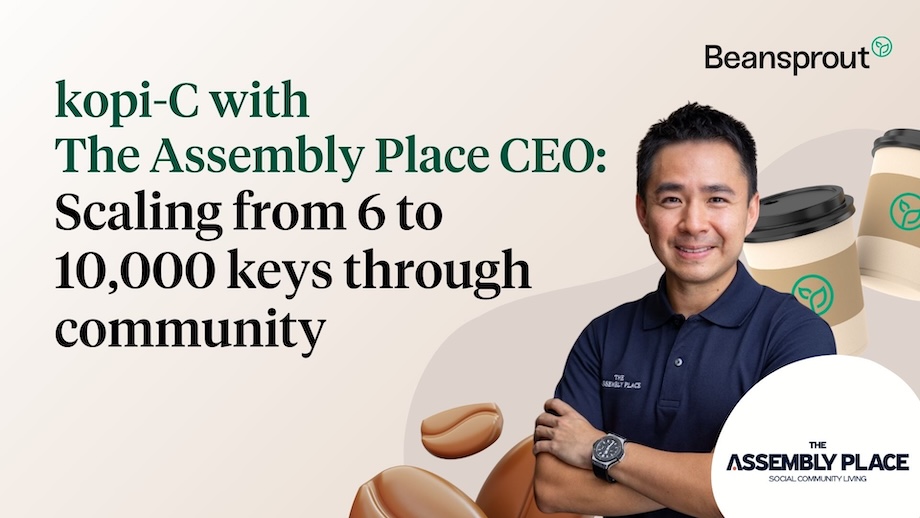
Eugene Lim has a very specific vision for what success looks like.
He imagines a distant moment in the future, years from now, when he runs into a young adult who tells him that their parents once lived at The Assembly Place while studying or working in Singapore. That they navigated different life stages there. That community living accompanied them before they settled down to build a family of their own.
“If that happens,” Lim says, “Then I'll know I built something really meaningful.”
This idea—of being part of someone’s journey rather than simply renting them a room—underpins how The Assembly Place (TAP) has grown, how it thinks about community, and why it is now preparing to enter the public markets.
Rewinding to the beginning
TAP began with an innocent moment of eavesdropping.
In 2019, Lim was already deep in real estate. One morning, riding the lift to his office, he overheard junior colleagues venting about their rental arrangements. One story in particular caught his attention: just that weekend, a young professional's landlord had barged into her room, unannounced, to switch off the air-conditioning. All just so the cost of utilities could be reduced.
The amount she was paying for her room at the time?
S$1000.
For Lim, the issue was as much about choice and dignity as it was about rent.
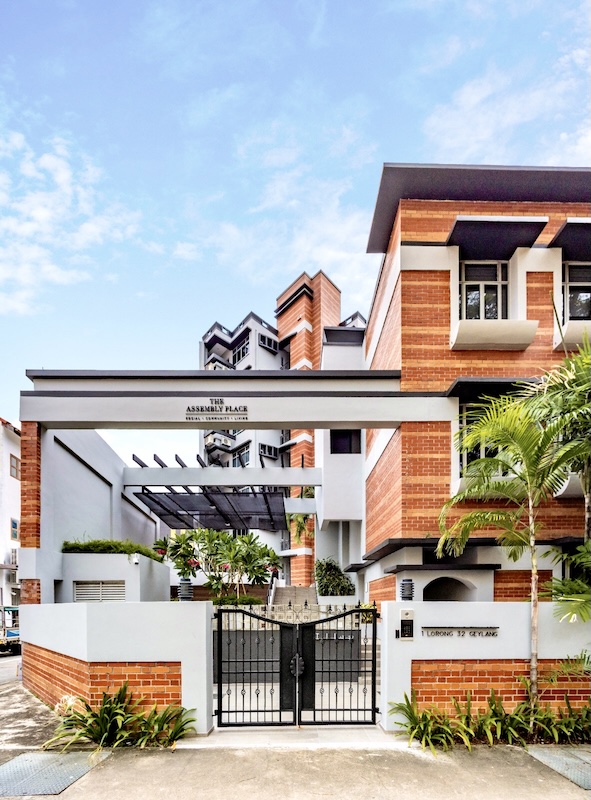
Shortly after this, a long-time client confided in him that he was having trouble renting out a six-room landed house near the Orchard area.
Lim realised that on one hand, young renters were paying a significant share of their income for poor living experiences. On the other hand, landlords were struggling to optimise space.
The problem, he hypothesised, was not supply. It was how housing was being experienced.
And so he decided to test a simple idea. He personally took on the house, repackaged the rooms individually, and within a week, all six rooms were taken, generating S$10,500 in monthly rent—well above the base rent of the property.
The demand surprised him. But it was what followed next that would go on to shape the future of TAP.
Toast Box, tiramisu, and the early meaning of “community”
Filled with pride, Lim shares about the first ever community event to be organised at TAP.
Contrary to expectations, it was not a workshop or a networking night. Instead, it was a simple Toast Box breakfast.
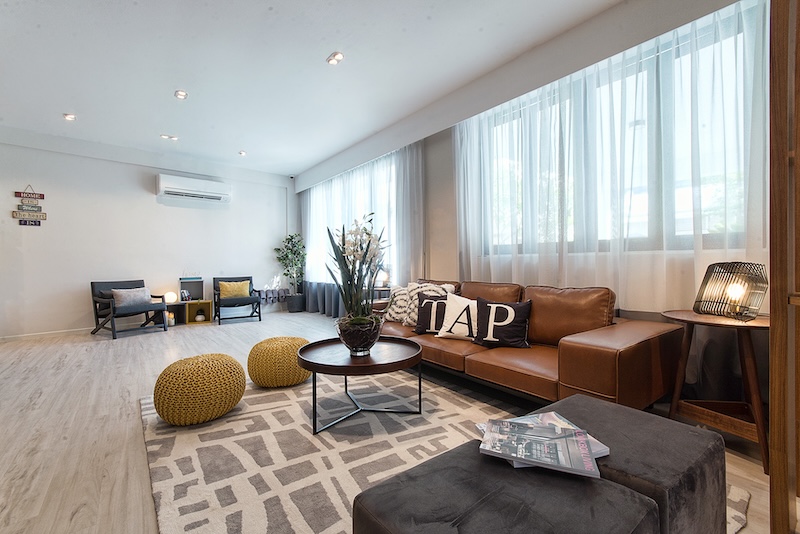
Lim ordered it via food delivery, placed it in the shared kitchen, and invited residents to eat together. There was no agenda and no call to action, yet residents loved it.
That principle—community as a platform for connection rather than for status or performance—was what defined TAP’s approach.
During the Covid-19 pandemic, TAP organised tiramisu-making sessions with a small local business that had been hit hard by lockdowns. Other events took residents (mostly foreigners) to places they would never have encountered on their own: MacRitchie Reservoir hikes, neighbourhood walks, and visits to cultural areas outside the usual tourist circuit.
The goals were clear: choose simple, consistent, and what was meaningful for residents, rather than what was flashy.
To make this point, Lim explicitly outlines what he avoids.
He avoids events run purely for attendance, with goodie bags used to incentivise people showing up, and the mindset that community can be mechanically scaled with volume.
“After all,” he says, “Community is a people business.”
Why community matters commercially
At the same time, Lim frames 'community' in operational terms.
Moving house, he points out, is one of life’s most stressful activities. Imagine all the packing, uncertainty, and disruption. Hence, most people avoid it unless they have no choice.
TAP’s objective is to remove unnecessary friction by allowing residents to stay within the same ecosystem as their lives evolve.
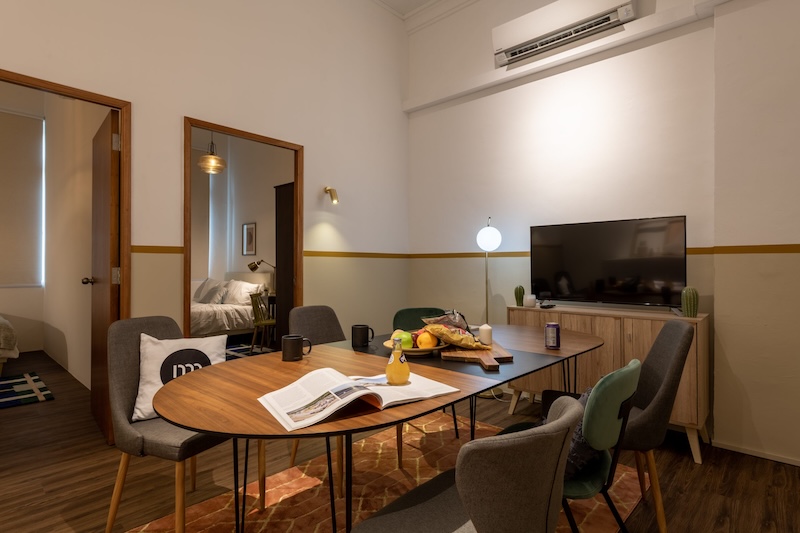
A student could begin in TAP’s campus accommodation. Upon graduation, they move into co-living. As their income grows, they can then upgrade again to a studio apartment, all without leaving TAP's network and community.
This lifecycle translates into the numbers.
From FY2022 to FY2025, TAP has maintained occupancy rates of above 90%, a level Lim attributes to retention rather than constant new acquisition. As of 17 December 2025, TAP operated approximately 3,422 keys across 100 property assets.
According to an industry report by Knight Frank as set out in TAP’s offer document, this makes it the largest Community Living operator in Singapore by number of keys as of 30 September 2025, with an estimated 34% market share.
Lim says that retention is the most resilient form of growth. From his experience, familiarity builds trust, which in turn reduces churn.
In turn, TAP has continued disproving the misconception that community-led businesses scale poorly.
The group operates an asset-light model and runs its portfolio with just 42 employees, translating to roughly one employee for every 81 keys. It uses an in-house Client Relationship Management (CRM) system and mobile app to manage occupancy, maintenance requests, and feedback loops.
Revenue grew from S$6.9 million in FY2022 to S$18.9 million in FY2024, reflecting a 66% compound annual growth rate. In the first half of 2025, the group generated positive net cash flows from operating activities of S$6.9 million in operating cash flow and maintained a net cash position of S$1.5 million as at 30 June 2025.
For Lim, these figures matter because they validate what began as a qualitative bet: that community, when done properly, can be economically durable.
Staying relevant is harder than managing real estate
Despite operating in property, Lim says real estate is not the hardest part of the business.
The harder challenge is relevance. He describes how social media, dating apps and instant access to information have compressed trends and expectations. What feels current today can feel outdated quickly.
That is why Lim remains personally involved, particularly around major community initiatives. Large events still require his sign-off, and he regularly pushes his team to review and reset, ensuring complacency doesn't creep in.
“If we stop being relevant,” he says, “We stop being attractive.”
Against this backdrop, TAP’s IPO is framed less as a finish line and more as a transition.
"It's not as though we can say we IPO and then the job is done," he points out.
Lim's rationale is twofold. First, nearly six years of operating history, consistently high occupancy and growing institutional acceptance suggest the concept has moved beyond experimentation. Second, many early investors backed him before there was data. Going public returns choice to them—to stay, to exit, or to reinvest.
“My investors were my first community,” he says, "They provided me with the resources and the opportunity, and this is my way of doing right by them."
With its listing on the SGX Stock Exchange, TAP plans to deepen its Singapore footprint before pursuing growth overseas. The company has outlined a target of over 10,000 keys by end-2030, with more than 600 additional keys already secured in the pipeline. Its first regional expansion is underway in Kuala Lumpur’s Bangsar district, scheduled to open in 2026.
Building something that outlasts the transaction
When Lim talks about the future, he rarely mentions exits.
Instead, he keeps returning to people—to the idea that TAP might one day be remembered as the social infrastructure that housed people while they were chasing their dreams and building their lives.
In a sector often reduced to yields and occupancy rates, Lim's conviction is that staying meaningfully present in people’s lives may turn out to be the most durable strategy of all.
Learn more about The Assembly Place by reading our report here.
To understand more about the living sector, read our guide to investing in the living sector here.
To find out more, join our upcoming webinar "Investing in the living sector: A growing real estate asset class" at 7.30pm on 28 January (Wed) where we will unpack the key trends shaping the living sector, and discuss the opportunities and risks investors should understand before investing in stocks within this growing real estate segment. Sign up for free here.
About The Assembly Place
The Assembly Place (TAP) is Singapore’s largest and most diversified Community Living operator, managing over 3,400 keys across more than 100 property assets. Operating an asset-light model, TAP provides community-driven living solutions across co-living, student accommodation, serviced apartments, and specialised housing segments. Founded by Eugene Lim, TAP focuses on retention-led growth, operational discipline, and building long-term relationships with residents as they move through different life stages.
About kopi-C: the Company brew
kopi-C is a regular column by SGX Research in collaboration with Beansprout, a MAS-licensed investment advisory platform, that features C-level executives of leading companies listed on SGX. These interviews are profiles of senior management aimed at helping investors better understand the individuals who run these corporations.
Read also
Gain financial insights in minutes
Subscribe to our free weekly newsletter for more insights to grow your wealth
Most Popular

Comments
0 comments