
Beyond Nvidia: 4 new SGX-listed ETFs to explore the AI opportunity across Japan, South Korea and Taiwan
ETFs
Powered by

By Nicole Ng • 11 Nov 2026
Why trust Beansprout? We’ve been awarded Best Investment Website at the SIAS Investors’ Choice Awards 2025
Explore four SGX-listed iFAST Xtrackers ETFs covering AI, Japan, Korea and Taiwan and how they differ.
This post was created in partnership with FSM Global. All views and opinions expressed in this article are Beansprout's objective and professional opinions.
What happened?
If you invest in the S&P 500 or Nasdaq-100, you probably already have exposure to artificial intelligence (AI) through companies such as Nvidia, Microsoft, and other large US technology stocks.
These companies have led the AI investment boom, benefiting from growing demand for computing power, cloud services, and AI applications.
However, the AI opportunity extends beyond companies developing AI models and operating data centres.
Behind the technology are businesses manufacturing advanced chips, supplying memory and producing the specialised equipment needed to build AI infrastructure.
Many of these companies are based in Japan, South Korea and Taiwan.
For investors looking to broaden their exposure beyond familiar US technology names, these markets could offer different ways to participate in the AI investment theme.
On 22 October 2026, four new iFAST Xtrackers exchange-traded funds (ETFs) began trading on the Singapore Exchange (SGX), offering Singapore investors access to global AI companies and the Japanese, South Korean and Taiwanese equity markets.
In this article, we look at what each ETF offers, how they differ, and what investors should consider before adding them to their portfolios.
iFAST introduces four new Xtrackers ETFs on SGX
iFAST has partnered with Xtrackers by DWS to introduce its first four ETFs on SGX.
The ETFs provide exposure to four different investment areas: global AI and Big Data, Japan, South Korea and Taiwan.
Each of these Singapore-domiciled ETFs uses a feeder-fund structure, investing substantially all its assets into a corresponding Xtrackers UCITS ETF, which is different from ETFs that invest directly into the underlying stocks.
This gives Singapore investors access to established overseas investment strategies through locally listed ETFs that trade in Singapore dollars.
Here's an overview of the four ETFs:
| ETF | SGX ticker | Index tracked | Overall TER |
| iFAST Xtrackers Artificial Intelligence & Big Data UCITS Index ETF | XBG | Nasdaq Global Artificial Intelligence and Big Data Index | 0.63% |
| iFAST Xtrackers Nikkei 225 UCITS Index ETF | JPY | Nikkei 225 | 0.43% |
| iFAST Xtrackers MSCI Korea UCITS Index ETF | KOR | MSCI Korea 20/35 Custom Index | 0.67% |
| iFAST Xtrackers MSCI Taiwan UCITS Index ETF | TWD | MSCI Taiwan 20/35 Custom Index | 0.77% |
| Source: iFAST Xtrackers ETF information, as at 31 August 2026. Overall TER includes the underlying fund's expenses and the fees charged at the iFAST ETF level. | |||
How does the AI investment opportunity extend beyond US tech companies?
AI depends on a broader supply chain of companies manufacturing advanced chips, memory, and specialised semiconductor equipment, beyond the known names such as Nvidia and Microsoft.
Several Asian markets play important roles in this ecosystem. In Japan, companies such as Advantest and Tokyo Electron supply equipment used to manufacture and test semiconductors.
Meanwhile, Samsung Electronics and SK hynix in South Korea produce memory chips, including high-bandwidth memory (HBM) used in AI systems.
TSMC, which is listed in the Taiwan market, manufactures advanced chips designed by companies such as Nvidia.
Growing AI-related demand is also supporting economic activity in these markets.
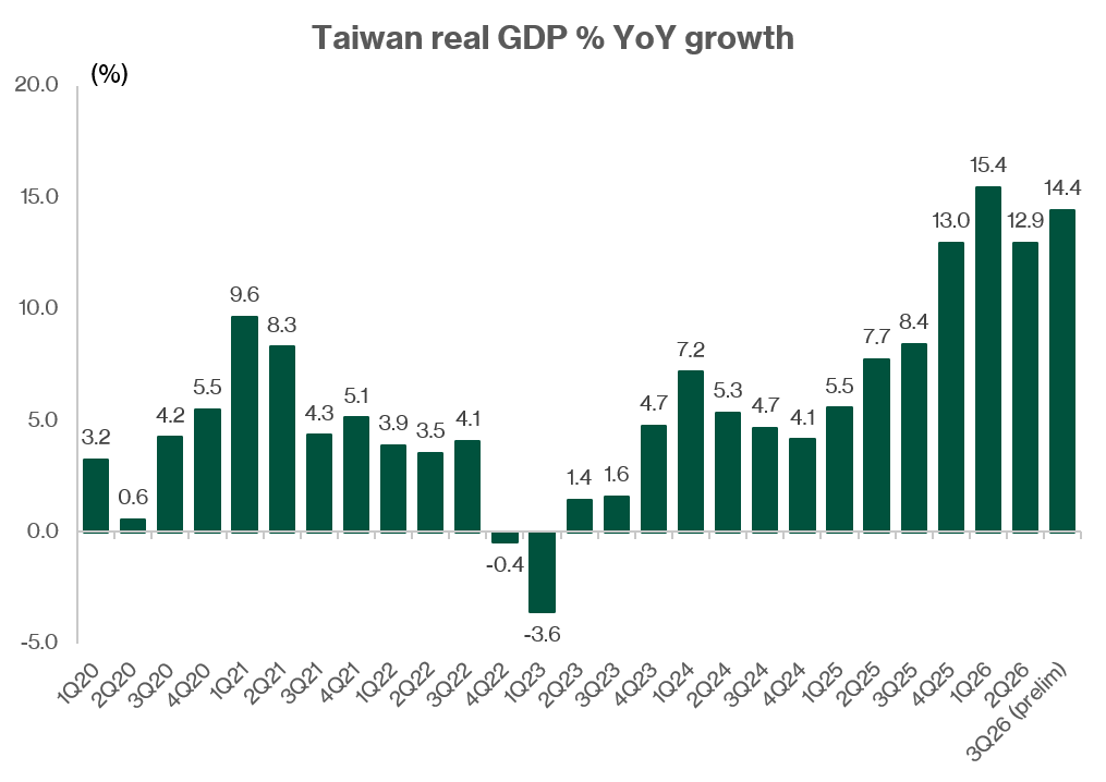
Taiwan's economy grew 14.36% year-on-year in the third quarter of 2026, accelerating from 12.93% in the previous quarter and exceeding market expectations of 12%, according to preliminary estimates, supported by strong AI-related exports and semiconductor manufacturing.
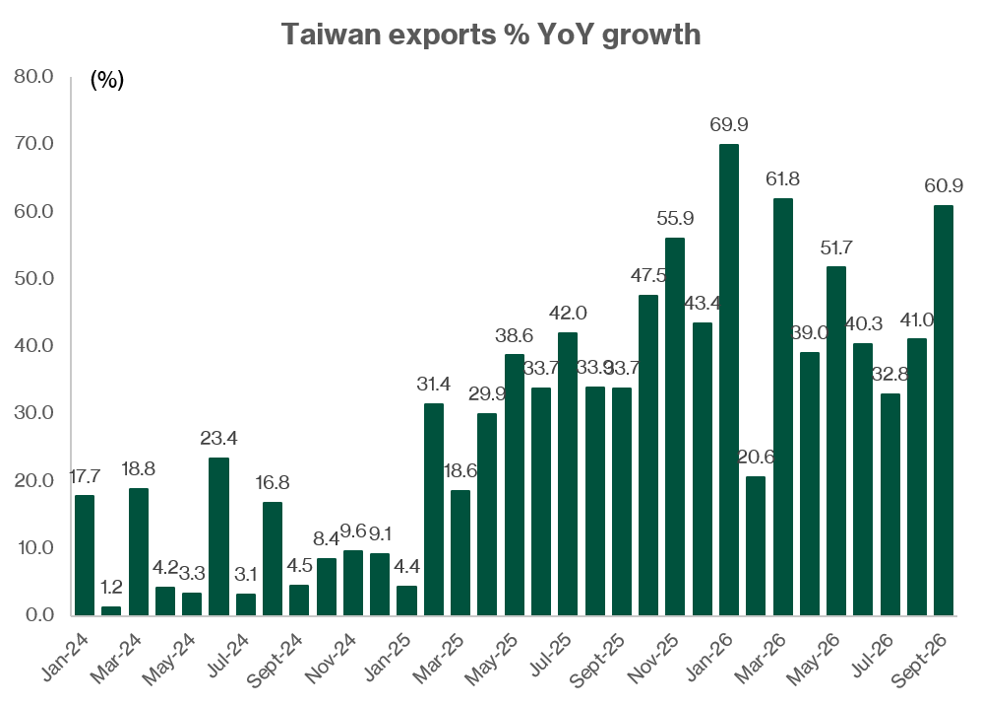
Taiwan's total monthly exports increased 60.9% year-on-year and registered the 35th straight month of growth.
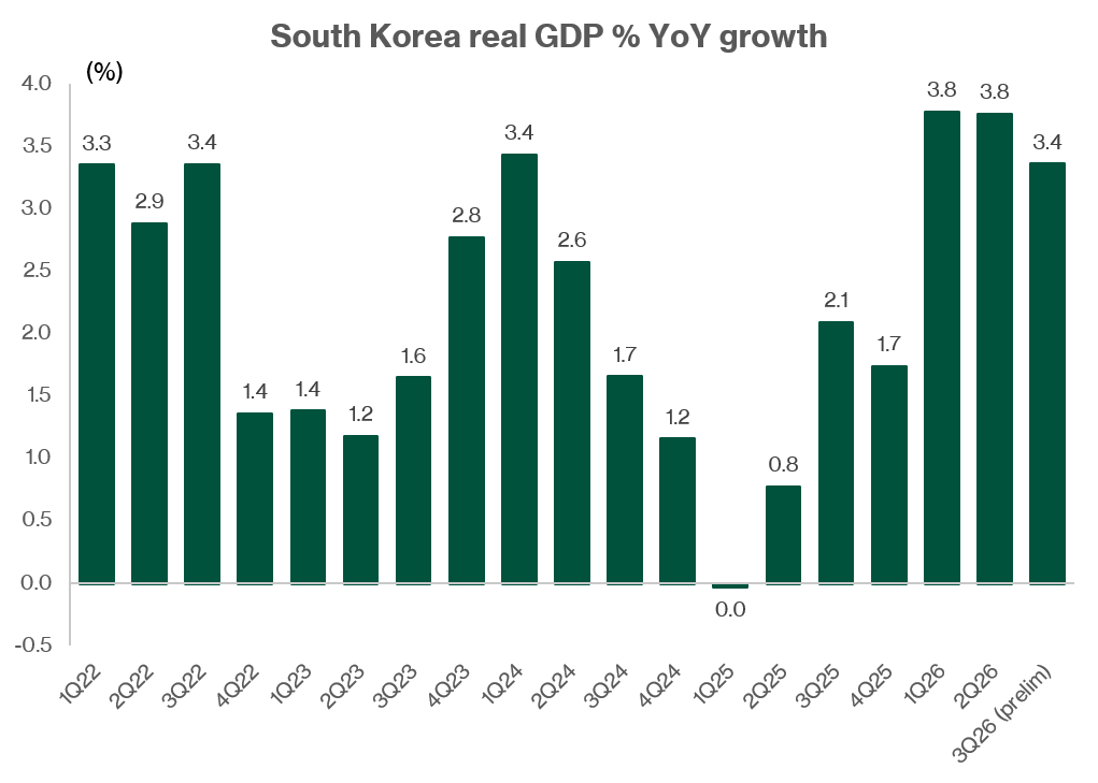
Similarly, Korea's economy grew 3.4% over the same period, with semiconductor demand supporting exports and investment.
How do the four iFAST Xtrackers ETFs differ?
#1 – XBG: Exposure to global AI and Big Data companies
The iFAST Xtrackers Artificial Intelligence & Big Data UCITS Index ETF (SGX: XBG) tracks the Nasdaq Global Artificial Intelligence and Big Data Index.
The index aims to identify companies involved in the development and adoption of AI and data-related technologies.
Alongside market cap, the index also uses measures including patent activity to identify businesses involved in eight technology themes.
These include deep learning, natural language processing, cloud computing, cybersecurity, and big data.
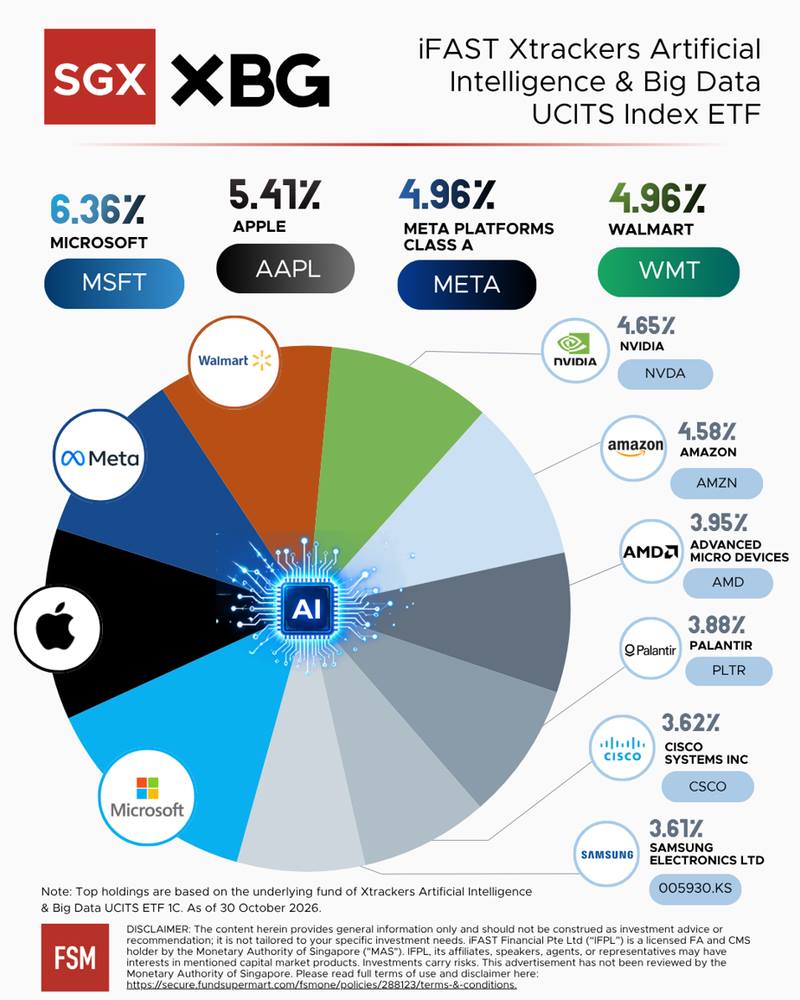
Some of the underlying ETF's major holdings include Microsoft, Nvidia, Apple, Amazon, and Meta.
This gives investors exposure to companies operating across different parts of the AI ecosystem, from computing infrastructure to software and applications.
#2 – JPY: Exposure to Japan's technology and industrial companies
The iFAST Xtrackers Nikkei 225 UCITS Index ETF (SGX: JPY) tracks Japan's Nikkei 225 Index.
It provides exposure to 225 Japanese companies across different sectors, including technology, manufacturing, consumer businesses and telecommunications.
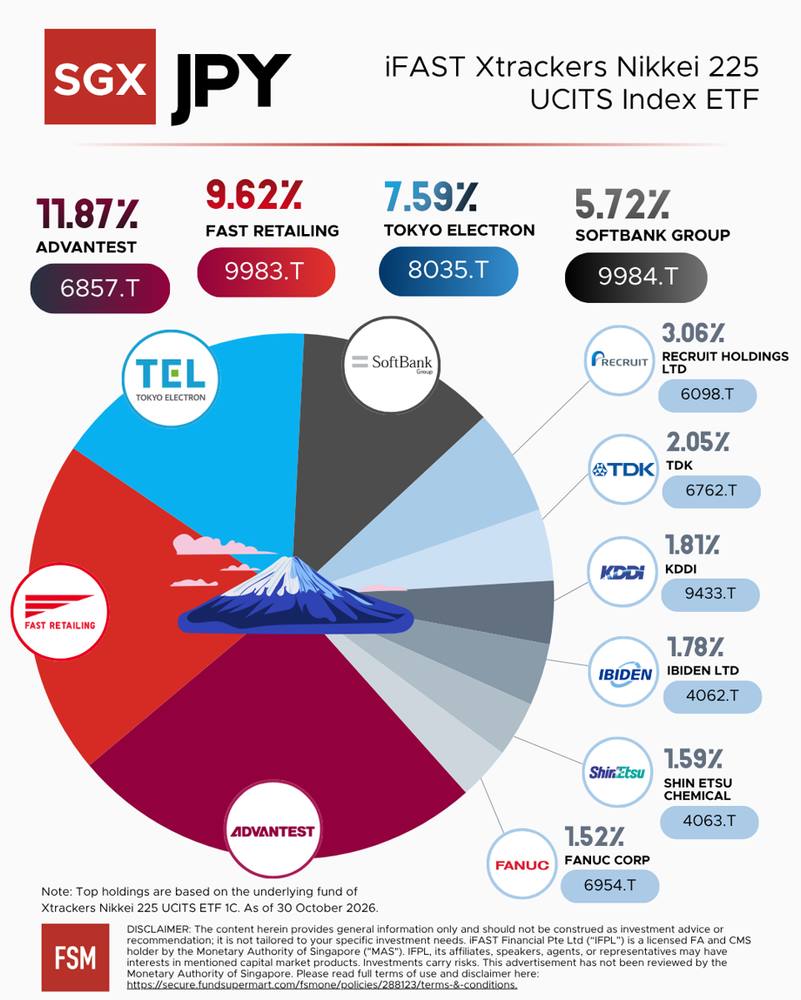
Among its underlying holdings are Advantest and Tokyo Electron, which supply equipment used in semiconductor production and testing.
Other companies include Fast Retailing, the parent company of Uniqlo, and SoftBank Group.
This means investors could gain exposure to companies benefiting from AI-related infrastructure spending alongside businesses driven by broader trends in Japan's economy.
One important feature of the Nikkei 225 is its index construction.
Unlike indices weighted by market capitalisation, the Nikkei 225 is price-weighted, meaning a company's share price, subject to the index's adjustment methodology, plays an important role in determining its weight.
As at 30 October 2026, Advantest and Tokyo Electron accounted for approximately 11.87% and 9.62% respectively of the underlying fund.
Together, these two semiconductor equipment companies represented more than one-fifth of its holdings.
#3 – KOR: Exposure to South Korea's technology and memory-chip companies
The iFAST Xtrackers MSCI Korea UCITS Index ETF (SGX: KOR) tracks the MSCI Korea 20/35 Custom Index.
It provides exposure to large and mid-sized companies listed in Korea.
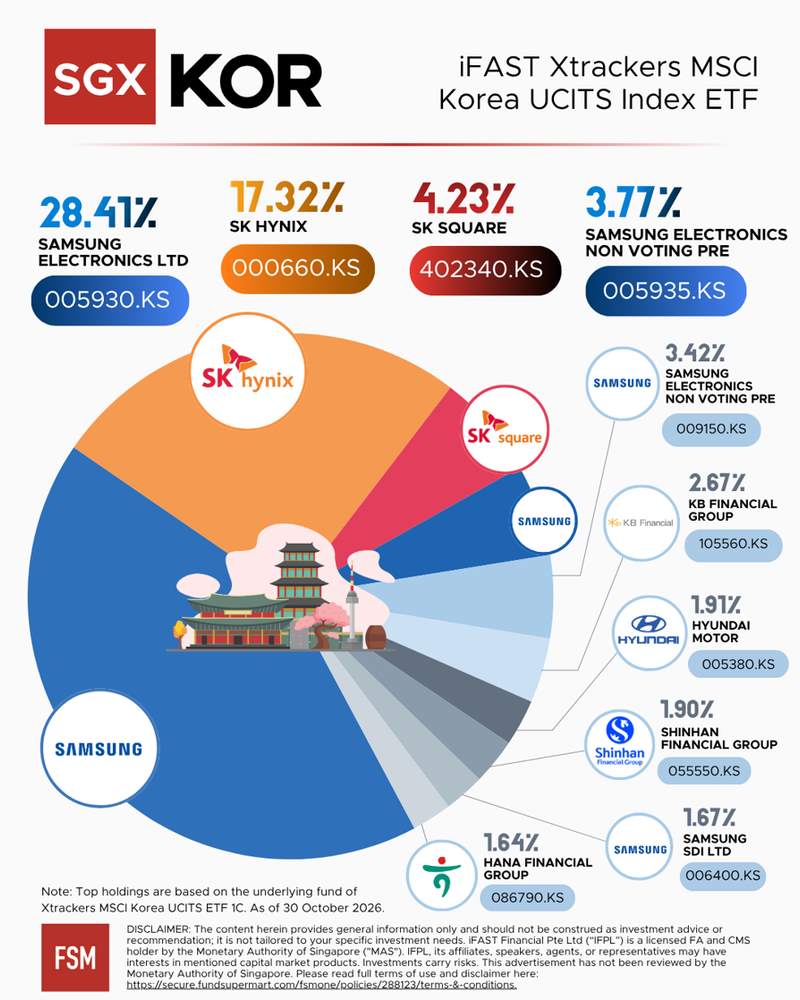
Two of its major underlying holdings are Samsung Electronics and SK hynix.
Both companies play important roles in the global memory-chip industry, supplying products used in smartphones, computers, servers, and AI infrastructure.
Demand for high-bandwidth memory (HBM), which helps AI processors access large amounts of data quickly, has increased alongside AI infrastructure spending.
SK hynix reported that its HBM revenue more than doubled year-on-year in 2025.
#4 – TWD: Exposure to Taiwan's semiconductor manufacturing industry
The iFAST Xtrackers MSCI Taiwan UCITS Index ETF (SGX: TWD) tracks the MSCI Taiwan 20/35 Custom Index.
It provides exposure to large and mid-sized companies in Taiwan, including businesses involved in semiconductor manufacturing, chip design, and electronics.
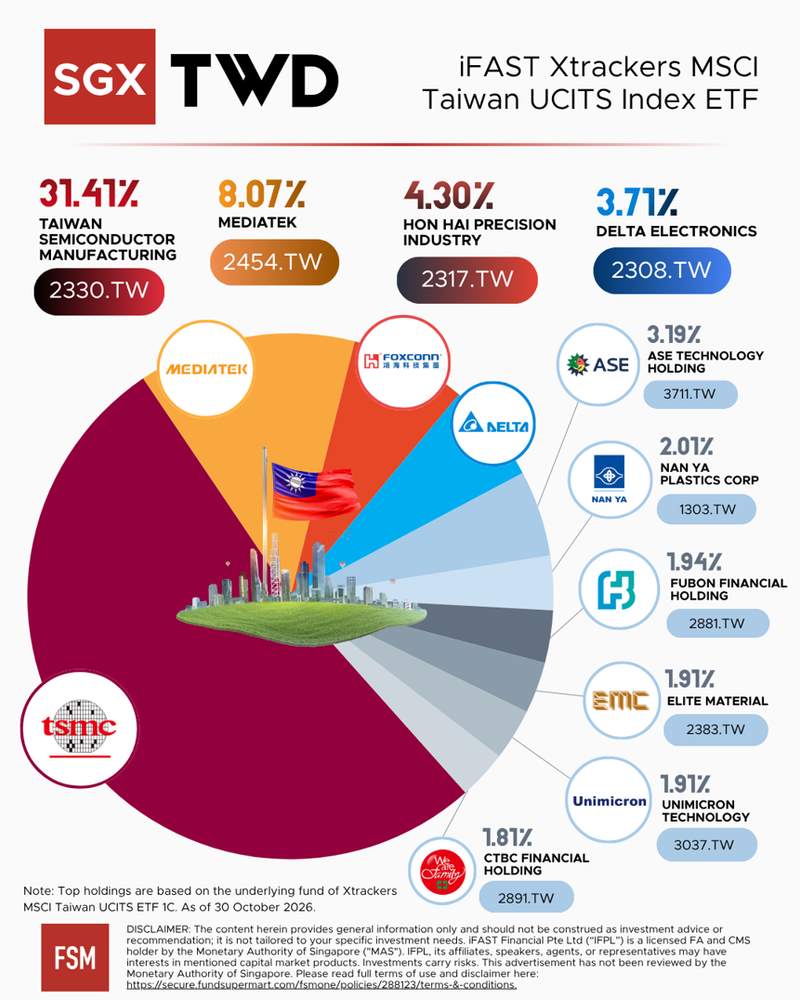
Its major underlying holdings include TSMC, MediaTek, Delta Electronics, and Hon Hai Precision Industry.
TSMC plays a critical role in the global AI supply chain, manufacturing advanced chips designed by companies such as Nvidia and AMD.
For example, Nvidia's Blackwell AI processors are manufactured using TSMC's advanced semiconductor technology.
Taiwan also has a wider semiconductor ecosystem, including companies specialising in chip design, packaging, testing, and electronics manufacturing.
Why access these ETFs through SGX?
#1 – Trade in Singapore dollars
All four ETFs can be bought and sold in Singapore dollars on SGX.
This means investors do not need to manually convert their Singapore dollars into US dollars, Japanese yen, or other foreign currencies each time they place a trade.
For investors who primarily hold Singapore dollars, this could simplify the investment process and reduce the need to manage multiple trading currencies.
#2 – Invest using SRS funds
All four ETFs are eligible for investment using SRS funds.
This gives Singapore investors another option for deploying their SRS savings into global and North Asian equities.
For investors with a long investment horizon, equity ETFs may offer the potential for capital growth over time.
#3 – Trade during local market hours with smaller board lots
Investors can buy and sell the ETFs during SGX trading hours instead of having to place orders during overseas market sessions.
This may be convenient for Singapore investors who prefer monitoring and managing their investments during the day.
The ETFs also have a board lot size of one share, which allows investors to build positions in smaller increments.
#4 – Different fund structure and tax considerations
The four ETFs are structured as Singapore-domiciled feeder funds investing in underlying Xtrackers UCITS ETFs.
This structure may have different tax and estate-planning implications compared with directly investing in certain US-domiciled securities.
For example, the location and structure of an investment fund can affect how dividend withholding taxes and estate-tax rules apply.
What should investors consider before buying?
#1 – Concentration risk
Investors who already hold S&P 500 or Nasdaq-100 ETFs may have significant exposure to companies such as Nvidia, Microsoft, and Apple.
Adding XBG could increase their exposure to these same companies.
Similarly, while JPY, KOR and TWD provide exposure to different markets, their performance can still be heavily influenced by a few major companies:
- JPY: The Nikkei 225 is price-weighted, which can result in substantial weights for high-priced stocks such as Advantest and Tokyo Electron.
- KOR: Samsung Electronics and SK hynix account for a significant proportion of the underlying index.
- TWD: TSMC is a dominant constituent, creating substantial single-company exposure.
These ETFs may also share similar industry risks.
For example, Advantest, SK hynix and TSMC operate in different parts of the semiconductor supply chain, but all are influenced by global semiconductor demand and AI infrastructure spending.
Investors should consider whether adding these ETFs would meaningfully diversify their portfolios or increase their exposure to existing companies and industry trends.
#2 – Valuations and semiconductor industry cycles
Although AI-related demand has supported economic growth in Korea and Taiwan, stronger economic activity does not automatically translate into higher stock market returns.
Investors need to consider whether expectations of future growth are already reflected in share prices.
The semiconductor industry is also cyclical, with company earnings influenced by changes in demand, supply, and pricing.
For example, if AI infrastructure spending slows or chipmakers expand capacity faster than demand grows, semiconductor companies could face pressure on their earnings.
This could affect the performance of ETFs with significant exposure to the semiconductor industry, particularly KOR and TWD.
#3 – Currency and geopolitical risks
Although all four ETFs trade in Singapore dollars, their underlying investments remain exposed to foreign currencies.
Movements in the Japanese yen, Korean won, Taiwan dollar, and other relevant currencies against the Singapore dollar can affect investment returns.
Investors should also consider geopolitical developments, particularly cross-strait tensions involving Taiwan, which could disrupt semiconductor supply chains and affect companies in the region.
#4 – Fees and investment costs
The four ETFs have overall total expense ratios ranging from 0.43% to 0.77% annually.
These ongoing expenses can affect long-term investment returns.
Investors should also account for brokerage fees, applicable exchange charges, and bid-ask spreads when buying or selling the ETFs.
#5 – Trading liquidity
As newly listed ETFs on SGX, the four funds have limited local trading histories.
Investors should pay attention to trading volumes and bid-ask spreads, particularly when the underlying overseas markets are closed.
A wider spread can increase the effective cost of buying or selling ETF units.
Investors may also wish to compare an ETF's market price against its indicative net asset value, where available, and consider using limit orders to manage their execution prices.
How can investors invest in SGX ETFs through FSM Global?
Investors can access the four iFAST Xtrackers ETFs through FSM Global, iFAST's B2C investment platform, using either cash or eligible SRS funds.
There are two ways to invest:
- Lump-sum investment: Buy SGX-listed ETFs through the FSM Global website or app at a flat processing fee of S$3.80 per trade, regardless of transaction size. GST and applicable exchange-related fees apply.
- Regular Savings Plan (RSP): Invest from as little as S$50 on a regular schedule, up to four times a month, with 0% processing fees on ETF RSP purchases. All four iFAST Xtrackers ETFs are available through FSM Global's RSP, which investors can pause or terminate when needed.
Beyond its competitive fees, FSM Global also provides access to a wider range of investments, including stocks, bonds and funds.
FSM Global is operated by MAS-regulated iFAST Financial, with client cash and investments segregated from the company's own assets under regulatory requirements.
The platform is part of SGX-listed iFAST Corporation, which has 26 years of operating history and S$36.76 billion in Group assets under administration as at 30 September 2026.
FSM Global also supports account opening by investors outside Singapore, subject to applicable eligibility requirements and restrictions.
For more details on the platform, its features and fees, read our FSM Global review.
Get up to S$58 in welcome rewards*
New FSM Global account holders can receive up to S$58 in cash rewards* by opening an account, depositing at least S$1,000 and completing qualifying RSP investments.
To receive the full reward, investors must complete RSP investments across funds, ETFs and managed portfolios within 40 days of account opening.
A minimum combined balance of S$1,000 must also be maintained at the end of the qualifying period. SRS and CPFIS transactions do not qualify for these rewards.
Open an FSM Global account and get up to S$58 in welcome rewards
*Terms and conditions apply. Fees and promotions are subject to change.
What would Beansprout do?
The four iFAST Xtrackers ETFs offer different ways to gain exposure to the AI investment theme, depending on what I already hold in my portfolio.
If I do not already have significant exposure to AI-related companies, XBG could be a starting point to explore, as it provides exposure to companies involved in AI development, cloud computing, and Big Data.
However, if I already invest in an S&P 500 or Nasdaq-100 ETF, I may already own major technology companies such as Nvidia, Microsoft, and Apple.
In that case, I would assess whether adding XBG provides meaningful additional exposure or simply increases my allocation to companies I already own.
I would also consider whether I want to gain exposure to other parts of the AI supply chain through Japan, Korea, or Taiwan.
The choice would depend on which investment opportunity I am looking to capture.
JPY could be worth exploring if I want broader exposure to Japanese equities, including semiconductor equipment manufacturers such as Advantest and Tokyo Electron.
KOR offers more targeted exposure to Korea's memory-chip industry through companies such as Samsung Electronics and SK hynix, although I would need to be comfortable with the semiconductor industry's cyclical nature.
TWD provides exposure to Taiwan's advanced semiconductor manufacturing ecosystem, but I would be particularly mindful of its significant concentration in TSMC.
I would also consider how these ETFs complement my existing holdings. For example, if I already own a global semiconductor ETF, adding KOR or TWD could increase my exposure to companies or industry trends that I am already invested in.
For investors looking for broader diversification, a global equity ETF may provide exposure across a wider range of countries and sectors.
The four iFAST Xtrackers ETFs, by comparison, could be considered for more targeted allocations.
Being able to invest in these ETFs through SGX using Singapore dollars or SRS funds is an added convenience.
Ultimately, the key question for me is which part of the AI investment opportunity I want more exposure to, and whether that exposure would meaningfully complement what I already own.
Explore the four iFAST Xtrackers ETFs and learn more about their investment exposure on FSM Global.
Important information
This advertisement has not been reviewed by the Monetary Authority of Singapore.
Read also
Gain financial insights in minutes
Subscribe to our free weekly newsletter for more insights to grow your wealth
Most Popular

Comments
0 comments