
After October's market correction, should investors turn defensive? Beansprout Investment Climate Nov 2026
Stocks, Bonds
By Gerald Wong, CFA • 05 Nov 2026
Why trust Beansprout? We’ve been awarded Best Investment Website at the SIAS Investors’ Choice Awards 2025

Make Beansprout your preferred source on Google
Add us on Google to see more of our insights in your search results
Singapore and technology stocks fell in October while bond yields remained elevated. We assess five indicators shaping the investment outlook for November 2026.

What happened?
Stock markets came under pressure in October.
The Straits Times Index (STI) fell 5.27% between 30 September and 30 October, while the Nasdaq Composite declined 5.30% and South Korea's Kospi fell 16.20%.
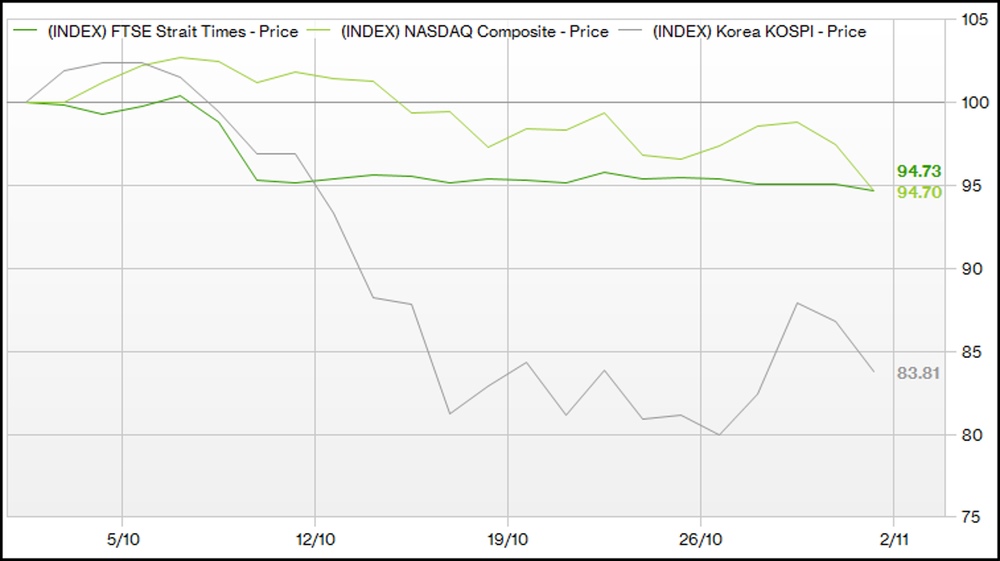
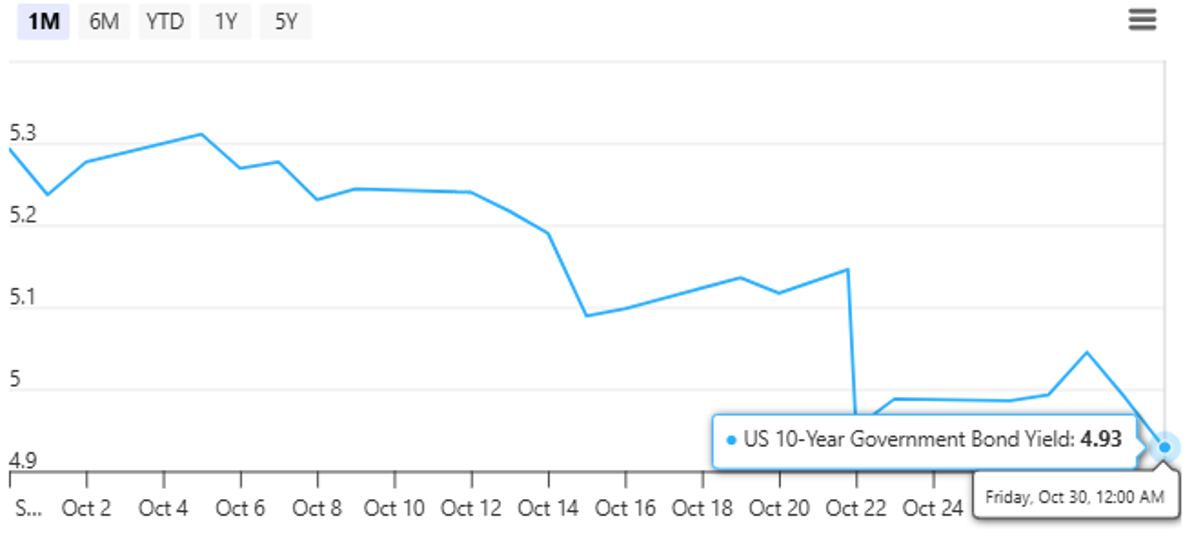
At the same time, bond yields remained elevated, although the US 10-year Treasury yield eased from 5.29% at end-September to approximately 4.93% on 30 October.
This raises an important question for investors: does October's market correction suggest that we should become more defensive, or could lower share prices present opportunities?
As we shared in our October Beansprout Investment Climate, higher bond yields can put pressure on stock valuations, particularly when investors can earn more from lower-risk assets.
However, rising bond yields and falling share prices do not necessarily mean that economic and corporate fundamentals have deteriorated.
This is why we believe it is important to look beyond market movements alone.
In our November Beansprout Investment Climate, we revisit the same five indicators to assess whether the investment environment has become more favourable or whether risks are increasing.
What is the Beansprout Investment Climate telling us now?
At Beansprout, we use five indicators to assess whether the investment environment is becoming more favourable or whether risks are increasing.
These are inflation, economic growth, corporate earnings, valuations and AI investments.
The first four are fundamental drivers of investment returns across different market cycles.
We track AI investments separately because their scale has made them an increasingly important driver of economic activity and stock market performance.
Our indicators focus primarily on the US, given its significant influence on global financial markets and Singapore's economy.
Rather than trying to predict every market movement, we monitor these indicators to understand how the underlying conditions supporting investment returns are changing.
In October, inflation was our biggest concern, while economic growth and corporate earnings remained resilient.
Equity valuations had also become more reasonable following the market correction, while AI investments continued supporting growth despite concerns about the returns on spending.
For November, inflation remains our biggest concern.
US core inflation has increased again, while oil prices remain elevated. Meanwhile, market expectations indicate that US interest rates could remain high.
However, economic growth continues to show resilience despite moderating, while corporate earnings expectations remain supportive.
Equity valuations have also moved closer to their historical average following the recent correction.
Taken together, we believe the investment environment remains cautiously constructive, although selectivity is becoming increasingly important.
Here is our November assessment.
| Indicator | Our November assessment | What we're watching |
| 1. Inflation | Concerning | Whether higher oil prices lead to persistent inflation and elevated interest rates |
| 2. Economic growth | Resilient, but moderating | Whether slower growth and weak consumer confidence eventually affect spending |
| 3. Corporate earnings | Resilient | Whether companies can sustain earnings growth into 2027 |
| 4. Valuations | More reasonable | Whether equity valuations remain justified relative to earnings and bond yields |
| 5. AI investments | Still supportive, but worth watching | Whether AI spending continues growing and delivers sustainable returns |
Let's take a closer look at each indicator.
#1 – Inflation: Our biggest concern remains
Inflation remains our biggest concern among the five indicators we track.
In October, we highlighted how rising oil prices were contributing to higher bond yields and increasing the risk that inflation could remain elevated.
The latest data suggests that inflation pressures have not disappeared, even though government bond yields have eased from their recent highs.
US core inflation remains above the Fed's target
US core inflation, which excludes food and energy prices, rose to 2.6% year-on-year in September 2026, from 2.4% in August.
This reverses some of the improvement seen in recent months, although core inflation remains below the 2.9% recorded in May.
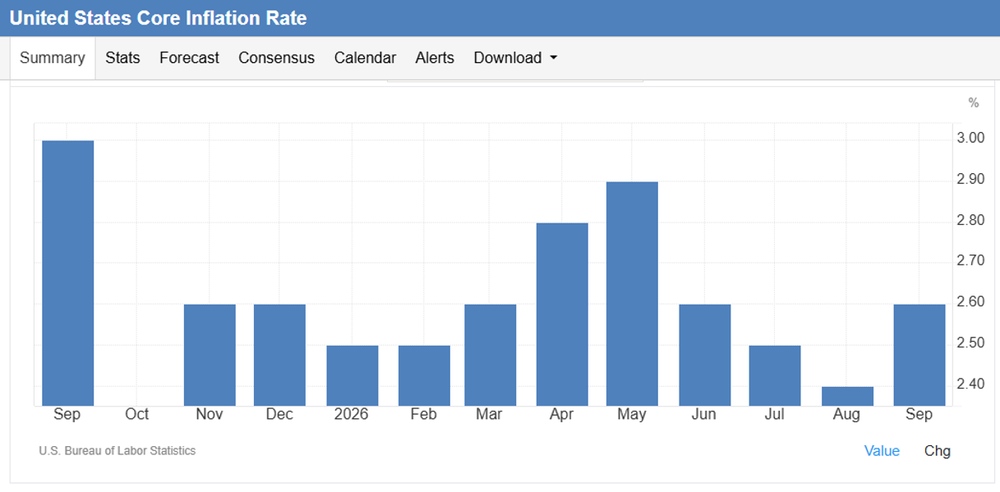
The increase suggests that underlying price pressures remain persistent.
This matters because the US Federal Reserve may have less room to lower interest rates if inflation remains elevated.
Oil prices remain elevated
Another concern is the continued increase in oil prices.
As of 2 November 2026, Brent crude oil was trading at approximately US$108.64 per barrel, compared with US$105.60 on 13 October.
This represents a further increase of approximately 2.9%.
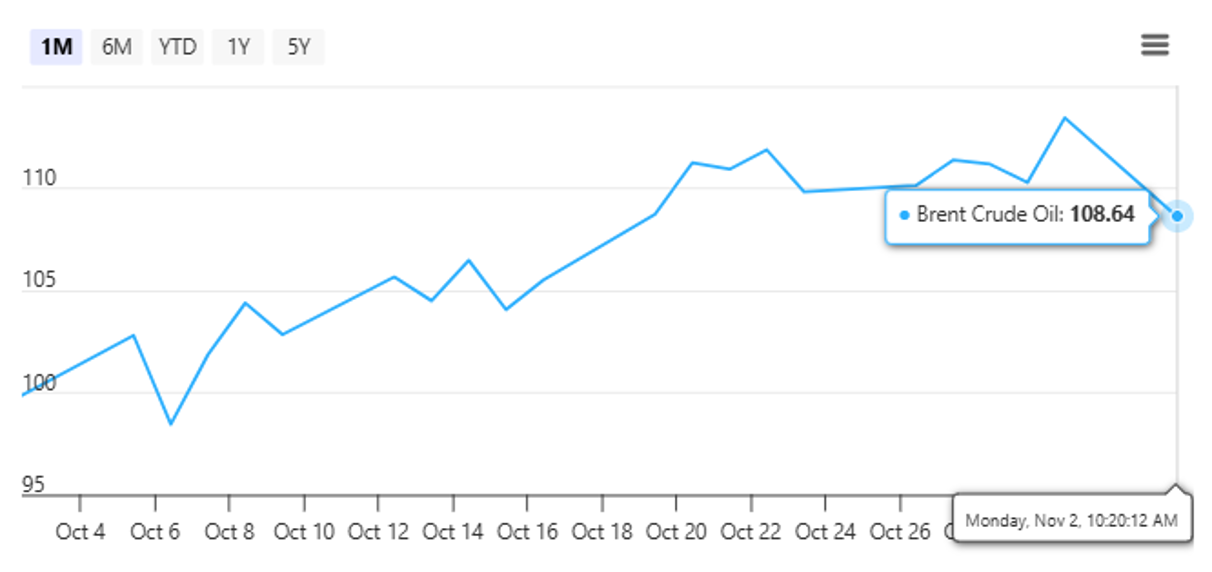
Higher oil prices can increase transportation and production costs for businesses.
If companies pass these costs on to consumers, inflation could remain elevated for longer, potentially leading to tighter monetary policy and pressure on corporate profit margins.
The concern is therefore not simply that oil prices have increased. It is whether higher energy costs translate into more persistent inflation across the economy.
Markets are assigning significant probability to higher Fed rates
The latest CME FedWatch probabilities suggest that market participants are pricing in the possibility of higher interest rates over the coming months.
This is consistent with Fed Chairman Kevin Warsh's recent statement during the FOMC that the financial conditions are not tight.
For the Federal Reserve meeting on 9 December 2026, the market assigns a 74.9% probability to a target range of 4.00% to 4.25%, compared with a 25.1% probability of 3.75% to 4.00%.
By the March 2027 meeting, the highest-probability outcome is a target range of 4.25% to 4.50%, with a probability of 56.8%.
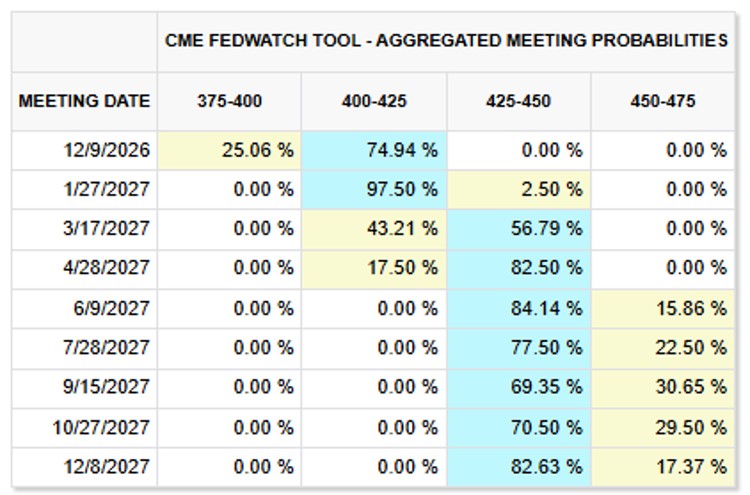
These probabilities indicate that markets are assigning significant weight to higher interest-rate outcomes over the coming months.
However, they are not forecasts from the Federal Reserve, and market expectations can change quickly as new economic data becomes available.
What does this mean for investors?
Despite these inflation concerns, the US 10-year Treasury yield eased from 5.29% at end-September to approximately 4.93% on 30 October 2026.
This has provided some relief for equity valuations, although bond yields remain elevated compared with much of the past decade.
For us, the key question is whether inflation can moderate without a significant deterioration in economic growth.
If oil prices remain elevated and underlying inflation continues rising, the Federal Reserve may need to maintain tighter monetary policy for longer.
That could put renewed upward pressure on bond yields, increase borrowing costs and weigh on corporate earnings.
Conversely, easing inflation alongside resilient economic growth would create a more favourable environment for equities.
For now, we continue to view inflation as the clearest risk to the investment outlook, particularly given the renewed increase in oil prices and core inflation.
#2 – Economic growth: Still resilient despite moderating growth
Despite elevated interest rates, the US economy has continued expanding, although the pace of growth has moderated.
As the chart below shows, US real gross domestic product (GDP) grew 2.1% year-on-year in the third quarter of 2026, compared with 2.2% in the second quarter and 2.6% in the first quarter.
This also marks a slowdown from the 2.6% growth recorded in the third quarter of 2025.
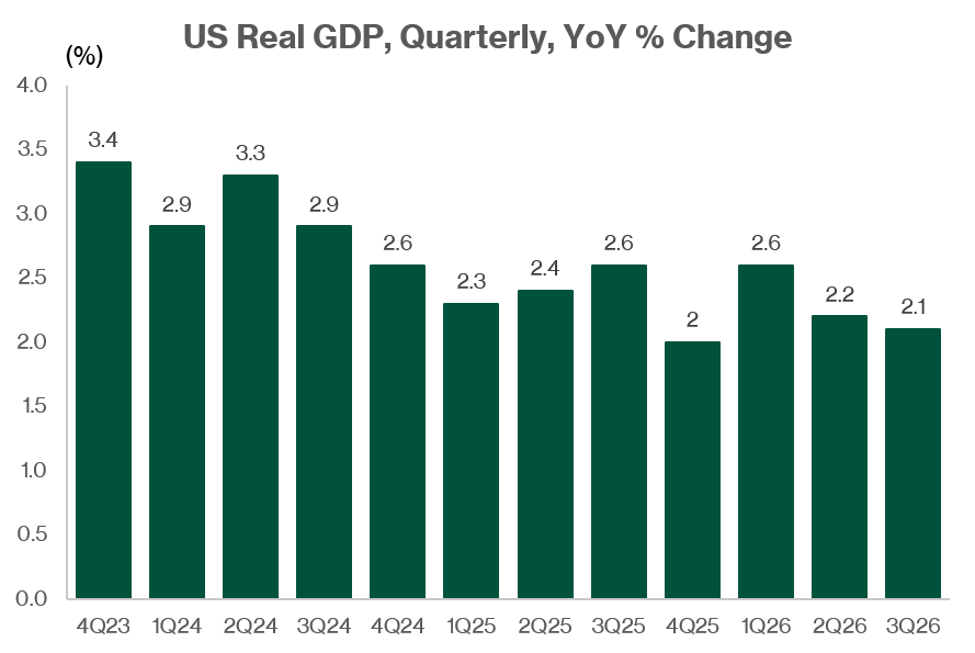
While economic growth has moderated, the latest figures do not suggest a sharp deterioration in economic activity.
However, there is a growing divergence between what the economic data is telling us and how consumers are feeling.
Consumer sentiment remains weak
The University of Michigan Consumer Sentiment Index remained around 48.0 in October 2026, broadly unchanged from September’s 48.1.
As the chart below shows, consumer sentiment remains near some of the lowest levels recorded in recent years.
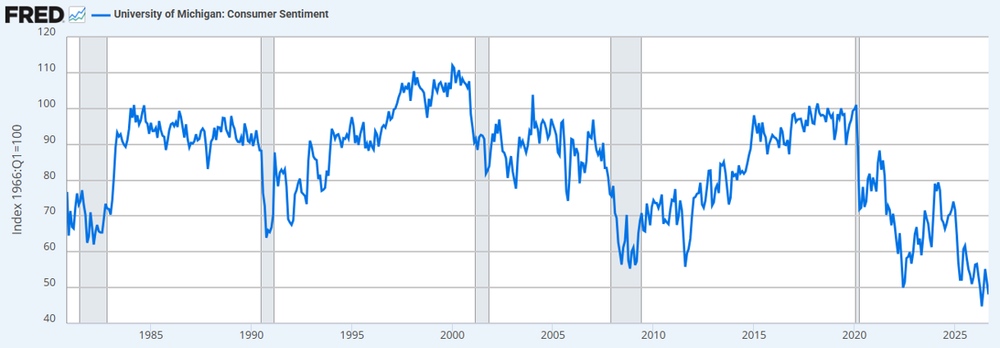
This suggests that many households remain concerned about their financial circumstances, even as overall economic activity continues expanding.
The key question is whether this weakness in consumer sentiment will eventually translate into lower spending.
If households begin cutting back significantly, businesses could experience weaker demand, potentially affecting hiring and investment decisions.
However, weak consumer sentiment does not always translate immediately into lower spending.
For now, the continued expansion in US GDP suggests that economic activity remains resilient despite weaker confidence.
Singapore's economic growth is expected to moderate in 2027
Closer to home, Singapore's economic outlook remains supportive.
Based on the latest forecast provided, Singapore's real GDP growth is projected to reach 5.4% in 2026, before moderating to 3.3% in 2027.
This follows growth of 5.0% in 2025.
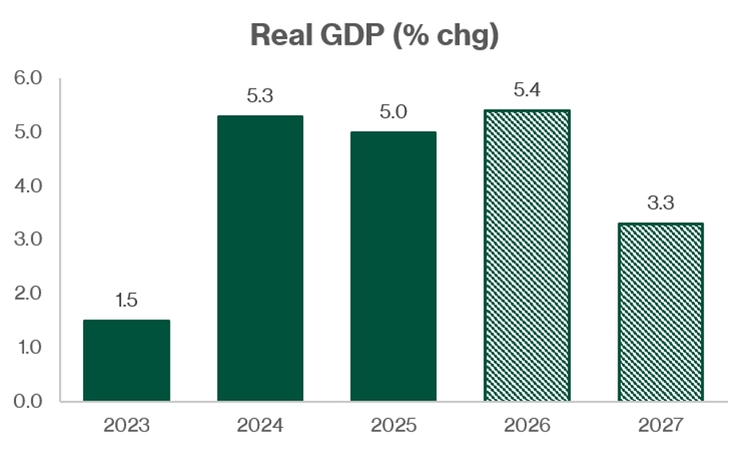
The moderation in growth does not necessarily imply an economic downturn.
Rather, it suggests that the pace of expansion could normalise after the strong growth recorded in 2026.
AI-related manufacturing, infrastructure investment and financial services could continue supporting economic activity, even if overall growth slows.
For investors, the more important question is whether companies can sustain earnings growth as the economy expands at a more moderate pace.
We would become more cautious if slower GDP growth is accompanied by weaker consumer spending, declining business investment and deteriorating employment conditions.
For now, we continue to assess economic growth as resilient, although moderating US growth and weak consumer sentiment warrant closer monitoring.
The latest midterm election results also means that US may face a gridlock in the government which may affect policies and affect growth.
#3 – Corporate earnings: Can companies continue growing profits?
Corporate earnings remain another important indicator of whether stock markets can withstand elevated bond yields.
When bond yields rise, companies may face higher borrowing costs, particularly if they have significant debt or refinancing requirements.
Higher input costs could also weigh on profit margins if businesses are unable to pass these increases on to customers.
However, companies that can continue growing earnings despite these challenges may be better positioned to withstand higher interest rates.
S&P 500 earnings growth remains resilient
The latest FactSet estimates suggest that S&P 500 earnings growth remains strong.
For calendar year 2026, estimated S&P 500 earnings growth stands at 32.9% year-on-year, compared with 32.2% as of 30 September.
For the third quarter of 2026, earnings growth stands at 30.2%, compared with 29.1% as of 30 September.
These figures suggest that the earnings outlook has improved modestly despite October's equity-market correction.
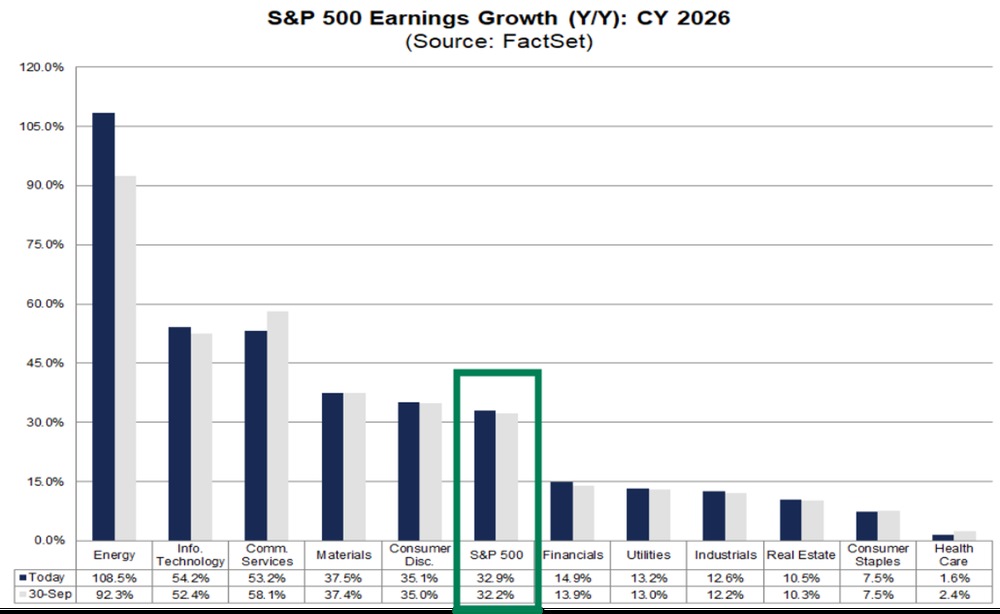
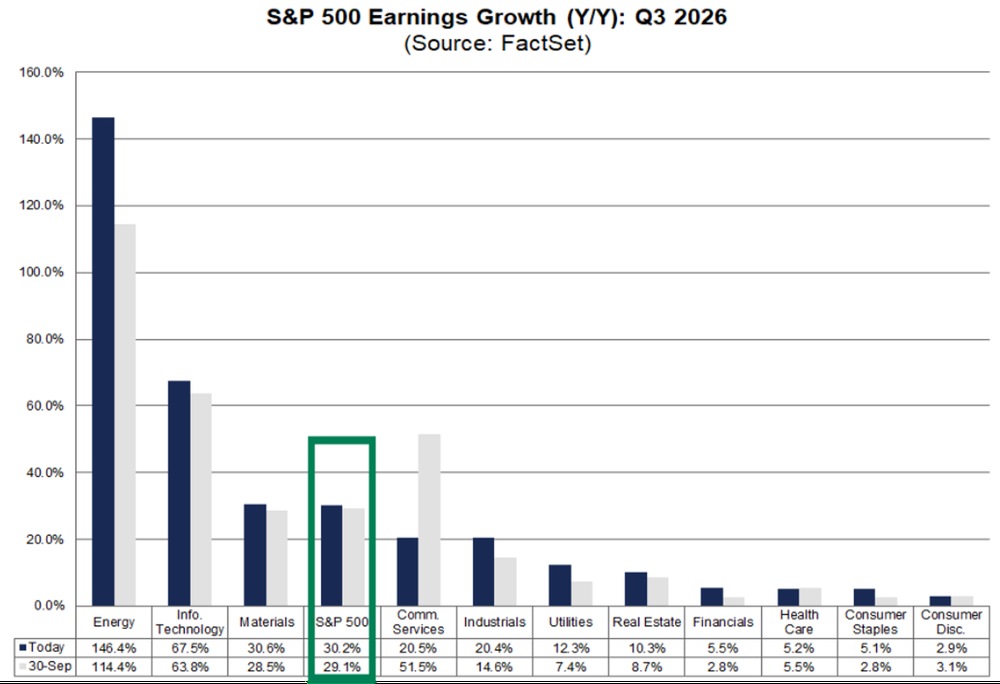
Looking across sectors, the strongest expected earnings growth for 2026 is concentrated in several areas.
Energy leads with estimated growth of 108.5%, followed by information technology at 54.2% and communication services at 53.2%.
For the third quarter alone, energy earnings growth is estimated at 146.4%, while information technology earnings are expected to grow 67.5%.
This suggests that certain sectors continue to contribute disproportionately to overall earnings growth.
However, it also highlights a potential risk.
If earnings growth is concentrated in a few sectors, a slowdown in those areas could have an outsized impact on the broader market.
S&P 500 earnings growth is expected to moderate in 2027
Looking ahead, analysts expect corporate earnings growth to moderate in 2027, although the outlook remains supportive.
According to the latest FactSet estimates, S&P 500 earnings are expected to grow 16.3% year-on-year in 2027, compared with projected growth of 32.9% in 2026.
The 2027 forecast has also been revised upwards from 15.4% as of 30 September 2026.
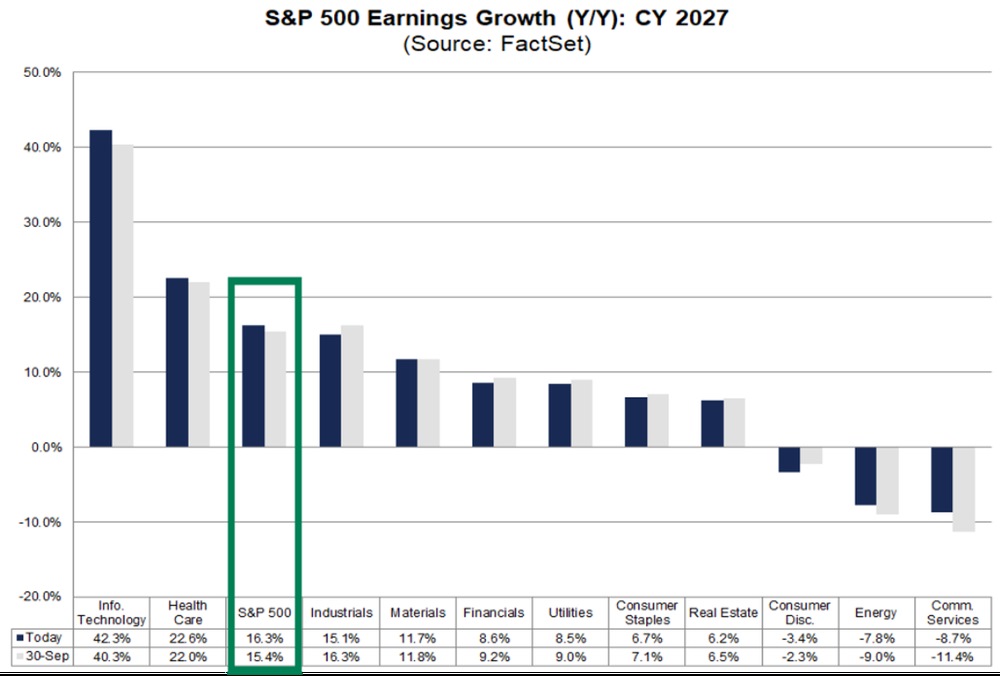
The sector outlook varies significantly.
Information technology is expected to lead earnings growth at 42.3%, followed by healthcare at 22.6% and industrials at 15.1%.
In contrast, earnings in communication services and energy are projected to decline by 8.7% and 7.8%, respectively.
This suggests that while overall earnings growth remains supportive, much of the expected growth is concentrated in selected sectors.
The moderation also means that investors may need to become more selective, particularly if valuations already reflect strong future earnings growth.
Why earnings growth matters when bond yields remain elevated
We previously highlighted how strong earnings growth can help stock markets withstand higher bond yields.
Historical data suggests that equity returns have generally been more resilient during periods of stronger earnings growth, even when government bond yields were rising.
Strong earnings growth can help offset some of the pressure from higher discount rates and more demanding equity valuations.
However, if earnings expectations begin deteriorating, stock markets could face pressure from both weaker profits and lower valuation multiples.
This would be a more concerning development.
For now, the upward revision to 2027 earnings expectations provides another reason why we believe it may be premature to turn outright defensive.
#4 – Valuations: Have stocks become more attractive?
Even when economic growth and corporate earnings remain strong, the price investors pay for an investment matters.
Higher valuations can make future returns more dependent on continued earnings growth and positive market expectations.
When bond yields are elevated, investors may also become less willing to pay high valuations for equities because bonds offer a more competitive alternative.
This makes valuation discipline particularly important.
October's correction has made valuations more reasonable
October was a difficult month for many equity markets, particularly in Asia and technology-related stocks.
The STI declined 5.27%, while the Nasdaq Composite fell 5.30% and South Korea's Kospi declined 16.20%.
The broader S&P 500 declined by a more modest 0.93%, while the Dow Jones gained 1.70%.
The difference in performance suggests that selling pressure was more concentrated in certain markets and sectors.
October 2026 equity-market performance
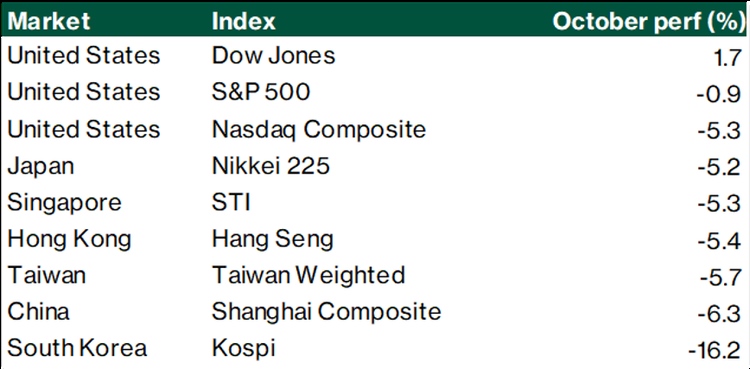
We believe the correction partly reflects investors reassessing the valuations they are willing to pay, rather than a broad deterioration in corporate earnings.
However, declining share prices do not automatically mean that stocks have become cheap.
The more important consideration is whether valuations are reasonable relative to the earnings that companies can generate.
S&P 500 valuations have returned closer to historical levels
The valuation chart provided shows that the S&P 500, based on State Street SPDR S&P 500 ETF's next-12-month forward price-to-earnings ratio has declined from levels above 22 times earlier in 2026 to 18.7 times.
This places valuations lower than the historical average of 19.06 times shown in the chart.
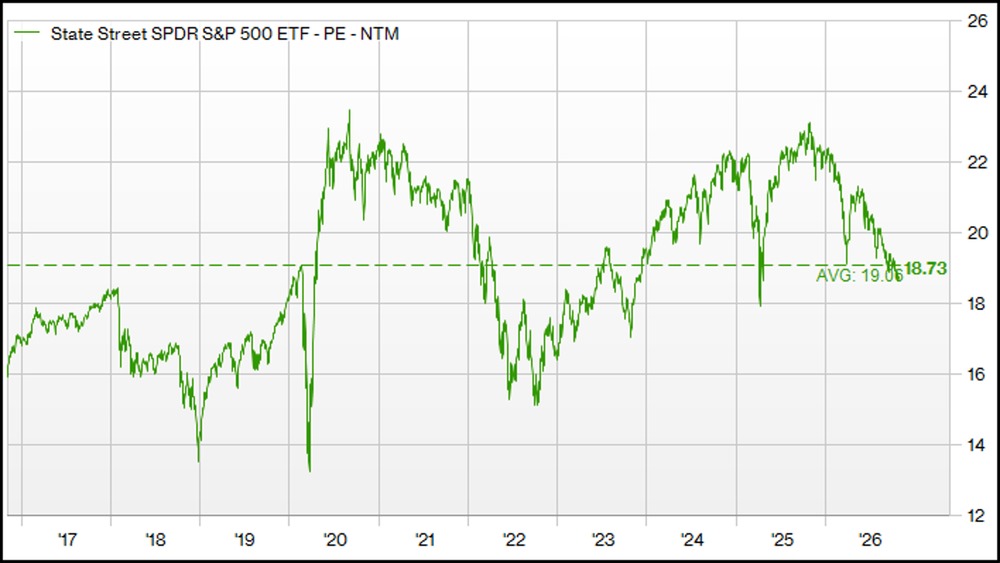
The decline suggests that investors are now paying less for each dollar of expected earnings than they were earlier in the year.
This makes valuations more reasonable, particularly if corporate earnings continue growing.
However, being close to the historical average does not necessarily mean that equities are cheap.
It also means that future market returns may depend more heavily on earnings growth rather than investors being willing to pay higher valuation multiples.
Singapore equity valuations remain above historical levels
Singapore stocks also experienced a correction in October, with the STI declining 5.27%.
However, the latest valuation data suggests that Singapore equities are not necessarily cheap despite the pullback.
As the chart below shows, the STI's forward P/E ratio, based on the State Street SPDR Straits Times Index ETF, stood at approximately 15.5 times as of 4 November 2026.
This remains above its 10-year historical average of approximately 12.8 times.
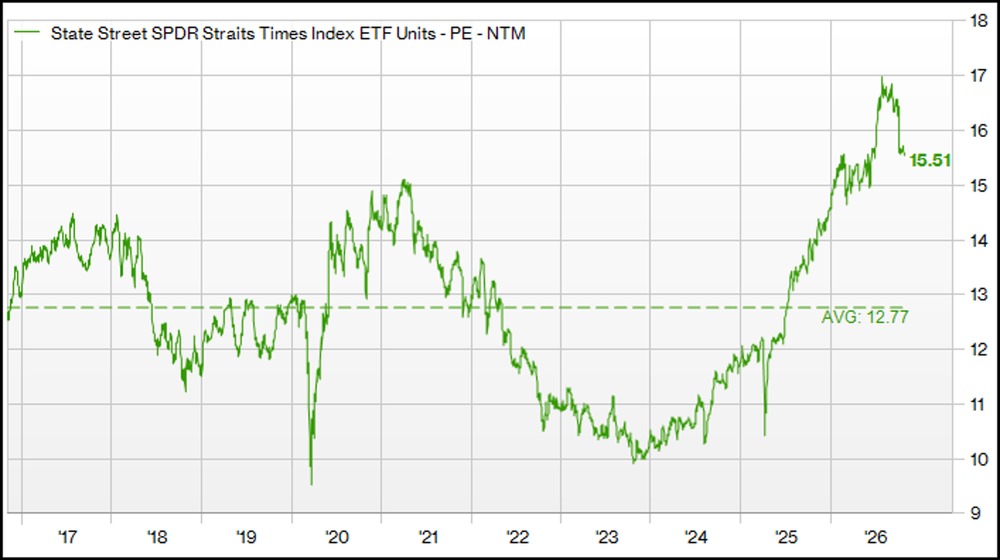
This suggests that investors are still paying a premium to historical valuations for Singapore equities, even after October's correction.
An important question is whether corporate earnings can continue growing sufficiently to justify this premium.
STI earnings growth is expected to moderate in 2027
Based on the earnings forecasts provided, the STI's earnings per share (EPS) are expected to grow 8.60% in 2026, before moderating to 7.05% in 2027.
Growth is then projected to improve to 7.80% in 2028.
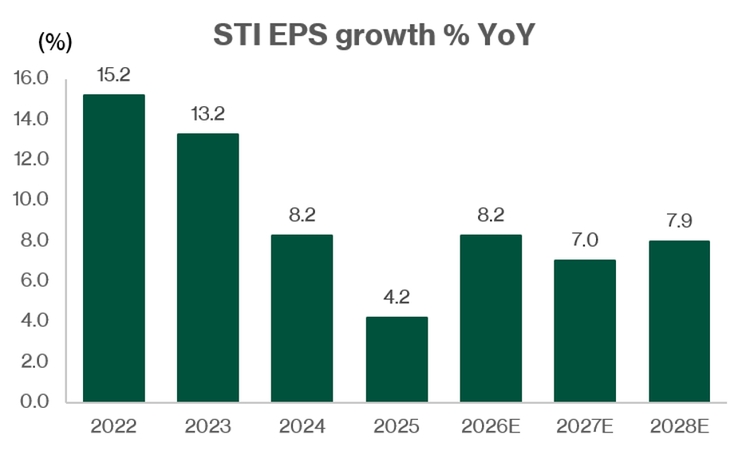
While these forecasts suggest that earnings growth should remain positive, the slower pace of growth in 2027 may limit the scope for further valuation expansion.
This is particularly relevant when the STI is still trading above its historical average valuation.
If earnings growth disappoints, investors could become less willing to pay a premium for Singapore equities, putting pressure on share prices.
On the other hand, stronger-than-expected earnings growth could help support current valuations.
For us, this reinforces the importance of assessing valuations alongside earnings growth rather than treating the recent share-price correction as sufficient reason to buy.
Bonds remain competitive with equities
At the same time, bond yields remain elevated.
The US 10-year Treasury yield stood at approximately 4.93% on 30 October 2026, despite easing from 5.29% at end-September.
Higher yields make fixed income investments more competitive with equities, particularly for investors seeking income.
However, bond prices could decline if yields rise further, especially for longer-duration bonds.
For equity investors, the implication is that companies may need to deliver stronger earnings growth to justify their valuations.
This is particularly relevant for growth stocks, where a significant portion of the valuation depends on profits expected further into the future.
For now, we believe equity valuations have become more reasonable, but there remains a need to be selective.
#5 – AI investments: Will spending continue to support growth?
AI investments remain an important driver of economic growth and stock market performance.
However, October's correction in technology stocks highlighted growing concerns about whether substantial AI spending can generate sufficient returns.
We believe this reflects a reassessment of investor expectations rather than clear evidence that the underlying AI investment cycle has ended.
AI capital expenditure is expected to continue growing
Our October Beansprout AI Tracker indicates that AI demand remains strong, supported by enterprise adoption, cloud revenue growth and infrastructure investment.
According to the supplied FactSet estimates, combined capital expenditure by five major hyperscalers is projected to increase from approximately US$806 billion in 2026 to US$1.1 trillion in 2027.
The pace of spending growth is expected to moderate from approximately 94% in 2026 to 37% in 2027.
These forecasts cover the companies' overall capital expenditure rather than spending exclusively on AI.
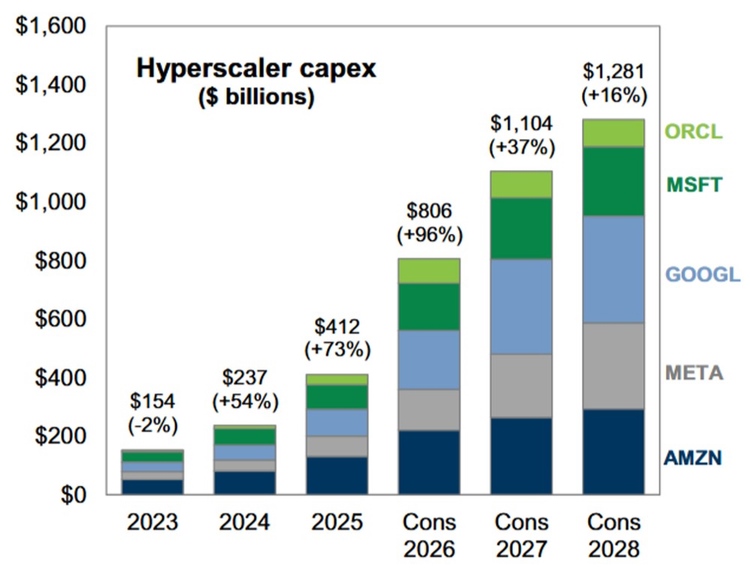
The projected increase in spending suggests that major technology companies continue investing heavily in AI infrastructure.
However, the expected slowdown in capital expenditure growth raises an important question about how much future economic and earnings growth can continue coming from AI-related investment.
Recent hyperscaler results show strong AI demand, but rising cash flow pressures
The latest quarterly results from Amazon, Alphabet and Microsoft suggest that demand for AI infrastructure remains strong.
Amazon Web Services revenue grew 39% year-on-year in the third quarter of 2026, while Google Cloud revenue increased 103% and Microsoft Azure revenue rose 48%.
These results indicate that demand for cloud computing and AI infrastructure continues to expand, providing support for the broader AI investment cycle.
However, the scale of spending required to meet this demand is also increasing.
Amazon expects cash capital expenditure of approximately US$220 billion in 2026, while Alphabet has maintained its full-year capital expenditure guidance of US$195 billion to US$205 billion.
Microsoft also reported capital expenditure of US$45.2 billion in its latest quarter.
The impact on cash flows is becoming more apparent.
Amazon reported negative free cash flow of US$42.4 billion over the trailing 12 months, while Alphabet's quarterly capital expenditure exceeded its operating cash flow.
Microsoft continued generating positive free cash flow, although its substantial infrastructure investments are absorbing a significant amount of cash.
For us, these results reinforce an important distinction.
AI demand remains strong, but strong demand alone does not guarantee attractive returns for investors.
We would pay closer attention to whether companies can translate AI spending into sustainable earnings and free cash flow, particularly as depreciation and financing costs increase.
While we remain positive on the long-term AI investment cycle, we believe companies' ability to fund their investments and generate sufficient returns will become increasingly important in determining their share-price performance.
Beansprout's take: Putting the five indicators together
October's market correction has raised concerns about whether stock markets could experience further declines.
However, our assessment of the five indicators suggests that it may be premature to turn outright defensive.
Inflation remains our biggest concern, particularly as higher oil prices and persistent core inflation could keep interest rates elevated.
At the same time, economic growth continues to expand, although the pace of growth is moderating and consumer confidence remains weak.
Corporate earnings remain resilient, with analysts revising 2027 earnings expectations upwards despite the recent market correction.
Equity valuations have also become more reasonable, with the S&P 500's forward price-to-earnings ratio moving closer to its historical average.
AI investments continue to support growth, although investors are increasingly focused on whether these investments can generate attractive returns.
Taken together, inflation remains our clearest source of concern, while the other indicators have not deteriorated sufficiently to warrant an outright defensive stance.
Our overall assessment of the investment climate therefore remains cautiously constructive.
We would not assume that October's correction signals the beginning of a prolonged market downturn.
However, we would also avoid assuming that lower share prices automatically represent attractive investment opportunities.
With bond yields remaining elevated, companies may need to deliver stronger earnings growth to justify their valuations.
We therefore believe the investment environment increasingly rewards selectivity rather than simply increasing equity exposure following a market correction.
What would make us change our view?
The key question is whether the risks we are monitoring begin spreading beyond inflation and market valuations.
We would become more cautious if elevated oil prices lead to persistent inflation, forcing the Federal Reserve to maintain higher interest rates for longer.
A sustained rise in bond yields, combined with weakening economic growth and declining corporate earnings expectations, would be particularly concerning for equities.
We would also watch whether AI investment growth slows more sharply than expected, or whether companies begin reporting weaker returns on their spending.
Conversely, the investment environment could become more supportive if inflationary pressures ease while economic growth and corporate earnings remain resilient.
Rather than trying to predict exactly where markets will move next, we believe it is more useful to monitor whether these underlying conditions are changing.
Through the Beansprout Investment Climate, we will continue tracking these five indicators and updating our assessment as new developments emerge.
What would Beansprout do?
Amid the changing economic environment, we would continue using our Four Pots of Wealth framework to make investment decisions based on the role each investment plays in our portfolio.
For our Liquidity Pot, elevated interest rates continue to provide opportunities to earn income on cash. We would compare savings accounts, fixed deposits and Singapore Treasury bills while maintaining sufficient liquidity for our near-term needs.
For our Growth Pot, October's market correction does not change our preference for long-term investing. Rather than trying to predict when markets will bottom, we would continue dollar-cost averaging into diversified investments over time.
For our Income Pot, we are gradually becoming more constructive on bonds. Higher bond yields have improved potential income opportunities, although we would remain mindful of the possibility of further price declines if yields continue rising.
For our Opportunity Pot, we see October's correction as a reason to revisit individual companies rather than assume that a rebound is due. We would focus on businesses with strong balance sheets, healthy cash flows and sustainable earnings growth, while assessing whether valuations adequately compensate us for the risks.
Maintaining some cash also gives us the flexibility to respond if better opportunities emerge.
For now, our preference is to remain invested for the long term while becoming more selective about where we allocate additional capital.
For Beansprout Pro subscribers, we take this analysis a step further.
In our latest Pro investment outlook, we share how we are translating our assessment of the investment climate into our positioning across equities and bonds, including where we see opportunities, the risks we are avoiding and what could prompt us to adjust our portfolios.
Read also
Gain financial insights in minutes
Subscribe to our free weekly newsletter for more insights to grow your wealth
Most Popular

Comments
0 comments