
You’ve put money into SRS. How bond ETFs can help build a more resilient portfolio
ETFs
Powered by
By Nicole Ng • 26 Nov 2026
Why trust Beansprout? We’ve been awarded Best Investment Website at the SIAS Investors’ Choice Awards
Learn how bond ETFs can help diversify your SRS portfolio, manage risk and provide potential income for retirement, with a look at Amova’s ABF and IGCB ETFs.
This article was created in partnership with Amova Asset Management Asia Limited. All views and opinions expressed in this article are Beansprout's objective and professional opinions.
Note: When comparing the ABF Singapore Bond Index Fund (A35) and the Amova SGD Investment Grade Corporate Bond Index ETF (MBH) in this article, the term “yield” refers to weighted average yield to maturity3, and the term “duration” refers to weighted average duration6.
What happened?
As we approach the end of 2026, you might be thinking about making a contribution to your Supplementary Retirement Scheme (SRS) account to reduce your taxable income.
Under the current SRS rules, Singapore Citizens and Permanent Residents can contribute up to S$15,300 annually, while foreigners can contribute up to S$35,700 with tax relief subject to the overall cap of S$80,000.
Once the money is in your SRS account, you still need to decide how to invest it to support your retirement goals.
While long-term growth remains important, generating income and managing portfolio volatility may become increasingly important as retirement approaches.
This is where fixed income investments, such as bonds, may play a role.
In this article, we look at how two Amova bond ETFs, the ABF Singapore Bond Index Fund (A35) and Amova SGD Investment Grade Corporate Bond Index ETF (MBH), can help diversify an SRS portfolio.
Your SRS portfolio may need more than growth
As retirement approaches, we generally have less time to recover from a market downturn before needing to use our savings.
For more risk-averse investors, bonds may also help reduce overall portfolio volatility, as high-quality bonds can behave differently from equities under certain market conditions.
Ultimately, our SRS portfolio may need to balance between long-term growth, passive income, and stability to manage market fluctuations.
Bonds can support the income and stability portion of a portfolio, as they generally provide interest payments and repayment obligations, subject to the issuer's ability to pay.
So, if we're considering adding bonds to our SRS portfolio, the next question is: What type of bond exposure best suits our retirement needs and risk preferences?
Adding bond exposure to your SRS portfolio with Amova bond ETFs
Two options that SRS investors can consider are the ABF Singapore Bond Index Fund (A35) and the Amova SGD Investment Grade Corporate Bond Index ETF (MBH).
Both are listed on the Singapore Exchange (SGX), invest in Singapore dollar-denominated bonds, and are eligible for SRS investments.
For investors who expect to spend their retirement savings in SGD, this provides fixed-income exposure in the same currency as their future spending needs, without the direct foreign-exchange risk associated with investing in foreign-currency bonds.
However, their underlying bond exposures differ, which means they can play different roles within a portfolio.
In broad terms, ABF Singapore Bond Index Fund (ABF ETF) offers higher credit quality but greater sensitivity to interest-rate changes, while the Amova SGD Investment Grade Corporate Bond Index ETF (IGCB ETF) offers higher potential yields3 and shorter duration6 in exchange for greater credit risk.
#1 – ABF Singapore Bond Index Fund (A35): Higher-quality government and government-related bond exposure
The ABF Singapore Bond Index Fund (A35) seeks to track the performance of the iBoxx ABF Singapore Index, which comprises Singapore dollar-denominated bonds issued or guaranteed by the Singapore Government and government-related entities.
The index may also include qualifying Singapore dollar-denominated bonds from other Asian government-related issuers and supranational institutions.
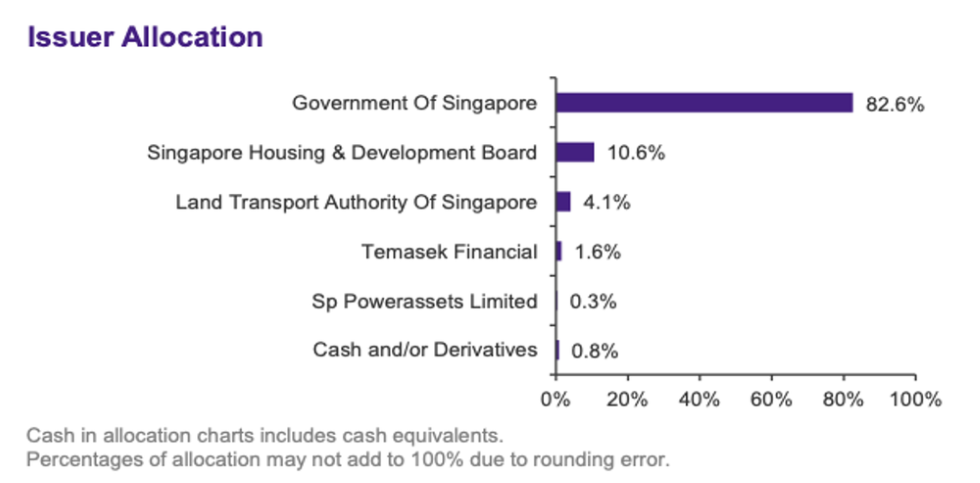
As of 30 September 2026, the fund's holdings are primarily made up of Singapore Government bonds, alongside bonds from Singapore government-related entities such as the Housing & Development Board and Land Transport Authority2.
Higher quality government and government-related bonds generally carry lower credit risk than corporate bonds, given the stronger credit quality of their issuers. As of 30 September 2026, ABF ETF had an average credit rating of AAA.¹
Through ABF ETF, investors can gain diversified exposure to a basket of high-quality Singapore dollar-denominated bonds with their SRS funds without having to purchase individual bonds themselves.
ABF ETF can provide a different source of potential investment returns through its portfolio of Singapore dollar-denominated bonds, which can help diversify an equity-heavy portfolio.
Learn more about the ABF Singapore Bond Index Fund (A35)
#2 – Amova SGD Investment Grade Corporate Bond Index ETF (MBH): Adding investment-grade credit exposure for potential income
For investors who want their SRS bond allocation to provide income potential while taking on more credit risk than Singapore government bonds, the Amova SGD Investment Grade Corporate Bond Index ETF (MBH), also known as IGCB ETF, is another option.
IGCB ETF seeks to track the performance of the iBoxx SGD Non-Sovereigns Large Cap Investment Grade Index, which aims to reflect the performance of Singapore dollar-denominated investment-grade non-sovereign bonds.
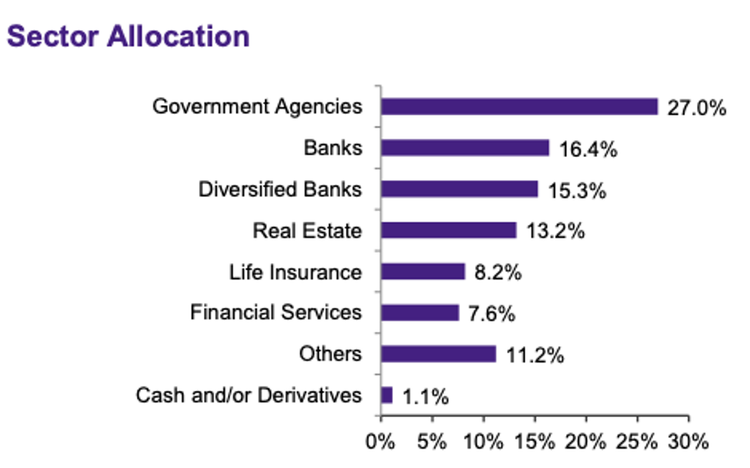
Only investment-grade bonds, with credit ratings ranging from AAA to BBB-, are eligible for inclusion in the index.
The index also applies investability and concentration criteria, including a minimum outstanding bond size of S$300 million and limits on exposure to individual issuers and affiliated groups.
Through IGCB ETF, investors can gain exposure to a diversified portfolio of bonds from issuers such as Temasek Financial, United Overseas Bank (UOB), HSBC and Singtel. ²
Corporate bonds typically offer higher yields4 than Singapore government bonds to compensate investors for taking on additional credit risk.
As a result, IGCB ETF provides a different source of potential income and risk from both equities and Singapore government bonds.
Individual corporate bonds can require substantial investment amounts, with many bonds commonly traded in denominations of S$250,000 or more.
By investing through IGCB ETF, investors can gain exposure to a diversified portfolio of investment-grade bonds in much smaller units, without having to purchase individual bonds themselves.
Learn more about the Amova SGD Investment Grade Corporate Bond Index ETF (MBH)
How do ABF and IGCB ETFs compare?
While both ETFs provide exposure to Singapore dollar-denominated bonds, their differences in their underlying holdings mean investors should evaluate them based on more than just their yields3.
ABF Singapore Bond Index Fund (A35) | Amova SGD Investment Grade Corporate Bond Index ETF (MBH) | |
| Main exposure | Primarily Singapore government and government-related SGD bonds | SGD-denominated investment-grade non-sovereign bonds |
| Benchmark | iBoxx ABF Singapore Index | iBoxx SGD Non-Sovereigns Large Cap Investment Grade Index |
| Average credit rating¹ | AAA | A |
| Weighted average yield to maturity³ | 2.54% p.a. | 3.17% p.a. |
| Weighted average duration6 | 8.18 years | 5.76 years |
| Management fee | 0.15% p.a. | 0.15% p.a. |
| Total expense ratio | 0.24% p.a. | 0.26% p.a. |
| Distribution frequency7 | Semi-annually, at the Manager's discretion | Semi-annually, at the Manager's discretion |
| SRS eligible | Yes | Yes |
| Source: Amova Asset Management Asia Limited, as of 30 September 2026. Total expense ratios are based on the audited financial period ended 30 June 2025. Management fees are included within the total expense ratios. | ||
ABF ETF offers higher credit quality but greater interest-rate sensitivity than IGCB ETF, which has a shorter duration6 and greater exposure to non-sovereign credit risk.
The choice depends on whether investors want to prioritise credit quality, potential income, interest-rate sensitivity or a combination of these objectives.
What risks should investors consider?
While bond ETFs can help diversify a portfolio and potentially reduce volatility, they are not risk-free.
Bond prices can fall when interest rates rise, particularly for longer-duration5 bonds such as those held by ABF ETF. IGCB ETF also carries greater credit risk due to its exposure to non-sovereign issuers.
Both ETFs can fluctuate in value, and investors may lose part of their investment. Neither ETF has a fixed maturity date, nor does it guarantee the return of invested capital. Their trading prices on SGX may also differ from their net asset values (NAV), and liquidity is not guaranteed.
While both ETFs have a semi-annual distribution frequency, distributions are not guaranteed and remain at the Manager's discretion. Distributions generally reduce the fund's NAV, and IGCB ETF may also pay distributions out of capital, which could reduce its value over time.7
How can you invest in ABF and IGCB ETFs using SRS?
Both ABF and IGCB ETFs are listed on SGX and are eligible for investment using SRS funds.
If you already have an SRS account with DBS, OCBC, or UOB, you may be able to invest in these ETFs through a brokerage platform that supports SRS-funded trades.
You would generally need to:
- Ensure your SRS account has sufficient available funds.
- Use a brokerage account that supports SRS investments and complete any required SRS account linkage.
- Search for ABF Singapore Bond Index Fund (A35) or Amova SGD Investment Grade Corporate Bond Index ETF (MBH).
- Select SRS as the funding source when placing your order, subject to your brokerage platform's procedures.
The tax treatment of SRS withdrawals depends on when and why they are made.
Under the usual rules, withdrawals before the retirement age applicable when you made your first SRS contribution are fully taxable and attract a 5% penalty. For qualifying withdrawals made at or after that age, only 50% of the amount withdrawn is subject to tax.
This is why it is important to consider when you expect to use your SRS savings before deciding how much to allocate to different investments.
What would Beansprout do?
When deciding how to invest my SRS savings, I would first consider when I expect to use the money, how much investment risk I am comfortable taking, and what other retirement assets I already have, including CPF savings and investments outside my SRS account.
While long-term growth remains important, I would also want part of my retirement portfolio to provide income and help manage market volatility, particularly as I get closer to retirement.
For instance, ABF ETF provides exposure to higher-credit-quality government and government-related bonds, while IGCB ETF offers investment-grade non-sovereign bond exposure with potentially higher yields3 but greater credit risk.
I may also consider combining both types of bond exposure to balance credit quality, potential income, and interest-rate sensitivity.
Beyond yield3, I would compare factors such as duration6, fees, and how each ETF complements my existing investments.
Ultimately, I would want my SRS portfolio to strike a balance between growing my retirement savings and managing the risk of market downturns.
This balance may also change over time, so I would review my allocation periodically as retirement approaches.
For investors looking to explore Singapore dollar-denominated bond ETFs for their SRS portfolios, you can learn more about the two Amova ETFs below:
Footnotes
¹Cash is included in the calculation of the average credit rating and is rated as AAA regardless of currencies held. The credit ratings of the underlying fixed-income securities are determined by S&P and/or Moody's, and where official credit ratings are unavailable, Amova Asia's internal credit ratings are used.
²Holdings as of 30 September 2026. Issuers mentioned are for illustration purposes only and should not be construed as recommendations for investment.
³Yield to maturity (YTM) of a bond is the average annualised rate of return expected if held to maturity. Weighted average YTM (%) is calculated by weighting the bonds with market capitalisation and duration. The figure is in local currency yield terms and on an unhedged foreign exchange basis. Weighted average YTM does not represent the fund's actual rate of return or distribution yield.
4Bond yield is a measure of the return from a bond based on its interest payments and current price, usually expressed as an annual percentage.
5Duration is a measure of a bond's sensitivity to interest-rate changes.
6 Duration is a measure of a bond's sensitivity to interest-rate changes. Weighted average duration (years) is weighted by the market value of each bond relative to the total portfolio market value. This figure is provided for reference only.
7Distributions are not guaranteed and are at the absolute discretion of the Manager. Any distribution is expected to result in an immediate reduction of the fund's NAV. For ABF ETF, distributions will only be paid to the extent available for distribution under the Trust Deed and covered by income received from the underlying investments. For IGCB ETF, distributions may be paid out of capital, which will result in capital erosion and a reduction in the fund's NAV, reflected in the redemption price of the units.
Disclaimer
The Central Provident Fund (“CPF”) Ordinary Account (“OA”) interest rate is the legislated minimum 2.5% per annum, or the 3-month average of major local banks' interest rates, whichever is higher, reviewed quarterly. The interest rate for Special Account (“SA”) is currently 4% per annum or the 12-month average yield of 10-year Singapore Government Securities plus 1%, whichever is higher, reviewed quarterly. Only monies in excess of $20,000 in OA and $40,000 in SA can be invested under the CPF Investment Scheme (“CPFIS”). Please refer to the website of the CPF Board for further information. Investors should note that the applicable interest rates for the CPF accounts and the terms of CPFIS may be varied by the CPF Board from time to time.
The performance of the ETF's price on the Singapore Exchange Securities Trading Limited (“SGX-ST”) may be different from the net asset value per unit of the ETF. The ETF may also be suspended or delisted from the SGX-ST. Listing of the units does not guarantee a liquid market for the units. Investors should note that the ETF differs from a typical unit trust and units may only be created or redeemed directly by a participating dealer in large creation or redemption units.
This document is purely for informational purposes only with no consideration given to the specific investment objective, financial situation and particular needs of any specific person. It should not be relied upon as financial advice. Any securities mentioned herein are for illustration purposes only and should not be construed as a recommendation for investment. You should seek advice from a financial adviser before making any investment. In the event that you choose not to do so, you should consider whether the investment selected is suitable for you. Investments in funds are not deposits in, obligations of, or guaranteed or insured by Amova Asset Management Asia Limited (“Amova Asia”).
Past performance or any prediction, projection or forecast is not indicative of future performance. The Fund or any underlying fund may use or invest in financial derivative instruments. The value of units and income from them may fall or rise. Investments in the Fund are subject to investment risks, including the possible loss of principal amount invested. You should read the relevant prospectus (including the risk warnings) and product highlights sheet of the Fund, which are available and may be obtained from appointed distributors of Amova Asia or our website (https://sg.amova-am.com) before deciding whether to invest in the Fund.
The information contained herein may not be copied, reproduced or redistributed without the express consent of Amova Asia. While reasonable care has been taken to ensure the accuracy of the information, Amova Asia does not give any warranty or representation, either express or implied, and expressly disclaims liability for any errors or omissions. Information may be subject to change without notice. Amova Asia accepts no liability for any loss, indirect or consequential damages, arising from any use of or reliance on this document. This advertisement has not been reviewed by the Monetary Authority of Singapore.
Amova Asset Management Asia Limited. Registration Number 198202562H.
Read also
Gain financial insights in minutes
Subscribe to our free weekly newsletter for more insights to grow your wealth
Most Popular

Comments
0 comments