
Beyond AI: The ASEAN Companies Building the Region's Data Centre Backbone
Stocks
Powered by

By Gerald Wong, CFA • 24 Nov 2026
Why trust Beansprout? We’ve been awarded Best Investment Website at the SIAS Investors’ Choice Awards
Explore ASEAN’s growing data-centre boom, the listed companies benefiting from AI and cloud demand, and key risks investors should consider.
AI may be driving the headlines, but behind every AI model, cloud application and digital service is a growing amount of physical infrastructure.
Data centres provide the computing capacity needed to store, process and move data.
Demand is rising as businesses across Southeast Asia adopt cloud services, digitalise their operations and increasingly use artificial intelligence.
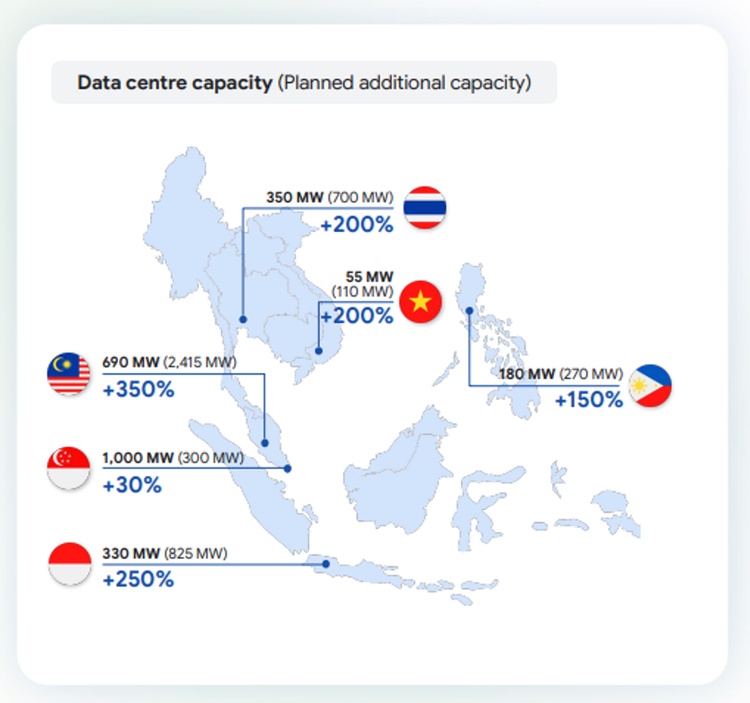
The scale of the buildout is significant. According to the e-Conomy SEA 2025 report by Google, Temasek and Bain & Company, Southeast Asia had about 4,620 megawatts (MW) of additional data-centre capacity planned as of the first half of 2025.
If completed, this would increase the region's capacity by around 180%, faster than the 120% growth projected for the rest of Asia-Pacific.
But the opportunity goes beyond companies operating the facilities themselves.
Every new data centre requires land, electricity, cooling, water and high-speed connectivity.
This creates potential opportunities across industrial-property developers, utilities, telecommunications companies and digital-infrastructure operators.
In this article, we look at what is driving ASEAN's data-centre boom, where capacity is being built, and the listed companies helping to build the infrastructure behind the region's digital economy.
Why is ASEAN seeing a data-centre boom?
Several structural trends are increasing the amount of computing capacity required across Southeast Asia.
#1 - ASEAN's digital economy continues to grow
More of Southeast Asia's economy is moving online.
According to the e-Conomy SEA 2025 report, Southeast Asia's digital economy was expected to surpass US$300 billion in gross merchandise value (GMV) in 2025.
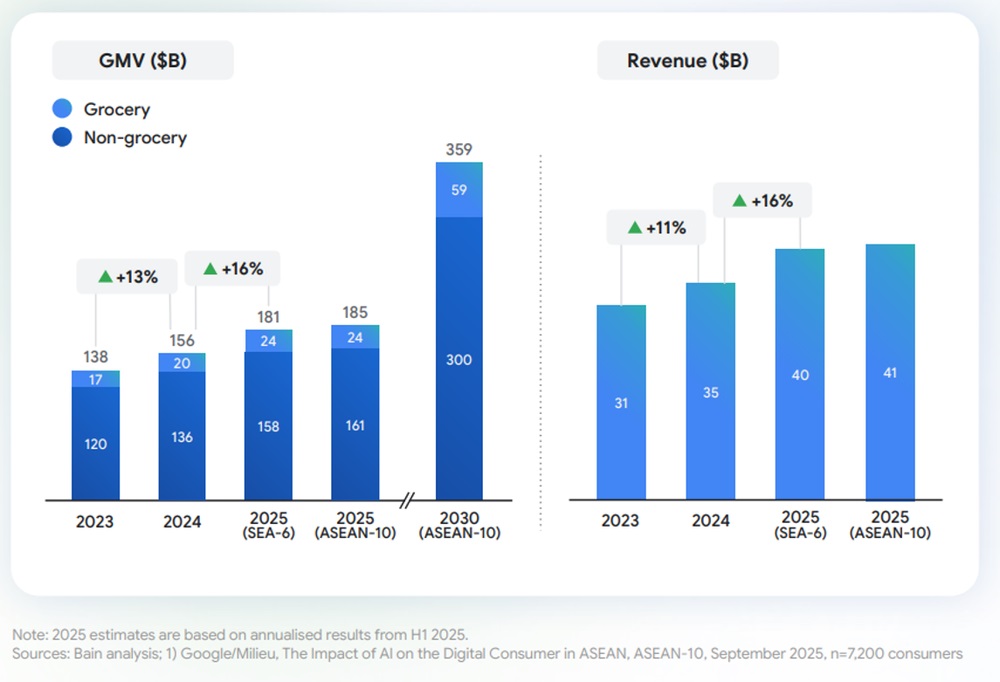
Over the past decade, more than 200 million people in the region have come online, while e-commerce, digital payments and other online services have become increasingly embedded in everyday life.
At the same time, businesses are moving more applications and IT workloads onto cloud platforms. Instead of every company maintaining its own computing infrastructure, cloud providers can operate large-scale facilities serving many customers.
This means data-centre demand was already increasing before the recent surge in generative AI.
#2 - AI is increasing the amount of computing power required
Artificial intelligence is adding another layer of demand.
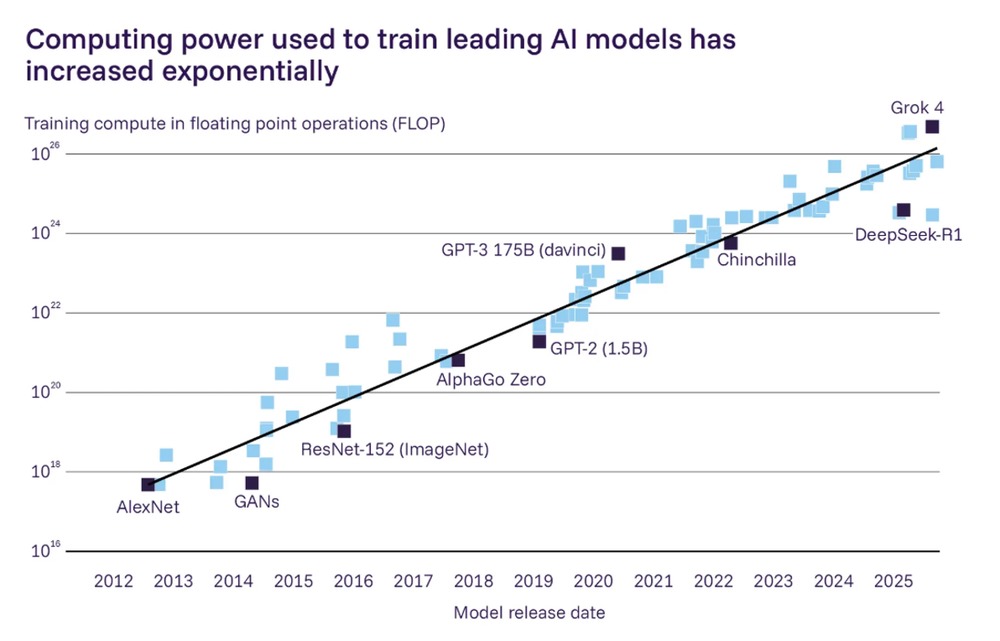
Training and running increasingly sophisticated AI models requires large amounts of computing power.
It can also require facilities capable of supporting much higher power density than traditional computing workloads.
The ASEAN Guide for Sustainable Data Centre Development notes that power consumption per rack could increase from around 8 kilowatts in 2021 to as much as 50 kilowatts by 2027 as facilities support more compute-intensive workloads.
This creates demand not just for additional data-centre space, but also for facilities that can provide sufficient electricity and cooling for increasingly powerful equipment.
#3 - Data centre capacity is spreading beyond Singapore
Singapore has long been Southeast Asia's main data-centre hub, supported by strong international connectivity and its position as a regional business and technology centre.
It has more than 1.4 gigawatts of capacity and over 70 cloud, enterprise and colocation facilities. Singapore is still expanding, with its Green Data Centre Roadmap targeting at least another 300 MW of capacity in the near term.
However, data centres require large amounts of land, electricity and water.
As demand grows, developers are increasingly looking at neighbouring ASEAN markets where these resources may be more readily available.
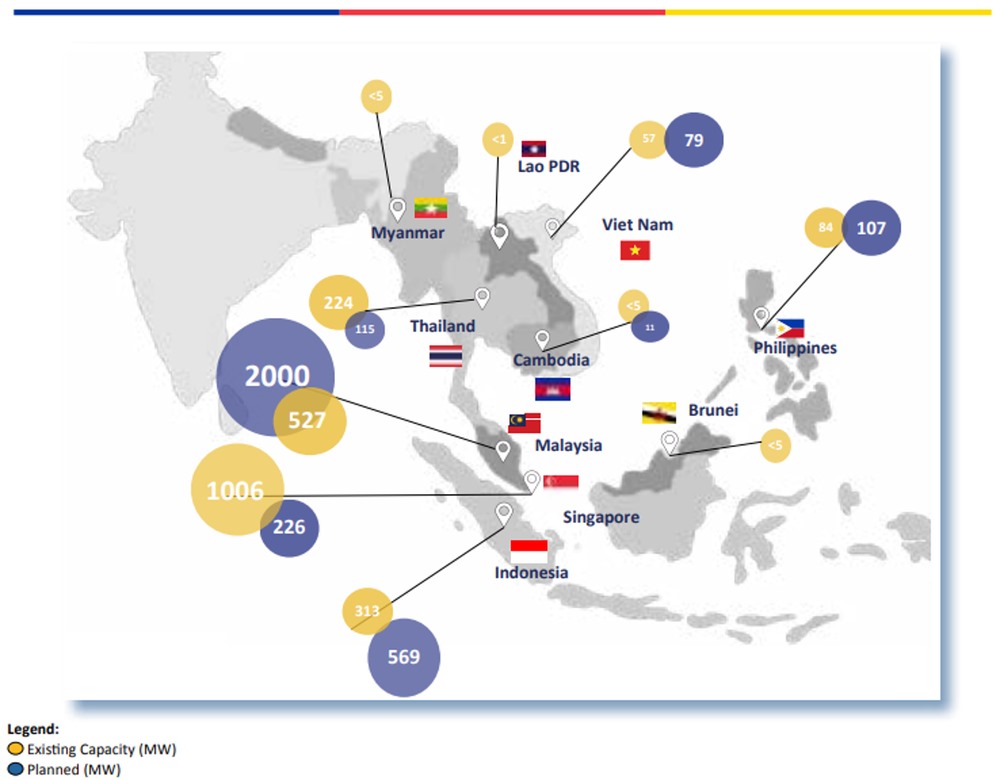
Johor has been one of the biggest beneficiaries. Its proximity to Singapore allows operators to tap into Singapore's digital ecosystem while accessing more land and power for large campuses.
Other markets are also developing for their own reasons. Indonesia has a large domestic digital economy, Thailand is attracting new hyperscale investment, and major telecommunications groups in the Philippines are expanding data-centre infrastructure.
Vietnam is similarly investing in domestic cloud and computing capacity.
Data localisation requirements can further support this trend by encouraging businesses to maintain infrastructure within individual markets rather than serving the entire region from Singapore.
As a result, ASEAN's data-centre story is becoming increasingly regional rather than being concentrated in a single hub.
Who actually benefits when a data centre gets built?
For investors, the opportunity is broader than data-centre operators.
Before a server begins processing data, a facility needs suitable land, reliable electricity, cooling, water and high-speed fibre connections.
| Part of the backbone | Why it is needed | How listed companies may participate |
| Data-centre facilities | House servers and provide power, cooling and physical infrastructure | Operators and data-centre REITs |
| Industrial land | Large sites close to power, water and fibre infrastructure | Industrial-estate and property developers |
| Power and cooling | Servers operate continuously, while AI increases power density | Utilities and power producers |
| Connectivity | Data needs to move quickly between centres, businesses and users | Telcos and fibre-network operators |
Some companies participate in more than one part of this value chain.
A power producer, for example, may supply electricity to data-centre customers while also developing its own facilities. A telecommunications group may provide fibre connectivity while operating a data-centre subsidiary.
This is why the companies benefiting from ASEAN's data-centre boom may not necessarily look like technology companies.
However, the type of exposure also matters. A dedicated operator may derive most of its revenue from data centres, while for a diversified utility, telco or property company, the theme may still represent only a small part of its overall earnings.
Where are the investment opportunities in ASEAN's data-centre buildout?
The companies below are shared for educational purposes only and do not constitute investment recommendations.
Singapore: Established operators with regional ambitions
Singapore offers some of the region's more established listed data centre exposure.
Keppel DC REIT (SGX: AJBU) is one of the more direct examples.
The REIT owns data-centre assets across Asia-Pacific and Europe, including Singapore. As of 30 June 2026, portfolio occupancy stood at 92.5%, with a weighted average lease expiry of 6.7 years by lettable area.
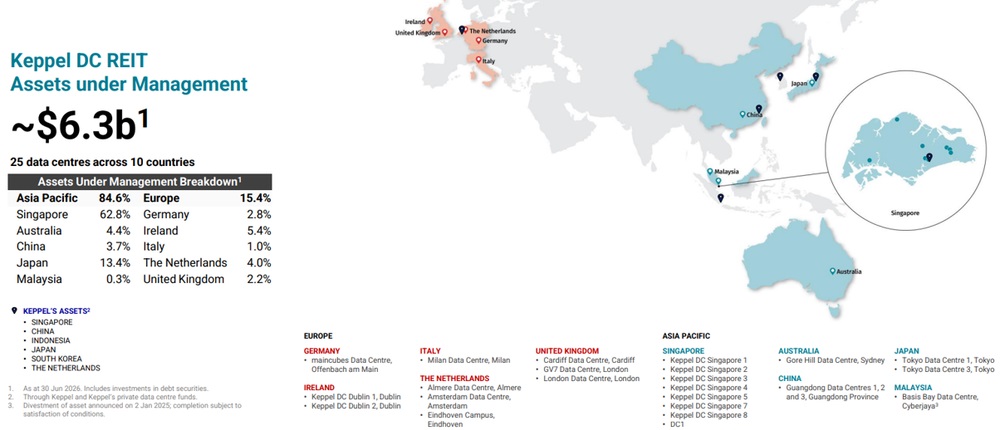
This provides exposure to rental income from existing data-centre assets, although its geographical footprint means it is not a pure ASEAN play.
Other Singapore-listed REITs also provide exposure to data-centre assets.
Examples such as Digital Core REIT (SGX: DCRU) and NTT DC REIT (SGX: NTDU) are also dedicated data-centre REITs with assets across Singapore, North America, Europe and Asia-Pacific.
Meanwhile, Mapletree Industrial Trust (SGX: ME8U) and CapitaLand Ascendas REIT (SGX: A17U) hold data centres in Singapore and overseas alongside other industrial and business-space properties, providing more diversified property exposure.
Singtel (SGX: Z74) participates through its regional data-centre arm, Nxera. Nxera opened its 58 MW DC Tuas facility in February 2026, bringing its Singapore capacity to 120 MW.
More than 90% of DC Tuas had already been committed before launch.
Nxera is also expanding through partnerships in Malaysia, Indonesia and Thailand, giving Singtel exposure to the broader regional buildout.
In September 2026, Singtel, through a KKR-Singtel consortium, completed its acquisition of STT GDC, which further raised its data centre exposure by 780 MW and a pipeline of over 1.7 GW in development.
Keppel Ltd (SGX: BN4) also participates across several parts of the data-centre value chain, including developing and operating facilities, power generation and subsea connectivity.
Its energy infrastructure includes the Keppel Sakra Cogen Plant, which commenced operations in May 2026. Keppel is also a joint-build partner in the Bifrost Cable System, providing high-capacity connectivity between Southeast Asia and North America.
CSE Global (SGX: 544) provides data-centre electrification solutions, including switchgear, power-distribution panels and prefabricated electrical systems. These help distribute electricity reliably to computing equipment.
InnoTek (SGX: M14) participates through precision manufacturing for GPU servers and related rack components including receiving recommended-vendor approvals from NVIDIA and server infrastructure provider IEIT Systems in September 2025 which provide exposure to the physical components supporting AI computing equipment.
Boustead Singapore (SGX: F9D) offers exposure through the engineering and construction business under Boustead Projects. In November 2024, the group announced a contract worth approximately RM300 million to construct a data centre in Malaysia, including its substation, pumphouse and cooling systems. Its role illustrates the opportunities for companies that design and build the facilities.
These examples illustrate Singapore’s broad exposure to the data centre value chain from REITs to power, connectivity, hardware, and more.
Malaysia: From power generation to hyperscale campuses
Malaysia has emerged as one of ASEAN's biggest data-centre expansion markets.
YTL Power International (Bursa: YTLPOWR) combines power infrastructure with direct data-centre exposure.
As of May 2026, it had 298 MW of contracted data-centre capacity and was planning to expand its YTL Green Data Center Park in Johor from 600 MW to 1,000 MW.
Data centres are also becoming more meaningful financially. For the financial year ended June 2026, YTL Power's data-centre segment generated RM867 million in revenue and RM345 million in profit before tax.
Telekom Malaysia (Bursa: TM) participates through TM Nxera, its joint venture with Singtel's Nxera.
Its AI-ready campus in Iskandar Puteri, Johor, has secured 280 MW of power supply from Tenaga Nasional and can eventually scale to more than 200 MW of data-centre capacity.
Together, these companies illustrate how Malaysia's opportunity spans both the data-centre facilities themselves and the infrastructure required to support them.
Indonesia: Serving a large domestic digital market
Indonesia's large population and growing digital economy create a different opportunity.
DCI Indonesia (IDX: DCII) provides relatively direct exposure. The company operates nine data centres across five locations, with 132 MW of shell capacity and more than 2,000 MW of potential capacity across its sites.
Its customers include cloud providers, telecommunications companies and enterprises.
Telkom Indonesia (IDX: TLKM) participates through NeutraDC. As of the first half of 2026, NeutraDC had 49.9 MW of effective capacity, while its Cikarang hyperscale data centre had reached 96% occupancy. NeutraDC's revenue also grew 11% year-on-year to Rp867 billion during the period.
The two companies provide contrasting exposure through a dedicated operator and a broader telecommunications group.
Thailand: Data centres create demand for power and land
Thailand shows particularly clearly why the theme extends beyond technology companies.
Gulf Development (SET: GULF) comes from the energy side of the ecosystem but is investing directly in digital infrastructure.
Its 25 MW GSA01 data centre is operational, while a 38 MW second facility and another project with capacity of up to 100 MW are under development. GULF aims to expand total data-centre capacity to 300–500 MW over the next three to five years.
Meanwhile, WHA Corporation (SET: WHA) provides exposure through industrial land. In the first quarter of 2026, WHA reported that a major data-centre operator had agreed to acquire more than 900 rai of land in one of its industrial estates.
For WHA, the opportunity is therefore not about operating servers. It lies in providing the industrial land and infrastructure that large data-centre campuses require.
Vietnam: Building domestic cloud and computing infrastructure
Vietnam starts from a smaller data-centre base, but local technology groups are increasing their investments.
FPT Corporation (HOSE: FPT), through its associate FPT Telecom, operates four large-scale data centres across Hanoi and Ho Chi Minh City, with combined capacity of more than 7,000 racks. Its newest facility, FPT Fornix HCM02, opened in August 2025 with capacity for 3,600 racks.
CMC Corporation (HOSE: CMG) received approval in 2025 to develop a new hyperscale facility at Saigon Hi-Tech Park, with investment of more than US$250 million. The initial phase is planned for 30 MW, with potential to expand beyond 100 MW.
Vietnam's opportunity is closely linked to the development of domestic cloud, AI, and digital infrastructure as its digital economy expands.
Philippines: Telcos are leading the buildout
In the Philippines, some of the largest listed exposure comes through telecommunications groups.
PLDT (PSE: TEL) owns VITRO through its digital subsidiary ePLDT. Its flagship VITRO Sta. Rosa facility is a 50 MW hyperscale data centre, with 36 MW of IT capacity.
PLDT also filed in June 2026 for a proposed listing of VITRO REIT, which would initially hold stabilised, income-generating data-centre assets. The proposed IPO remains subject to regulatory approvals and market conditions.
Globe Telecom (PSE: GLO) participates through ST Telemedia Global Data Centres Philippines, its joint venture with STT GDC and Ayala Corporation.
Its Fairview campus has a planned design capacity of 124 MW, while the group's operating capacity is expected to exceed 30 MW by the end of 2026 as its Fairview and Cavite facilities ramp up.
Across these markets, the opportunity therefore ranges from relatively direct data-centre exposure to companies supplying the power, land and connectivity required to support the buildout.
What should investors pay attention to?
The size of a company's data-centre pipeline can be eye-catching, but planned capacity alone does not tell investors how much value a project may eventually create.
Here are four areas worth considering.
#1 - Operating capacity matters more than headline pipeline
Companies may disclose operating capacity, facilities under construction, and potential capacity from sites that could be expanded years into the future.
These figures should not be treated as equivalent.
A facility that is already operating and largely contracted provides greater revenue visibility than a project that is still waiting for construction, power connections or customers.
For example, more than 90% of Singtel Nxera's new DC Tuas capacity had been committed before launch, while Telkom Indonesia reported 96% occupancy at its Cikarang hyperscale facility.
Meanwhile, DCI Indonesia has a pipeline of more than 2,000 MW of potential capacity, but currently operates 132 MW of shell capacity.
Investors should therefore distinguish between operating, contracted, under-construction and longer-term potential capacity.
This is particularly important given the size of ASEAN's development pipeline.
If capacity grows faster than customer demand, operators could face lower occupancy, weaker pricing or longer periods before new projects generate adequate returns.
#2 - Can the project secure enough power and cooling?
A data centre cannot operate without reliable electricity.
As facilities become larger and AI workloads increase power density, access to grid capacity can become a major constraint on development.
Water and cooling may also matter depending on the technology used.
For example, Thailand's WHA Utilities & Power has said data-centre customers can consume 12 to 16 times more water than conventional businesses, highlighting how the industry's growth can create additional utility requirements.
Technical requirements are also evolving. Higher-density AI equipment can require more advanced cooling and electrical infrastructure, meaning older facilities may need upgrades to remain competitive.
This means investors should consider not just the number of megawatts available, but also the quality and technical capabilities of that capacity.
#3 - How much capital is required, and who are the customers?
Data centres require significant upfront investment in land, construction, power systems, cooling and connectivity.
Large pipelines can therefore translate into large capital-expenditure and financing requirements.
If a facility takes longer than expected to fill, returns on that investment may take longer to materialise.
Investors should consider the company's debt levels, funding structure, and ability to expand in phases as customer demand emerges.
Customer concentration is another consideration.
Large hyperscalers can provide long-term contracts and quickly fill new facilities, but reliance on one or two major customers can also increase risk if they slow expansion, renegotiate contracts, or move workloads elsewhere.
#4 - Is the exposure meaningful to the company's earnings?
This is especially important when assessing ASEAN data-centre plays.
For dedicated operators, data centres may represent most of the business. For telecommunications, power or property groups, they may sit alongside much larger existing operations.
A large data-centre announcement therefore does not necessarily mean the theme will materially change a company's financial performance.
YTL Power provides one example of how investors can assess this transition. The group began reporting data centres as a separate operating segment after contributions increased as new facilities were completed and occupied.
For the financial year ended 2026, its data-centre segment generated RM867 million in revenue and RM345 million in profit before tax.
However, the company’s total revenue and profit before tax were RM22,200 million and RM2,398 million respectively.
For diversified companies, investors can therefore look at whether data-centre revenue and earnings are being separately disclosed and whether the business has become large enough to affect overall group performance.
Taken together, these factors can help distinguish between companies already benefiting financially from ASEAN's data-centre buildout and those whose exposure remains primarily based on future plans.
Putting ASEAN's data-centre opportunity into perspective
ASEAN's data-centre buildout is a long-term infrastructure story, but it is not a single investment opportunity.
Singapore offers established operators and income-generating assets. Malaysia is seeing a major wave of hyperscale development, while Indonesia combines domestic digital demand with dedicated operators. Thailand's buildout is creating opportunities around power and industrial land, while Vietnam and the Philippines are expanding domestic digital infrastructure through technology and telecommunications groups.
For investors, the key question is therefore not simply which country will build the most data centres.
It is where value is being created across the infrastructure chain, and whether that exposure is already meaningful to a company's earnings.
Strong growth in cloud computing, AI and digital services may require significantly more infrastructure across Southeast Asia. But strong industry growth does not automatically translate into strong investment returns.
Investors should still consider each company's utilisation, customer commitments, funding requirements, execution track record and valuation before making an investment decision.
More information about ASEAN Exchanges can be found here.
Follow Beansprout on YouTube, Facebook and Instagram, and add Beansprout as your preferred source on Google so you never miss an update.
Read also
Gain financial insights in minutes
Subscribe to our free weekly newsletter for more insights to grow your wealth
Most Popular

Comments
0 comments