
DBS profit falls 5% in 3Q26 on lower trading income and declares S$0.81 in total dividends: Our Quick Take
Stocks
By Gerald Wong, CFA • 04 Nov 2026
Global Wealth Technology Pte. Ltd. is regulated by the Monetary Authority of Singapore (MAS) as a licensed Financial Adviser.

Make Beansprout your preferred source on Google
Add us on Google to see more of our insights in your search results
DBS reported a 5% drop in 3Q26 net profit to S$2.81 billion as weaker markets trading income offset franchise momentum, while maintaining its 3Q26 total dividend of S$0.81.
DBS 3Q26 earnings and dividend highlights
DBS has announced its earnings for the third quarter of 2026. Key highlights include:
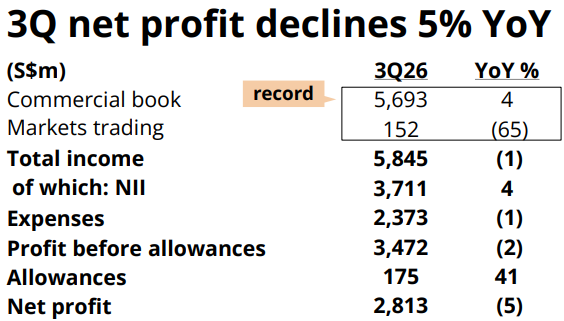
- 3Q 2026 net profit: SGD 2.81 billion (-5% year-on-year, -9% quarter-on-quarter), missing the S$2.95 billion consensus forecast
- 3Q 2026 total income: SGD 5.85 billion (-1% year-on-year, -4% quarter-on-quarter)
- 9M 2026 net profit: SGD 8.82 billion (+2% year-on-year), a new record
- 9M 2026 total income: SGD 17.9 billion (+2% year-on-year), a new high
- 9M Return on equity: 17.0%
- Interim dividend of 66 cents per share for 3Q 2026
- Capital Return dividend of 15 cents per share for 3Q 2026
What we learnt from DBS 3Q26 earnings
#1 - Net profit declines on weaker markets trading income
3Q26 net profit fell 5% year-on-year to S$2.81 billion, as a sharp drop in markets trading income more than offset stronger net interest income, higher fees and record treasury customer sales.
Compared to the previous quarter, net profit was 9% lower.
Markets trading income fell 65% year-on-year (and 68% quarter-on-quarter) to S$152 million, as unfavourable equity market conditions weighed on trading performance.
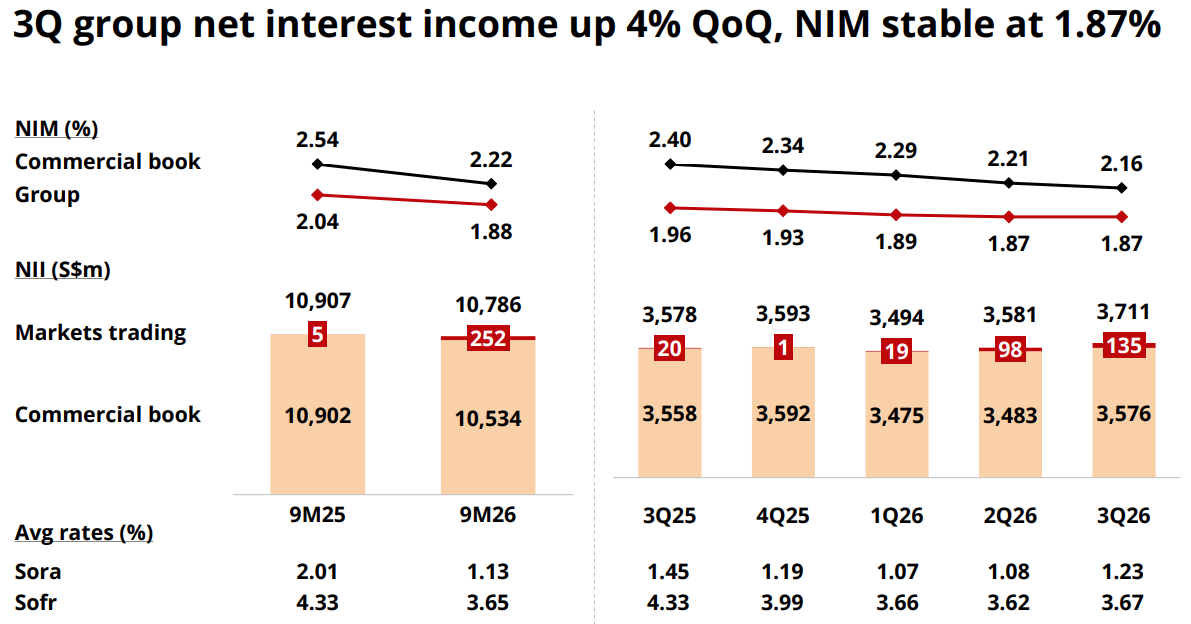
Group net interest income rose 4% year-on-year to S$3.71 billion as proactive hedging and strong balance sheet growth more than offset the impact of lower SORA.
Group net interest margin (NIM) narrowed nine basis points year-on-year to 1.87% but was stable quarter-on-quarter.
Management noted that net interest income has passed the trough, with the exit NIM at 1.90%.
Loans grew S$46 billion (+11% year-on-year) in constant-currency terms to S$479 billion, led by growth in non-trade corporate lending.
On a quarter-on-quarter basis, loans expanded 3% or S$13 billion.
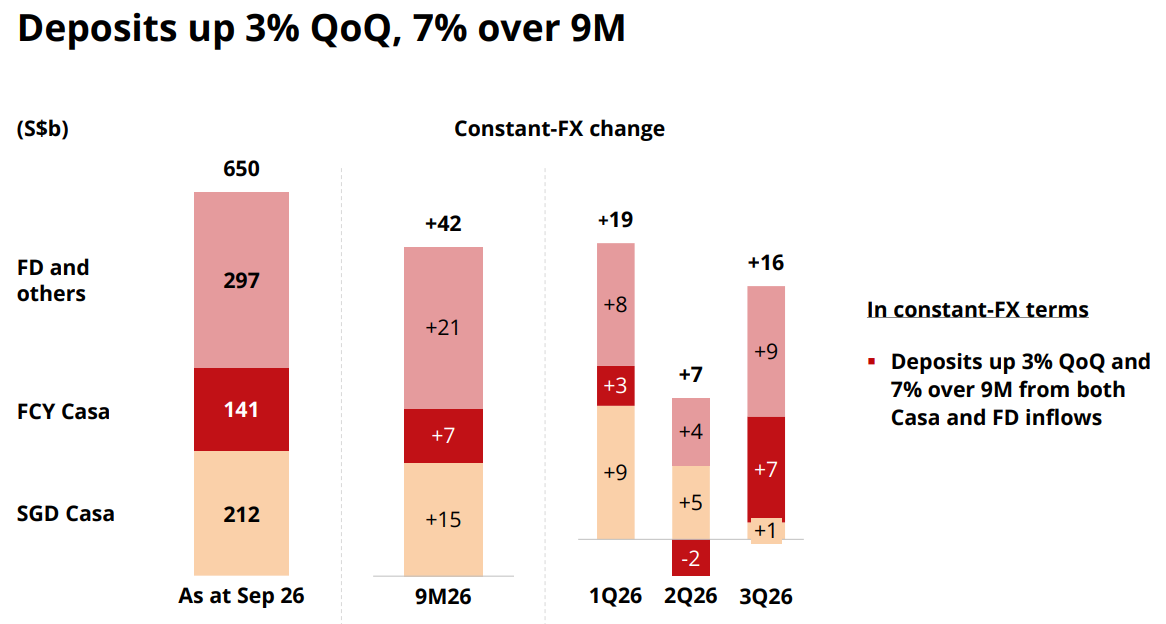
Deposits rose S$58 billion (+10% year-on-year) to S$650 billion, led by CASA growth.
On a quarter-on-quarter basis, deposits grew 3% or S$16 billion, with inflows across both CASA and fixed deposits..
#2 - Wealth segment AUM at record S$544 billion despite moderating customer activity
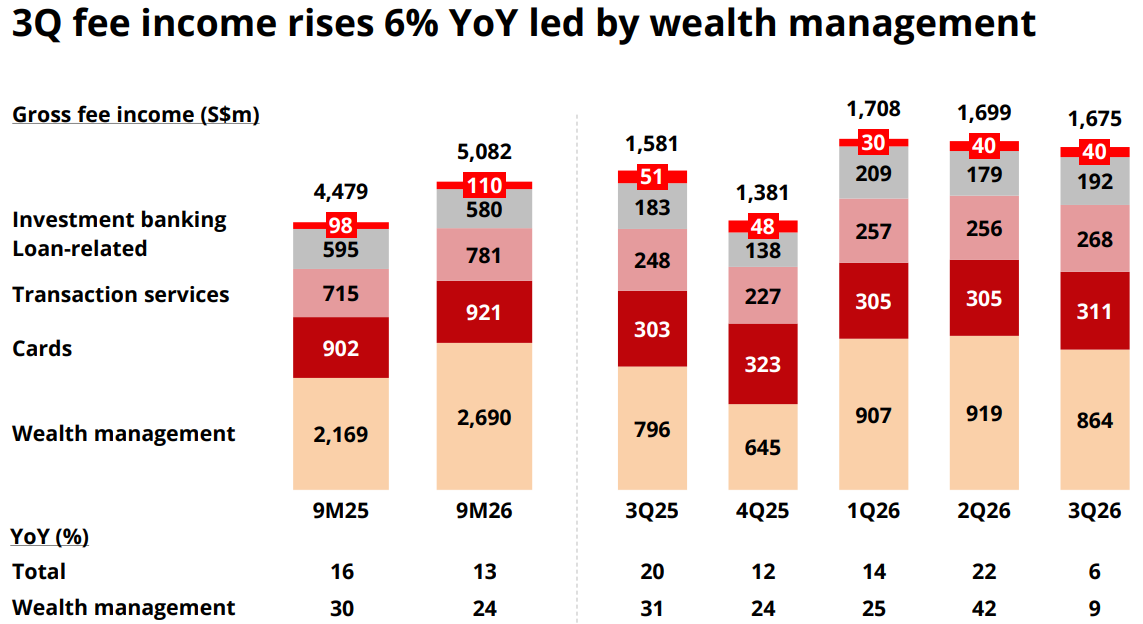
Net fee income rose 6% year-on-year to S$1.43 billion in 3Q26, easing 2% from the record 2Q26 level.
Wealth management fees grew 9% year-on-year to S$864 million, supported by growth in assets under management, though fees declined 6% quarter-on-quarter as customer investment activity moderated from a strong second quarter.
Wealth segment assets under management rose to a new high of S$544 billion, up 16% year-on-year in constant-currency terms and 5% from the previous quarter, driven by record net new money inflows.
Transaction services fees reached a new high, while loan-related and card fees also increased.
Commercial book other non-interest income grew 19% year-on-year to S$685 million, driven mainly by higher treasury customer sales.
#3 - Asset quality improves, NPL ratio falls to 0.9%
DBS’ non-performing loan (NPL) ratio improved to 0.9% from 1.0% in the previous quarter.
Non-performing assets fell 3% quarter-on-quarter to S$4.63 billion, as new NPA formation was more than offset by repayments and write-offs.
Specific allowances were S$191 million in 3Q26 (or 17 basis points of loans), bringing the nine-month total to S$536 million or 16 basis points, within management’s guided range.
Allowance coverage stood at 134% (or 202% after considering collateral).
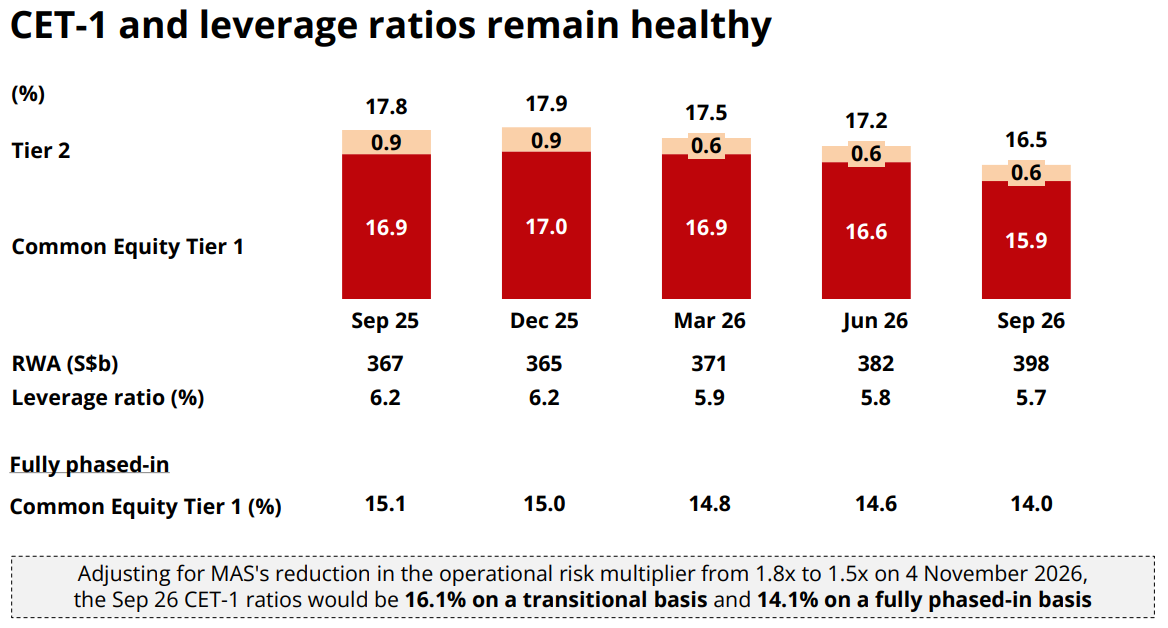
The reported Common Equity Tier-1 ratio was 15.9% based on transitional arrangements, while the pro-forma ratio on a fully phased-in basis was 14.0%.
Separately, the Monetary Authority of Singapore reduced DBS’ operational risk multiplier from 1.8 times to 1.5 times on 4 November 2026, following progress in strengthening technology and operational risk controls.
Adjusting for this, the CET-1 ratios at 30 September 2026 would have been 16.1% (transitional) and 14.1% (fully phased-in).
#4 - Dividend maintained at 81 cents per quarter
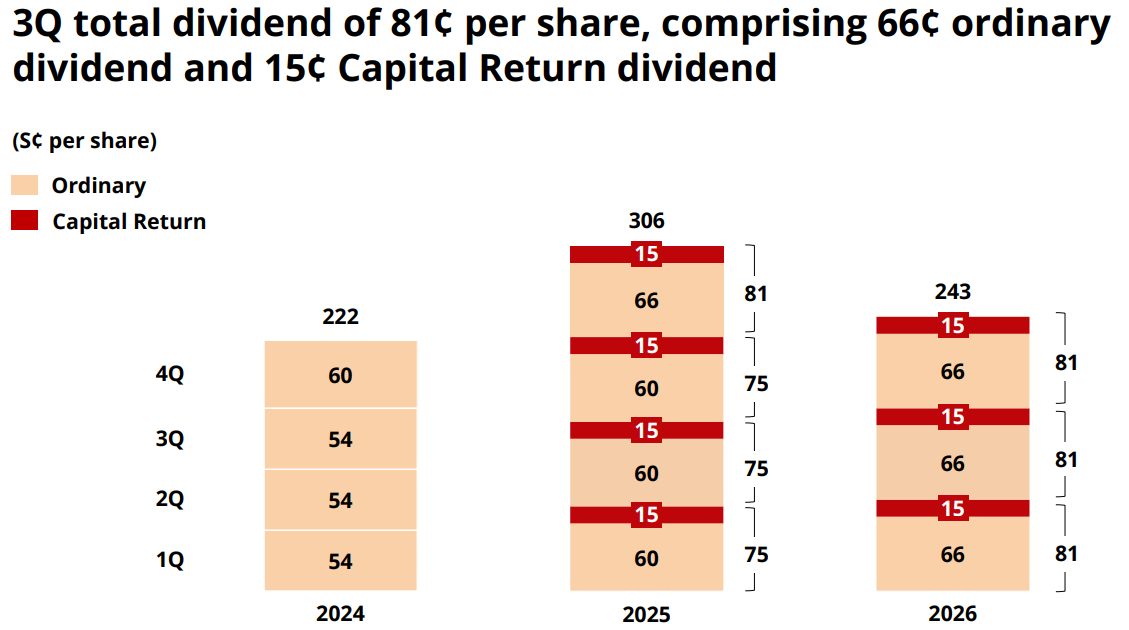
The board declared an interim dividend of SGD 66 cents per share and a Capital Return dividend of SGD 15 cents per share for 3Q 2026, in line with the previous quarter.
This brings the 9M 2026 total to S$1.98 per share in ordinary dividends and S$0.45 per share in Capital Return dividends, or S$2.43 per share in aggregate.
Management has previously reaffirmed that the Capital Return dividend of 15 cents per quarter will be maintained through 2026 and 2027.
#5 - 2027 guidance for mid-single-digit total income growth; chairman succession announced
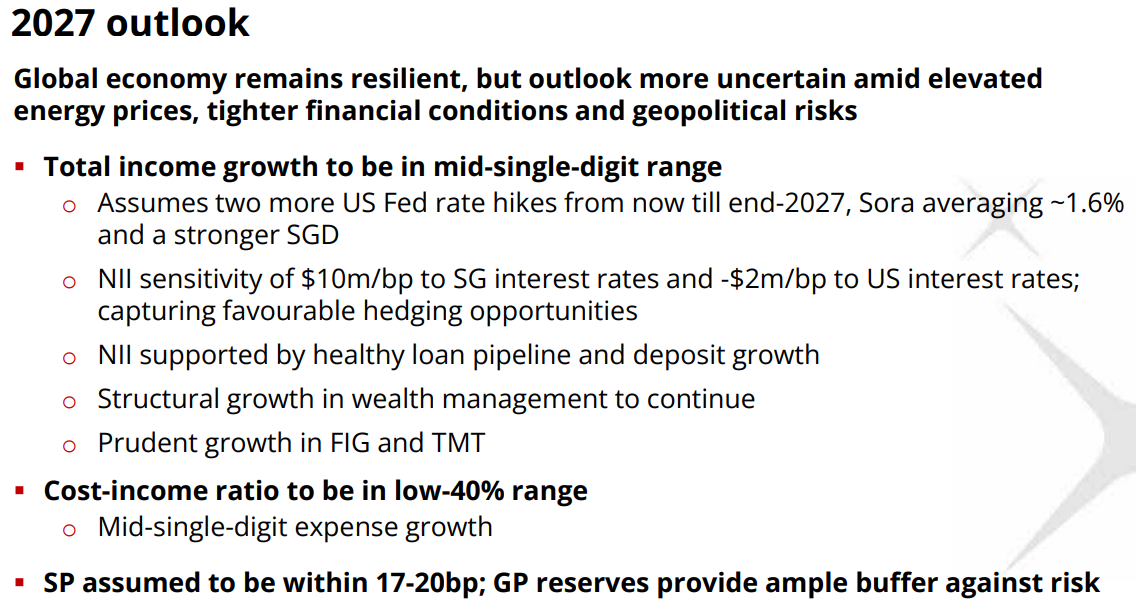
DBS guided for FY2027 total income growth to be in the mid-single-digit range.
The outlook assumes two more US Fed rate hikes from now till end-2027, SORA averaging around 1.6% and a stronger Singapore dollar.
Net interest income is expected to be supported by a healthy loan pipeline, continued deposit growth and favourable hedging opportunities.
Structural growth in wealth management is expected to continue, with prudent growth in financial institutions group (FIG) and technology, media and telecommunications (TMT) businesses.
The cost-income ratio is expected to remain in the low-40% range, with mid-single-digit expense growth.
Specific provisions are assumed at 17–20bp, with general provision reserves providing an ample buffer against risk.
CEO Tan Su Shan noted that while the global economy has remained resilient, the outlook has become more uncertain amid elevated energy prices, tighter financial conditions and geopolitical risks.
“As we enter 2027, we will stay nimble to capture opportunities while prudently managing risks,” she said.
Separately, DBS announced that Peter Seah will retire as chairman of the board after 16 years in the role, with current board member Anthony Lim succeeding him from 1 January 2027.
Beansprout’s Quick Take on DBS earnings
DBS reported a mixed set of results for 3Q26, with net profit declining 5% year-on-year to S$2.81 billion and missing the S$2.95 billion consensus forecast.
A 65% drop in markets trading income on unfavourable equity market conditions more than offset stronger net interest income, higher fees and record treasury customer sales.
Looking through the quarterly noise, underlying business momentum remained healthy.
Wealth segment assets under management reached a new high of S$544 billion on record net new money inflows, while loans and deposits grew 3% quarter-on-quarter.
Group net interest income rose 4% year-on-year and management flagged that net interest income has passed the trough, with the exit NIM at 1.90%.
Asset quality also improved, with the NPL ratio falling to 0.9% from 1.0%, and the MAS’ reduction of DBS’ operational risk multiplier provides a modest boost to capital ratios.
For FY2027, management guided for total income growth in the mid-single-digit range, with the outlook now assuming two more Fed rate hikes rather than cuts, reflecting a less dovish rate backdrop.
DBS declared a 3Q total dividend of 81 cents, which translates to an annualised total dividend per share of $3.24.
Based on the closing price of S$70.78 (as of 5 November 2026), this implies a dividend yield of about 4.6%.
DBS currently trades at a price-to-book valuation of about 2.9x, above its historical average of 1.6x.
Want to see how DBS stacks up against OCBC and UOB on valuation, dividend yield and returns? Try Beansprout’s stock comparison tool here.
DBS is one of the stocks in Beansprout’s Opportunity Pot Portfolio, where our analyst team highlights the opportunities we believe stand out in the market today. See the stocks in the portfolio, how much we allocate to each, and what we are watching next.
Related links:
Check out Beansprout's guide to the best stock trading platforms in Singapore with the latest promotions to invest in DBS.
Follow us on Telegram, Youtube, Facebook and Instagram to get the latest financial insights.
Read also
Gain financial insights in minutes
Subscribe to our free weekly newsletter for more insights to grow your wealth
Most Popular

Comments
0 comments