
Gain access to 2 new China semiconductor and robotics ETFs on SGX: How do SMC and RBZ compare?
ETFs
Powered by

By Nicole Ng • 27 Nov 2026
Why trust Beansprout? We’ve been awarded Best Investment Website at the SIAS Investors’ Choice Awards
Explore two new China semiconductor and robotics ETFs on SGX. Learn how SMC and RBZ differ, their key holdings, fees, risks, and how to invest.
This post was created in partnership with FSM Global. All views and opinions expressed in this article are Beansprout’s objective and professional opinions.
What happened?
China's AI development is extending beyond models and software into the chips that power computing and the robots that bring AI into physical applications.
Singapore investors will soon have two new ways to access these industries through exchange-traded funds (ETFs) from iFAST and China Asset Management (ChinaAMC):
- iFAST ChinaAMC CNI Semiconductor Chips Index ETF (SGX: SMC)
- iFAST ChinaAMC CSI Robot Index ETF (SGX: RBZ)
Both ETFs are open for subscription during their Initial Offer Period (IOP) from 10 to 27 November 2026, ahead of their scheduled SGX listing on 7 December 2026.
Following listing, they will trade in SGD and be eligible for investment using SRS funds.
While both are linked to China's AI ecosystem, they invest in different businesses. Here's how they compare and what investors should consider.
A quick summary of the 2 new iFAST ChinaAMC ETFs
| Feature | SMC | RBZ |
| Full name | iFAST ChinaAMC CNI Semiconductor Chips Index ETF | iFAST ChinaAMC CSI Robot Index ETF |
| Index tracked | CNI Semiconductor Chips Index | CSI Robot Index |
| Investment exposure | 30 companies across China's semiconductor supply chain | Companies across China's robotics and automation value chain |
| Expected overall TER | 0.64% p.a. | 0.64% p.a. |
| Trading currency | SGD | SGD |
| SRS eligibility | Yes, from listing | Yes, from listing |
| SGX listing date | 7-Dec-26 | 7-Dec-26 |
| Source: iFAST ChinaAMC ETF materials. Expected overall total expense ratio (TER) includes underlying fund expenses and iFAST's fees. | ||
Both ETFs are Singapore-domiciled feeder funds that invest all or substantially all of their assets in corresponding ChinaAMC ETFs listed in mainland China, instead of holding the underlying Chinese stocks directly.
How do semiconductors and robotics contribute to China's AI development?
#1 – Semiconductors: Supporting AI computing and China's domestic chip industry
Semiconductors are used in AI processors, servers, data centres and other computing systems.
Their production also depends on an extensive supply chain, including chip designers, manufacturing facilities, specialised equipment and materials.
China has been investing in developing its domestic semiconductor capabilities, partly to reduce reliance on foreign technology.
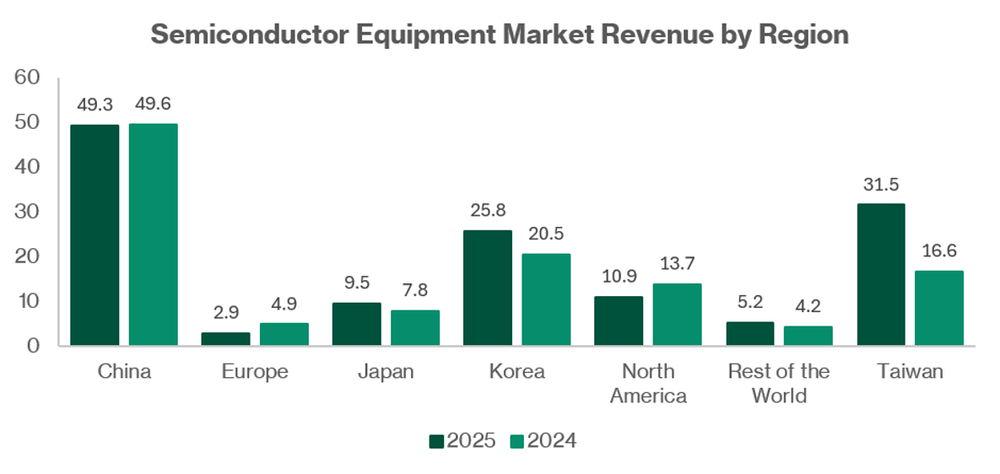
In 2025, semiconductor equipment spending in China reached US$49.3 billion, remaining near record levels as domestic chipmakers continued investing in manufacturing capacity.
Not all this spending is directed at cutting-edge AI chips: it also supports mature-node production and other manufacturing capabilities.
For investors, this means the opportunity extends beyond AI chip designers to companies supporting domestic manufacturing.
However, chipmakers and suppliers remain exposed to technological competition, export restrictions, and cyclical demand.
#2 – Robotics: Bringing AI into physical applications
Robotics combines sensors, software, motors, and precision components to automate physical tasks.
China is already the world's largest industrial robot market.
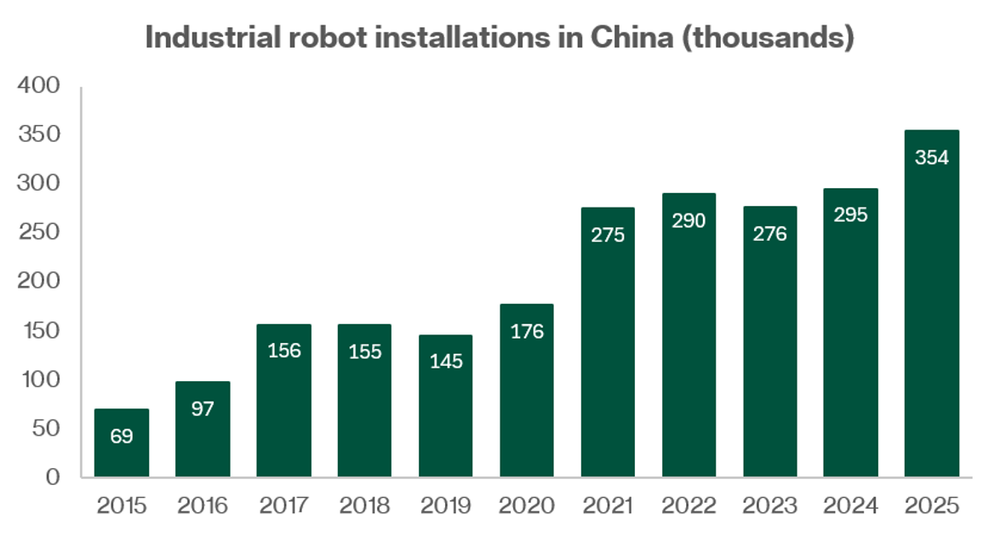
According to the International Federation of Robotics, China installed 354,000 industrial robots in 2025, accounting for 59% of global installations.
While industrial robots are widely used in manufacturing, advances in AI are also accelerating the development of humanoid robots.
According to China's Ministry of Industry and Information Technology, the country had produced more than 40,000 humanoid robots by June 2026.
The investment opportunity extends beyond manufacturers of finished robots to suppliers of motion controls, vision systems, and precision components.
However, increased production does not necessarily translate into commercial success.
The adoption and profitability of emerging robotics applications remain uncertain.
What does the iFAST ChinaAMC CNI Semiconductor Chips Index ETF (SMC) invest in?
SMC tracks the CNI Semiconductor Chips Index, comprising 30 companies across chip design, manufacturing, equipment, materials, and packaging and testing.
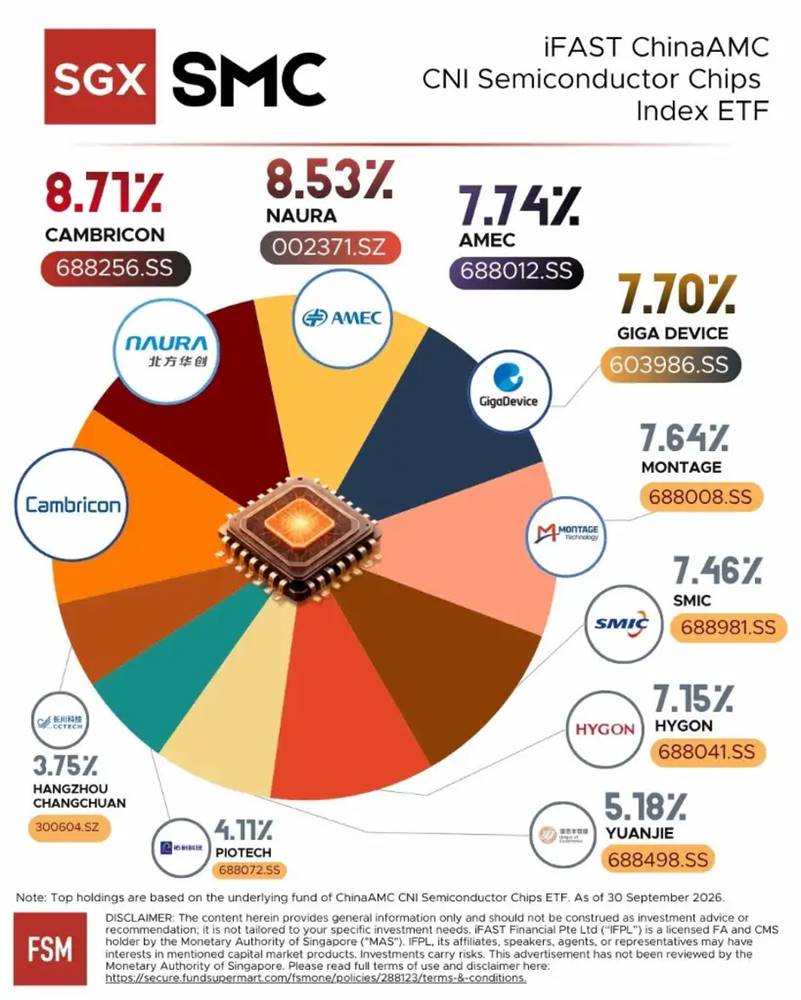
Some of the index's major underlying holdings include:
| Company | Business exposure |
| Cambricon Technologies | AI processors and computing chips |
| NAURA Technology | Semiconductor manufacturing equipment |
| AMEC | Semiconductor fabrication equipment |
| GigaDevice | Semiconductor design and memory |
| Montage Technology | Memory-interface and data-centre chips |
| Source: FSM Global, ChinaAMC, as of 30 September 2026. Holdings are subject to change. | |
These companies may respond to different drivers: greater demand for AI computing could support chip designers, while investment in local manufacturing capacity could benefit equipment suppliers.
A chip designer depends on securing customers for its processors, while an equipment supplier may benefit when chipmakers expand capacity.
This could cause their earnings to move differently even within the same semiconductor index.
SMC offers exposure to China's broader chip supply chain, not just AI processors.
It’s important to note that demand and earnings can fluctuate significantly with semiconductor investment cycles.
What does the iFAST ChinaAMC CSI Robot Index ETF (RBZ) invest in?
RBZ tracks the CSI Robot Index, covering companies across industrial automation and robotics, from sensors and control systems to motors, mechanical components, and software.
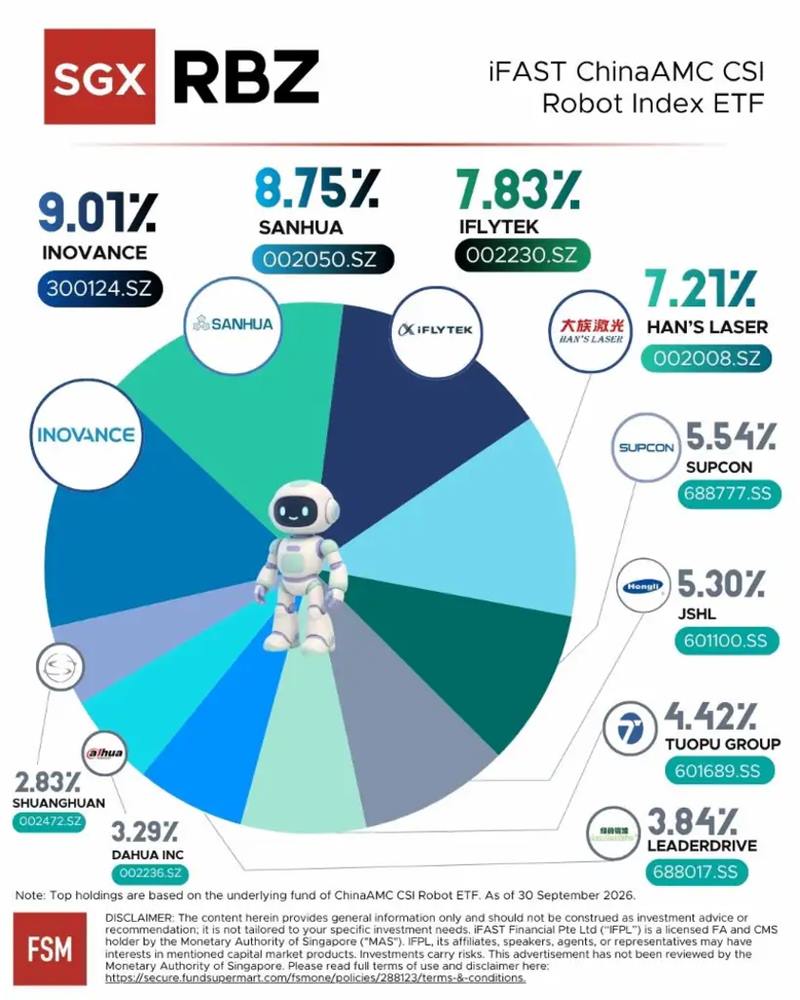
Some of the index's major underlying holdings include:
| Company | Business exposure |
| Inovance | Industrial automation, motors and drives |
| Sanhua | Thermal management and precision components |
| iFLYTEK | AI software and speech technologies |
| Han's Laser | Industrial laser and automation technologies |
| SUPCON | Industrial automation and control systems |
| Source: ChinaAMC, as of 30 September 2026. Holdings are subject to change. | |
Consider what goes into a humanoid robot, such as those developed by Chinese robotics company Unitree.
Vision sensors help it perceive its surroundings, motors and drives enable movement, and precision reducers help control joints.
Companies such as Orbbec, Inovance and Green Harmonic illustrate these different parts of the robotics supply chain, although they are not necessarily suppliers to Unitree.
This is why an ETF covering robotics suppliers should not be judged solely on headlines about humanoid prototypes: its holdings serve different customers and markets.
Importantly, many such businesses also serve established manufacturing industries.
Their prospects therefore depend on broader automation spending, not solely the adoption of humanoid robots.
RBZ provides exposure to the robotics ecosystem rather than a bet on finished robots alone, although emerging applications may take years to become commercially significant.
Semiconductor vs robotics ETFs: How do they differ?
| SMC: Semiconductors | RBZ: Robotics | |
| Main investment theme | AI computing infrastructure and domestic semiconductor development | Industrial automation and physical AI applications |
| Key business exposure | Chip designers, manufacturers and equipment suppliers | Component manufacturers, automation and robotics companies |
| Potential growth drivers | AI computing demand and semiconductor localisation | Automation adoption and advances in robotics technology |
| Key considerations | Semiconductor cycles, technology restrictions and competition | Adoption rates, commercialisation and competition |
For example, higher spending on AI data centres could benefit SMC's chip and equipment holdings, whereas factory automation spending may support RBZ's motors and control-system suppliers.
Owning both does not automatically create a diversified portfolio.
Both concentrate on Chinese equities and may be affected by the same economic conditions, policies, and technology-sector sentiment.
The semiconductor investment thesis depends partly on AI infrastructure spending and progress in China's chip supply chain.
Robotics depends more on automation uptake, with advanced humanoids representing a less mature potential market.
The more useful question is which part of the ecosystem an investor wants exposure to.
What should investors consider before investing in these ETFs?
#1 – Currency, fees and trading liquidity
Although the ETFs trade in SGD, their Chinese investments create foreign-currency risk.
Their expected overall TER is 0.64% p.a., before brokerage and other trading costs.
As new listings, trading volume and bid-ask spreads also matter: ETF prices can differ from net asset value.
The feeder structure adds underlying-fund and tracking considerations.
#2 – Growth industries may still be subject to short-term volatility
A growing industry does not guarantee attractive investment returns.
Chipmakers may face pricing pressure or excess capacity, while it remains unclear which robotics companies will profit from new applications.
Even strong earnings growth may disappoint investors if share prices already assume faster growth.
#3 – Concentration and overlapping exposure
Unlike broad-market ETFs, both funds focus on specific industries in China.
SMC is sensitive to semiconductor demand and technology restrictions, while RBZ is more exposed to industrial spending and robotics adoption.
A small number of major index constituents could also have an outsized influence on returns.
Investors holding China or technology ETFs should check both the index weights and any overlapping exposures before adding either fund.
How can Singapore investors invest in the new iFAST ChinaAMC ETFs?
After their scheduled listing on 7 December 2026, investors can trade both ETFs through brokers offering SGX access.
Their one-share board lots allow smaller purchases, while SGD trading removes the need to manually convert currency before buying.
Both are also SRS-eligible from listing, although SGD trading does not remove underlying currency risk.
Through FSM Global, SGX-listed ETF trades carry a flat S$3.80 processing fee, excluding GST and applicable exchange charges.
Both ETFs will also be available through its Regular Savings Plan (RSP), with 0% processing fees on eligible ETF RSP buy orders under the current fee arrangement.
Enjoy up to S$110 cashback through FSM Global
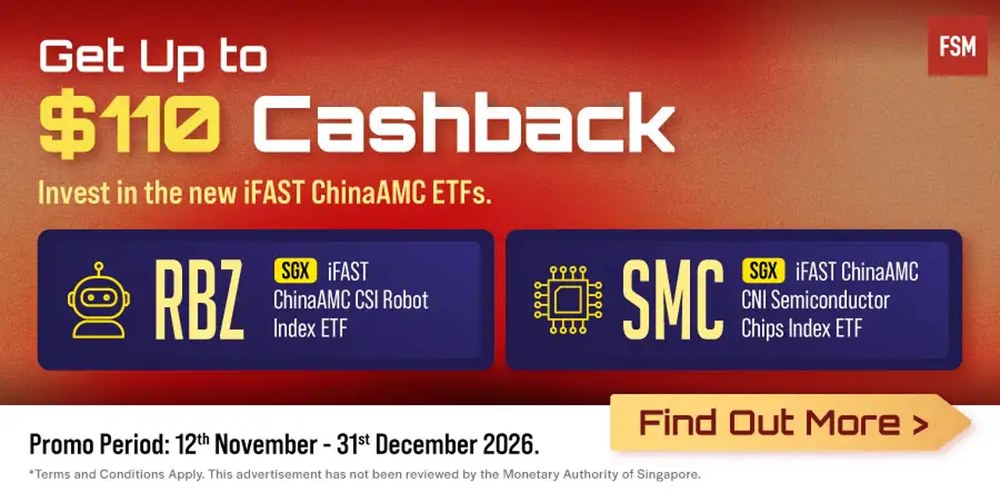
FSM Global's promotion runs from 12 November to 31 December 2026.
Eligible investors can receive S$10 cashback for every S$10,000 invested in either ETF, capped at S$50 per ETF, plus S$10 extra for investing at least S$10,000 in each.
The promotion applies to eligible Cash and Auto-Sweep transactions; SRS and CPFIS investments are excluded.
Cashback is calculated on net eligible investments, qualifying holdings must be maintained until SGX closes on 31 December 2026, and rewards are credited as FSM Global Cash Account credits.
During the IOP, subscriptions via FSM Global require at least 1,000 units at S$1 each, in multiples of 1,000.
Cash applications close at 11:30 am and Auto-Sweep applications at 9:30 am on 27 November 2026.
SRS and RSP cannot be used during the IOP; these options become available after listing.
Promotion terms and eligibility criteria apply. See FSM Global's full terms and conditions. Cashback should be secondary to the investment's risk and suitability.
Learn more about SMC and RBZ and explore how to invest through FSM Global.
Beansprout’s Take
The two new iFAST ChinaAMC ETFs offer exposure to different parts of China's growing technology ecosystem.
For investors, the starting point would be deciding which part of the industry you want more exposure to.
SMC provides access to companies across China's semiconductor supply chain, while RBZ focuses on businesses involved in robotics and industrial automation.
However, investors should remain mindful of currency risk.
Although both ETFs trade in SGD, their underlying investments are in Chinese equities, meaning exchange-rate movements could affect returns.
Both ETFs also have an expected overall TER of 0.64% per annum.
Before investing, investors should consider how much China and technology exposure they already have through existing ETFs, and whether either fund adds meaningful diversification to their portfolio.
For investors interested in these opportunities, the two ETFs will be listed on SGX from 7 December 2026, with the Initial Offer Period running until 27 November 2026.
To learn more about the ETFs, their fees and how to invest, visit FSM Global.
Important information
This article is for general information only and does not constitute investment advice or a recommendation to buy or sell any financial product. Investments involve risks, including the possible loss of capital. Investors should read the relevant prospectus and product highlights sheet and consider their investment objectives and risk tolerance before investing.
This advertisement has not been reviewed by the Monetary Authority of Singapore.
Read also
Gain financial insights in minutes
Subscribe to our free weekly newsletter for more insights to grow your wealth
Most Popular

Comments
0 comments