
kopi-C with InnoTek Chairman: The Singapore company powering the AI hardware boom
Stocks
Powered by

By Julian Wong • 18 Mar 2026
Why trust Beansprout? We’ve been awarded Best Investment Website at the SIAS Investors’ Choice Awards 2025
'%3e%3cpath%20fill-rule='evenodd'%20clip-rule='evenodd'%20d='M17.64%209.20455C17.64%208.56637%2017.5827%207.95273%2017.4764%207.36364H9V10.845H13.8436C13.635%2011.97%2013.0009%2012.9232%2012.0477%2013.5614V15.8195H14.9564C16.6582%2014.2527%2017.64%2011.9455%2017.64%209.20455V9.20455Z'%20fill='%234285F4'/%3e%3cpath%20fill-rule='evenodd'%20clip-rule='evenodd'%20d='M9%2018C11.43%2018%2013.4673%2017.1941%2014.9564%2015.8195L12.0477%2013.5614C11.2418%2014.1014%2010.2109%2014.4205%209%2014.4205C6.65591%2014.4205%204.67182%2012.8373%203.96409%2010.71H0.957275V13.0418C2.43818%2015.9832%205.48182%2018%209%2018V18Z'%20fill='%2334A853'/%3e%3cpath%20fill-rule='evenodd'%20clip-rule='evenodd'%20d='M3.96409%2010.71C3.78409%2010.17%203.68182%209.59318%203.68182%209C3.68182%208.40682%203.78409%207.83%203.96409%207.29V4.95818H0.957273C0.347727%206.17318%200%207.54773%200%209C0%2010.4523%200.347727%2011.8268%200.957273%2013.0418L3.96409%2010.71V10.71Z'%20fill='%23FBBC05'/%3e%3cpath%20fill-rule='evenodd'%20clip-rule='evenodd'%20d='M9%203.57955C10.3214%203.57955%2011.5077%204.03364%2012.4405%204.92545L15.0218%202.34409C13.4632%200.891818%2011.4259%200%209%200C5.48182%200%202.43818%202.01682%200.957275%204.95818L3.96409%207.29C4.67182%205.16273%206.65591%203.57955%209%203.57955V3.57955Z'%20fill='%23EA4335'/%3e%3c/g%3e%3cdefs%3e%3cclipPath%20id='clip0_0_2849'%3e%3crect%20width='18'%20height='18'%20fill='white'/%3e%3c/clipPath%3e%3c/defs%3e%3c/svg%3e)
Make Beansprout your preferred source on Google
Add us on Google to see more of our insights in your search results
InnoTek makes parts most people will never see, for products that are reshaping the world. As the Singapore-listed precision manufacturer navigates a difficult FY2025—EV turbulence, tariff headwinds, shrinking margins—its non-executive chairman Neal Chandaria believes the company is better positioned than the numbers suggest.
In October 2025, Jensen Huang took the stage at NVIDIA's product launch and unveiled the company's new Viking rack series. Behind him, floor to ceiling, were the products.
Prominent in that display were components made in a factory in Dongguan, China, by a company listed on the Singapore Exchange.
InnoTek Limited had been approved as a recommended vendor by NVIDIA just weeks earlier, and its subsidiary had machined the precision aluminium panels standing behind one of the world's most recognised technology companies.
"Our products were right front and centre," says Neal Chandaria, InnoTek's chairman, as he watched the presentation and immediately recognised his company's work.
From losses to the AI supply chain
To understand why the NVIDIA win matters, we first need to understand where InnoTek came from. The company was once known as Magnecomp International, a key player in Singapore's hard disk drive industry.
In 2007, it sold its core business and was left with a precision metal stamping operation in China as well as its new name, InnoTek.
More crucially, a combination of rising operating costs in China, stiff competition across all three product segments (Auto, OA and TV), and a series of leadership changes resulted in four years that accumulated S$62.2 million in losses.
The Chandaria family, which holds 36.6% of the company through a family trust, stepped in.
In late 2015, Chandaria joined the board. He later became chairman in 2017, and on the same day, a new CEO was appointed: Lou Yiliang, a Shanghai-born executive who had spent years in Japan and built businesses in adjacent manufacturing sectors.
Prior to this, Chandaria had spent months in China meeting candidates. Before making the decision to go with Lou, he accompanied Lou on a visit to one of InnoTek's underperforming operations.
What he observed gave him confidence.
Rather than directing people, Lou gathered the management team and invited them to give frank, open feedback about the team—a collective reflection on what needed to change and how to move forward together.
"It was very much a team focus, in the Japanese style of management," Chandaria says. "Not only that he is the leader, but that he involves and works with the whole team."
As non-executive chairman, Chandaria’s role was deliberately limited once Lou was in place: "Mr Lou is responsible for delivering the results. My role is on strategy, direction, governance, and supporting the management."
His family's majority shareholding didn't change that—"Our role as shareholders is not about what we benefit. It's about what is best for the company, and finding the best people who can build it."
Soon, InnoTek moved from accumulated losses to S$58.4 million in combined net profit over the four years to FY2019. As of FY2025, the company has delivered ten consecutive years of profitability, with cumulative profits of S$98.5 million.
What NVIDIA actually demands
InnoTek began building its GPU server business in 2022, and the NVIDIA relationship only came later in end 2025.
NVIDIA operates by an internal principle that it calls "speed of light." When approaching a potential supplier, they share early ideas and expect prototypes back the next morning.
"You've got to go back to China at night, work overnight, come back immediately with what's possible," Chandaria says.
"Their quality expectations are phenomenally high. They want you to perform 12 out of 10."
"Their quality expectations are phenomenally high. They want you to perform 12 out of 10."
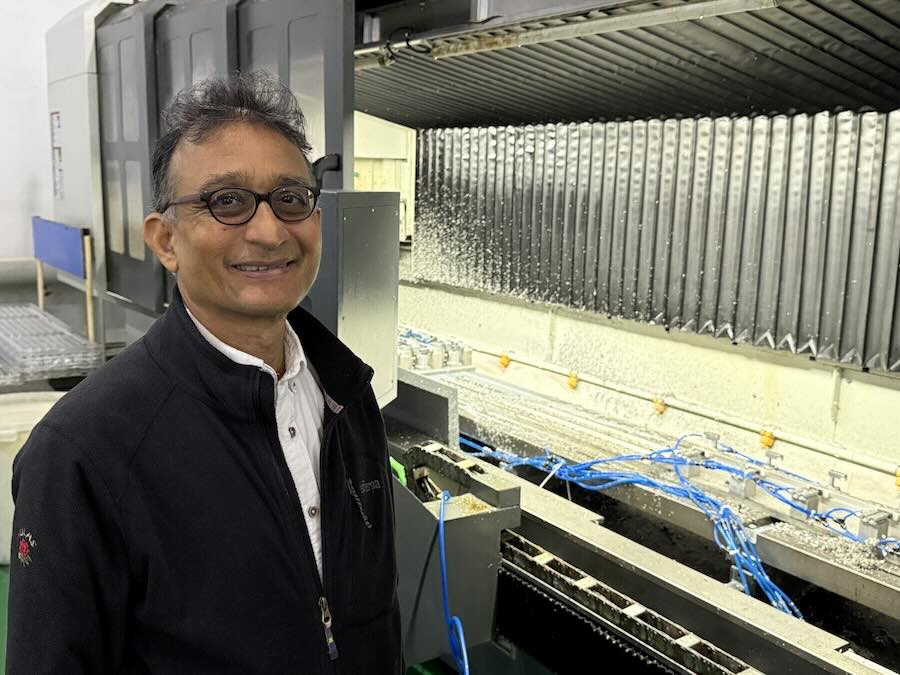
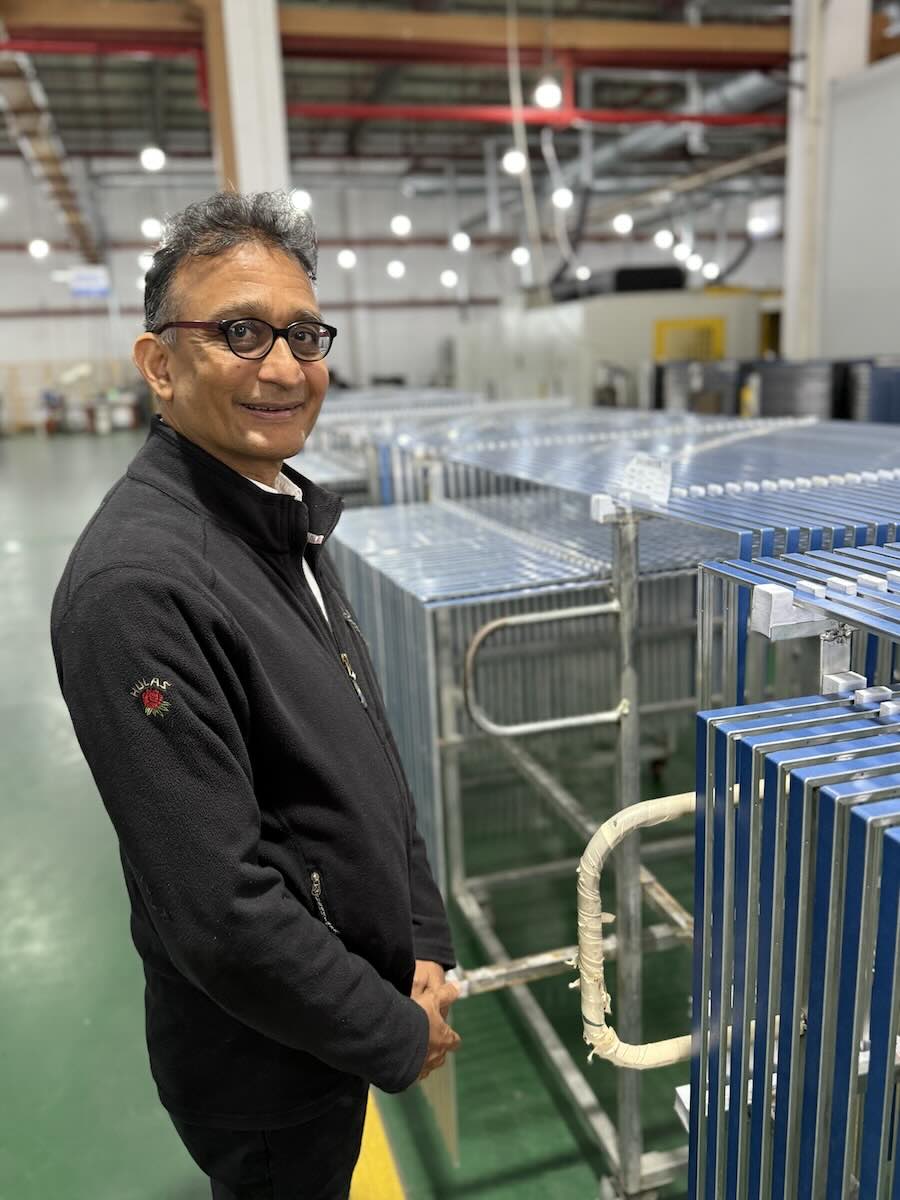
The component Chandaria shows as an example is a translucent, precision-machined aluminium panel from NVIDIA's Viking rack series. Machined from a solid slab of aluminium, it showcases a finish and colour in a specific shade of gold chosen personally by Jensen Huang. Everything must be exactly right.
InnoTek went from initial engagement to approved supplier in roughly six months, a qualification timeline that Chandaria says normally takes at least two years.
Since the approval, other players in the AI server and rack market have approached InnoTek. Chandaria calls this the 'halo effect'—being qualified by NVIDIA has signalled a level of manufacturing capability that others in the supply chain recognise.
Today, InnoTek is producing components for additional customers across the AI server space, with further prototype work underway with other GPU players.
A more complex picture
Chandaria however, does not present InnoTek as a company with only tailwinds.
On whether AI demand is sustainable, he appears measured. He believes the scale of capital committed by the world's largest technology companies will sustain the market for the next few years, yet acknowledges the central question: whether that investment can be monetised.
"If the big companies cannot monetise their AI investment, then yes, this AI explosion will have its own issues," he acknowledges.
He is also clear that InnoTek cannot be fully AI-dependent, and that, "Like any business, we have to diversify."
Their experience in electric vehicles illustrates why.
InnoTek entered the EV space in 2021, targeting the shift away from conventional petrol-engine vehicles. The focus was on China, where EV adoption has moved fastest, and by FY2023, higher sales of EV battery components were already contributing to automotive segment growth.
The path has not been smooth, and Chandaria is candid about the challenges.
The EV price war in China has seen too many brands competing aggressively, with some going out of business entirely. Conventional automotive projects, which InnoTek valued for their multi-year revenue visibility, were cut short as those models lost ground to EVs faster than expected.
"It has been very painful," he says. But he frames it as the turbulence of a market in rapid consolidation, not a structural problem with InnoTek's position within it.
To him, the ongoing rationalisation of the EV market, including the Chinese government's recent intervention to curb destructive price-cutting, has been a stabilising signal for suppliers like InnoTek that stayed the course.
After all, the automotive segment has held up as InnoTek's largest contributor, accounting for 39% of revenue in FY2025.
The company is now expanding its automotive manufacturing capacity in Thailand, targeting global Tier-1 customers and broadening its geographic base beyond China as the market matures.
Tariffs, however, have added to the challenges.
InnoTek's direct shipments from China to the US represent roughly 10% of revenue, but the indirect exposure is wider. Many of its customers export finished goods to the US, and when tariff uncertainty rose sharply, the customer response was a broad freeze on new commitments.
"Whatever new projects, new activities, new sites they had, suddenly they put a halt on them," Chandaria says.
The combined effect is visible in InnoTek's most recent full-year results. FY2025 revenue came in at S$209.9 million, down 11.8% from FY2024's S$238.0 million. Gross profit fell to S$28.6 million, with gross margin contracting from 15.3% to 13.6%.
What comes next
InnoTek's response to the tariff environment has been to accelerate geographic diversification.
Manufacturing capacity has been built out in Thailand and Vietnam, and a first Malaysian subsidiary was incorporated in Melaka in 2025, with operations targeted for mid-2026. Chandaria highlights that this expansion tracks customers' own moves out of China and positions InnoTek to serve them wherever they land.
For now, the near-term picture for InnoTek has two distinct growth engines running in parallel.
In AI hardware, the NVIDIA approval has opened doors across the GPU supply chain, and the company is in active prototype development with additional players.
In automotive, Chandaria points out that the worst of the EV price war appears to be stabilising, and InnoTek's relationships with leading battery and component manufacturers position it to benefit as the market consolidates around stronger players.
Longer term, his focus is on scale and succession.
He is candid that InnoTek remains a small company in a market that doesn't always pay attention to small industrial companies. Organic growth is the primary path, though acquisitions remain on the table.
A next generation of leaders is already in training, including a Taiwanese national handling Precision Intelligent Manufacturing & AI customer relationship—a background Chandaria describes as strategically important, given how much of the AI hardware ecosystem runs through Taiwan—with a Chinese national overseeing the Precision Mechanical Manufacturing business.
For Chandaria, his job as chairman has always been consistent: find the right people, give them responsibility, and support them.
The components InnoTek makes are already around us: in office printers, consumer electronics, car airbags and battery systems, and now in the AI server and racks being installed in data centres around the world.
The question InnoTek is now answering is how big that last category can become.
About InnoTek Limited
Singapore Exchange Mainboard-listed InnoTek Limited is a precision metal components manufacturer serving the consumer electronics, office automation and automotive industries. With five manufacturing facilities in the PRC, one facility in Rayong, Thailand, one facility in Hanoi, Vietnam and one facility in Melaka, Malaysia, the Group’s wholly owned subsidiary, Mansfield Manufacturing Company Limited, provides precision metal stamping, commercial tool and die fabrications and precision machining works to a strong and diversified base of international end-customers.
About kopi-C: the Company brew
kopi-C is a regular column by SGX Research in collaboration with Beansprout, a MAS-licensed investment advisory platform, that features C-level executives of leading companies listed on SGX. These interviews are profiles of senior management aimed at helping investors better understand the individuals who run these corporations.
Read also
Gain financial insights in minutes
Subscribe to our free weekly newsletter for more insights to grow your wealth
Most Popular

Comments
0 comments