
kopi-C with MariBank: Scaling through simplicity and ecosystem integration
Powered by

By Raphael Lim • 15 Jul 2026
Why trust Beansprout? We’ve been awarded Best Investment Website at the SIAS Investors’ Choice Awards 2025
'%3e%3cpath%20fill-rule='evenodd'%20clip-rule='evenodd'%20d='M17.64%209.20455C17.64%208.56637%2017.5827%207.95273%2017.4764%207.36364H9V10.845H13.8436C13.635%2011.97%2013.0009%2012.9232%2012.0477%2013.5614V15.8195H14.9564C16.6582%2014.2527%2017.64%2011.9455%2017.64%209.20455V9.20455Z'%20fill='%234285F4'/%3e%3cpath%20fill-rule='evenodd'%20clip-rule='evenodd'%20d='M9%2018C11.43%2018%2013.4673%2017.1941%2014.9564%2015.8195L12.0477%2013.5614C11.2418%2014.1014%2010.2109%2014.4205%209%2014.4205C6.65591%2014.4205%204.67182%2012.8373%203.96409%2010.71H0.957275V13.0418C2.43818%2015.9832%205.48182%2018%209%2018V18Z'%20fill='%2334A853'/%3e%3cpath%20fill-rule='evenodd'%20clip-rule='evenodd'%20d='M3.96409%2010.71C3.78409%2010.17%203.68182%209.59318%203.68182%209C3.68182%208.40682%203.78409%207.83%203.96409%207.29V4.95818H0.957273C0.347727%206.17318%200%207.54773%200%209C0%2010.4523%200.347727%2011.8268%200.957273%2013.0418L3.96409%2010.71V10.71Z'%20fill='%23FBBC05'/%3e%3cpath%20fill-rule='evenodd'%20clip-rule='evenodd'%20d='M9%203.57955C10.3214%203.57955%2011.5077%204.03364%2012.4405%204.92545L15.0218%202.34409C13.4632%200.891818%2011.4259%200%209%200C5.48182%200%202.43818%202.01682%200.957275%204.95818L3.96409%207.29C4.67182%205.16273%206.65591%203.57955%209%203.57955V3.57955Z'%20fill='%23EA4335'/%3e%3c/g%3e%3cdefs%3e%3cclipPath%20id='clip0_0_2849'%3e%3crect%20width='18'%20height='18'%20fill='white'/%3e%3c/clipPath%3e%3c/defs%3e%3c/svg%3e)
Make Beansprout your preferred source on Google
Add us on Google to see more of our insights in your search results
MariBank CEO Natalia Goh is scaling the digital bank by prioritising simplicity over traditional banking's condition-heavy products. Having grown FY2025 income by 53%, the bank is now pursuing regional scale while building toward sustainable profitability.
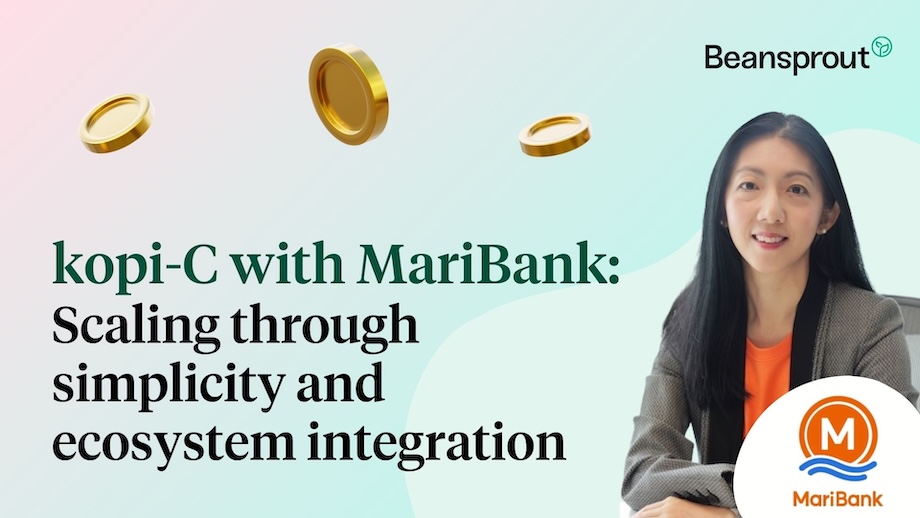
Ask customers about their common frustrations when dealing with banks, and recurring themes quickly emerge — whether it’s the hassle of securing annual credit card fee waivers, navigating layers of conditions to unlock headline interest rates, or meeting high minimum investment thresholds.
MariBank’s Chief Executive Officer Natalia Goh wants to change that.
Since taking the helm of one of Singapore’s two digital full banks in July 2024, her focus has been set on delivering banking that is “simple, reliable and rewarding” by minimising pain points that customers experience.
“We believe that there is a sizable pool of customers who are looking for a more simplified experience, something that's just truly convenient and not complicated,” she says.
Despite Singapore being a well-banked market— where most individuals hold multiple bank accounts or financial products — MariBank’s surveys suggest that recurring friction points still exist, Goh notes.
This includes recurring requests for annual fee waiver for credit cards or having to fulfill multiple conditions in order to get rewards or higher interest rates.
“Because I’ve been in the banking industry, I know why these things exist,” Goh says. “I know why there are fees on certain products. I also know why terms and conditions such as having to hold a minimum balance in the account or minimum transaction sizes exist for users to earn certain rewards, cashback and so on.”
But after spending close to two decades in traditional banks, she decided that it was time to find ways to create business opportunities by solving for such friction points.
Traditional banks tend to design products around economics first, and then retrofit customer experience around those constraints, Goh notes. MariBank’s approach flips that sequence: starting with customers at the heart, then engineering the economics around it.
Simplicity as a product strategy
This philosophy is most visible in MariBank’s product and app design.
Its credit card offers a flat 1.5 per cent cashback on all eligible spending including overseas spend, without complex criteria – no minimum spend, no defined categories, no FX or annual fees. While higher headline cashback rates exist elsewhere, these typically come with hidden fees and behavioral requirements that many users find tiring.
“There are customers out there who are seeking a simple proposition. They just want to be rewarded without any complications,” Goh says.
The same logic applies across the bank’s investment products. Instead of inundating users with a wide range of choices, MariBank selects a single “best-in-class” option per asset category.
Investors can start with as little as S$1, a deliberate move to lower both financial and psychological barriers to entry. Investment products, in particular, have seen strong take-up, with many users starting their investment journey on MariBank precisely because the entry barriers are low.
This accessible approach has already paid off, driving strong cross-sell momentum from the Mari Savings Account into Mari Invest.
“What's important for us is when we engage our customers, we want to make sure that they see value in every interaction, every transaction with us, so they're not coming to us only for that one-time signup offer,” Goh says.
To ensure that the bank is meeting its objectives of simplicity and reliability for customers, MariBank also goes beyond tracking metrics like traditional banks such as interest margins, to indicators more commonly associated with technology and e-commerce platforms.
These include number of clicks for users to complete an action, app load times, as well as daily and monthly active users to get a sense of engagement.
App Ratings are also an important metric that Goh watches out for, and she notes that MariBank has consistently ranked among the highest when compared to traditional and digital competitors. As of June, MariBank’s rating in the Apple App Store and Google Play stood at 4.8 out of 5, which is on par with some of the bigger traditional banks in Singapore
“Being a digital bank, the only way that we are present to users is actually through the app, unlike a traditional bank where you have branches and ATMs,” Goh notes. “How users interact within the app, how they rate us, the feedback they give is important.”
Such factors are important as the bank moves beyond its initial build-out phase towards scaling up its business towards a sustainable path of profitability.
Leveraging the ecosystem to scale towards profitability
MariBank’s structural advantage lies in its place within Sea’s ecosystem, which operates the digital entertainment and gaming business Garena as well as the e-Commerce platform Shopee.
“We can acquire customers through the ecosystem at a lower cost. It also gives us valuable data,” Goh notes. Such data could be valuable for the bank as it broadens its solutions for a wider pool of retail customers and business owners.
By overlaying Sea’s rich ecosystem data on top of standard credit bureau records, MariBank has a fuller picture of a customer’s ability to repay, and can extend credit to customers where traditional incumbents typically hesitate.
“If you think about Shopee, there's shoppers, but there's also the sellers, so that also creates an opportunity for us in terms of business banking,” Goh says.
In FY2025, MariBank Singapore’s total income grew 53 per cent on year to S$37.4 million, on the back of stronger net interest income and fee income. Deposits and balances from customers rose from S$1.5 billion in 2024 to S$1.9 billion in 2025.
“Currently we're in the scaling phase, and what we're trying to do is build a sustainable path to profitability,” Goh says.
To drive that, MariBank has built different revenue drivers – interest income from lending, fee income from cards and investments etc.
Total expenses, meanwhile, remained relatively flat at S$72.5 million, with costs being kept through a deliberately tech-first foundation.
Being part of Sea, a technology-native group, has also accelerated the bank’s adoption of AI across areas such as customer service, AML monitoring, and credit risk modelling. The intent is not just efficiency, but scalability: adding new products and users without a proportional increase in cost.
MariBank is also looking at driving regional synergies, forming the MariBank banking group, which brings MariBank Philippines under the broader group. The inclusion of the subsidiary has increased the group’s deposit base to S$2.8 billion in end-2025, while total income for FY2025 has also risen to S$196.2 million.
“That will be another thing we will continue to do, which is bringing the banks together to see how we can get more regional synergies,” Goh says. As to whether MariBank Group will expand beyond these two markets, Goh responded that, “For us as a banking group, we remain open to see which other markets make sense for us.”
In the next three years, Goh remains focused on scaling up the business and deepening its engagement with customers.
“It's really, how do we continue to grow the bank? How do we continue to scale and stay true to our values?” Goh says, noting that the challenge would be bringing value in a market that has strong competition from both traditional and fintech players.
She adds: “We (need to) make sure that it's a product that customers trust, that they love to use. That will give us relevance over time and will ensure that we build a path to sustainable profitability.”
About MariBank
MariBank is a digital bank that operates under a licence from the Monetary Authority of Singapore (MAS). Launched publicly in March 2023, MariBank aims to support the banking needs of digital natives and small businesses in Singapore through the provision of simple and purpose-built banking products. MariBank’s initial offering was the Mari Savings Account, which was subsequently complemented by a suite of credit and payment facilities, as well as wealth management products. MariBank is a wholly-owned subsidiary of Sea Limited.
For more information, please visit https://www.maribank.sg/about-us.
About kopi-C: the Company brew
kopi-C is a regular column by SGX Research that features C-level executives of leading companies. These interviews are profiles of senior management aimed at helping investors better understand the individuals who run these corporations.
Read also
Gain financial insights in minutes
Subscribe to our free weekly newsletter for more insights to grow your wealth
Most Popular

Comments
0 comments