
How to use options to enter stocks at potentially better prices
Brokerage Account
Powered by

By Nicole Ng • 13 Apr 2026
Why trust Beansprout? We’ve been awarded Best Investment Website at the SIAS Investors’ Choice Awards 2025
'%3e%3cpath%20fill-rule='evenodd'%20clip-rule='evenodd'%20d='M17.64%209.20455C17.64%208.56637%2017.5827%207.95273%2017.4764%207.36364H9V10.845H13.8436C13.635%2011.97%2013.0009%2012.9232%2012.0477%2013.5614V15.8195H14.9564C16.6582%2014.2527%2017.64%2011.9455%2017.64%209.20455V9.20455Z'%20fill='%234285F4'/%3e%3cpath%20fill-rule='evenodd'%20clip-rule='evenodd'%20d='M9%2018C11.43%2018%2013.4673%2017.1941%2014.9564%2015.8195L12.0477%2013.5614C11.2418%2014.1014%2010.2109%2014.4205%209%2014.4205C6.65591%2014.4205%204.67182%2012.8373%203.96409%2010.71H0.957275V13.0418C2.43818%2015.9832%205.48182%2018%209%2018V18Z'%20fill='%2334A853'/%3e%3cpath%20fill-rule='evenodd'%20clip-rule='evenodd'%20d='M3.96409%2010.71C3.78409%2010.17%203.68182%209.59318%203.68182%209C3.68182%208.40682%203.78409%207.83%203.96409%207.29V4.95818H0.957273C0.347727%206.17318%200%207.54773%200%209C0%2010.4523%200.347727%2011.8268%200.957273%2013.0418L3.96409%2010.71V10.71Z'%20fill='%23FBBC05'/%3e%3cpath%20fill-rule='evenodd'%20clip-rule='evenodd'%20d='M9%203.57955C10.3214%203.57955%2011.5077%204.03364%2012.4405%204.92545L15.0218%202.34409C13.4632%200.891818%2011.4259%200%209%200C5.48182%200%202.43818%202.01682%200.957275%204.95818L3.96409%207.29C4.67182%205.16273%206.65591%203.57955%209%203.57955V3.57955Z'%20fill='%23EA4335'/%3e%3c/g%3e%3cdefs%3e%3cclipPath%20id='clip0_0_2849'%3e%3crect%20width='18'%20height='18'%20fill='white'/%3e%3c/clipPath%3e%3c/defs%3e%3c/svg%3e)
Make Beansprout your preferred source on Google
Add us on Google to see more of our insights in your search results
Want to buy stocks at a potentially better price? Discover how cash-secured puts work, how to earn premium income, and how to use moomoo to execute the strategy.

This post was created in partnership with Moomoo Singapore. All views and opinions expressed in this article are Beansprout's objective and professional opinions.
What happened?
From time to time, stocks may pull back from their highs, accompanied by increased volatility.
For long-term investors like me, this is when opportunities emerge where stocks on my watchlist can start to trade at more attractive levels.
But deciding how to enter isn’t always straightforward.
Some investors may average into positions over time while others may wait for clearer signs of stability before deploying capital.
And in volatile markets, timing entries becomes even more challenging.
If I already have a price in mind, one approach I can consider is using options to structure that entry.
For example, the cash-secured put strategy allows me to define the price I’m willing to pay while earning income as I wait.
Instead of committing fully at today’s prices or staying on the sidelines, it offers a more deliberate way to enter positions, though it may be more suitable in certain market conditions.
Here, I’ll walk through how the cash-secured put strategy works, how to use it in practice, and what to watch out for before getting started.
What is a cash-secured put strategy?
A cash-secured put is a strategy where you sell a put option on a stock you’re willing to own at a certain price, while keeping enough cash ready to buy the shares if needed.
In exchange, you receive a premium upfront.
If you are assigned the shares, that premium helps lower your effective entry price.
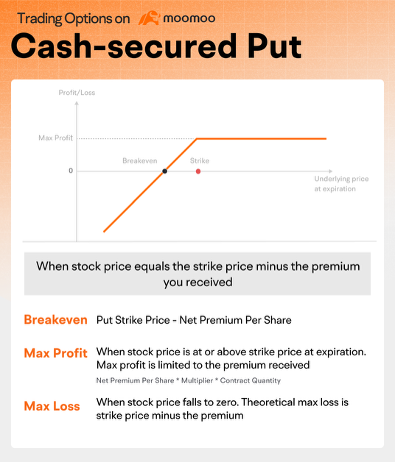
How to use cash-secured put options to enter stocks at potentially better prices
Step 1: Select a stock you are comfortable owning
This is the most important starting point.
Cash-secured puts should only be used on stocks you’ve already researched and would be comfortable buying if the price falls to a price you find attractive.
Step 2: Choose a strike price based on the price you want to buy at
The strike price is the price at which you agree to buy the shares if the option is exercised.
You typically set this below the current market price, at a level where you feel the stock offers good value.
Step 3: Set aside enough cash to buy the shares
Because this is a cash-secured strategy, you need to have the full amount ready in your account in case you are required to buy the stock.
For a put with $95 strike price on 100 shares, that means keeping $9,500 ready.
Step 4: Sell the put option and collect the premium
Once you sell the contract, the premium is credited to your account upfront. This is the income you earn for agreeing to buy the stock at your chosen price if assigned.
Step 5: Wait for expiry
There are two possible outcomes when the option expires.
| Scenario | What happens | Outcome |
| Stock stays above $95 | Option expires worthless | You didn't buy the stock, but you earned the premium of $200 |
| Stock falls below $95 | You are assigned the shares at $95 if the buyer exercises the option | You bought the shares at $95, but your effective cost is $93 per share after accounting for the premium you already received. |
A quick example
Say a stock you've been watching is trading at $100.
You decide you’d be comfortable owning it at $95, so you sell a put option at a $95 strike that expires in one month.
In return, you receive a $200 premium (or $2 per share for 100 shares).
If the stock stays above $95 when the option expires, the option expires worthless, and you keep the $200.
Your cash is then released, and you can choose to run the strategy again.
If the stock falls to, say, $88 at expiry, and the buyer exercises the option, you will be assigned and have to buy the shares at $95.
However, because you already received the $200 premium, your effective cost works out to $93 per share. ($95 x 100 shares - $200 premium = $9,300)
That means you are still buying the stock at a lower net price than your strike price, and below the $100 level where the stock was originally trading.
How investors can explore cash-secured puts on moomoo
Having the right platform makes a real difference when running options strategies.
On moomoo, you have access to a few tools that help you plan and execute cash-secured puts more effectively.
#1 – Use the options and P&L analysis to plan trades
With the moomoo platform, you can evaluate different options strategies and their potential outcomes before placing a trade.
Instead of guessing, the built-in P&L analysis lets you visualise how a trade performs across different price scenarios, including your maximum profit, breakeven level, and probability of profit.
This is particularly useful when executing a cash-secured put strategy.
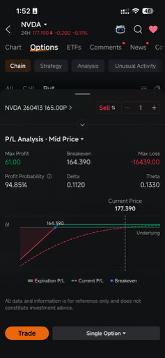
For example, if you’re looking to buy NVDA at a lower price, you may sell a put at your desired entry price and use moomoo’s P&L analysis to understand the trade upfront:
- Max profit reflects the premium you receive (e.g. $61)
- Breakeven price shows your effective entry price after receiving the premium (e.g. $164.39)
- Profit probability helps you gauge the likelihood of keeping the premium (e.g. 94.85%)
- Max loss outlines the downside risk if the stock falls significantly
By visualising this payoff, you can clearly see how you’re getting paid while waiting for your target entry price, which in this case is the strike price of $165.
Beyond this, moomoo also gives you access to the options chain, where you can view available strike prices, premiums, and expiries across calls and puts in real time.
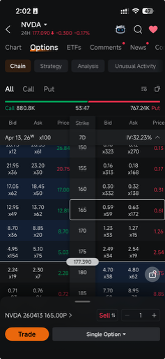
This allows you to compare different entry prices and select a strike price that aligns with your investment thesis.
If you’re exploring different market views, the platform also provides pre-built strategies based on your outlook, whether you expect the price to rise, fall, or remain range-bound.
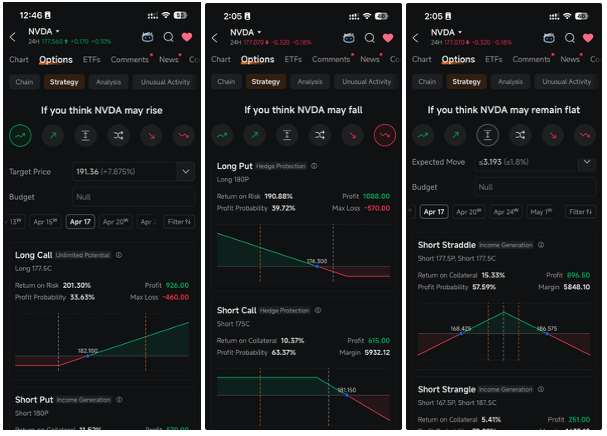
These include strategies such as long calls, short puts, covered calls, and spreads, helping you quickly identify approaches that fit your objective, whether it’s generating income, hedging risk, or positioning for upside.
Simply tap on the direction you expect and moomoo will show a range of strategies under that view.
You can then input your expected price move and budget to generate the corresponding strike price, along with the estimated probability of profit and required capital.
For example, if you expect NVIDIA to stay above $165, the platform can suggest a short put at that level and show the premium you can earn.
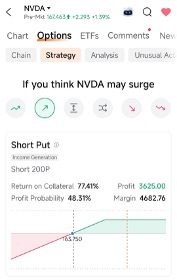
Moomoo also provides key metrics like delta and theta, helping you better understand how time decay and price movements may impact your trade.
You can access options by going to the stock quote, then clicking on Options → Chain (to explore strikes) or → Strategy tab (to view suggested strategies based on your outlook) → Select a trade → View P&L Analysis
#2 – Low and transparent fees
When it comes to options strategies like cash-secured puts, fees can have a meaningful impact on your overall returns, especially if you’re running the strategy consistently over time.
On moomoo, the fee structure is relatively straightforward and competitive.
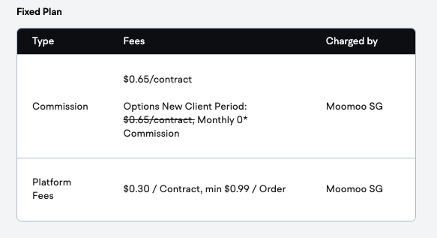
For US options, commissions are typically $0.65 per contract, with a platform fee of $0.30 per contract (minimum $0.99 per order).
moomoo is also running a new-to-options user promotion where you get 0 commission* on up to 100 options contracts each month for 6 months, which can be found under the “Me” → “Rewards” tab. This applies to new and existing users who have not traded options before. *after you complete 1 trade on US option per month.
This can help lower your cost when you’re starting out or testing different strategies.
For more active traders, moomoo also offers a tiered pricing structure, where the commission per contract decreases as your trading volume increases. This goes as low as $0.30 per contract at higher tiers.
What stands out is the transparency of the fee structure.
You know exactly what you’re paying per trade, which makes it easier to factor costs into your expected returns, particularly when evaluating strategies like cash-secured puts.
#3 – Tools for options selling strategies
moomoo also offers features useful for investors looking to sell put options such as the Option Seller Dashboard.
You can find the Option Seller Dashboard under Market → Options → Seller Dashboard.
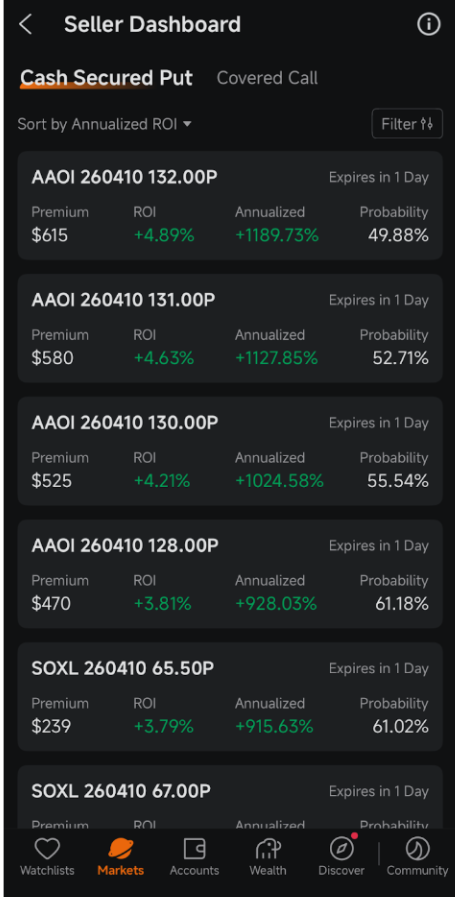
This dashboard surfaces options contracts with high ROI and highlights trending seller strategies. This way, you can easily identify potential opportunities without manually scanning through multiple strike prices and expiries on various stock quote pages.
This can also act as a reference point to see how other sellers are positioning in the options market.
Moomoo also has a feature called SmartSave, which enables a “triple yield” approach.

On moomoo, your uninvested cash can be automatically invested into selected money market funds under Cash Plus, allowing you to potentially earn a return on your cash while waiting for your target entry price.
When you sell the put option, you also collect the premium, which is also automatically invested through SmartSave.
Learn more about moomoo’s SmartSave here
Key risks to consider
While cash-secured puts can be a useful way to enter stocks at potentially better prices, they are not risk-free.
Here are some important considerations to keep in mind:
#1 – Stock price can fall significantly
The strategy tends to work best in mildly bullish, neutral, or range-bound markets, where prices remain relatively stable or experience only shallow pullbacks.
However, if the market turns more bearish and the stock declines sharply, you may end up buying at a price that is still above the current market level.
For example, you might be assigned at $95, but the stock continues to fall to $85. Even after accounting for the premium received, your position could still be at a loss.
#2 – Capital is tied up
Because the position is fully cash-secured, you need to set aside the full amount required to purchase the shares.
For instance, selling a put at a $95 strike would require $9,500 in capital. This cash remains tied up until the option expires or is closed, which may limit your ability to deploy capital elsewhere.
That said, with moomoo’s SmartSave, uninvested cash can be automatically allocated into selected money market funds under Cash Plus, allowing it to potentially earn some yield while waiting.
#3 – Stock selection matters
This strategy works best on stocks you are comfortable owning for the long term.
If the stock is assigned to you, you should be prepared to hold through potential volatility, rather than viewing the trade purely as a way to generate short-term income.
#4 – Requires understanding of options
Cash-secured puts may appear straightforward, but they still involve options mechanics such as assignment, expiry, and pricing dynamics.
Investors should have a basic understanding of how options work before getting started, and ensure the strategy fits their overall portfolio and risk tolerance.
What would Beansprout do?
For me, cash-secured puts are a tool I would consider using when I already have a clear price in mind for a stock I want to own.
Instead of rushing to buy during short-term volatility, I would use the strategy to be more deliberate about my entry and get paid while waiting for my target price.
That said, I would only apply this approach if I’m comfortable owning the stock for the long term.
If I get assigned, I need to be prepared to hold through volatility.
Market conditions matter as well. I’m more likely to use cash-secured puts in mildly bullish or range-bound environments, rather than during sharp downtrends where prices can continue falling.
At the same time, I would ensure that the trade fits within my overall portfolio, given that capital is tied up while the option is active.
In practice, I see cash-secured puts as a way to complement a longer-term investing approach.
It helps me enter positions more intentionally, while generating some income along the way. But like any strategy, it works best when used with a clear plan, rather than as a way to chase premiums.
If you’re looking to try out this strategy, you can get started on moomoo and explore its options tools for yourself.
Sign up for moomoo via Beansprout to receive a S$50 FairPrice voucher within 5 working days when you sign up using the promo code BEANSPROUTS1, along with up to S$1,864 in welcome rewards*.
Learn more about the promo here.
You can also join moomoo’s Options Bootcamp, where you can earn up to US$70* in cash plus reward points while learning how to trade options more effectively. Check out the event here
Disclaimer
*T&Cs apply. Moomoo Singapore is the sponsor of this content. This content is for informational purposes only, does not constitute financial advice, and reflects Beansprout's independent opinion. I did my own research on options trading and this reflects my personal approach to investing. Please conduct your own research and invest according to your personal risk tolerance.
This advertisement has not been reviewed by the Monetary Authority of Singapore.
Read also
Gain financial insights in minutes
Subscribe to our free weekly newsletter for more insights to grow your wealth
Most Popular

Questions and Answers
0 questions