
OCBC reports 3% rise in 3Q26 net profit and upgrades 2026 guidance: Our Quick Take
Stocks
By Gerald Wong, CFA • 06 Nov 2026
Global Wealth Technology Pte. Ltd. is regulated by the Monetary Authority of Singapore (MAS) as a licensed Financial Adviser.

Make Beansprout your preferred source on Google
Add us on Google to see more of our insights in your search results
OCBC Group has reported net profit of S$2.04 billion for 3Q26, up 3% compared to the previous year, and upgraded its 2026 financial guidance.
OCBC 3Q26 earnings highlights
OCBC announced its earnings for the third quarter of 2026 (3Q26) and the first nine months of 2026 (9M26). Key highlights include:
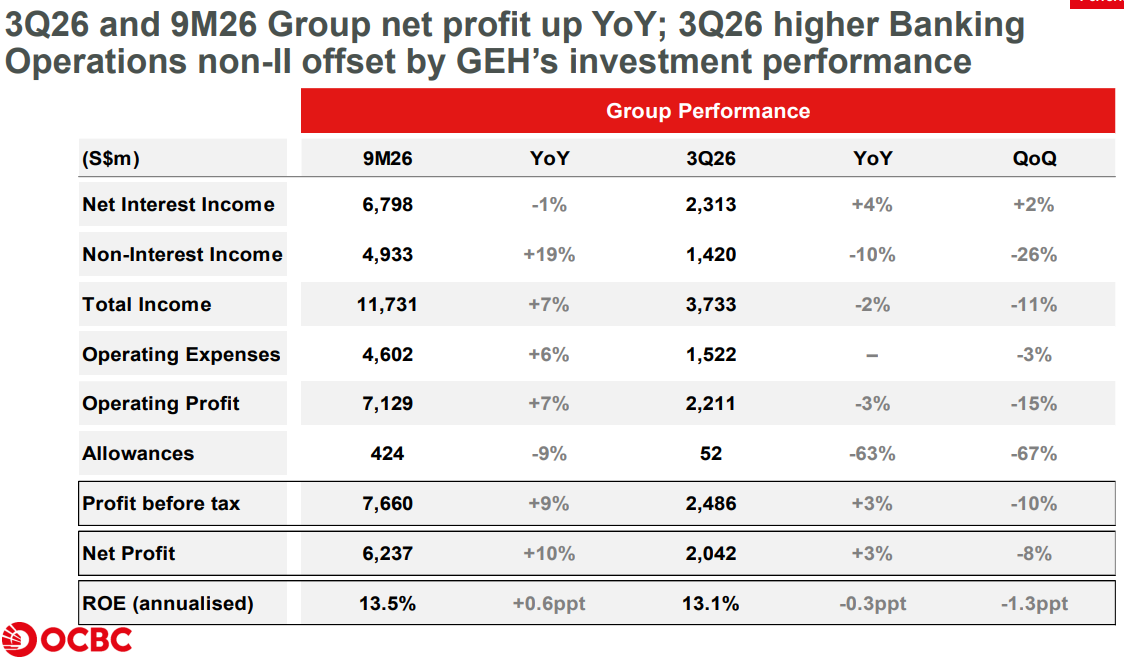
- Net profit of S$2.04 billion in 3Q26, up 3% year-on-year but 8% below the record level in 2Q26, slightly above the S$2.00 billion Bloomberg consensus forecast. 9M26 net profit rose 10% year-on-year to a record S$6.24 billion.
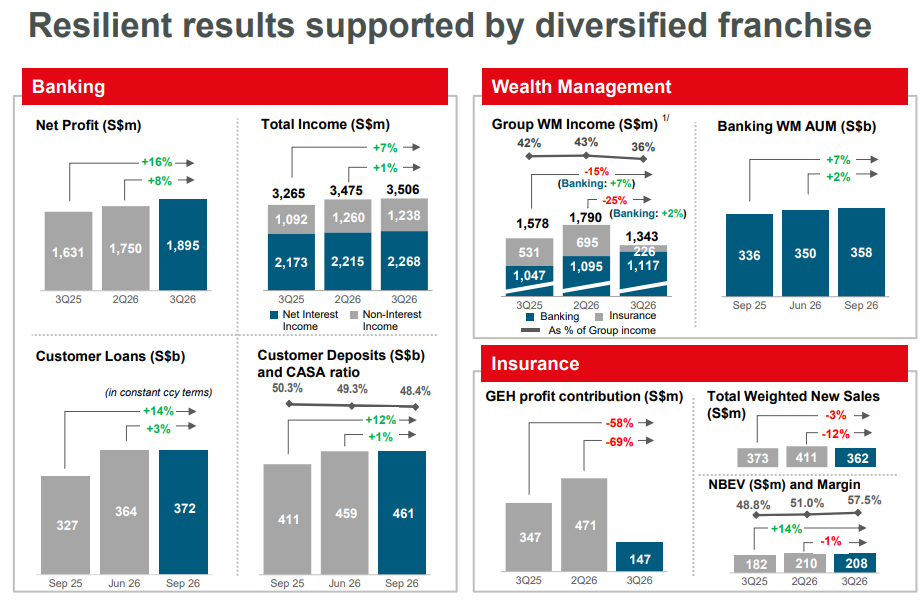
- Banking Operations net profit reached a record high of S$1.90 billion in 3Q26, up 16% year-on-year and 8% quarter-on-quarter, offset by weaker investment performance from Great Eastern Holdings (GEH).
- Net interest income rose 4% year-on-year to S$2.31 billion, the highest level in six quarters.
- Loans grew 14% year-on-year (in constant currency terms) to S$372 billion.
- Asset quality continued to improve, with NPL ratio down to 0.8% and total NPA coverage rising to 168%. Credit costs came in at just 6 basis points in 3Q26.
- OCBC upgraded its 2026 financial guidance across several key metrics, including loan growth, total income and credit costs.
What you need to know about OCBC 3Q26 results
OCBC Group has reported net profit of S$2.04 billion for 3Q26, up 3% year-on-year but 8% below the record level in 2Q26.
This brings 9M26 net profit to a record S$6.24 billion, up 10% year-on-year.
#1 - Record Banking Operations profit offset by weaker Great Eastern contribution
OCBC's Banking Operations delivered a record quarterly net profit of S$1.90 billion in 3Q26, up 16% year-on-year and 8% quarter-on-quarter.
This was underpinned by record Banking Operations total income, which rose 7% year-on-year.
However, Group net profit was held back by weaker investment performance from Great Eastern Holdings (GEH).
GEH was impacted by mark-to-market losses on its bond portfolios amid rising interest rates in 3Q26, while the significant gains on its equity portfolio in 2Q26 were not repeated this quarter.
GEH's underlying insurance business remained resilient. 3Q26 new business embedded value (NBEV) grew 14% year-on-year, driven by more than 20% growth in its agency and bancassurance channels in Singapore.
NBEV margin improved to 57.5% from 51.0% in the previous quarter.
For 9M26, GEH's profit contribution rose 5% year-on-year to S$941 million.
#2 - Net interest income returned to year-on-year growth
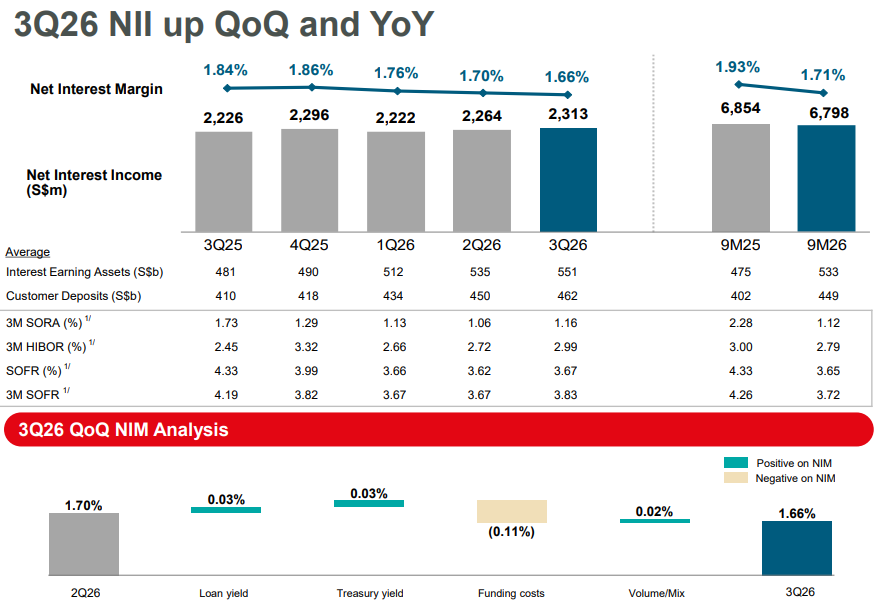
OCBC's net interest income for 3Q26 rose 4% year-on-year to S$2.31 billion, the highest level in six quarters.
The improvement was supported by a 15% growth in average assets, driven by growth in both customer loans and high-quality non-commercial assets.
This was partly offset by an 18 basis point (0.18%) contraction in net interest margin in a lower interest rate environment.
Quarter-on-quarter, net interest income grew 2%, supported by a 3% increase in average assets and higher yields, partly offset by a rise in funding costs, particularly from the rise in US rates.
OCBC's net interest margin (NIM) was 1.66% in 3Q26, 18 basis points (0.18%) lower than 3Q25 and 4 basis points (0.04%) lower than 2Q26.
The quarter-on-quarter NIM compression continues to moderate, having narrowed from 10 basis points (0.10%) in 1Q26 to 6 basis points (0.06%) in 2Q26 and now 4 basis points (0.04%) in 3Q26.
Management noted that higher SORA rates were a net positive to NII in 3Q26, as asset yields rose faster than funding costs.
However, the rise in US rates was a net negative this quarter, as funding repriced faster than assets. The benefits from higher US rates are expected to flow through in the coming quarters as assets reprice.
#3 - Non-interest income impacted by GEH; customer flow trading at record high
Non-interest income came in at S$1.42 billion in 3Q26, down 10% year-on-year and 26% quarter-on-quarter, mainly reflecting weaker GEH investment performance.
Underlying customer-driven income, however, remained strong.
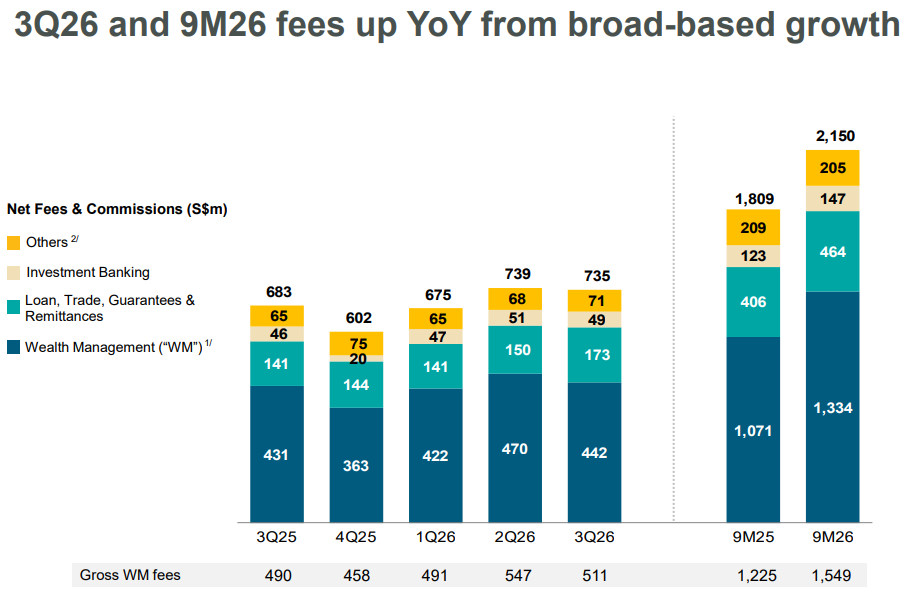
Net fee income of S$735 million grew 8% year-on-year to a level comparable to the record 2Q26, despite more challenging market conditions.
Wealth management fees were the second highest on record at S$442 million, led by higher bancassurance and fund management fees.
Customer flow trading income rose to a new record of S$480 million in 3Q26, up 29% year-on-year, driven by growth across all segments, in particular corporates.
Net trading and investment income overall, however, declined 33% quarter-on-quarter to S$465 million.
This was mainly due to mark-to-market losses on GEH's bond portfolio in its shareholders' fund amid rising interest rates in 3Q26, as well as the absence of significant gains on its equity portfolio in 2Q26 that were not repeated this quarter.
Insurance income fell 48% quarter-on-quarter to S$198 million, reflecting market-driven valuation losses arising from interest rate movements.
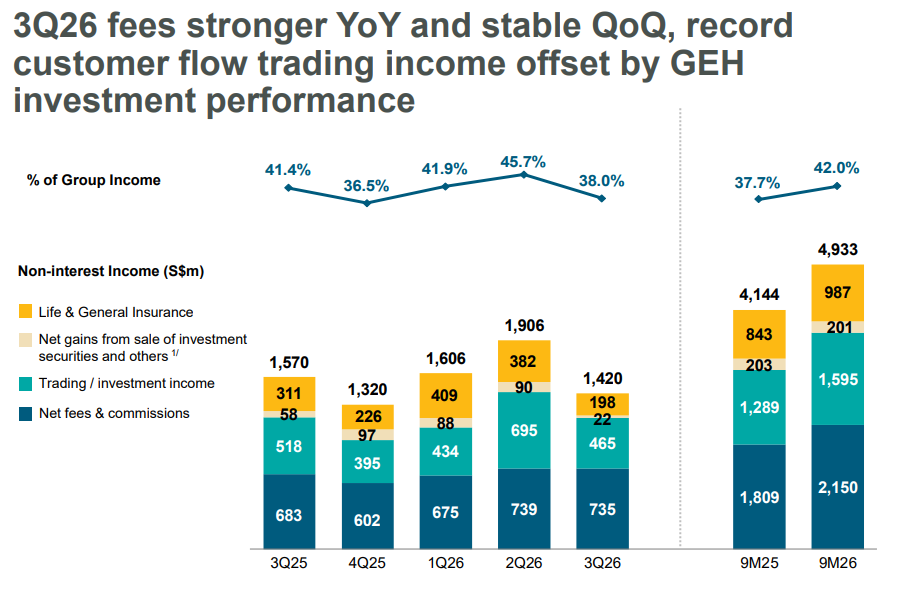
For 9M26, non-interest income grew 19% year-on-year to a record S$4.93 billion, accounting for 42% of total income, up from 38% in the previous year.
Banking wealth management AUM continued to grow to a new high of S$358 billion, up 7% year-on-year and 2% quarter-on-quarter.
#4 - Credit costs lower at 6 basis points; NPL ratio improved to 0.8%
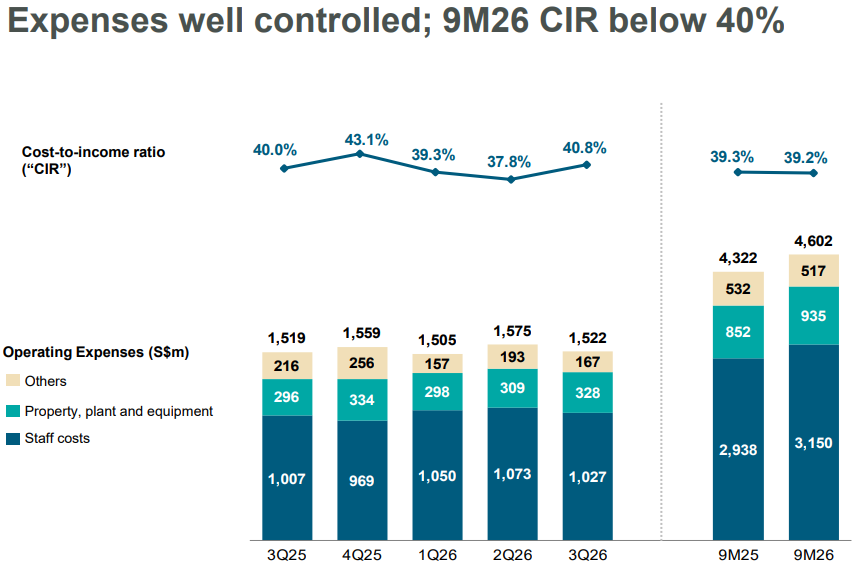
OCBC's operating expenses for 3Q26 came in at S$1.52 billion, unchanged year-on-year and 3% lower quarter-on-quarter.
The cost-to-income ratio (CIR) was 40.8% in 3Q26, higher than 37.8% in 2Q26 due to the lower income base, and higher than 40.0% a year ago.
For 9M26, CIR was 39.2%, in line with 39.3% in 9M25.
Total allowances in 3Q26 declined sharply to S$52 million, down 63% year-on-year and 67% quarter-on-quarter, mainly from a decline in allowances for impaired assets.
Credit costs were just 6 basis points on an annualised basis, significantly lower than the 14 basis points recorded in 2Q26 and 16 basis points in 3Q25.
For 9M26, credit costs were 14 basis points on an annualised basis, down from 17 basis points in 9M25.
Asset quality also improved. The NPL ratio declined to 0.8% as at 30 September 2026, from 0.9% as at 30 June 2026, as recoveries and upgrades more than offset benign corporate NPA formation.
Total NPA coverage rose to 168%, from 163% in the previous quarter.
#5 - Strong loan and deposit growth
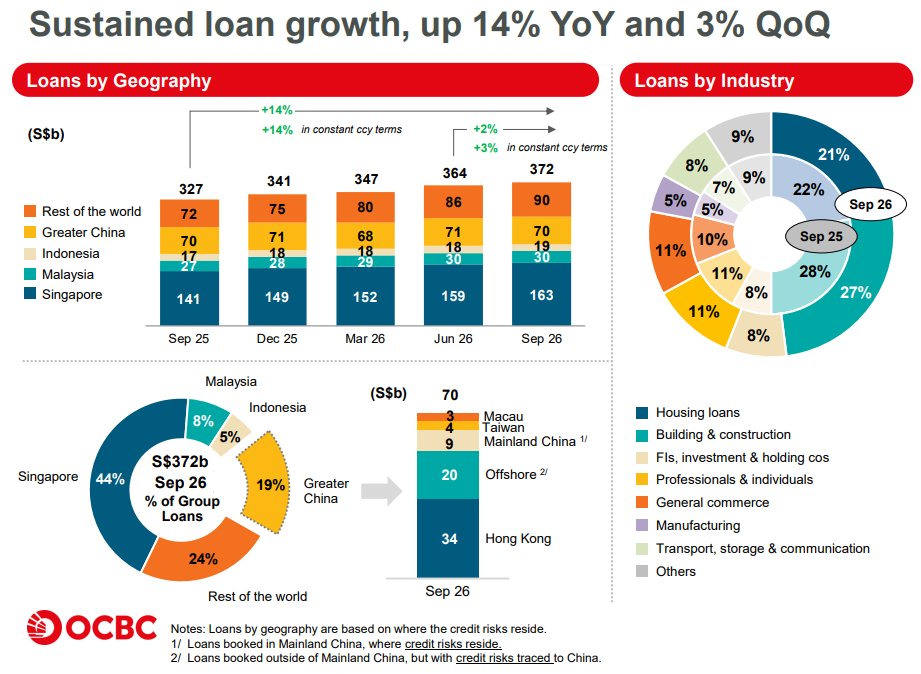
Customer loans grew to S$372 billion as at 30 September 2026, up 14% year-on-year and 3% quarter-on-quarter on a constant currency basis.
The year-on-year loan growth was broad-based across geographies and industries, led by high-growth sectors including TMT, digital infrastructure, transportation and power & utilities, as well as real estate in developed markets, consumer wealth and Singapore mortgage loans.
OCBC's sustainable financing loans grew 13% year-on-year to S$62.0 billion, accounting for 17% of total customer loans, with total commitments at S$86.0 billion.
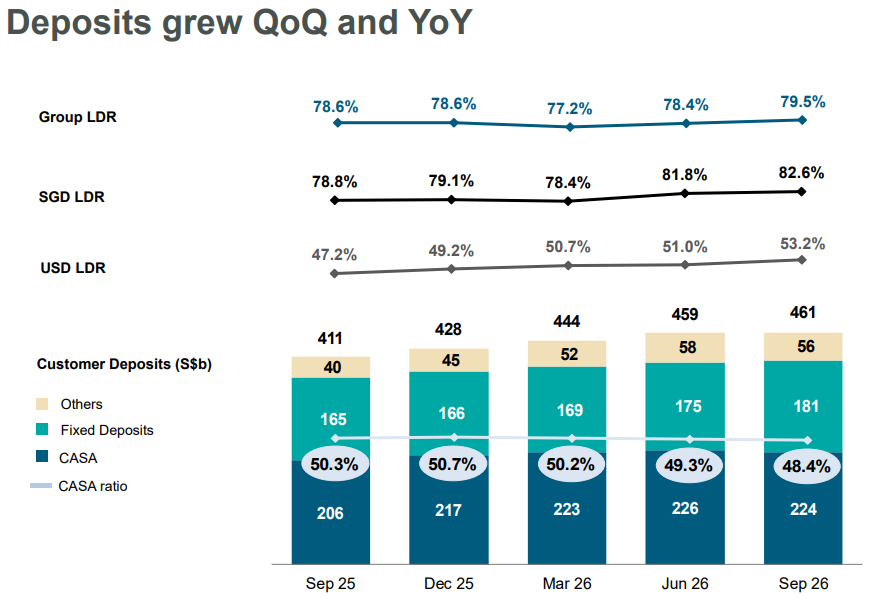
Customer deposits rose 12% year-on-year to S$461 billion, driven by growth in both CASA deposits and fixed deposits. The CASA ratio declined to 48.4% as at 30 September 2026, from 49.3% in the previous quarter.
#6 - Further upgrade to 2026 outlook
OCBC upgraded its 2026 financial guidance again alongside its 3Q26 results, following the earlier upgrade at 2Q26.
The main upgrade was once again in loan growth.
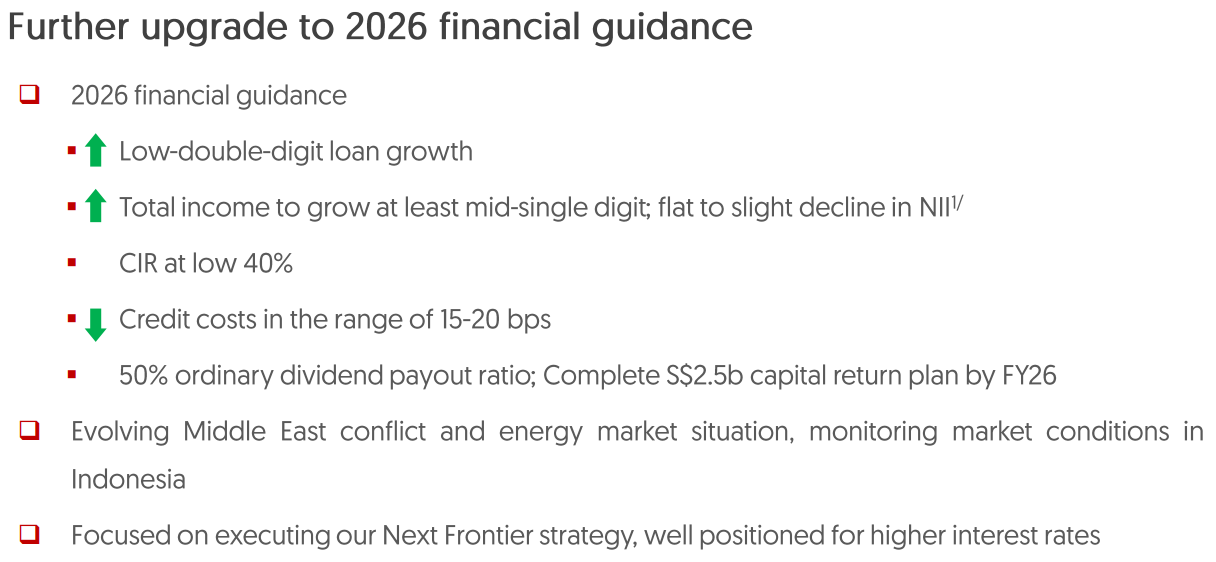
OCBC now expects loan growth to be in the low-double-digit range, up from its earlier high-single-digit to low-double-digit guidance. This follows the strong 14% year-on-year loan growth achieved in 9M26.
Total income guidance was also lifted further.
Management now expects total income to grow at least mid-single digit percentage, more specific than the earlier guidance of simply "to grow".
Net interest income guidance was slightly improved to flat to slight decline, from the earlier slight decline.
OCBC also provided updated FY26 rate assumptions of 3M SORA of around 1.2%, one additional Fed Fund Rate hike in 4Q26, and 3M HIBOR of around 2.9%.
Cost discipline guidance was maintained, with CIR expected to be at low 40%.
Credit cost guidance was significantly lowered to 15 to 20 basis points, from the earlier 20 to 25 basis points. This reflects the lower credit costs of just 14 basis points achieved in 9M26.
Dividend guidance was unchanged, with OCBC maintaining its 50% ordinary dividend payout ratio and its S$2.5 billion capital return plan targeted for completion by FY2026.
Notably, OCBC said it is now well positioned for higher interest rates, suggesting the bank sees the trajectory of rates turning in its favour.
Beansprout's Quick Take on OCBC 2Q26 earnings
OCBC's share price has pulled back from recent highs, with the stock closing at S$27.93 on 6 November 2026, ahead of the release of its 3Q26 results.
The results were supported by stronger banking operations. Net profit from banking operations reached a record S$1.90 billion, up 16% year-on-year, while net interest income rose 4% to S$2.31 billion.
Net interest margin (NIM) fell by just 4 basis points quarter-on-quarter, the smallest decline this year. OCBC also said it is well positioned for higher interest rates.
Loan growth remained strong at 14% year-on-year, while asset quality improved further. The non-performing loan ratio fell to 0.8%, with credit costs at 6 basis points.
Management also upgraded its guidance for loan growth, total income, net interest income and credit costs, reflecting a stronger operating outlook.
One area I would watch is Great Eastern. While underlying new business embedded value grew 14%, mark-to-market movements in its investment portfolio could continue to make insurance earnings more volatile.
The decline in OCBC's CASA ratio to 48.4% is another factor to monitor, as a larger share of fixed deposits could increase funding costs.
Valuation is also an important consideration. OCBC is now trading at 2.03x price to book, above historical average price-to-book multiples of 1.18x.
OCBC did not declare a dividend at the 3Q26 results, in line with its half-yearly dividend schedule.
Based on the consensus 2026 dividend per share of S$0.99, this would imply a dividend yield of 3.5% based on its closing price of S$27.93 on 6 November.
Investors can expect the FY26 final ordinary dividend, along with any special dividend as part of the S$2.5 billion capital return plan, to be announced alongside the 4Q26 results.
Want to see how OCBC stacks up against DBS and UOB on valuation, dividend yield and returns? Try Beansprout’s stock comparison tool here.
OCBC is one of the stocks in Beansprout’s Opportunity Pot Portfolio, where our analyst team highlights the opportunities we believe stand out in the market today. See the stocks in the portfolio, how much we allocate to each, and what we are watching next.
Related links:
Check out Beansprout's guide to the best stock trading platforms in Singapore with the latest promotions to invest in OCBC.
Enjoyed this insight? Follow Beansprout on Telegram, Youtube, Facebook and Instagram, and add Beansprout as your preferred source on Google so you never miss an update.
Read also
Gain financial insights in minutes
Subscribe to our free weekly newsletter for more insights to grow your wealth
Most Popular

Comments
0 comments