
kopi-C with Riverstone Holdings CEO: The glove maker quietly benefiting from the AI Boom
Stocks
Powered by

By Julian Wong • 24 Jun 2026
Why trust Beansprout? We’ve been awarded Best Investment Website at the SIAS Investors’ Choice Awards 2025
'%3e%3cpath%20fill-rule='evenodd'%20clip-rule='evenodd'%20d='M17.64%209.20455C17.64%208.56637%2017.5827%207.95273%2017.4764%207.36364H9V10.845H13.8436C13.635%2011.97%2013.0009%2012.9232%2012.0477%2013.5614V15.8195H14.9564C16.6582%2014.2527%2017.64%2011.9455%2017.64%209.20455V9.20455Z'%20fill='%234285F4'/%3e%3cpath%20fill-rule='evenodd'%20clip-rule='evenodd'%20d='M9%2018C11.43%2018%2013.4673%2017.1941%2014.9564%2015.8195L12.0477%2013.5614C11.2418%2014.1014%2010.2109%2014.4205%209%2014.4205C6.65591%2014.4205%204.67182%2012.8373%203.96409%2010.71H0.957275V13.0418C2.43818%2015.9832%205.48182%2018%209%2018V18Z'%20fill='%2334A853'/%3e%3cpath%20fill-rule='evenodd'%20clip-rule='evenodd'%20d='M3.96409%2010.71C3.78409%2010.17%203.68182%209.59318%203.68182%209C3.68182%208.40682%203.78409%207.83%203.96409%207.29V4.95818H0.957273C0.347727%206.17318%200%207.54773%200%209C0%2010.4523%200.347727%2011.8268%200.957273%2013.0418L3.96409%2010.71V10.71Z'%20fill='%23FBBC05'/%3e%3cpath%20fill-rule='evenodd'%20clip-rule='evenodd'%20d='M9%203.57955C10.3214%203.57955%2011.5077%204.03364%2012.4405%204.92545L15.0218%202.34409C13.4632%200.891818%2011.4259%200%209%200C5.48182%200%202.43818%202.01682%200.957275%204.95818L3.96409%207.29C4.67182%205.16273%206.65591%203.57955%209%203.57955V3.57955Z'%20fill='%23EA4335'/%3e%3c/g%3e%3cdefs%3e%3cclipPath%20id='clip0_0_2849'%3e%3crect%20width='18'%20height='18'%20fill='white'/%3e%3c/clipPath%3e%3c/defs%3e%3c/svg%3e)
Make Beansprout your preferred source on Google
Add us on Google to see more of our insights in your search results
Wong Teek Son built Riverstone Holdings from a glove chlorination service into one of the world's leading cleanroom glove manufacturers. He explains how an unassuming Malaysian industrialist ended up at the centre of the global semiconductor supply chain.
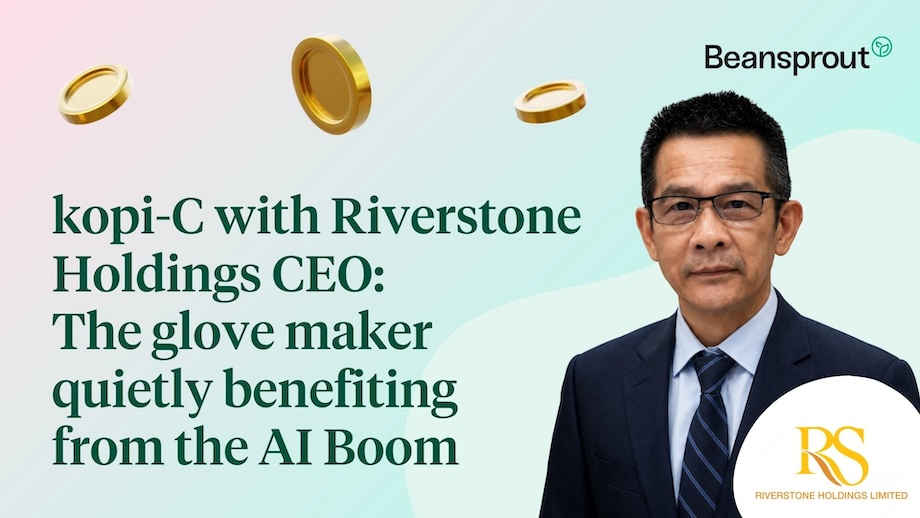
Wong Teek Son had already been at work for two hours.
He had flown into Singapore for Riverstone Holdings' annual general meeting, and even before sitting down for his 9 AM interview, he was on calls with raw material suppliers.
Now 64, Wong grew up in Cameron Highlands and studied chemistry, before going to work as an R&D chemist at a company supplying cleanroom products. When that company shut down, he saw an opening.
In the late 1980s, he established a sole proprietorship providing glove chlorination services to manufacturers already clustered in Malaysia. He did this with "very minimum capital expenditure," as he puts it.
His insight came from observing what those manufacturers were selling, and to whom. At the time, electronics companies across Malaysia were importing specialised cleanroom gloves from abroad.
Wong looked at what Malaysia already had (an established glove industry, the raw materials, the labour) and realised, “We could think of Malaysia as a high tech, clean room glove manufacturer.”
And he asked what felt like an obvious question: "Why don't we make use of this opportunity?"
In 1991, he and co-founder Lee Wai Keong established Riverstone Resources Sdn Bhd. By Wong's account, Riverstone became the first manufacturer in Asia with a fully integrated cleanroom glove production process. By 1995, the company had pioneered nitrile clean room glove manufacturing in Malaysia—a decade ahead of most peers.
Eventually, in 2006, it listed on the Singapore Exchange. They had done this, according to Wong, without a single bank loan.
“We just earned the profit and invested it,” he says.
As of 31 March 2026, Riverstone carries approximately RM700 million in net cash and no debt.
Two glovers, two businesses
At the moment, Riverstone makes two types of gloves.
The first is healthcare gloves which are used in hospitals, food service, and general industrial settings. These are a high-volume commodity, and competition is fierce, margins are thin, and the market often treats most products in this category as interchangeable.
The second is cleanroom gloves. These are unique in that they are engineered not only to protect the worker, but to protect the product. A semiconductor wafer, for instance, cannot tolerate contamination, corrosion, or static charge. The glove a technician wears serves as the last line of defence.
"A pair of gloves is not very expensive," Wong says, "but without the glove, they cannot start operations."
Manufacturing a cleanroom glove involves three distinct production stages compared to one for a standard examination glove. Every specification is customised: from glove length, surface finish, and electrostatic properties, to ionic content.
For instance, a single customer operating facilities across different countries might have different requirements at each site. Riverstone would then have to develop a distinct product for each.
Because the qualification process is so rigorous, switching suppliers is costly and disruptive. Once Riverstone's glove is qualified at a facility, it tends to stay.
Riverstone allocates roughly 80% of production capacity to healthcare gloves and 20% to cleanroom, but the cleanroom segment contributes around 70% of the group's gross profit.
The unlikely beneficiary of the AI boom
Among Riverstone's most important cleanroom customers are manufacturers in the hard disk drive and semiconductor industries—the companies whose products that power the data infrastructure on which the modern economy runs.
Until recently, the hard disk drive industry was widely considered a sunset business. Wong sees it differently now.
The explosion of AI infrastructure—data centres built to run large language models—has dramatically increased demand for high-density data storage. His major HDD customers are actively ramping up capacity, investing in heat-assisted magnetic recording, a technology that stores significantly more data per disk, and which requires the kind of precision manufacturing environment that Riverstone's cleanroom gloves are designed for.
And more production means more cleanroom gloves.
"Today, everyone is talking about AI," Wong says.
On the healthcare side, Wong remains clear-eyed about the competitive landscape.
Post-pandemic oversupply has kept pricing under pressure, and manufacturers expanding across Southeast Asia add further competition. Riverstone's response has been to push further into customised healthcare products—lower-chemical content gloves for food manufacturers and chemical-resistant variants—where it commands better margins than the generic market.
Looking ahead
Wong turns 64 this year. He starts work at 7:30 AM and schedules nothing after 3:30 PM in the afternoon. He has no immediate plans to retire, but preparations for succession have been underway.
Two alternate directors, both chemical engineers with over 30 years at Riverstone, sit on Riverstone’s board. Behind them, he describes two layers of internal successors in their forties and fifties.
"These are the people that will replace the founder," he says.
Right now, Riverstone plans to continue its approach of paying out approximately 100% of earnings plus a special dividend roughly equal to annual depreciation. It is a practice that has been consistent for years, aligned with Wong’s intent for capital to flow back to shareholders.
But more importantly, what Wong wants retail investors to understand is that Riverstone is not a story of dramatic growth, but of durable differentiation.
"A lot of people just compare Riverstone with other glove factories," he says.
He thinks that misses the point: "Over the past 30 years, we are the leader in developing all these new products."
In his view, this is what truly counts.
About Riverstone Holdings Limited
Malaysia-based Riverstone is a global market leader in the manufacturing of nitrile and natural rubber clean room gloves used in highly controlled and critical environments as well as premium nitrile gloves used in the healthcare industry. The company’s proprietary “RS Riverstone Resources” brand is the preferred cleanroom glove for use in high-tech manufacturing industries. The company also manufactures cleanroom consumables such as finger cots and facemasks. Its customers are global leaders in the HDD, LCD, semiconductor, consumer electronics, pharmaceutical and healthcare industries. The company employs approximately 3,000 people throughout its six manufacturing facilities in Malaysia (4), Thailand (1) and China (1) with an annual production capacity of 10.5 billion gloves. It also has an established global network of sales offices to serve its customers in Singapore, Malaysia, Thailand, the Philippines, China and the U.S. Riverstone was listed on the Mainboard of the Singapore Exchange in 2006.
About kopi-C: the Company brew
kopi-C is a regular column by SGX Research in collaboration with Beansprout, Singapore’s trusted investment intelligence platform which helps everyday investors build the knowledge and confidence to make decisions that matter. kopi-C features C-level executives of leading companies listed on SGX. These interviews are profiles of senior management aimed at helping investors better understand the individuals who run these corporations.
Read also
Gain financial insights in minutes
Subscribe to our free weekly newsletter for more insights to grow your wealth
Most Popular

Comments
0 comments