
Your savings aren't just for retirement. They're your permission slip to take risks
CPF & Retirement
By Julian Wong • 28 Mar 2026
Why trust Beansprout? We’ve been awarded Best Investment Website at the SIAS Investors’ Choice Awards 2025
'%3e%3cpath%20fill-rule='evenodd'%20clip-rule='evenodd'%20d='M17.64%209.20455C17.64%208.56637%2017.5827%207.95273%2017.4764%207.36364H9V10.845H13.8436C13.635%2011.97%2013.0009%2012.9232%2012.0477%2013.5614V15.8195H14.9564C16.6582%2014.2527%2017.64%2011.9455%2017.64%209.20455V9.20455Z'%20fill='%234285F4'/%3e%3cpath%20fill-rule='evenodd'%20clip-rule='evenodd'%20d='M9%2018C11.43%2018%2013.4673%2017.1941%2014.9564%2015.8195L12.0477%2013.5614C11.2418%2014.1014%2010.2109%2014.4205%209%2014.4205C6.65591%2014.4205%204.67182%2012.8373%203.96409%2010.71H0.957275V13.0418C2.43818%2015.9832%205.48182%2018%209%2018V18Z'%20fill='%2334A853'/%3e%3cpath%20fill-rule='evenodd'%20clip-rule='evenodd'%20d='M3.96409%2010.71C3.78409%2010.17%203.68182%209.59318%203.68182%209C3.68182%208.40682%203.78409%207.83%203.96409%207.29V4.95818H0.957273C0.347727%206.17318%200%207.54773%200%209C0%2010.4523%200.347727%2011.8268%200.957273%2013.0418L3.96409%2010.71V10.71Z'%20fill='%23FBBC05'/%3e%3cpath%20fill-rule='evenodd'%20clip-rule='evenodd'%20d='M9%203.57955C10.3214%203.57955%2011.5077%204.03364%2012.4405%204.92545L15.0218%202.34409C13.4632%200.891818%2011.4259%200%209%200C5.48182%200%202.43818%202.01682%200.957275%204.95818L3.96409%207.29C4.67182%205.16273%206.65591%203.57955%209%203.57955V3.57955Z'%20fill='%23EA4335'/%3e%3c/g%3e%3cdefs%3e%3cclipPath%20id='clip0_0_2849'%3e%3crect%20width='18'%20height='18'%20fill='white'/%3e%3c/clipPath%3e%3c/defs%3e%3c/svg%3e)
Make Beansprout your preferred source on Google
Add us on Google to see more of our insights in your search results
What a former record label MD's journey taught me about financial freedom, and how a boring savings habit can be the most exciting decision you ever make.

When Gerald Ang left his job as Managing Director of a major record label, he wasn't running away from something. He was stepping towards an idea he'd already been preparing for. He just hadn’t fully realised it.
He had teams, resources, and a title that commanded respect in rooms. Yet he gave it all up to start from scratch—doing everything himself—for clients he was still figuring out how to find.
What made that possible was something far more unglamorous than a brilliant business plan: years of simply being prudent with his spending.
Passion that doesn't pay is a hobby
Gerald’s relationship with money started in a pretty familiar place: ignoring it entirely.
Fresh out of Monash University, he and a group of friends started Frontal Labs, a music and lifestyle marketing company that ran events, managed a DJ school, and built one of Singapore's early online communities around music culture. They worked for brands like Gatsby and Levi's. They were the official website for Zouk Out. They were doing something real.
What they weren't doing was making much money.
Gerald was earning around $900 to $1,000 a month and didn't think twice about it. He was living in his parents’ home, had minimal expenses, and was completely absorbed in building something he cared about.
‘Passion first, profit later’ was his operating principle. And then the money ran out.
"I was broke," he says simply. "I needed to find a job."
It was a hard call to make because he felt he was selling out.
He was young and his financial literacy was low, but he knew enough to understand that passion doesn't pay rent. His mother—who had raised him and his brother on her own, working two jobs—exemplified this plainly. It was time to find something stable.
He got a job. Then something interesting happened: the financial stability didn't mute his creative ambition. It funded it.
What 'enough' really means
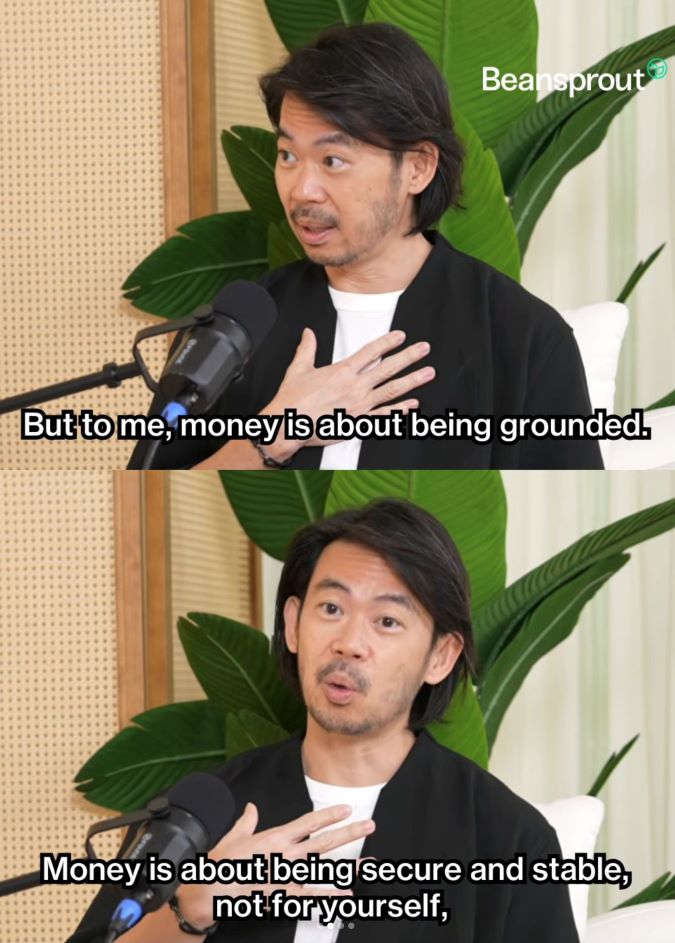
We all have different ways of defining financial success. For some it's a number—a specific portfolio value, a retirement target, a passive income figure. For others, it's a feeling.
Gerald’s definition has always been closer to the latter.
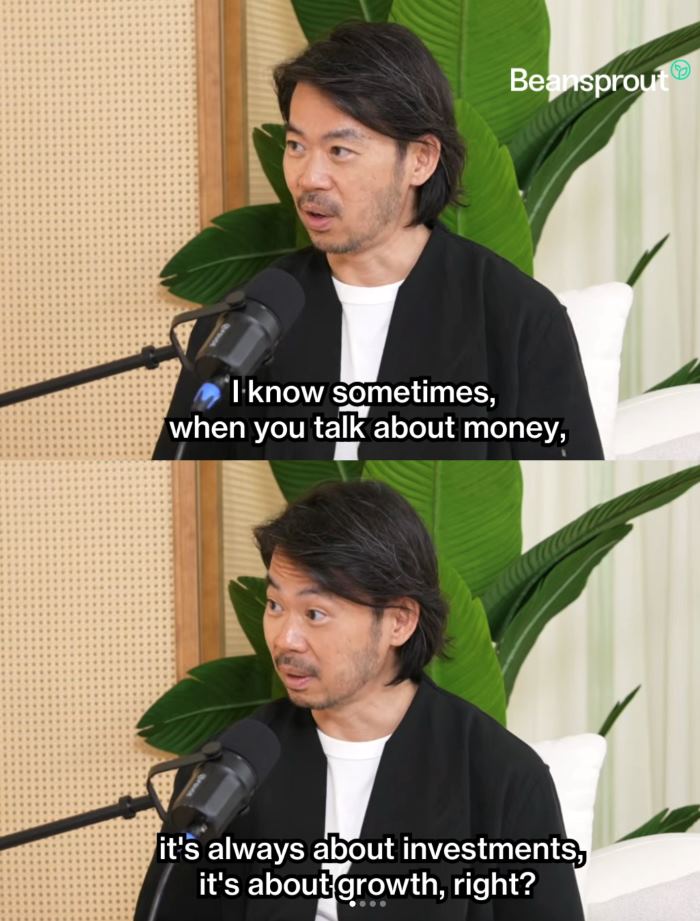
He describes it me in disarmingly simple terms: waking up without worrying about money. Looking after his family. Taking his friends out for beers and meals without thinking twice.
"It’s as simple as that," he says.
Simple, yet powerful. Because he wasn't chasing a glitzy target, he didn't inflate his lifestyle every time his income grew. As he moved up in his career—starting from NCS and eventually being headhunted into other roles, and eventually into senior leadership at a global record label—the money grew, but his baseline needs didn't grow with it.
He automated 20% of his salary into a company share scheme. He watched it accumulate over five or six years, and eventually pulled it out and felt, he said, pleasantly surprised.
He didn't have a financial strategy, exactly. But he had a habit, and the habit compounded.
His benchmark for comfort was eventually settling on having one to two years of living expenses in reserve. It wasn’t aggressive or sophisticated, but the number gave him peace of mind.
The buffer as a launchpad
Most personal finance content frames the emergency fund as a defensive tool. As something you build so that a bad month doesn't snowball into a catastrophe.
While this framing is correct, it leaves something out.
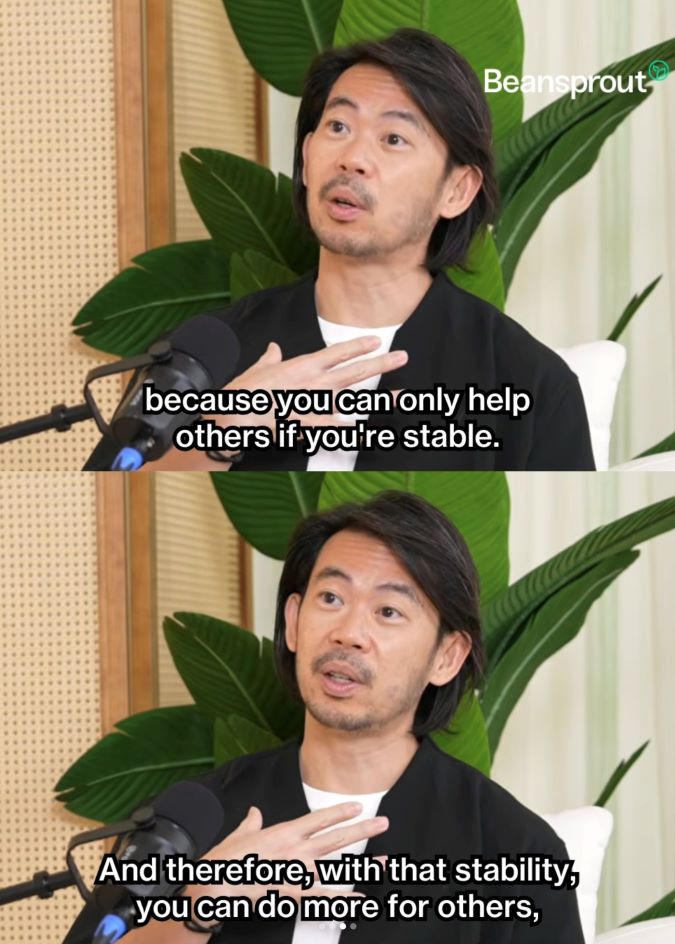
Gerald’s story illustrates that a cash buffer is also an offensive weapon. It gives you the ability to take risks, change direction, and say no to the wrong opportunity while waiting for the right one.
When he finally made the leap into running his own business, the prudence paid off in a way he never expected: it gave him confidence.
What was that confidence built on? It was built on the knowledge that he had time. Time to figure it out; to make mistakes without those mistakes ending the game.
"Businesses take a while to build and grow," he says. "As entrepreneurs, as small business owners, sometimes you run out of resources before you can give yourself a chance."
That buffer was his chance. It bought him the runway to get started, stay the course, and eventually build something that now supports a small team.
He's the first to admit the journey wasn't perfectly planned. He never strategised his way into senior roles and he didn't have a five-year plan.
Instead, he relied on having a clear sense of what he valued, the discipline not to spend money on things that didn't align with those values, and enough in reserve to act when the right moment came.
The one dumb decision he doesn't regret
Yet he’s also human, and he reminds us that none of this means living a life of relentless financial optimisation.
Gerald drove a Mini for about twelve years. In fact, he owned two Minis in total.
He was well aware of all the reasons not to own a car in Singapore—the fact that it was a depreciating asset, that COE prices in Singapore make cars a particularly poor financial decision. His salary wasn't even especially high when he bought his first one.
He bought it anyway.
“I tell people that was the dumbest thing I’ve ever done,” he said. “It’s so dumb, but it felt great.”
He got married in that car. Took his dog out in it. Made memories he still talks about. It wasn’t the smartest financial decision. But the financial groundwork he'd laid gave him the room to make this one impractical decision without it derailing everything else.
When your foundation is solid, you can afford the Mini. When it isn't, you can't.
What this means in practice
To be clear, Gerald’s story shouldn’t be treated as an instruction manual. His circumstances—single-parent household, early entrepreneurial phase, corporate trajectory—are his own. But the underlying principles should resonate.
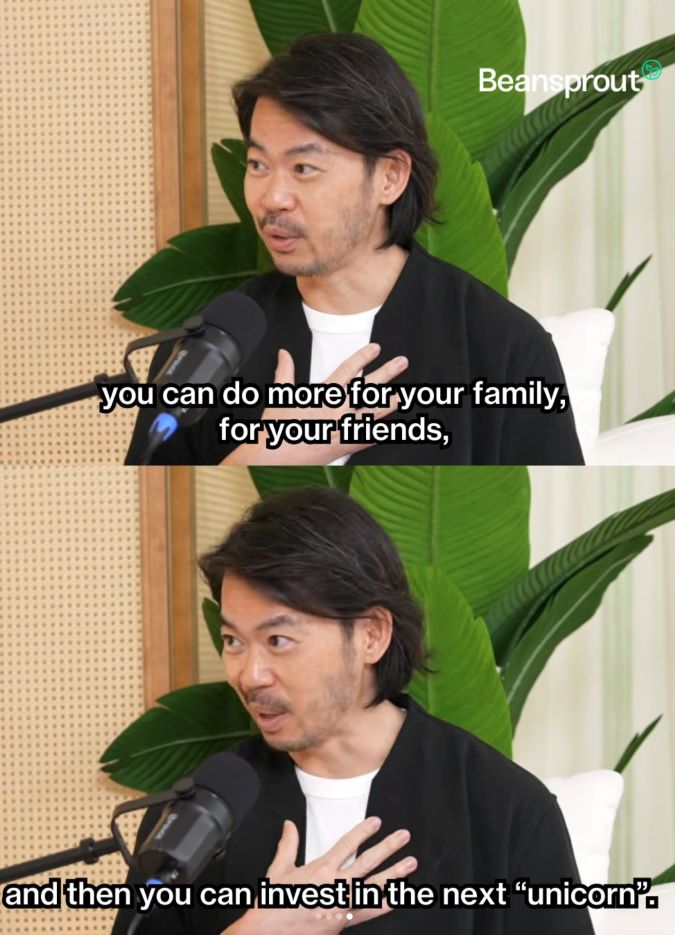
Savings aren't just a retirement vehicle. They're also a tool that gives us options.
They let you take career risks, leave jobs that are wrong for you, and start something without being forced to either make it work in three months or give up.
The question isn't just, “How much do I need to retire?” It's, “How much do I need to feel free to make decisions on my own terms?”
For Gerald, the answer was one to two years of expenses.
For you, it might be different.
But the principle remains: figure out your number, build towards it, automate it so you're not relying on discipline every month, and then leave it alone.
It won't feel exciting, but that's the point. If the timing is right, the excitement comes later—when the opportunity appears and you can actually say yes.
Gerald Ang shares his full story on the latest episode of Money Diaries. Watch it here now.
Follow us on Telegram, Youtube, Facebook and Instagram to get the latest financial insights.
Read also
Gain financial insights in minutes
Subscribe to our free weekly newsletter for more insights to grow your wealth
Most Popular

Comments
0 comments