
Inside the AI chip: Accessing TSMC and SK hynix through SGX SDRs
Singapore Depository Receipts
Powered by

By Gerald Wong, CFA • 13 Nov 2026
Why trust Beansprout? We’ve been awarded Best Investment Website at the SIAS Investors’ Choice Awards 2025

Make Beansprout your preferred source on Google
Add us on Google to see more of our insights in your search results
Learn how TSMC and SK hynix support AI computing through advanced chip manufacturing, high-bandwidth memory and packaging, and how investors can access them through SGX SDRs.
What happened?
A powerful AI processor is only useful if it can get the data it needs quickly enough.
As AI models become larger and more demanding, improving computing performance is no longer just about making the processor faster.
The memory supplying that processor also has to keep up, while the different components need to be connected closely enough to exchange enormous amounts of data efficiently.
This is why a modern AI accelerator increasingly depends on three important pieces working together: advanced logic chips, high-bandwidth memory, and advanced packaging.
TSMC and SK hynix play different roles in this system.
TSMC manufactures the advanced logic chips used in AI accelerators and provides packaging technologies that integrate them with other components.
SK hynix produces high-bandwidth memory, or HBM, which helps supply those processors with data at very high speeds.
Their technologies are also becoming more closely connected.
TSMC and SK hynix are collaborating on next-generation HBM and advanced packaging as AI systems demand more computing power and memory bandwidth.
In this article, we look inside an AI accelerator to understand why logic, memory, and packaging all matter, how TSMC and SK hynix contribute to the system, and how Singapore investors can access both companies through SGX-listed SDRs.
What actually goes into an AI accelerator?
An AI accelerator is best understood as an integrated computing system.
At the core is the logic processor, such as a GPU or other AI accelerator, which performs the calculations required to train and run AI models.
Compute performance, however, also depends on how quickly data can be supplied to that processor.
As model sizes and workloads increase, memory bandwidth can become a constraint if data cannot be transferred fast enough to keep the processor fully utilised.
High-bandwidth memory, or HBM, addresses this requirement by stacking multiple DRAM dies vertically and placing them close to the processor.
Compared with conventional memory architectures, this allows significantly more data to move between memory and the accelerator at the same time.
SK hynix describes HBM as a high-performance memory product that vertically connects multiple DRAM chips to increase data-processing speed.
The next challenge is integrating the processor and memory efficiently.
Advanced packaging allows multiple semiconductor components to be combined within a single package with high-density connections between them.
This is increasingly important for AI accelerators, where logic and memory need to exchange large volumes of data with minimal delay.
TSMC's CoWoS, or Chip-on-Wafer-on-Substrate, is one example.
The technology enables a logic processor and multiple HBM stacks to be integrated within the same package, providing high-bandwidth connections between the compute and memory components.
A simplified view of the AI accelerator ecosystem is:
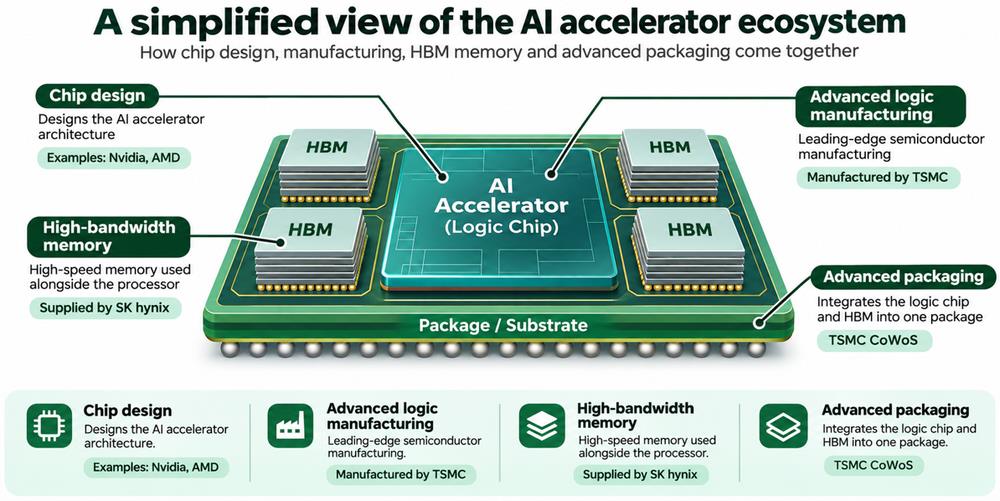
The key point is that AI performance is determined by the system as a whole. Increasing processor performance alone is not sufficient if memory bandwidth or the connections between components become bottlenecks.
As AI accelerators become more powerful, the requirements for leading-edge logic, faster memory, and more advanced packaging rise together.
TSMC: Who actually manufactures the AI processor?
TSMC sits at the manufacturing end of the semiconductor value chain.
The company operates as a pure-play foundry, manufacturing chips designed by customers across high-performance computing, smartphones, automotive, and other applications.
For AI accelerators, this role has become increasingly important as chip designs move towards more advanced manufacturing processes.
Semiconductor processes are commonly described by nodes such as 7nm, 5nm, 3nm and 2nm.
While these labels no longer correspond directly to a single physical dimension on the chip, newer process technologies generally allow chip designers to increase transistor density while improving performance and power efficiency.
That matters for AI workloads, where processors are being asked to perform more calculations while managing growing power and thermal constraints.
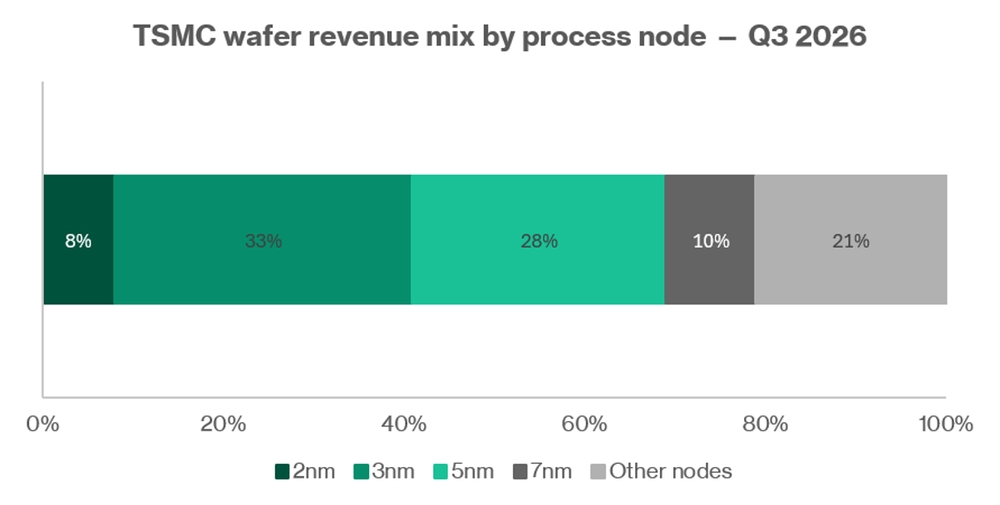
TSMC's revenue mix reflects this shift towards advanced manufacturing.
In Q3 2026, 79% of its wafer revenue came from process technologies at 7nm or below. Its 3nm technology accounted for 33% of wafer revenue, followed by 5nm at 28%, 7nm at 10%, and the newer 2nm process at 8%.
At the same time, high-performance computing has become TSMC's largest end-market platform.
HPC accounted for 68% of revenue in 3Q26, up from 57% a year earlier.
This category includes applications such as AI accelerators, data-centre processors and other high-performance chips.
For investors, TSMC's exposure to AI is mainly through the manufacturing requirements created by increasingly complex chip designs.
As customers move towards more advanced processors, demand can translate into greater use of leading-edge process nodes and advanced packaging capacity.
The key variables to watch are AI adoption rate, customer demand for advanced nodes, manufacturing yields, capacity utilisation, and TSMC's ability to ramp new process technologies at scale.
Why advanced packaging matters for AI chips
As AI chips become larger and require more memory, semiconductor companies increasingly need to integrate multiple components within the same package.
This has pushed advanced packaging from a relatively downstream manufacturing step into a more important part of system performance.
TSMC's CoWoS, or Chip-on-Wafer-on-Substrate, technology is designed for this type of integration. It allows advanced logic chips and multiple HBM stacks to sit within the same package, connected through high-density interconnects.
For AI accelerators, the benefit is straightforward: the closer and more efficiently the processor and memory can communicate, the more data can be transferred without creating a bottleneck around the compute engine.
TSMC has continued to increase the size and capability of its CoWoS platform to accommodate more logic and HBM. Its newer configurations are designed to support larger AI systems as customers increase both computing power and memory capacity within each package.
This also creates a second source of AI-related demand for TSMC beyond wafer manufacturing. As AI accelerators become more complex, advanced packaging capacity can become an important constraint alongside leading-edge foundry capacity.
For investors, this makes packaging utilisation, capacity expansion and customer adoption increasingly relevant alongside more traditional indicators such as process-node mix and wafer demand.
SK hynix: Why memory bandwidth matters
SK hynix plays a different role in the AI hardware stack.
The company is one of the world's largest memory semiconductor manufacturers, producing DRAM, NAND flash and specialised memory products. Within AI infrastructure, a key source of AI exposure comes from high-bandwidth memory, or HBM.
AI processors can perform large numbers of calculations in parallel, but their performance also depends on how quickly data can be supplied to them.
As model sizes and workloads grow, memory bandwidth becomes increasingly important because the processor needs to access larger volumes of data without spending time waiting.
HBM helps address this bottleneck by stacking multiple DRAM dies vertically and placing the memory stacks alongside the accelerator within the same package. A wide interface allows large amounts of data to move between memory and compute simultaneously.
SK hynix’s HBM3E delivers bandwidth of up to 1.23 terabytes per second per stack. Its HBM4 doubles the interface width from 1,024 to 2,048 bits, supporting bandwidth above 2 terabytes per second. According to the company, its HBM4 also improves power efficiency by more than 40% compared with the previous generation.
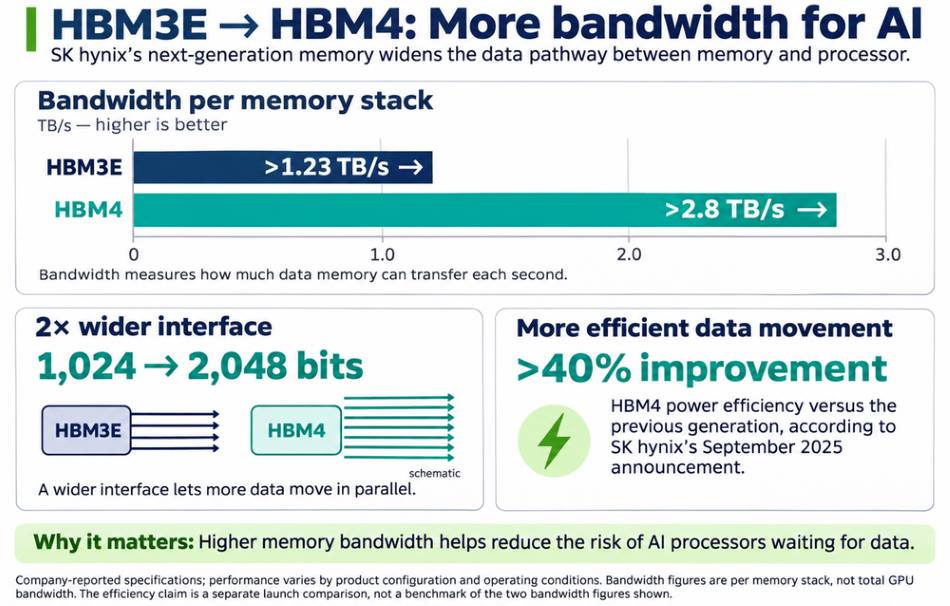
Greater power efficiency matters as AI data centres expand. Moving more data while using less energy per bit can help manage electricity consumption and heat generation, alongside improvements in computing performance.
SK hynix has been ramping HBM4 production as customers transition to newer generations of AI accelerators. Management has also pointed to long-term customer agreements as a source of greater demand visibility.
For investors, however, AI server growth is only part of the picture. SK hynix’s earnings also depend on its HBM market share, customer qualification, production yields and ability to deliver new product generations at scale. Broader DRAM and NAND pricing remains important, even as HBM becomes a larger part of its business.
How TSMC and SK hynix are becoming more closely linked
Although TSMC and SK hynix operate in different parts of the semiconductor value chain, the technologies they produce are increasingly interconnected.
In 2024, the companies announced a collaboration on HBM4 and next-generation packaging technologies.
SK hynix plans to use TSMC's advanced logic process for the HBM4 base die, while both companies are also working to optimise the integration of HBM with TSMC's CoWoS platform.
This reflects a broader change in AI hardware design.
As the industry moves towards larger accelerators with more memory and higher bandwidth requirements, performance increasingly depends on how well the processor, memory and packaging architecture are designed to work together.
The relationship also shows why analysing AI hardware companies purely by product category can be limiting.
TSMC is primarily a foundry, and SK hynix is primarily a memory manufacturer, but the performance requirements of next-generation AI accelerators increasingly link their technologies together.
Same AI demand, different business models
TSMC and SK hynix both benefit from rising demand for AI infrastructure, but the way that demand flows through their businesses is different.
| TSMC | SK hynix | |
| Business model | Pure-play semiconductor foundry | Memory semiconductor manufacturer |
| AI exposure | Advanced logic manufacturing and packaging | HBM and server memory |
| Key technologies | 2nm, 3nm, CoWoS | HBM3E, HBM4 |
| Main demand drivers | Advanced chip designs, leading-edge node demand, packaging capacity | HBM volumes, memory content, server demand and pricing |
| Key operating metrics | Node mix, yields, utilisation and capacity | HBM share, product transitions, yields and memory pricing |
Their geographic exposure is also broader than where the companies are headquartered.
In 3Q26, 79% of TSMC's revenue came from customers based in North America, while China accounted for 5%. This reflects the company's role as a manufacturing partner to semiconductor designers around the world.
SK hynix also serves a global customer base, including major technology and cloud companies. As of October 2026, the company had signed long-term agreements with 14 major customers, including leading global cloud service providers, covering more than 50% of its total planned production capacity for 2027 and 2028.
Both companies' earnings are closely tied to global semiconductor and data-centre investment trends.
How do their valuations compare?
TSMC and SK hynix are both profitable semiconductor companies, but their valuations reflect different growth prospects and earnings risks.
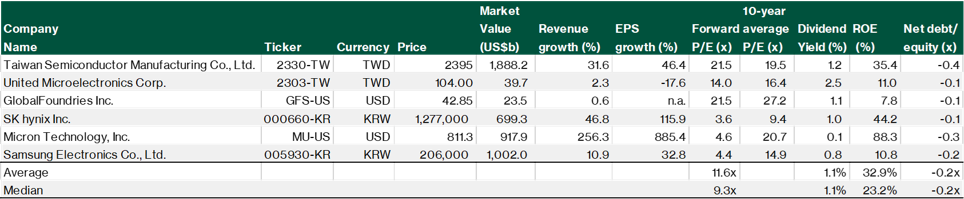
TSMC trades at 21.5 times forward earnings, about 10% above its 10-year average of 19.5 times.
Management’s guidance provides some support for this premium. TSMC expects revenue to grow by around 44% in US dollar terms in 2026, and has guided for fourth-quarter gross margins of 65%–67%. This points to strong growth alongside continued high profitability.
However, trading above its historical average means sustained growth remains important.
SK hynix trades at 3.6 times forward earnings, about 62% below its 10-year average of 9.4 times.
It also trades below memory peers Micron and Samsung Electronics, at 4.6 times and 4.4 times respectively.
Management’s outlook offers support for demand visibility. SK hynix expects HBM4 to surpass HBM3E in shipment volume and revenue in the fourth quarter, and says long-term customer agreements cover more than half of its production capacity for 2027 and 2028.
These arrangements could help support a more durable earnings base.
Nevertheless, a low P/E does not automatically mean the shares are undervalued.
Memory companies can look particularly inexpensive when earnings are near a cyclical high. If pricing weakens and profits decline, the P/E can rise even without an increase in the share price.
Ultimately, TSMC’s premium depends on delivering sustained growth, while SK hynix’s discount needs to be assessed against the durability of its earnings. Historical valuations provide a useful reference, but changes in growth prospects and business mix also matter.
What risks should investors watch?
TSMC: execution and capital intensity
Moving to a new semiconductor process requires significant research spending and capital investment. New nodes also need to achieve sufficient manufacturing yields before they can be produced efficiently at scale.
TSMC's expansion into the US, Japan and Europe can diversify its manufacturing footprint, but overseas fabs may also carry higher construction and operating costs.
The company remains exposed to geopolitical risk and changes in semiconductor export controls given its position in the global advanced-chip supply chain.
Investors may want to monitor new-node yields, capital expenditure, utilisation rates, overseas fab costs and customer concentration.
SK hynix: memory cycles and HBM execution
Memory remains a cyclical industry.
Changes in DRAM and NAND supply can cause prices to rise or fall sharply, which can have a meaningful impact on SK hynix's revenue and margins.
HBM provides a higher-value growth segment, but it also introduces execution risk. Each new generation needs to meet demanding performance requirements and qualify with major customers before production can scale.
Competition is another consideration, with Samsung Electronics and Micron also investing heavily in next-generation HBM.
Investors may want to monitor HBM market share, customer qualification, product yields, memory pricing and the pace of HBM3E-to-HBM4 adoption.
AI infrastructure spending
Both companies are also exposed to the pace of global AI infrastructure investment.
A slowdown in data-centre capital expenditure could reduce demand for advanced processors, HBM and packaging capacity.
The effect would not be identical. For TSMC, it would affect demand for advanced logic manufacturing and packaging. For SK hynix, it would flow more directly through HBM volumes, memory pricing and product mix.
How can Singapore investors access TSMC and SK hynix through SGX SDRs?
Singapore investors can access both companies through Singapore Depository Receipts, or SDRs, listed on SGX.
The TSMC and SK hynix SDRs began trading on 16 October 2026.
| Company | SGX SDR | SDR ratio | Effective date |
| TSMC | UTSD | 300 SDRs : 1 underlying security | 16-Oct-26 |
| SK hynix | UNXD | 100 SDRs : 1 underlying security | 16-Oct-26 |
Both counters trade in Singapore dollars.
Unlike some of the Hong Kong SDRs available on SGX, these SDRs reference the companies' US-listed depository securities rather than their Taiwan- or Korea-listed ordinary shares.
For investors, the SDR provides another way to gain economic exposure to the underlying company through SGX. The SDR ratio determines how many SDR units correspond to one underlying depository security.
Trading in Singapore dollars does not remove foreign-exchange exposure. The value of an SDR is influenced by the price of the underlying security as well as factors such as foreign-exchange movements, liquidity, supply and demand. The SDR ratio determines how many SDR units correspond to one underlying security.
Investors should also review how corporate actions, distributions and other shareholder entitlements are handled under the relevant SDR programme.
What should investors take away?
TSMC and SK hynix provide exposure to different parts of the AI hardware supply chain.
TSMC's role is centred on advanced logic manufacturing and packaging, while SK hynix is exposed primarily through HBM and other memory products.
Their collaboration on HBM4 also illustrates how closely these parts of the semiconductor value chain are becoming connected as AI accelerators require more compute, more memory and greater bandwidth.
For investors looking at companies linked to AI infrastructure, the more useful question is not simply whether a company has "AI exposure".
It is where the company sits in the hardware stack, what drives demand for its products, and what operational factors determine whether that demand translates into earnings.
Download the full report here.
Check out Beansprout's guide to the best stock trading platforms in Singapore with the latest promotions to invest in Singapore Depository Receipts.
Join the Beansprout Telegram group for the latest insights on Singapore stocks, REITs, bonds and ETFs.
Important Disclosures
Analyst Certification and Disclosures
The analyst(s) named in this report certifies that (i) all views expressed in this report accurately reflect the personal views of the analyst(s) with regard to any and all of the subject securities and companies mentioned in this report and (ii) no part of the compensation of the analyst(s) was, is, or will be, directly or indirectly, related to the specific views expressed by that analyst herein. The analyst(s) named in this report (or their associates) does not have a financial interest in the corporation(s) mentioned in this report.
An associate is defined as (i) the spouse, or any minor child (natural or adopted) or minor step-child, of the analyst; (ii) the trustee of a trust of which the analyst, his spouse, minor child (natural or adopted) or minor step-child, is a beneficiary or discretionary object; or (iii) another person accustomed or obliged to act in accordance with the directions or instructions of the analyst.
Company Disclosure
Global Wealth Technology Pte Ltd (“Beansprout”) does not have any financial interest in the corporation(s) mentioned in this report.
Beansprout received monetary compensation from Singapore Exchange (SGX) to provide independent research on Singapore Depository Receipts (SDRs).
Disclaimer
This report is provided by Beansprout for the use of intended recipients only and may not be reproduced, in whole or in part, or delivered or transmitted to any other person without our prior written consent. By accepting this report, the recipient agrees to be bound by the terms and limitations set out herein.
You acknowledge that this document is provided for general information purposes only. Nothing in this document shall be construed as a recommendation to purchase, sell, or hold any security or other investment, or to pursue any investment style or strategy. Nothing in this document shall be construed as advice that purports to be tailored to your needs or the needs of any person or company receiving the advice. The information in this document is intended for general circulation only and does not constitute investment advice. Nothing in this document is published with regard to the specific investment objectives, financial situation and particular needs of any person who may receive the information.
Nothing in this document shall be construed as, or form part of, any offer for sale or subscription of or solicitation or invitation of any offer to buy or subscribe for any securities. The data and information made available in this document are of a general nature and do not purport, and shall not in any way be deemed, to constitute an offer or provision of any professional or expert advice, including without limitation any financial, investment, legal, accounting or tax advice, and shall not be relied upon by you in that regard. You should at all times consult a qualified expert or professional adviser to obtain advice and independent verification of the information and data contained herein before acting on it. Any financial or investment information in this document are intended to be for your general information only.
You should not rely upon such information in making any particular investment or other decision which should only be made after consulting with a fully qualified financial adviser. Such information do not nor are they intended to constitute any form of financial or investment advice, opinion or recommendation about any investment product, or any inducement or invitation relating to any of the products listed or referred to. Any arrangement made between you and a third party named on or linked to from these pages is at your sole risk and responsibility.
You acknowledge that Beansprout is under no obligation to exercise editorial control over, and to review, edit or amend any data, information, materials or contents of any content in this document. You agree that all statements, offers, information, opinions, materials, content in this document should be used, accepted and relied upon only with care and discretion and at your own risk, and Beansprout shall not be responsible for any loss, damage or liability incurred by you arising from such use or reliance.
This document (including all information and materials contained in this document) is provided “as is”. Although the material in this document is based upon information that Beansprout considers reliable and endeavours to keep current, Beansprout does not assure that this material is accurate, current or complete and is not providing any warranties or representations regarding the material contained in this document. All opinions contained herein constitute the views of the analyst(s) named in this report, they are subject to change without notice and are not intended to provide the sole basis of any evaluation of the subject securities and companies mentioned in this report. Any reference to past performance should not be taken as an indication of future performance. To the fullest extent permissible pursuant to applicable law, Beansprout disclaims all warranties and/or representations of any kind with regard to this document, including but not limited to any implied warranties of merchantability, non-infringement of third-party rights, or fitness for a particular purpose.
Beansprout does not warrant, either expressly or impliedly, the accuracy or completeness of the information, text, graphics, links or other items contained in this document. Neither Beansprout nor any of its affiliates, directors, employees or other representatives will be liable for any damages, losses or liabilities of any kind arising out of or in connection with the use of this document. To the best of Beansprout’s knowledge, this document does not contain and is not based on any non-public, material information. The information in this document is not intended for distribution to, or use by, any person or entity in any jurisdiction where such distribution or use would be contrary to law or regulation, or which would subject Beansprout to any registration requirement within such jurisdiction or country. Beansprout is not licensed or regulated by any authority in any jurisdiction or country to provide the information in this document.
As a condition of your use of this document, you agree to indemnify, defend and hold harmless Beansprout and its affiliates, and their respective officers, directors, employees, members, managing members, managers, agents, representatives, successors and assigns from and against any and all actions, causes of action, claims, charges, cost, demands, expenses and damages (including attorneys’ fees and expenses), losses and liabilities or other expenses of any kind that arise directly or indirectly out of or from, arising out of or in connection with violation of these terms, use of this document, violation of the rights of any third party, acts, omissions or negligence of third parties, their directors, employees or agents. To the extent permitted by law, Beansprout shall not be liable to you, any other person, or organization, for any direct, indirect, special, punitive, exemplary, incidental or consequential damages, whether in contract, tort (including negligence), or otherwise, arising in any way from, or in connection with, the use of this document and/or its content. This includes, without limitation, liability for any act or omission in reliance on the information in this document. Beansprout expressly disclaims and excludes all warranties, conditions, representations and terms not expressly set out in this User Agreement, whether express, implied or statutory, with regard to this document and its content, including any implied warranties or representations about the accuracy or completeness of this document and the content, suitability and general availability, or whether it is free from error.
If these terms or any part of them is understood to be illegal, invalid or otherwise unenforceable under the laws of any state or country in which these terms are intended to be effective, then to the extent that they are illegal, invalid or unenforceable, they shall in that state or country be treated as severed and deleted from these terms and the remaining terms shall survive and remain fully intact and in effect and will continue to be binding and enforceable in that state or country.
These terms, as well as any claims arising from or related thereto, are governed by the laws of Singapore without reference to the principles of conflicts of laws thereof. You agree to submit to the personal and exclusive jurisdiction of the courts of Singapore with respect to all disputes arising out of or related to this Agreement. Beansprout and you each hereby irrevocably consent to the jurisdiction of such courts, and each Party hereby waives any claim or defence that such forum is not convenient or proper.
Read also
Gain financial insights in minutes
Subscribe to our free weekly newsletter for more insights to grow your wealth
Most Popular

Comments
0 comments