
Should India be in your portfolio? How investors can access the Nifty 50 through SGX
ETFs
Powered by
By Gerald Wong, CFA • 30 Oct 2026
Why trust Beansprout? We’ve been awarded Best Investment Website at the SIAS Investors’ Choice Awards 2025
Should India be in your portfolio? We examine the Nifty 50's performance, valuations, and risks, and how UTI's new SGX-listed ETF compares with other India ETFs.

This post was created in partnership with UTI Investments. All views and opinions expressed in this article are Beansprout's objective and professional opinions.
What happened?
2026 has been a difficult year for Indian equities.
According to Bloomberg data shared by UTI, the Nifty 50 fell about 18% in US dollar terms year-to-date as at 30 September 2026.
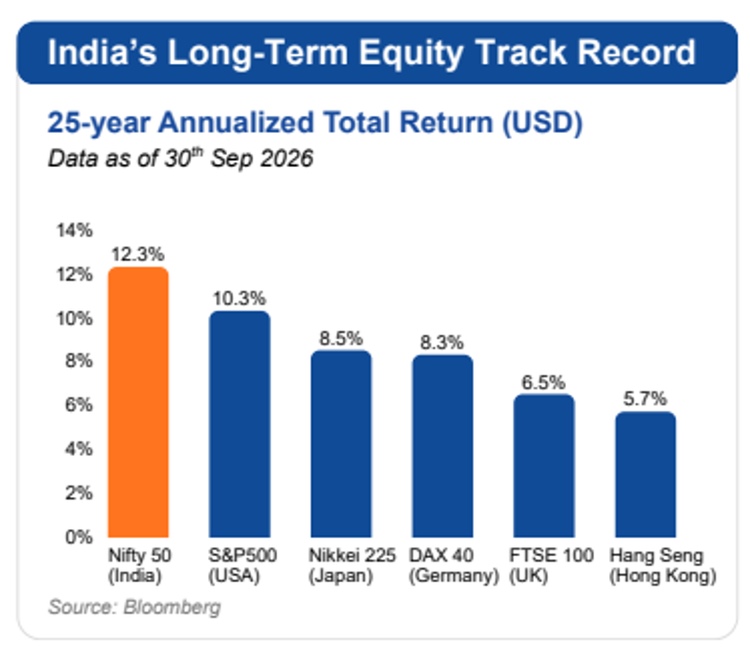
This comes despite India's longer-term economic growth potential and strong historical stock market returns. Over the past 25 years, the Nifty 50 generated an annualised total return of 12.3% in US dollar terms.
Singapore investors will soon have another way to gain exposure to the Indian stock market.
The UTI India Nifty 50 Index ETF VCC, managed by UTI International (Singapore), is scheduled to list on SGX on 12 November 2026. It will be the first SGX-listed ETF tracking the Nifty 50, India's flagship large-cap index.
But does India's recent underperformance mean that valuations have become more attractive, or are there still risks investors should be aware of?
In this article, we'll look at some reasons to look at India, what the Nifty 50 offers, how the new UTI ETF compares with other India ETFs, and what to consider before adding India exposure to your portfolio.
What are reasons to look at India?
#1 – India's stock market has delivered strong long-term returns
India has been one of the stronger-performing major equity markets over the past 25 years, although its performance has varied considerably across shorter periods.
According to Bloomberg data published by UTI, the Nifty 50 generated an annualised 12.3% total return in US dollars over the 25 years to 30 September 2026, versus 10.3% for the S&P 500 over the same period.
However, returns for Singapore investors may differ due to currency movements, while shorter investment periods may also produce different outcomes.
#2 – Indian equity valuations have moderated
The Nifty 50's trailing P/E is 20.38x, below its 10-year average of 23.49x as of 30 September 2026, according to Bloomberg data published by UTI.
The trailing P/E ratio measures valuations relative to the underlying companies' earnings over the preceding 12 months.
This suggests that investors are paying less for each dollar of historical earnings compared with the average over that period.
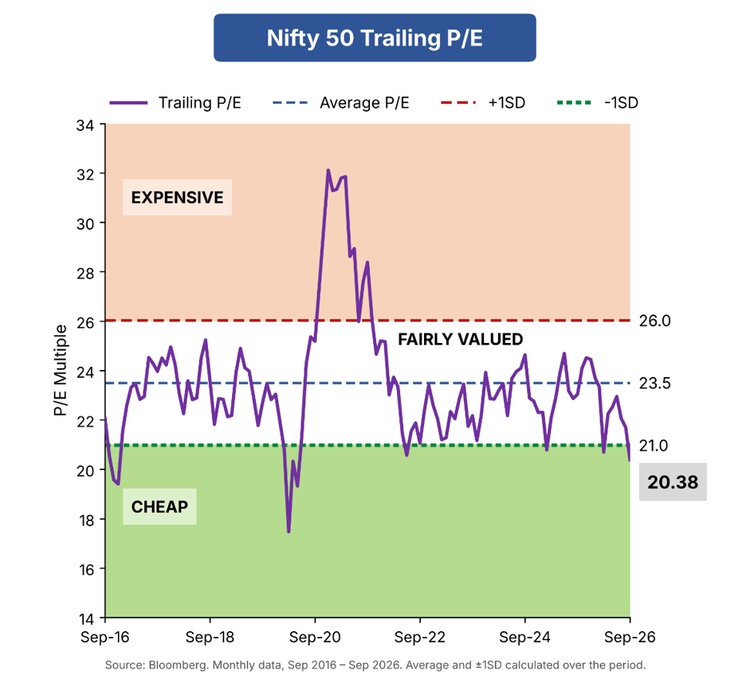
A lower starting valuation could improve the long-term investment case, particularly if corporate earnings continue to grow.
However, lower valuations do not necessarily mean Indian equities are cheap or that a market recovery is imminent.
Earnings could weaken, while investors may become less willing to pay a premium for Indian companies.
#3 – India offers exposure to different economic and earnings drivers
For investors whose portfolios are largely invested in US equities, India may offer exposure to a different set of economic drivers.
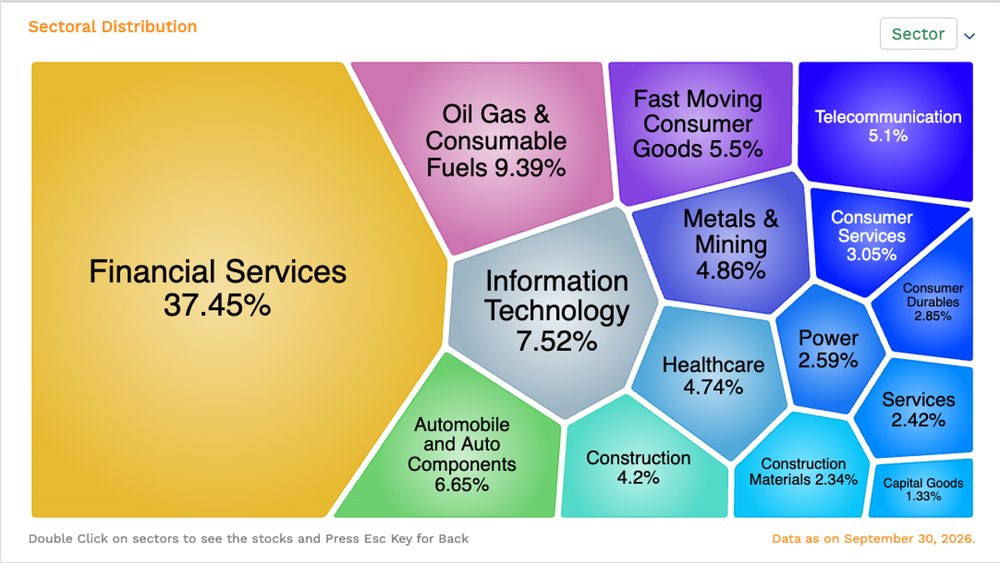
While major US indices are heavily influenced by large technology companies, the Nifty 50 has a very different sector mix
Financial services make up about 37% of the index, while information technology accounts for around 7.5%. The remaining exposure includes energy, autos, consumer goods, telecommunications and industrials.
India's economic growth is also supported by domestic demand. The World Bank projects India's economy to grow by 7.1% in FY2026/27, supported by domestic demand and exports.
These trends could support earnings growth for Indian companies, providing investors with exposure to businesses that may respond differently to economic developments compared with US technology stocks.
However, economic growth does not necessarily translate into investment returns. Companies still need to grow earnings, and the valuations investors pay also matter.
What does the Nifty 50 Index give exposure to?
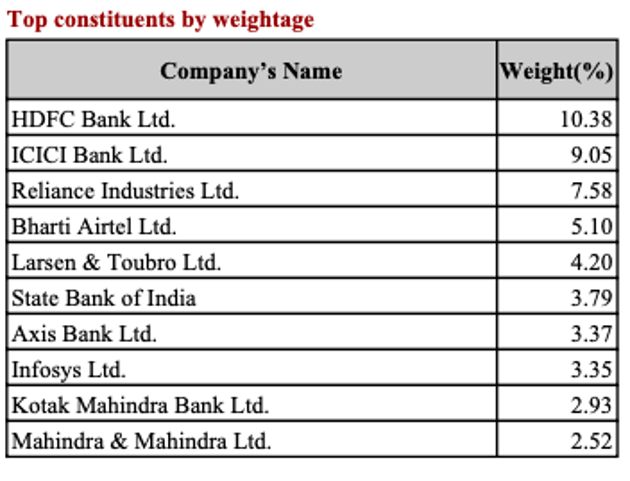
The Nifty 50 is a benchmark index of 50 large, liquid Indian companies listed on the National Stock Exchange of India, including HDFC Bank, ICICI Bank, Reliance Industries, and Bharti Airtel.
The index is weighted by free-float market capitalisation, so larger companies have more influence on its performance.
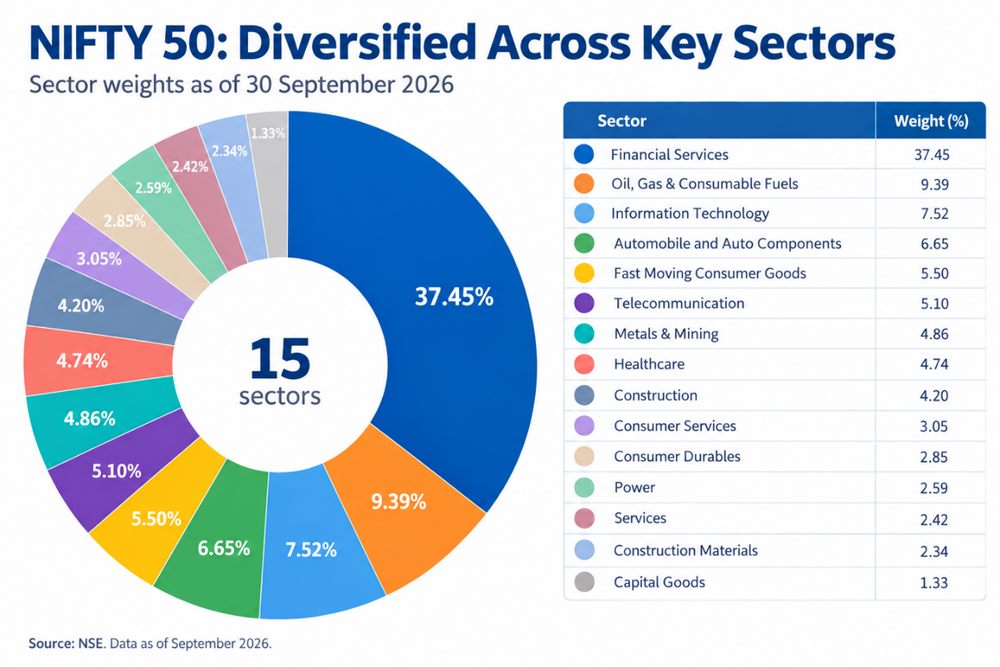
While the index spans multiple sectors, financial services accounts for more than one-third of the Nifty 50, and its 10 largest constituents make up approximately 52% of the index.
How should investors think about India in their portfolios?
Investors who are positive on India’s long-term growth prospects may consider whether a dedicated India allocation has a role within their portfolios.
Within Beansprout’s Four Pots of Wealth framework, we would generally view targeted country exposures such as India as part of the Opportunity Pot. This is where investors can express specific investment views, while keeping the size of these positions within appropriate limits.
This is different from the diversified investments in the Growth Pot, which are intended to form the foundation of a long-term portfolio.
Before adding an India-focused investment, it can be useful to first understand how much exposure an existing portfolio already has to the market.
For example, investors holding a global equity ETF or an emerging markets ETF may already have exposure to Indian companies. Adding a dedicated India ETF would therefore increase their exposure to India, rather than introduce an entirely new market to the portfolio.
What is the UTI India Nifty 50 Index ETF VCC?
The UTI India Nifty 50 Index ETF VCC is a Singapore-incorporated ETF managed by UTI International (Singapore) Private Limited, operating under the UTI Investments brand.
UTI Investments is a wholly owned subsidiary of UTI Asset Management Company Limited (UTI AMC), an Indian asset manager with an investment heritage dating back to 1964 and with over US$170 billion in AUM as of 30 September 2026.
It is headquartered in Singapore, regulated by MAS, and has offices in London, Paris, New York and Dubai.
The new ETF aims to track the performance of the Nifty 50 Index as closely as possible, before fees and expenses.
However, rather than purchasing the 50 constituent stocks directly, the Singapore-listed ETF uses a feeder-fund structure.
It invests all or substantially all of its assets into the India-listed UTI Nifty 50 Exchange Traded Fund, which holds the underlying Indian equities.
The underlying Indian ETF has been operating since 2015.
This structure allows Singapore investors to gain exposure to the Nifty 50 through an SGX-listed investment product.
UTI India Nifty 50 Index ETF VCC at a glance
| Feature | Details |
| Fund name | UTI India Nifty 50 Index ETF VCC |
| Reference benchmark | Nifty 50 Total Return Index |
| Fund structure | Singapore feeder ETF investing into the India-listed UTI Nifty 50 ETF |
| Fund domicile | Singapore |
| Exchange | SGX |
| Stock codes | NIU (USD) / NIF (SGD) |
| Fund base currency | USD |
| Investment exposure | 50 large Indian companies |
| SRS eligible | Yes |
| Distributions | No distributions currently planned; any distributions are at the manager's discretion |
| Total expense ratio | Currently capped at 0.43% p.a*. |
| Inception/listing date | 12 November 2026, with initial offer period running from 19 October to 6 November 2026. |
| Source: UTI Product Highlights Sheet dated 8 October and Replacement Prospectus 16 October 2026 and POEMS October 2026 launch information. *Expenses of the underlying ETF are reflected in its NAV. | |
How UTI India Nifty 50 Index ETF VCC provides access
#1 – Access the Nifty 50 directly through SGX
Investors who want to gain exposure to India's large-cap equity market would not need to access the Indian stock exchange directly.
Instead, they can trade the UTI ETF through an SGX-enabled brokerage account during Singapore market hours.
The ETF's board lot size is one share, making it possible to purchase smaller quantities after listing, subject to the prevailing market price and brokerage requirements.
#2 – Trade in Singapore dollars or US dollars
The ETF will have two trading counters: NIU in US dollars and NIF in Singapore dollars.
This gives investors flexibility to use their preferred trading currency.
However, both counters represent the same underlying USD share class.
Buying the SGD counter does not mean the Indian investments are hedged against currency fluctuations.
Investors will remain exposed to movements in the Indian rupee, with returns also affected by the relevant currency conversions.
#3 – Invest using SRS funds
The ETF is also SRS-eligible.
For investors who have accumulated SRS savings and are considering diversifying their retirement investments, this provides another ETF option accessible through the Singapore market.
However, SRS eligibility does not make the investment inherently less risky.
Investors should still consider whether a dedicated India equity allocation is appropriate for their retirement investment horizon and risk tolerance.
How does the UTI India Nifty 50 Index ETF VCC compare with other India ETFs?
Singapore investors can access Indian equities through ETFs listed in Singapore, the US and Europe.
These ETFs differ in their underlying indices, investment coverage, fees, and accessibility.
Comparing four India ETF options
| Feature | UTI India Nifty 50 Index ETF VCC | iShares MSCI India ETF | iShares MSCI India UCITS ETF | iShares MSCI India Climate Transition ETF |
| Trading ticker | NIU / NIF | INDA | NDIA / IIND | I98 / QK9 |
| Underlying index | Nifty 50 Total Return Index | MSCI India Index | MSCI India Index | MSCI India ESG Enhanced CTB Select Index |
| Approximate index coverage | 50 companies | 165 companies | 165 companies | 148 companies |
| Investment exposure | Large-cap India | Large- and mid-cap India | Large- and mid-cap India | Indian companies selected using ESG and climate criteria |
| Fund domicile | Singapore | United States | Ireland | Singapore |
| Exchange | SGX | Cboe BZX | London Stock Exchange | SGX |
| Trading currency | USD / SGD | USD | USD / GBP | USD / SGD |
| Published annual fund fee (basis)^ | Up to 0.43% p.a. (Singapore feeder fund TER cap)* | 0.61% (expense ratio) | 0.65% (TER) | 0.66% (expense ratio FYE 2025) |
| SRS eligible | Yes | No | No | Yes |
| Sources: UTI fund documents and POEMS; BlackRock/iShares product pages; MSCI index information. Figures generally reflect September–October 2026, with the climate-transition index count as at August 2026. ^The published fees use different measures and may not represent directly comparable all-in costs. *Expenses of the underlying ETF are reflected in its NAV. | ||||
The main distinction is investment coverage.
The Nifty 50 focuses on 50 large Indian companies, while the MSCI India Index includes mid-cap companies, offering broader exposure.
For Singapore investors, SGX-listed ETFs may also offer greater convenience, including SRS eligibility.
ETF domicile can have tax implications too. For example, US-listed ETFs may carry US estate-tax considerations for non-US investors, depending on their circumstances.
The UTI India Nifty 50 Index ETF VCC uses a Singapore-domiciled feeder-fund structure, investing in units of an India-listed ETF rather than directly holding Indian shares.
Under the India–Singapore Double Taxation Avoidance Agreement (DTAA), the Singapore fund may be able to claim an exemption from Indian capital gains tax when it sells units of the underlying ETF.
However, this exemption is not guaranteed and depends on meeting the relevant treaty conditions. Indian tax authorities may also challenge the fund's eligibility for these benefits.
So, investors should compare total costs, including brokerage fees, FX charges and bid-ask spreads, alongside potential tax implications.
What are the risks of investing in the UTI India Nifty 50 Index ETF VCC?
#1 – Single country risk and concentration risk
The ETF remains concentrated in India, making it sensitive to changes in the country's economy, government policies, and market conditions.
As at 30 September 2026, financial services accounted for 37.45% of the Nifty 50, while its 10 largest constituents represented approximately 52.3% of the index.
For Singapore investors who already own significant holdings in local banks, adding the Nifty 50 could increase their overall exposure to the financial sector, even as they diversify geographically.
#2 – Currency and repatriation risk
While the ETF trades in SGD and USD on SGX, its underlying investments are denominated in Indian rupees (INR).
If the rupee depreciates against the Singapore dollar, this could reduce returns for Singapore investors, even when Indian share prices rise.
Restrictions on currency conversion and the repatriation of funds from India could also affect the underlying fund.
#3 – ETF trading and tracking risks
The ETF's trading price on SGX may differ from its net asset value (NAV), particularly during periods of low liquidity or wider bid-ask spreads. Trading may also be suspended, and the ETF could be delisted.
As the ETF invests through an underlying India-listed ETF, expenses at both fund levels and tracking differences could cause its returns to deviate from the Nifty 50 Index.
#4 – Tax risk
The potential capital gains tax exemption under the India–Singapore Double Taxation Avoidance Agreement (DTAA) is not guaranteed.
Changes in Indian tax rules or how treaty benefits are applied could affect the fund's returns.
How can Singapore investors invest in the UTI India Nifty 50 Index ETF VCC?
The UTI India Nifty 50 Index ETF VCC is expected to begin trading on SGX on 12 November 2026.
Before listing, investors may be able to subscribe during the initial offering period through participating dealers:
- DBS Vickers Securities (Singapore) Pte. Ltd.
- Flow Traders Asia Pte. Ltd.
- IFast Financial Pte. Ltd.
- Moomoo Financial Singapore Pte. Ltd.
- Phillip Securities Pte. Ltd.
- Tiger Brokers (Singapore) Pte. Ltd.
All broker promotions listed below:
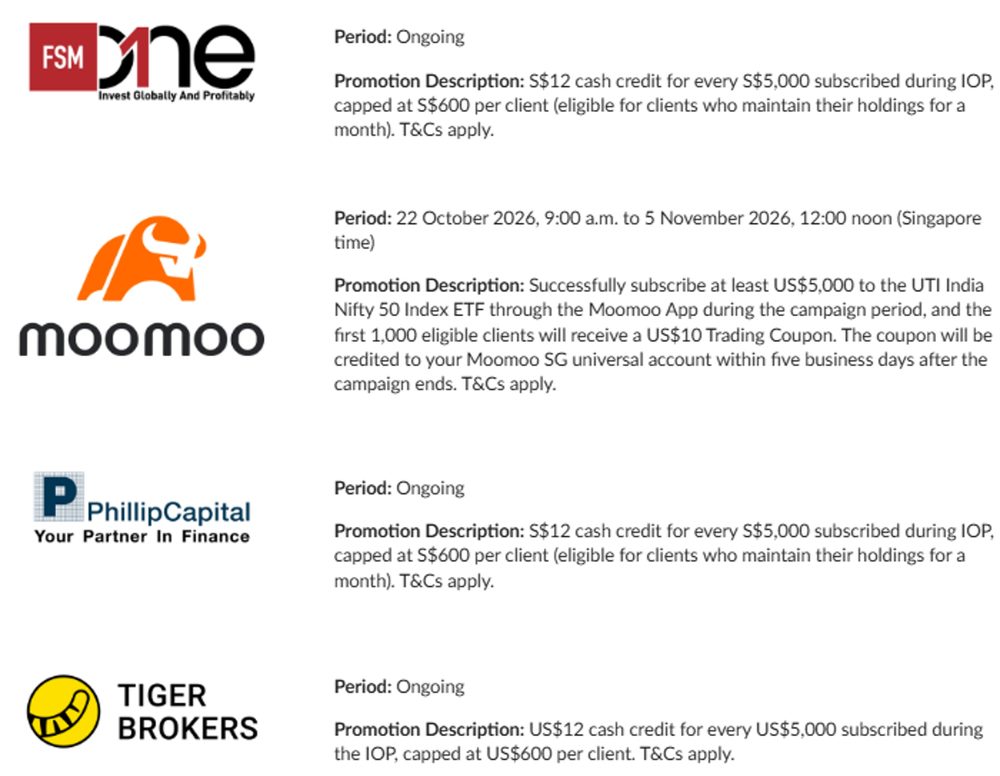
Investors should check their participating dealer's subscription deadlines, application requirements, and applicable fees, as these can differ.
After listing, investors can look for the ETF through an SGX-enabled brokerage account using the following stock codes:
- NIU: USD trading counter
- NIF: SGD trading counter
Investors who want to use their SRS funds should check the supported trading arrangements with their SRS operator and broker.
For more information, investors can refer to the fund page on the UTI website, where the prospectus and Product Highlights Sheet are available, and to the ETF’s SGX listing page.
Beansprout’s Take
For Singapore investors whose portfolios are primarily invested in Singapore and US equities, India offers exposure to another market with different companies and economic drivers.
The Nifty 50 provides access to major Indian businesses across financial services, energy, consumption and infrastructure.
According to UTI, India's long-term structural growth story remains intact, while recent market underperformance has brought valuations to more moderate levels.
However, India may still trade at a premium to other emerging markets, and investors need to remain mindful of market volatility, currency risk and the Nifty 50's concentration in financial services.
We would first consider how much India exposure we already have through existing global or emerging-market funds, and what role a dedicated India allocation would play in our portfolio.
Ultimately, the decision to add India exposure should depend on how it complements existing investments, the investor's investment horizon, and the level of risk they are comfortable taking.
The UTI India Nifty 50 Index ETF VCC offers Singapore investors another route to accessing India's largest listed companies through SGX, using cash or SRS funds.
For details on how to subscribe during the initial offer period or buy the ETF after listing, visit the SGX listing page for the list of participating dealers and any available broker promotions.
To learn more about the ETF's structure, fees and risks, visit the UTI product page, where you can access the fund's prospectus and Product Highlights Sheet before deciding whether to invest.
Are you considering adding India to your portfolio? Share your thoughts in the comments or our Telegram community.
Important information
This advertisement has not been reviewed by the Monetary Authority of Singapore. The information herein is for informational purposes only and does not constitute a recommendation, offer or solicitation to buy or sell Shares in the Fund. It does not consider the specific investment objectives, financial situation or particular needs of any person. You should read the Prospectus and Product Highlights Sheet of the UTI India Nifty 50 Index ETF VCC, available at www.utifunds.com or from the Manager's business address at 3 Church Street, #22-01 Samsung Hub, Singapore 049483, before deciding whether to invest. You may wish to seek advice from a financial adviser before investing. If you choose not to, you should consider whether the Fund is suitable for you.
Investments in the Fund are subject to investment risks, including the possible loss of the principal amount invested. The value of Shares and any income from them may fall or rise. Past performance, and any prediction, projection or forecast, is not necessarily indicative of future performance. The Fund is a feeder fund concentrated in a single country (India) and may be more volatile than funds with more diversified portfolios. Returns of the Underlying Fund and the Index are shown in INR; returns to investors in USD or SGD will be affected by currency movements.
The Shares are listed on the SGX-ST. Listing does not guarantee a liquid market for the Shares. The trading price of Shares on the SGX-ST may differ from their Net Asset Value per Share, and Shares may be suspended or delisted. The ETF differs from a typical unit trust: Shares may only be created or redeemed directly by Participating Dealers in Creation or Redemption Units of 50,000 Shares. Investors who hold fewer Shares can only realise their value by selling on the SGX-ST.
Tax treatment depends on individual circumstances and may change. The availability of treaty benefits described in this material is not assured. Investors should seek independent tax advice.
The information contained herein may not be copied, reproduced or redistributed without the express consent of UTI International (Singapore) Private Limited. While reasonable care has been taken to ensure its accuracy, no warranty or representation is given, and no liability is accepted for any loss arising from reliance on this material. Information may change without notice. UTI International (Singapore) Private Limited, Company Registration No. 200617079Z. UTI India Nifty 50 Index ETF VCC, Company Registration No. T26VC0077H.
Index Disclaimer - NSE Indices Limited
Index disclaimer: The Nifty indices referenced in this article are owned and maintained by NSE Indices Limited. For the full index-specific disclaimer, please refer to www.niftyindices.com/disclaimer.
Read also
Gain financial insights in minutes
Subscribe to our free weekly newsletter for more insights to grow your wealth
Most Popular

Comments
0 comments