
How I’m upgrading my DCA strategy with Webull’s Dynamic RSP for better value averaging
Brokerage Account
Powered by

By Nicole Ng • 21 May 2026
Why trust Beansprout? We’ve been awarded Best Investment Website at the SIAS Investors’ Choice Awards 2025
I explore how Webull’s Dynamic RSP helps Singapore investors upgrade DCA by investing more during market dips and less during rallies.
This post was created in partnership with Webull Singapore. All views and opinions expressed in this article are Beansprout's objective and professional opinions.
What happened?
The past few months have shown how quickly markets can swing, and how hard they are to time.
In late March 2026, the S&P 500 fell close to 9% from its all-time high amid concerns around the Iran conflict.
But the pullback didn’t last long. By early May, the index had already rebounded strongly, climbing more than 14% from its March lows.
For long-term investors using a traditional monthly DCA strategy (dollar cost averaging) or a traditional RSP (regular savings plan), the dip came and went quickly.
Unless your scheduled investment date happened to fall during that short window, you likely missed the chance to invest more at lower prices.
While investing a fixed amount regularly helps remove emotion and timing decisions, it also means you invest the same amount whether markets are expensive or in the middle of a correction.
Over time, I realised this was something I wanted to improve, especially during periods of volatility.
I still wanted the discipline and consistency of DCA. But I also wanted a way to automatically invest more during market weakness, without needing to monitor the market every day or manually decide when to deploy extra cash.
That’s what led me to explore Webull Singapore’s Dynamic RSP.

What is a Dynamic RSP?
A traditional Regular Savings Plan (RSP) works by investing a fixed amount at fixed intervals. For example, investing US$500 into an S&P 500 ETF every month.
It’s simple, consistent, and removes the pressure of trying to time the market.
But there’s one limitation: the amount invested never changes, regardless of market conditions.
When investing for the long term, investors like me would want to buy more during dips.
The challenge is that doing this consistently is harder than it sounds because I would need to monitor the markets regularly, decide when a dip is worth buying, and have the confidence to invest when sentiment is weak.
Dynamic RSP works differently. Instead of investing the same amount every time, it adjusts your monthly investment based on market conditions.
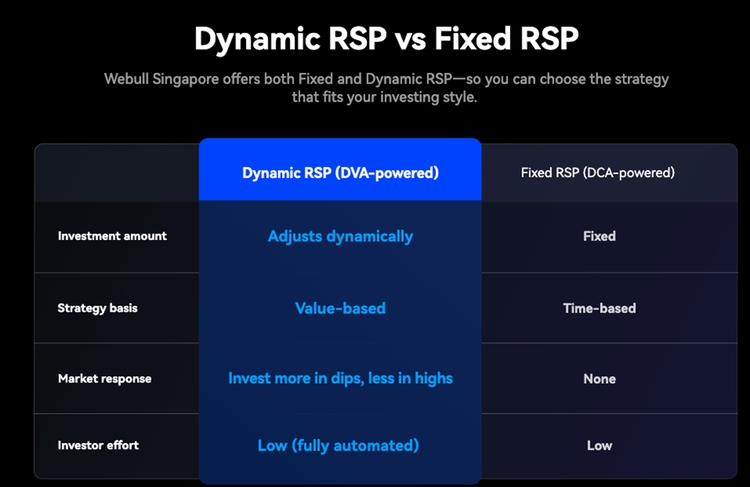
For example, if you set a monthly investment of US$1,000 into the SPY ETF, Dynamic RSP may automatically increase your investment to US$1,400 when the S&P 500 is trading below its moving average.
On the other hand, if markets are running hot and trading above trend, it may reduce the investment amount to US$800 instead.
| Market Condition | Traditional DCA | Dynamic RSP |
| Market dips | US$1,000 | US$1,400 |
| Market rallies | US$1,000 | US$800 |
The idea is that you get to stay disciplined, but gradually gain more value over time.
Introducing Webull’s Dynamic RSP
Webull Singapore is currently the only broker platform in Singapore offering a Dynamic RSP feature.
It allows investors to automate what many have been trying to do manually for years by buying more during weakness, and easing off when prices are high.
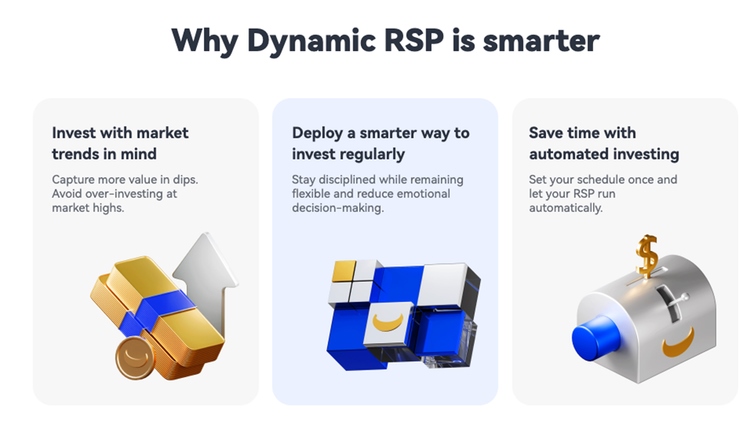
All without needing to watch the market every day or second-guess each decision.
How does Webull’s Dynamic RSP work?
The system compares the market’s previous closing price against a selected moving average:
- If the market is trading below its moving average, the Dynamic RSP increases your investment amount.
- If the market is trading above its moving average, the investment amount decreases.
How much more or less depends on three settings you choose when setting it up:
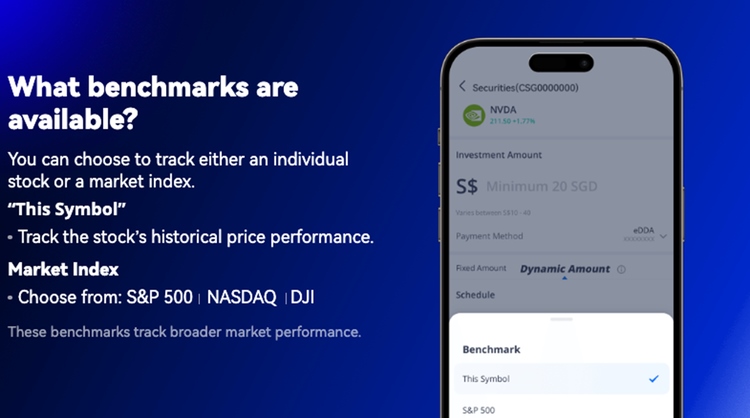
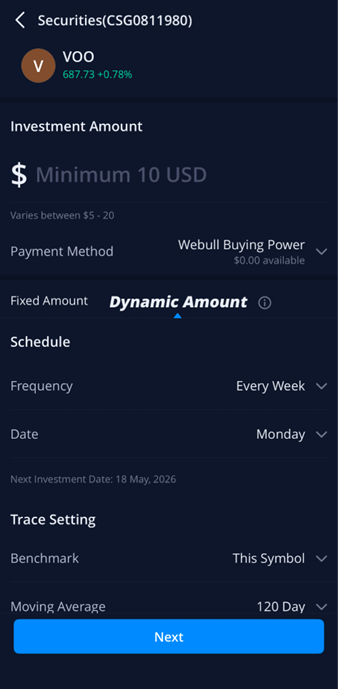
#1 – Your benchmark
You can track the stock or ETF itself, or use a broader market index like the S&P 500, NASDAQ, or DJI.
#2 – Your moving average period
Options include 120-day, 250-day, or 300-day moving averages. A longer period generally means less sensitivity to short-term swings.
#3 – Your multiplier
Your actual investment will always fall between 50% and 200% of your set amount, depending on how far the price deviates from the benchmark.
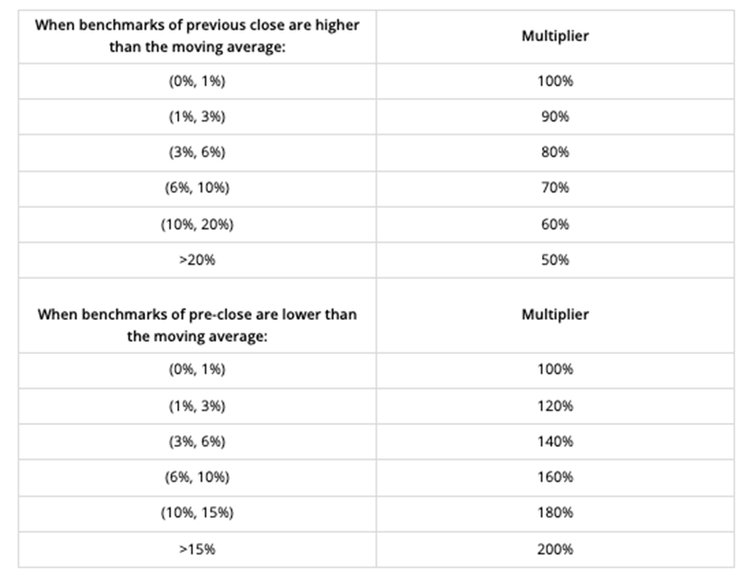
Say your monthly RSP is US$1,000 into an S&P 500 ETF, with the index as your benchmark.
If the S&P 500 closes 4% below its moving average, Webull’s Dynamic RSP might invest US$1,000 × 140% = US$1,400 that month.
If the S&P 500 closes 4% above its moving average, it might invest US$1,000 × 80% = US$800 that month.
| Market Condition | Benchmark against moving average | Multiplier | Traditional DCA | Dynamic RSP |
| Market dips | Below 4% | 140% | US$1,000 | US$1,400 |
| Market rallies | Above 4% | 80% | US$1,000 | US$800 |
This allows you to systematically lean into weakness and pull back from strength, without you having to make that call yourself.
How Webull supports DCA investing
A few things also make Webull particularly useful for investors building US market exposure gradually:
#1 – Zero transaction fees on US stocks and ETFs
Another factor that makes Webull’s Dynamic RSP appealing for long-term investing is its relatively low-cost structure.
For US stocks and ETFs, Webull charges zero commissions and platform fees, so you keep every dollar you earn. These fees can compound over time, and choosing a zero-fee platform can save you a meaningful sum.
Aside from US stocks, if you trade US options, commissions are also relatively low at US$0.55 per contract.
And if you also invest in Singapore stocks, new users currently receive one year of commission-free trading under the welcome promotion, after which fees are charged at 0.05% per trade with a minimum of S$1.60.
There are also no account maintenance fees or minimum funding requirements to open an account.
While standard regulatory and exchange fees still apply, Webull remains one of the more competitive options for investors regularly building positions in US stocks or ETFs over time.
#2 – Access to US markets with low barriers to entry
It goes without saying that Webull provides access to the US stock market. But alongside that, it also allows investors to invest across US options, Treasuries, and mutual funds all within a single platform.
You can start investing with as little as US$1 with US fractional shares, making it easier to gradually build exposure to higher-priced US companies over time.
Beyond the US market, investors can also access Singapore-listed and Hong Kong-listed stocks, making it easier to build a more diversified portfolio across different markets and asset classes.
#3 – Easy-to-use interface
One of the advantages of Webull’s RSP feature is how straightforward the overall setup process is.
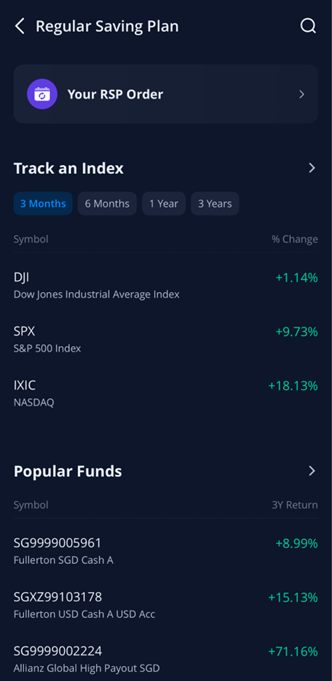
Investors can set up a recurring investment plan in just a few steps directly within the app, choosing their preferred investment amount, schedule, benchmark, and moving average settings for Dynamic RSP.
You can start from as low as US$10.
Contributions can also be adjusted, paused, modified, or cancelled easily at any time, which adds flexibility as financial goals or market conditions change.
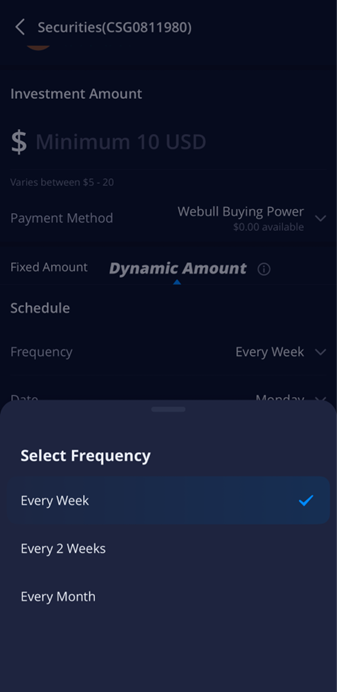
Webull also supports multiple investment frequencies including daily, weekly, bi-weekly, and monthly schedules.
This makes it easier for investors to build a plan around their own cash flow and investing habits.
Combined with features like fractional share investing, portfolio tracking tools, watchlists, and an intuitive mobile interface, the platform lowers the barrier for investors looking to automate long-term investing without overcomplicating the process.
Key risks and considerations
Dynamic RSP can improve how you average into markets, but it’s still important to understand the trade-offs.
#1 – It does not guarantee higher returns
A Dynamic RSP is designed to invest more during market weakness and less during periods of strength, but that does not automatically mean it will outperform a traditional fixed RSP in every environment.
For example, if markets continue climbing steadily over a long period without significant pullbacks, a fixed RSP that consistently invests the full amount each month may end up accumulating more exposure earlier and potentially deliver stronger returns.
In contrast, a Dynamic RSP may reduce contributions during stronger markets, which could slightly limit upside participation in prolonged bull markets.
Rather than trying to maximise returns in every scenario, the strategy is better viewed as a way to improve discipline and potentially achieve better entry prices over time.
#2 – It works best over the long term
Dynamic RSP is designed for long-term investing rather than short-term market timing.
The value-averaging effect tends to play out gradually across multiple market cycles, corrections, and recoveries, not over weeks or months.
There may be periods where the strategy appears to underperform, especially during strong market rallies or low-volatility environments.
But over longer time horizons, systematically investing more during periods of weakness can help smooth out the average cost of entry over time.
Because of this, the strategy generally works best for investors who are consistently building positions over many years rather than actively trading around short-term market moves.
#3 – You’re still exposed to market risk
While Dynamic RSP helps investors lean into market weakness more systematically, it does not reduce the underlying risks of investing in equities.
In fact, when markets decline, the strategy may automatically deploy more capital into falling markets.
While this can improve long-term averaging if markets eventually recover, it also means investors need to be comfortable investing during periods of uncertainty and volatility.
Investors are still exposed to risks such as sharp US market corrections, economic slowdowns, sector-specific volatility, and currency fluctuations between the US dollar and Singapore dollar.
As with any long-term investing strategy, it’s important to ensure the investment amount remains aligned with one’s financial goals, risk tolerance, and time horizon.
What would Beansprout do?
For investors already using DCA, Dynamic RSP could help upgrade your long-term investing strategy.
It keeps the structure and discipline that make DCA effective, while adding a more responsive approach during periods of market volatility.
This could be worth exploring if you already invest regularly into US stocks or ETFs, prefer a hands-off investing approach, or find it difficult to deploy extra cash confidently during market pullbacks.
Given that Webull is currently the only platform in Singapore offering a Dynamic RSP feature, alongside zero transaction fees on US stocks and ETFs, it provides an interesting option for investors looking to build long-term US market exposure more systematically.
Summary of Webull Promotion
Snatch these exclusive rewards when you sign up via Beansprout
Learn more about the promotion here.
Disclaimer
*T&Cs apply. For detailed terms and conditions and full disclaimer, please refer to Webull Singapore’s website at https://www.webull.com.sg/. All investments involve risk and are not suited for every investor.
All views expressed in the article are the objective opinions of Beansprout. Neither Webull or its affiliates shall be liable for the content of the information provided. This advertisement has not been reviewed by the Monetary Authority of Singapore.
This article contains affiliate links. Beansprout may receive a share of the revenue from your sign-ups to keep our site sustainable. You can view our editorial guidelines here.

Get up to S$160 Fairprice voucher^ within 10 working days plus up to S$1,888 in welcome rewards.
Read also
Gain financial insights in minutes
Subscribe to our free weekly newsletter for more insights to grow your wealth
Most Popular

Questions and Answers
0 questions
