
Mi Material Holding Limited: Precision solder sphere leader riding the AI wave
Stocks
By Goh Lay Peng • 28 Oct 2026
Global Wealth Technology Pte. Ltd. is regulated by the Monetary Authority of Singapore (MAS) as a licensed Financial Adviser.

Make Beansprout your preferred source on Google
Add us on Google to see more of our insights in your search results
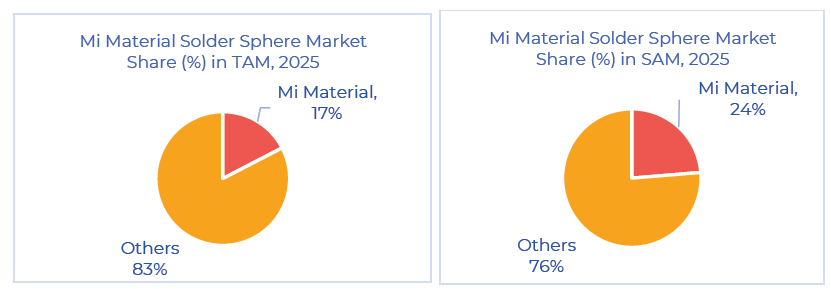
Mi Material is one of the world’s top 3 suppliers with 24.0% share of the global solder sphere serviceable addressable market (SAM) in 2025.
Top 3 Global Solder Sphere Supplier
Mi Material Holding Limited (Mi Material) designs and manufactures precision solder spheres.
These solder spheres are critical interconnect components that enabling electrical conductivity between integrated circuits (“ICs”) and printed circuit boards (“PCBs”).
According to Yole, Mi Material is one of the world’s top 3 suppliers with 24.0% share of the global solder sphere serviceable addressable market (SAM) in 2025.
Spin-off from Mi Technovation
Mi Material is the semiconductor materials unit of Bursa-listed Mi Technovation Berhad (MiTB). Post IPO, MiTB remains the largest shareholder with 72.7% shareholding.
Structural growth runway
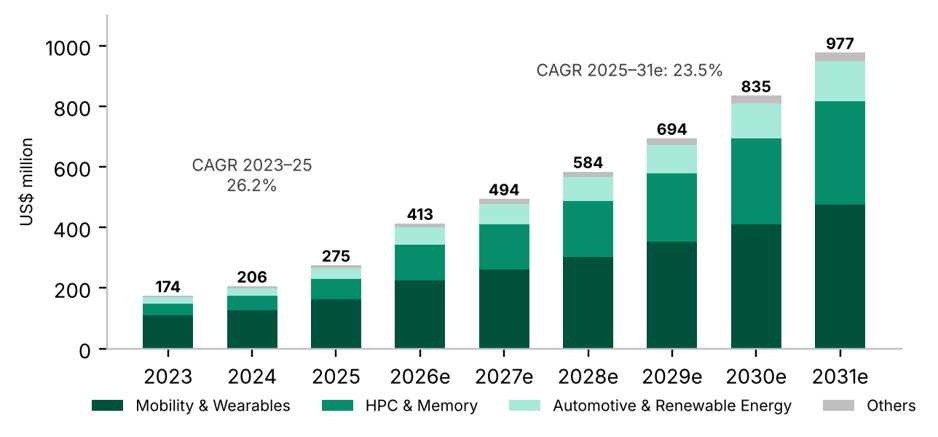
Yole projects the solder sphere SAM to grow from US$275 million in 2025 to US$978 million by 2031, a 23.5% CAGR, with HPC & Memory the fastest-growing segment.
New lines in Malaysia and Taiwan should lift annual capacity to 11,340–15,260 billion spheres from 6,600–8,900 billion currently.
Mix shift to specialty alloys lifts margins
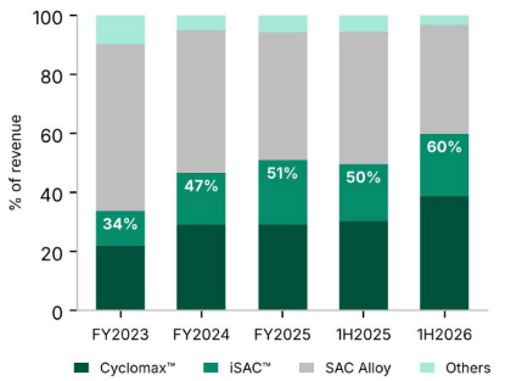
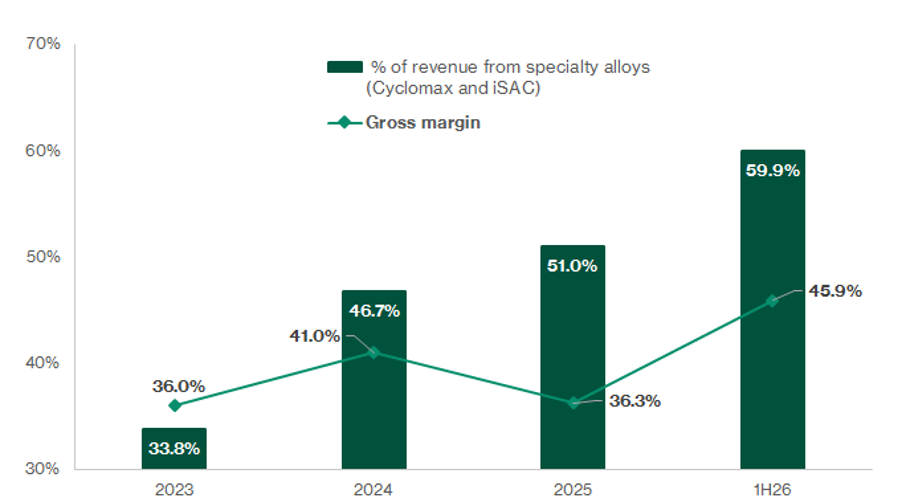
Proprietary Cyclomax™ and iSAC™ solder spheres made up 59.9% of revenue in 1H26, up from 33.8% in FY2023.
Gross margin expanded to 45.9% in 1H26 from 37.3% in 1H25, and management estimates 3Q26 gross margin at 47.5%.
Designed-in and hard to replace
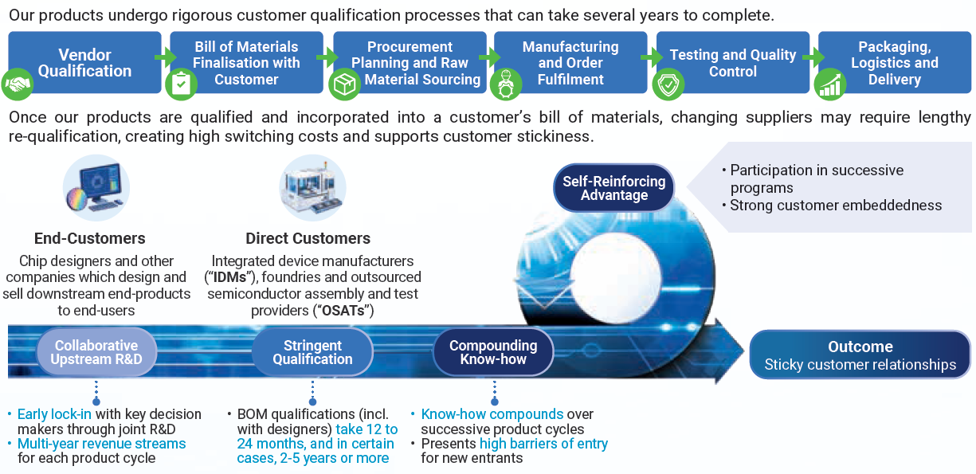
Qualification for inclusion in a customer’s bill of materials takes two to five years or longer, and Mi Material co-develops alloys with chip designers.
Its three key end-customers – a premium consumer electronics company, a leading AI ASIC designer and a US memory maker – contributed 24%, 18% and 16% of 1H26 revenue respectively.
Strong growth momentum
Revenue grew at a 28.1% CAGR over FY2023–FY2025 to US$65.3 million.
In 1H26, revenue more than doubled to US$53.7 million and adjusted net profit rose nearly five-fold to US$14.3 million.
Company management expects 3Q26 revenue to reach US$37.8 million, up 15.6% quarter-on-quarter.
Valuation
At the IPO price of S$1.80, Mi Material has a market cap of S$891 million. It is valued at trailing 12-month P/E 32.5x (annualised 1H26 P/E 24.4x), and post-IPO P/B 3.0x.
Listed solder sphere peers trade at an average of P/E 15.5x and P/B 2.1x. Mi Material trades at a premium, reflecting its higher margins, faster growth and pure-play exposure to AI and HPC packaging.
Key risks
Customer concentration, semiconductor cyclicality, silver and tin price volatility, negative operating cash flow from working capital build-up, expansion execution and geopolitical risks.
Powering advanced semiconductor packaging
About Mi Material
Mi Material Holding Limited (“Mi Material”) is a specialist manufacturer of precision solder spheres and specialty alloy solutions used in advanced semiconductor packaging.
Founded in Tainan, Taiwan in 1998, Mi Material designs, develops and manufactures precision solder spheres. It operates under the corporate brand “Accurus”.
The business was acquired by Henkel’s electronics group in 2003, underwent a management buyout in 2006, and became part of Mi Technovation Berhad (MiTB) in April 2021 as its Semiconductor Material Business Unit.
MiTB (KLSE: MI) is listed on Bursa Malaysia with a market capitalisation of S$1.78 billion as of 20 October 2026. Following the spin-off from MiTB, Mi Material was listed on the SGX Mainboard on 28 October 2026.
Mi Material is one of the world’s top 3 solder sphere suppliers. Mi Material produced 4.1 trillion solder spheres in 2025. According to Yole, Mi Material has 24% market share of the global solder sphere serviceable addressable market (SAM).
Solder sphere acts as the electrical interconnect between integrated circuits (ICs) and printed circuit boards (PCBs), and between stacked dies in advanced semiconductor packages.
These solder spheres connect integrated circuits (“ICs”) to printed circuit boards (“PCBs”) across a broad spectrum of advanced semiconductor packaging applications.
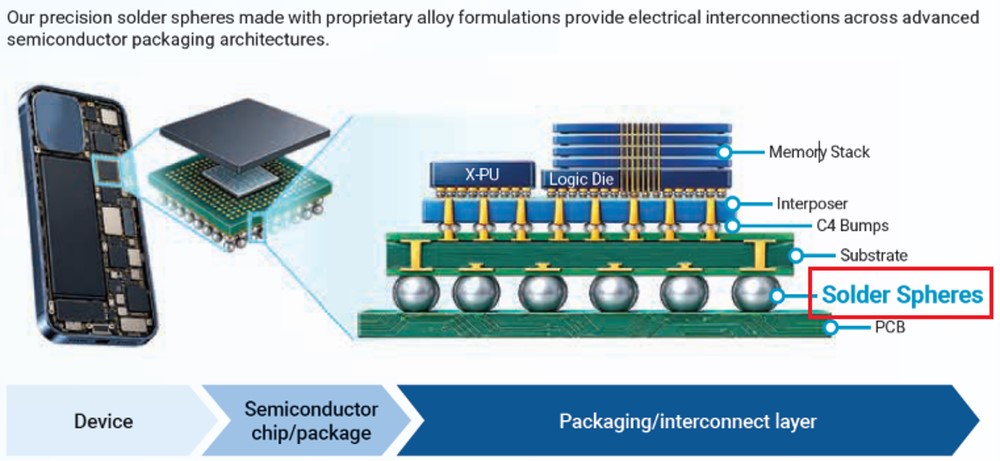
Mi Material focuses on fine-pitch and ultra-fine-pitch applications. Its spheres range from 0.030 mm to 0.889 mm in diameter.
They are used mainly in high-performance computing (HPC) for AI, memory including high bandwidth memory (HBM), mobile devices and wearables, and automotive applications.
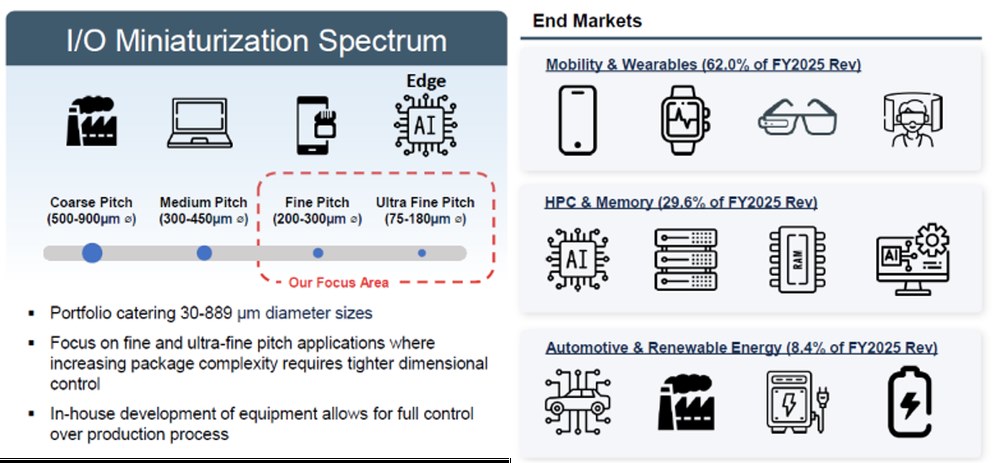
Mi Material is headquartered in Singapore, with production facilities in Tainan, Taiwan (13 lines) and Ningbo, China (six lines).
A third facility in Senai, Johor, Malaysia is targeted to be ready for production by 4Q2026. The Malaysia facility will comprise seven production lines with an annual production capacity of 2.1 trillion to 2.8 trillion solder spheres.
The expansion in Taiwan will expand production capacity between 2.6 trillion to 3.6 trillion solder spheres.
By 2030, the total capacity will increase by 71%, from the current 6.6 - 8.9 trillion solder spheres, to 11.3 - 15.3 trillion solder spheres.
Mi Material holds 27 patents and designs much of its specialised production machinery in-house.
Shareholding structure
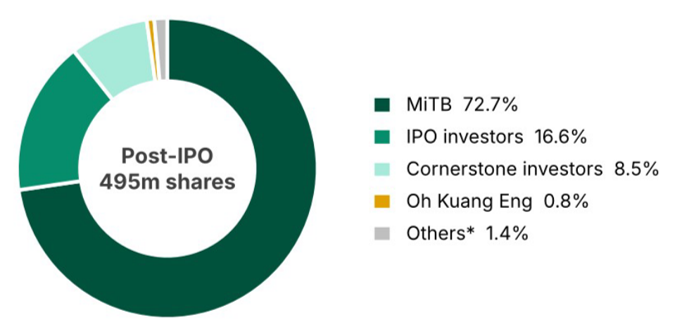
Post-IPO, MiTB will remain Mi Material’s controlling shareholder with a 72.7% stake. IPO investors will hold 16.6% and cornerstone investors will own 8.5%.
The remaining shares comprise 0.8% held by Mr Oh Kuang Eng and 1.4% by other shareholders.
MiTB’s substantial ownership provides continuity in strategic direction, although minority shareholders will have limited influence over corporate decisions.
Use of proceeds
Mi Material raised S$157.9 million in net proceeds. About one-third of the gross proceeds will fund a new R&D and demonstration centre in Texas, United States, close to key customers’ R&D and qualification teams.
The rest will go to upgrading the Taiwan facility, expanding the Malaysia plant, building a Singapore R&D laboratory, and working capital.
Industry outlook
According to independent market research by Yole Group SA (Yole), the global semiconductor device market is expected to grow at about 12% CAGR from 2025 to 2031 to reach US$1.6 trillion.
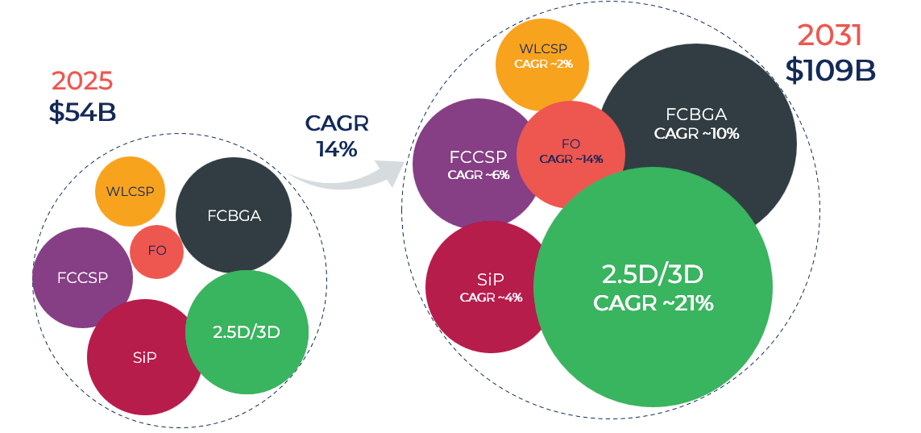
Within this, the advanced packaging market is projected to double from US$54 billion in 2025 to US$109 billion in 2031, a 14% CAGR. 2.5D/3D packaging is expected to be the fastest-growing platform at about 21% CAGR.
Demand for solder spheres depends on more than chip volumes alone. Advanced packages need more interconnects, finer pitches and more specialised alloys, which raises solder content per package.
Solder sphere serviceable addressable market (SAM) excludes electroplated bumping and hybrid bonding which fall outside Mi Material’s scope. For the period 2025 to 2031, Yole expects the solder sphere SAM to sustain growth at 23.5% CAGR. The SAM is expected to grow from US$275 million in 2025 to US$977 million in 2031. The growth is driven by rapid expansion of high-performance computing, artificial intelligence, automotive and high-density packaging applications.
For the period 2025 to 2031, the broader total addressable market (TAM) is expected to grow at a 31.4% CAGR to US$1.9 billion.
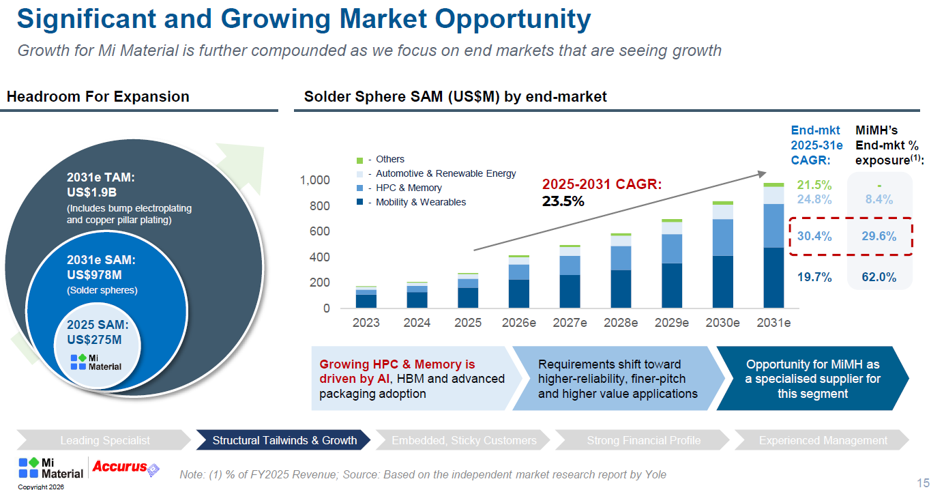
From the end user perspective, HPC & Memory is the fastest-growing segment, with its share of the SAM expected to rise from 25% in 2025 to 35% by 2031, driven by AI accelerators, GPUs and HBM.
Mi Material’s HPC & Memory share of revenue rose to 31.1% in 1H26 from 27.6% in FY2023.
Business model
Mi Material sells mainly to outsourced semiconductor assembly and test providers (OSATs), integrated device manufacturers (IDMs) and foundries.
These Direct Customers place the purchase orders. However, demand is often decided upstream by End-Customers – the chip designers and device makers that specify which materials go into their bill of materials (BOM).
Revenue is generated mostly from the sale of solder spheres, with smaller contributions from copper core solder spheres (CCSS), solder paste, solder ingots and chemicals distribution in Singapore.
It also charges End-Customers for development fees, engineering samples and tooling.
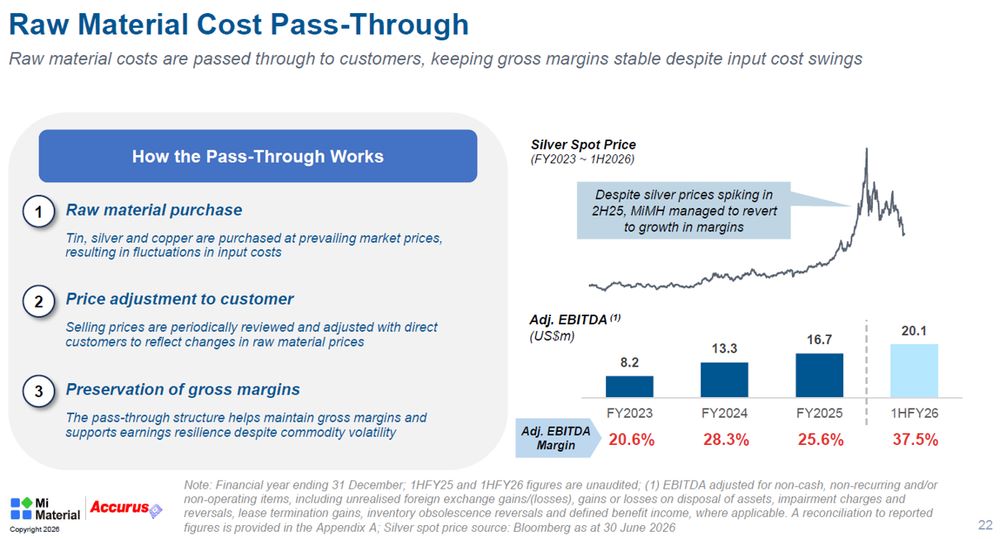
Raw materials are purchased at spot prices. Mi Material relies on a cost-plus pricing model to pass through higher metal prices.
Silver and tin are the main purchases, accounting for 89.2% of the total purchases in 1H26. With periodic selling price reviews, Mi Material was able to grow EBITDA margins in 1H26 despite the spike in silver prices in 2H2025.
Products and services
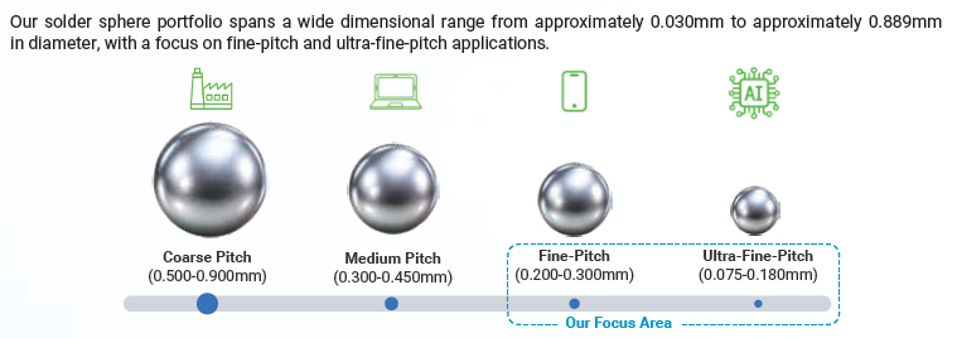
Mi Material offers a broad portfolio of solder spheres ranging from 0.03 mm to 0.889 mm in diameter.
Mi Material is increasingly focused on fine-pitch and ultra-fine-pitch applications, where growing package complexity requires tighter dimensional tolerances and greater manufacturing precision.
Its manufacturing capabilities are supported by in-house equipment development, allowing it to maintain control over the production process and product quality.
Besides the standard Sn-Ag-Cu (SAC) alloys, being tin, silver and copper, Mi Material invested in R&D collaboration with customers to develop specialty alloys.
The SAC alloy portfolio serves applications where proven reliability and widespread adoption remain important.
Mi Material differentiates its products through proprietary alloy formulations designed to meet specific performance and reliability requirements.
The Cyclomax™ series targets ultra-high-reliability applications.
The iSAC™ series focuses on high performance and reliability.
The EcOlloy™ series is positioned as a lower-cost, environmentally friendly alternative
Proprietary alloys, such as iSAC™ and Cyclomax™, generally command higher margins than standard SAC alloys.
Smaller-diameter solder spheres tend to generate higher margins than larger spheres.
Applications such as 2.5D/3D packaging, high-bandwidth memory (HBM) stacking and chiplet architectures require increasingly precise interconnects and enhanced reliability, potentially supporting demand for smaller-diameter solder spheres and specialty alloys.
Smaller-diameter proprietary alloy products deliver the highest overall margins, followed by larger-diameter proprietary alloys and smaller-diameter standard SAC alloys. Larger-diameter standard SAC alloys have the lowest relative margins.

Production footprint
Taiwan is the main production base, running at 80–85% utilisation in 1H26.
The Ningbo, China facility remains underutilised at 10–15% and has been loss-making since production began.
Due to export control regulations implemented by China, Mi Material plans to reposition the Ningbo facility to serve domestic Chinese customers.
The new production facility in Senai, Malaysia will have 3 lines ready by 4Q26. The Malaysia unit is not exposed to export controls.
Facility | Production lines | Status and capacity |
|---|---|---|
Tainan, Taiwan | 13 (+4 planned) | Main production base; 1H2026 utilisation 80–85%. Expansion of US$26.0m to start in 2027, operations from 2030 |
Ningbo, China | 6 (expandable to 12) | 1H2026 utilisation 10–15%; to be repositioned for China domestic market |
Senai, Malaysia | 7 (in two phases) | Phase 1 (3 lines) ready by 4Q2026, ramp-up early 2027; Phase 2 (4 lines) by end-2027. Total capex US$21.8m. Adds 2,100–2,800bn spheres a year |
Texas, United States | 2 automated lines | R&D and demonstration centre targeted by end-2028; may be converted into full production |
Singapore | R&D laboratory | About 40 R&D staff; operations expected from 2Q2030 |
Source: Company prospectus dated 19 October 2026 | ||
Capture advanced packaging growth
Mi Material plans to intensify R&D efforts to capture growth in advanced semiconductor packaging.
Mi Material is focusing on next-generation proprietary alloys, ultra-fine-pitch solder spheres with the potential to replace C4 bumps.
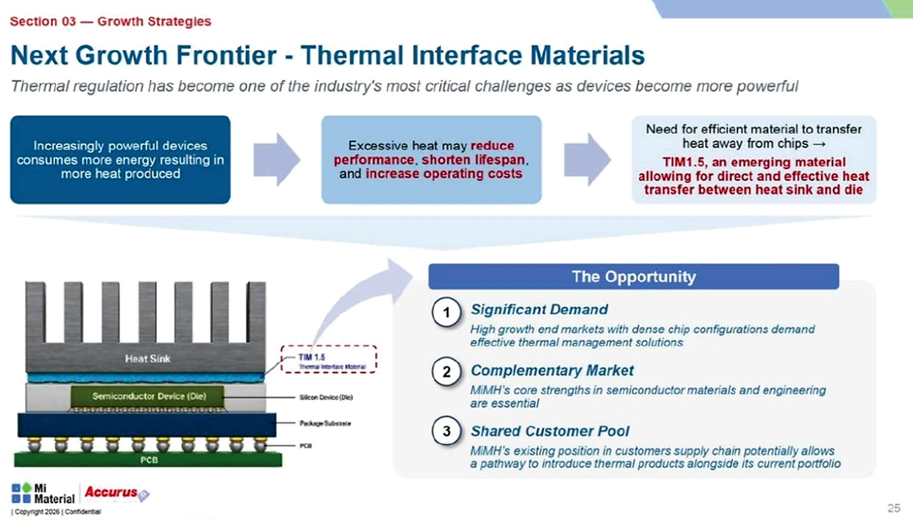
It is also exploring thermal interface materials (TIM) designed to manage higher power densities and heat in advanced semiconductor packages.
Key strengths
Focused on the fastest-growing, highest-value segments
Mi Material has deliberately focused on fine-pitch and ultra-fine-pitch solder spheres and specialty alloys. This is where packaging complexity, reliability requirements and growth rates are highest.
Smaller spheres and specialty alloys command higher margins because they need tighter process control.
This is reflected in the share of specialty alloys rising from 33.8% of revenue in FY2023 to 59.9% in 1H26. With the shift in product mix towards specialty alloys, gross margin increased from 36.0% to 45.9% over the same period.
Mi Material is working with customers on 0.020 mm. At these sizes, solder spheres can compete with plating-based interconnects such as C4 microbumps, which could expand its addressable market.
Leading semiconductor technologies reinforce solder spheres
Hybrid bonding is often seen as a threat to solder interconnects. However, according to Yole, its adoption is limited to a small segment of ultra-high-end devices such as HBM stacks. Moreover, in those packages, solder spheres are still needed for package-to-substrate and substrate-to-board connections.
As internal interconnect density rises, packages need more external signal exits at finer pitches. This increases the number of solder spheres per package.
In high-value AI packages, solder spheres are yield-critical components to the module.
High barriers to entry due to designed-in and quality control
Mi Material typically works with chip designers at the package design stage. Once designed in, procurement is executed by OSATs and IDMs.
Mi Material benefits from multi-year revenue streams tied to product life cycles. Qualification from first engagement to BOM inclusion takes two to five years or longer. The supply chain covers both the alloy and the specific production plant.
For example, a specialty alloy co-developed with a major customer in 2015 now contributes about 38.7% of revenue, with applications across mobility, automotive, HPC and data centre memory.
The trade-off is customer concentration. The top five Direct Customers accounted for 41.4% of 1H26 revenue.
Among End-Customers, Customer X (premium consumer electronics) contributed about 24%, Customer Y (AI ASICs and networking) 18% and Customer Z (HBM, DRAM and NAND memory) 16%.
Long standing customer relationships
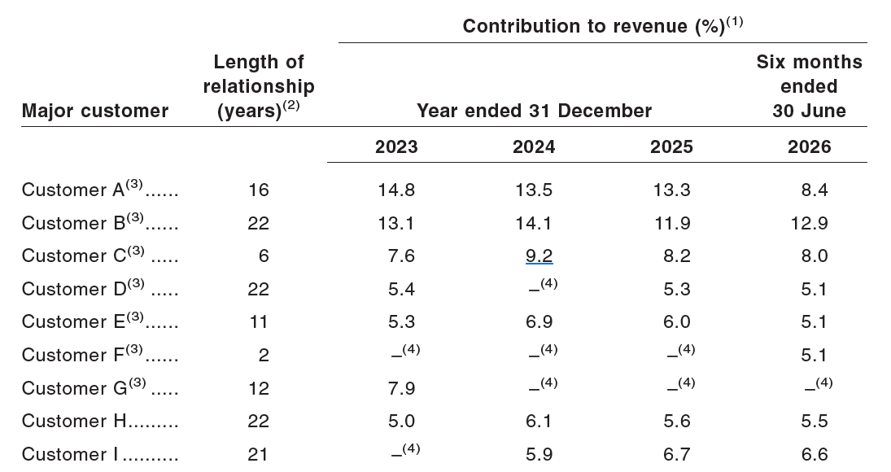
The company has established long-standing relationships with major direct customers.
The longest major customer relationship span 22 years, with global headquartered OSATs,. as well as leading-edge semiconductor fabs with relationships spanning 16 years.
The average relationship with major Direct Customers is about 17 years.
Strong in-house capabilities
Mi Material design and develop in-house much of the specialised machinery used in our production processes. This enables customised customer solutions and greater control over its manufacturing processes.
This in-house expertise enables Mi Material to have full control over their production process. More importantly, Mi Material is able to deliver integrated and customised solutions.
Experienced management team
Mi Material is led by an experienced management team with expertise in materials science and process engineering. Apart from the CEO, all executive officers have been with the company for more than 15 years.
Chairman Oh Kuang Eng, who is also Group CEO of MiTB, led the acquisition of the business in 2021. He has 30 years of experience in semiconductor equipment and automation. Currently, he is the Executive Director and Group CEO of MiTB. He oversees group strategy, business development and product development.
CEO Kevin Tan Kiang Hiong was promoted from Chief Operating Officer. He brings over 15 years of experience in the electronics materials and semiconductor industry. During the period 2010 to 2022, Mr Tan held technical, regional management and sales leadership roles at Henkel Singapore.
Executive Director Heng Kok Lin has over 35 years of experience in electronics materials and has been with the business since 2000. He held sales and marketing roles at Mi Material Taiwan from 2010 to 2023.
The combination of long-tenured leadership and deep technical capabilities provides a strong foundation for developing specialised solder sphere solutions used in complex semiconductor packaging applications.
Competitors
The solder sphere market is concentrated and regional.
Korea is largely served by Duksan Hi-Metal, which holds an estimated 60–70% of its domestic market.
Taiwan is centred around Senju Metal, Shenmao (with its PMTC unit) and Mi Material. Chinese suppliers may scale up over time as domestic OSAT capacity grows.
Yole identifies Senju Metal (privately held, Japan), Duksan Hi-Metal, Shenmao Technology and MK Electron as the main competitors.
Yole evaluates their alloys expertise. In the low-temperature high-reliability segment, Senju offers a catalogue product. According to management of Mi Material, Mi Material is at a similar stage of commercialisation as Senju. This meaningfully differentiates the addressable market of Mi Material from the peers.
Among the listed peers, only Duksan Hi-Metal is a solder sphere pure-play like Mi Material. Mi Material stands out on profitability, with a FY2025 gross margin of 36.3% compared with 6–19% for its listed peers.
It also passes through raw material costs to customers, while listed peers rely mainly on financial hedging.
Financial performance
Revenue and profitability
In FY2025, revenue grew 39.5% to US$65.3 million, but gross margin fell to 36.3% from 41.0%. This was because metal prices spiked in 2025, and there was a time lag before higher costs could be passed on to customers. Net profit rose 22.5% to US$10.0 million.
Mi Material’s revenue rose 109.5% year-on-year to US$53.7 million in 1H26. This was driven by higher sales volumes across all product categories, particularly from HPC and memory customers, a richer mix of specialty alloys and fine-pitch spheres, and the pass-through of higher tin, silver and copper prices.
Gross margin widened to 45.9% from 37.3%, and net profit rose to US$14.3 million from US$2.9 million. Adjusted EBITDA margin reached 37.5%, up from 25.5% in 1H25.
Demand is seasonal and tends to be stronger in the second half, as End-Customers typically launch products in the third quarter. Management estimates 3Q2026 revenue rose 15.6% quarter-on-quarter to US$37.8 million, with gross margin stable at 47.5%.
Management expected 3Q26 revenue to increase by 15.6% to US$37.8 million. Gross margin remains stable at 47.5%, from 48.0% in 2Q26.
Mi Material continues to benefit from favourable shift in product mix to higher margin specialty alloys.
For the period 9M26, the revenue of US$91.5 million, represents an increase of 40.8% from FY25. 9M26 gross margin at 46.6% represents an increase of 10.3 percentage point from 36.3% in FY25.
Management explained that the revenue growth and improvement in gross margin could be attributed to the shift towards higher margin speciality alloys. They expect the growth trend and higher profitability to be sustainable going forward.
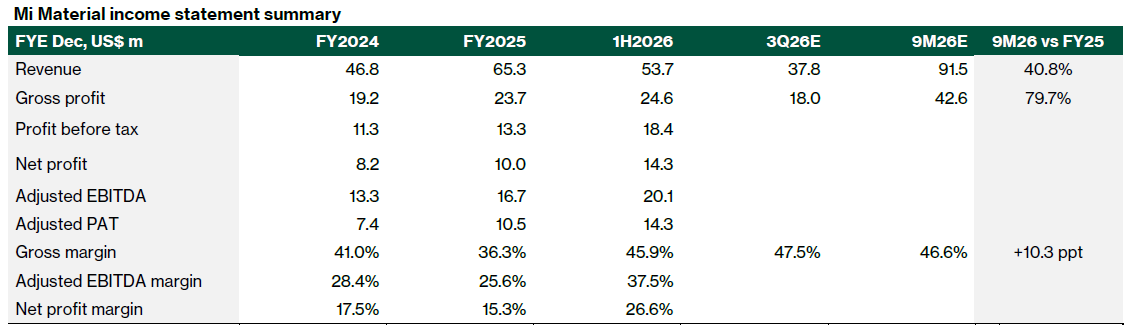
1H and 3Q figures are unaudited. Adjusted figures exclude non-cash, non-recurring and non-operating items
Capital management
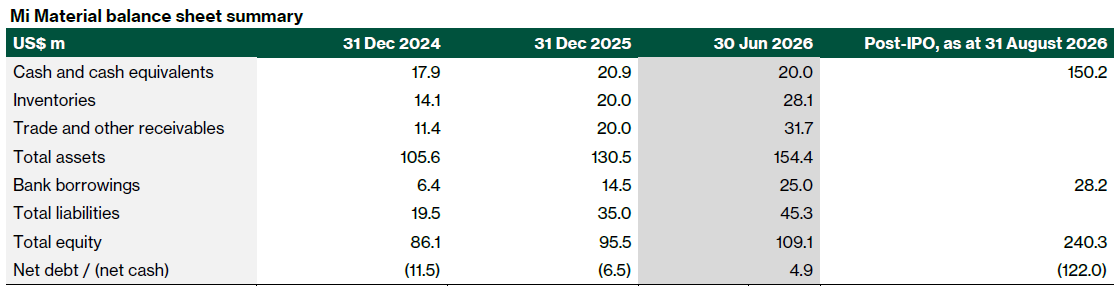
As of 30 June 2026, Mi Material had US$20.0 million in cash and US$25.0 million in bank borrowings, mainly short-term working capital facilities. This was a small net debt position of US$4.9 million, compared with net cash of US$6.5 million at end-2025.
After the IPO, Mi Material will receive net proceeds of about S$157.9 million (around US$123 million), which will turn it into a net cash position.
Post-IPO net asset value is estimated at S$0.60 per share.
Cash flow adequacy
Rapid growth has absorbed cash. Operating cash flow turned negative at US$0.9 million in FY2025 and US$5.4 million in 1H26, despite rising profits.
This was due to higher working capital requirements. Inventories rose to US$28.1 million and trade receivables to US$31.7 million as at 30 June 2026, while metal suppliers typically require payment in advance.
Management attributes the receivables build to sales being concentrated towards period-ends, and notes that 81.5% of receivables outstanding at end-June 2026 had been collected by 23 September 2026.
Average receivable days were stable at 83 days.
The IPO proceeds should ease the funding strain, but investors should watch whether operating cash flow turns positive as growth normalises.
US$ m | FY2023 | FY2024 | FY2025 | 1H2026 |
|---|---|---|---|---|
Funds from operations | 8.3 | 13.2 | 16.8 | 20.0 |
Operating cash flow | 5.5 | 11.3 | (0.9) | (5.4) |
Investing cash flow | (0.5) | (0.9) | (3.0) | (2.4) |
Financing cash flow | (3.9) | (4.5) | 6.3 | 6.9 |
Capex (purchase of PPE) | (0.6) | (1.0) | (3.0) | (2.5) |
Free cash flow (OCF – capex) | 4.9 | 10.3 | (3.9) | (7.9) |
Dividends paid | (6.3) | (4.0) | – | (3.5) |
Source: Company prospectus dated 19 October 2026. Capex rounded as disclosed in the MD&A | ||||
Planned capital expenditure for 2026 is US$12.0 million, funded internally.
The expansion projects in Malaysia, Taiwan, US and Singapore will be financed by IPO proceeds. Investors should expect higher depreciation as these facilities come on stream from 2027.
Dividend policy
Mi Material does not have a fixed dividend policy.
However, the board intends to pay at least 20% of net profit after tax as dividends for the period from listing to 31 December 2026 and for FY2027. Based on trailing 12-month earnings, a 20% payout implies a yield of about 0.6% at the IPO price.
Valuation
At the IPO price of S$1.80, Mi Material has a market capitalisation of S$891 million (about US$696 million).
Based on trailing 12-month net profit of US$21.4 million (2H25 and 1H26), it is valued at P/E 32.5x.
On annualised 1H26 earnings, Mi Material trades at P/E 24.4x.
Post-IPO, Mi Material trades at P/B 3.0x, based on post-IPO net asset value of S$0.60 per share.
Listed solder sphere peers trade at an average of FY26E P/E 15.5x, P/B 2.1x.
Mi Material’s premium reflects its much higher margins, faster growth and pure-play exposure to AI and HPC packaging.
However, the valuation leaves less room for error if the semiconductor cycle turns or margins normalise.
Key risks
Key risks include customer concentration, semiconductor cyclicality, raw material price volatility, working capital needs, execution risk on expansion, geopolitical exposure and controlling shareholder considerations.
Customer concentration
High customer concentration as three End-Customers accounts for 58% of 1H26 revenue. Top 5 Direct Customers accounts for 41.4% of 1H26 revenue. Losing product qualification or a customer phasing out a product line would hurt revenue.
Semiconductor cycle and AI demand
With solder sphere as the core product, Mi Material faces risk of downturn in the semiconductor cycle. Slowdown in hyperscaler AI spending, smartphone shipments or automotive production could reduce demand. Mobility & Wearables still accounts for about 62% of revenue.
Raw material prices
Silver and tin make up 89.2% of purchases. Mi Material relies on passing through price changes, which works with a lag. As its exposure to HPC grows, its sensitivity to metal prices may rise.
Working capital and cash flow
Operating cash flow has been negative since FY2025 due to higher inventories and receivables. Higher growth has to be balanced with rising working capital requirements.
Execution risk on expansion
The company is building or upgrading facilities in Malaysia, Taiwan, the US and Singapore at the same time. Customer qualification of the new Malaysia plant will be phased, and delays or cost overruns could weigh on returns.
Geopolitical and regulatory risks
Production is concentrated in Taiwan and China, and 77.7% of FY2025 revenue was delivered to these two markets. Export controls, tariffs and China’s export licensing on silver could disrupt supply chains or demand for semiconductor products.
As of May 2026, silver is subject to export-license administration. Due to the export controls on silver, Mi Material is not able to export solder sphere products from the Ningbo facility.
Controlling shareholder and valuation
MiTB will control about 73.7% of the company after listing, which limits free float and the influence of minority shareholders.
The IPO price is three times post-IPO net asset value, implying 66.6% immediate dilution for new investors, and cornerstone shares are not subject to lock-up.
Download the full report here.
Read also: What is advanced manufacturing? Advanced Manufacturing Guide for Investors
Behind every powerful AI chip are materials that help connect it all together. In this upcoming Beansprout webinar on 2 November, meet Mi Material Holding Limited, a Singapore-headquartered manufacturer of precision solder spheres and related interconnect solutions newly listed on the SGX Mainboard. Discover where it fits in the AI supply chain and what retail investors should know about its business.
You’ll learn about:
- Mi Material’s business and its role in advanced semiconductor packaging.
- How its products support AI, high-performance computing and high bandwidth memory, alongside mobile devices, wearables and automotive electronics.
- Its global customer base and exposure to key semiconductor end markets.

Check out Beansprout guide to the best stock trading platforms in Singapore with the latest promotions to Mi Material Holding Limited.
Join the Beansprout Telegram group for the latest insights on Singapore stocks, REITs, bonds and ETFs.
Important Disclosures
Analyst Certification and Disclosures
The analyst(s) named in this report certifies that (i) all views expressed in this report accurately reflect the personal views of the analyst(s) with regard to any and all of the subject securities and companies mentioned in this report and (ii) no part of the compensation of the analyst(s) was, is, or will be, directly or indirectly, related to the specific views expressed by that analyst herein. The analyst(s) named in this report (or their associates) does not have a financial interest in the corporation(s) mentioned in this report.
An associate is defined as (i) the spouse, or any minor child (natural or adopted) or minor step-child, of the analyst; (ii) the trustee of a trust of which the analyst, his spouse, minor child (natural or adopted) or minor step-child, is a beneficiary or discretionary object; or (iii) another person accustomed or obliged to act in accordance with the directions or instructions of the analyst.
Company Disclosure
Global Wealth Technology Pte Ltd (“Beansprout”) does not have any financial interest in the corporation(s) mentioned in this report.
Disclaimer
This report is provided by Beansprout for the use of intended recipients only and may not be reproduced, in whole or in part, or delivered or transmitted to any other person without our prior written consent. By accepting this report, the recipient agrees to be bound by the terms and limitations set out herein.
You acknowledge that this document is provided for general information purposes only. Nothing in this document shall be construed as a recommendation to purchase, sell, or hold any security or other investment, or to pursue any investment style or strategy. Nothing in this document shall be construed as advice that purports to be tailored to your needs or the needs of any person or company receiving the advice. The information in this document is intended for general circulation only and does not constitute investment advice. Nothing in this document is published with regard to the specific investment objectives, financial situation and particular needs of any person who may receive the information.
Nothing in this document shall be construed as, or form part of, any offer for sale or subscription of or solicitation or invitation of any offer to buy or subscribe for any securities. The data and information made available in this document are of a general nature and do not purport, and shall not in any way be deemed, to constitute an offer or provision of any professional or expert advice, including without limitation any financial, investment, legal, accounting or tax advice, and shall not be relied upon by you in that regard. You should at all times consult a qualified expert or professional adviser to obtain advice and independent verification of the information and data contained herein before acting on it. Any financial or investment information in this document are intended to be for your general information only. You should not rely upon such information in making any particular investment or other decision which should only be made after consulting with a fully qualified financial adviser. Such information do not nor are they intended to constitute any form of financial or investment advice, opinion or recommendation about any investment product, or any inducement or invitation relating to any of the products listed or referred to. Any arrangement made between you and a third party named on or linked to from these pages is at your sole risk and responsibility.
You acknowledge that Beansprout is under no obligation to exercise editorial control over, and to review, edit or amend any data, information, materials or contents of any content in this document. You agree that all statements, offers, information, opinions, materials, content in this document should be used, accepted and relied upon only with care and discretion and at your own risk, and Beansprout shall not be responsible for any loss, damage or liability incurred by you arising from such use or reliance.
This document (including all information and materials contained in this document) is provided “as is”. Although the material in this document is based upon information that Beansprout considers reliable and endeavours to keep current, Beansprout does not assure that this material is accurate, current or complete and is not providing any warranties or representations regarding the material contained in this document. All opinions contained herein constitute the views of the analyst(s) named in this report, they are subject to change without notice and are not intended to provide the sole basis of any evaluation of the subject securities and companies mentioned in this report. Any reference to past performance should not be taken as an indication of future performance. To the fullest extent permissible pursuant to applicable law, Beansprout disclaims all warranties and/or representations of any kind with regard to this document, including but not limited to any implied warranties of merchantability, non-infringement of third-party rights, or fitness for a particular purpose.
Beansprout does not warrant, either expressly or impliedly, the accuracy or completeness of the information, text, graphics, links or other items contained in this document. Neither Beansprout nor any of its affiliates, directors, employees or other representatives will be liable for any damages, losses or liabilities of any kind arising out of or in connection with the use of this document. To the best of Beansprout’s knowledge, this document does not contain and is not based on any non-public, material information. The information in this document is not intended for distribution to, or use by, any person or entity in any jurisdiction where such distribution or use would be contrary to law or regulation, or which would subject Beansprout to any registration requirement within such jurisdiction or country. Beansprout is not licensed or regulated by any authority in any jurisdiction or country to provide the information in this document.
As a condition of your use of this document, you agree to indemnify, defend and hold harmless Beansprout and its affiliates, and their respective officers, directors, employees, members, managing members, managers, agents, representatives, successors and assigns from and against any and all actions, causes of action, claims, charges, cost, demands, expenses and damages (including attorneys’ fees and expenses), losses and liabilities or other expenses of any kind that arise directly or indirectly out of or from, arising out of or in connection with violation of these terms, use of this document, violation of the rights of any third party, acts, omissions or negligence of third parties, their directors, employees or agents. To the extent permitted by law, Beansprout shall not be liable to you, any other person, or organization, for any direct, indirect, special, punitive, exemplary, incidental or consequential damages, whether in contract, tort (including negligence), or otherwise, arising in any way from, or in connection with, the use of this document and/or its content. This includes, without limitation, liability for any act or omission in reliance on the information in this document. Beansprout expressly disclaims and excludes all warranties, conditions, representations and terms not expressly set out in this User Agreement, whether express, implied or statutory, with regard to this document and its content, including any implied warranties or representations about the accuracy or completeness of this document and the content, suitability and general availability, or whether it is free from error.
If these terms or any part of them is understood to be illegal, invalid or otherwise unenforceable under the laws of any state or country in which these terms are intended to be effective, then to the extent that they are illegal, invalid or unenforceable, they shall in that state or country be treated as severed and deleted from these terms and the remaining terms shall survive and remain fully intact and in effect and will continue to be binding and enforceable in that state or country.
These terms, as well as any claims arising from or related thereto, are governed by the laws of Singapore without reference to the principles of conflicts of laws thereof. You agree to submit to the personal and exclusive jurisdiction of the courts of Singapore with respect to all disputes arising out of or related to this Agreement. Beansprout and you each hereby irrevocably consent to the jurisdiction of such courts, and each Party hereby waives any claim or defence that such forum is not convenient or proper.
Read also
Gain financial insights in minutes
Subscribe to our free weekly newsletter for more insights to grow your wealth
Most Popular

Comments
0 comments