
What is advanced manufacturing? Advanced Manufacturing Guide for Investors
Stocks
Powered by

By Gerald Wong, CFA • 09 Oct 2026
Global Wealth Technology Pte. Ltd. is regulated by the Monetary Authority of Singapore (MAS) as a licensed Financial Adviser.
'%3e%3cpath%20fill-rule='evenodd'%20clip-rule='evenodd'%20d='M17.64%209.20455C17.64%208.56637%2017.5827%207.95273%2017.4764%207.36364H9V10.845H13.8436C13.635%2011.97%2013.0009%2012.9232%2012.0477%2013.5614V15.8195H14.9564C16.6582%2014.2527%2017.64%2011.9455%2017.64%209.20455V9.20455Z'%20fill='%234285F4'/%3e%3cpath%20fill-rule='evenodd'%20clip-rule='evenodd'%20d='M9%2018C11.43%2018%2013.4673%2017.1941%2014.9564%2015.8195L12.0477%2013.5614C11.2418%2014.1014%2010.2109%2014.4205%209%2014.4205C6.65591%2014.4205%204.67182%2012.8373%203.96409%2010.71H0.957275V13.0418C2.43818%2015.9832%205.48182%2018%209%2018V18Z'%20fill='%2334A853'/%3e%3cpath%20fill-rule='evenodd'%20clip-rule='evenodd'%20d='M3.96409%2010.71C3.78409%2010.17%203.68182%209.59318%203.68182%209C3.68182%208.40682%203.78409%207.83%203.96409%207.29V4.95818H0.957273C0.347727%206.17318%200%207.54773%200%209C0%2010.4523%200.347727%2011.8268%200.957273%2013.0418L3.96409%2010.71V10.71Z'%20fill='%23FBBC05'/%3e%3cpath%20fill-rule='evenodd'%20clip-rule='evenodd'%20d='M9%203.57955C10.3214%203.57955%2011.5077%204.03364%2012.4405%204.92545L15.0218%202.34409C13.4632%200.891818%2011.4259%200%209%200C5.48182%200%202.43818%202.01682%200.957275%204.95818L3.96409%207.29C4.67182%205.16273%206.65591%203.57955%209%203.57955V3.57955Z'%20fill='%23EA4335'/%3e%3c/g%3e%3cdefs%3e%3cclipPath%20id='clip0_0_2849'%3e%3crect%20width='18'%20height='18'%20fill='white'/%3e%3c/clipPath%3e%3c/defs%3e%3c/svg%3e)
Make Beansprout your preferred source on Google
Add us on Google to see more of our insights in your search results
Discover Singapore’s advanced manufacturing sector, including key growth drivers, investment opportunities, listed companies, valuations and key risks.
What happened?
Singapore’s advanced manufacturing sector is moving up the value chain.
Artificial intelligence (AI), robotics and precision engineering are increasing the complexity of products such as data centre chips, smartphones, electric vehicles and medical devices.
That creates demand for more advanced production, packaging, testing and engineering capabilities.
The semiconductor industry is also recovering after the downturn in 2022 and 2023.
For investors, this means advanced manufacturing could benefit from both a cyclical recovery and longer-term demand from AI, automation and more complex electronics.
Singapore is already an important part of this supply chain, with capabilities spanning wafer fabrication, semiconductor equipment, precision engineering and aerospace.
Newer areas such as advanced packaging, edge AI, photonics and space technologies could broaden that exposure further.
The more useful question is not simply whether advanced manufacturing will grow. It is which parts of the value chain can translate that growth into sustainable earnings and cash flow.
What is advanced manufacturing?
Advanced manufacturing uses technologies such as AI, robotics, precision engineering, additive manufacturing and advanced semiconductor packaging to improve how products are designed and made.
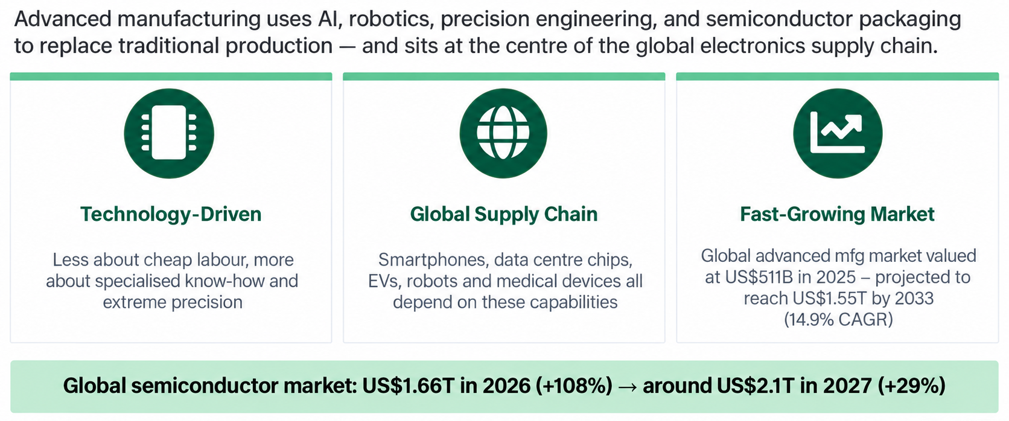
The advantage increasingly comes from specialised know-how, high precision and the ability to combine software with physical production.
These capabilities are used across semiconductors, aerospace, medical devices, industrial equipment and consumer electronics.
For investors, that makes advanced manufacturing broader than a semiconductor theme.
The opportunity extends from chip equipment and testing to precision components, electronics manufacturing, aerospace services and newer technologies such as metalenses and satellite communications.
What are the main growth drivers for advanced manufacturing?
Several trends could support demand over the coming years, but they affect different parts of the supply chain in different ways.
| Growth driver | What is changing | Why it matters for investors |
|---|---|---|
| AI and data centres | AI infrastructure requires graphics processing units (GPUs), memory, networking equipment and more sophisticated packaging. | More powerful chips can require additional testing, thermal management, precision components and production equipment. |
| Advanced packaging and chiplets | It is becoming harder and more expensive to improve performance only by shrinking transistors. Chipmakers are increasingly combining smaller chips within one package. | More value may move into areas such as 2.5D and 3D stacking, fan-out packaging and hybrid bonding. |
| Edge AI | More AI processing could move directly onto wearables, sensors, cameras, vehicles and medical devices. | This may support demand for ultra-low-power chips that can run AI applications with limited battery use. |
| Semiconductor equipment | More complex chips require increasingly specialised tools for production, inspection, packaging and testing. | Equipment and component suppliers can benefit when semiconductor manufacturers increase capital spending. |
| Precision engineering | Advanced chips, medical devices, aircraft systems and industrial equipment require tighter tolerances and higher reliability. | Qualified manufacturers can become more valuable as product complexity rises and customers diversify supply chains. |
| Aerospace and space | Aircraft production, maintenance and satellite-related services continue to expand. | This gives the sector growth drivers beyond semiconductors and consumer electronics. |
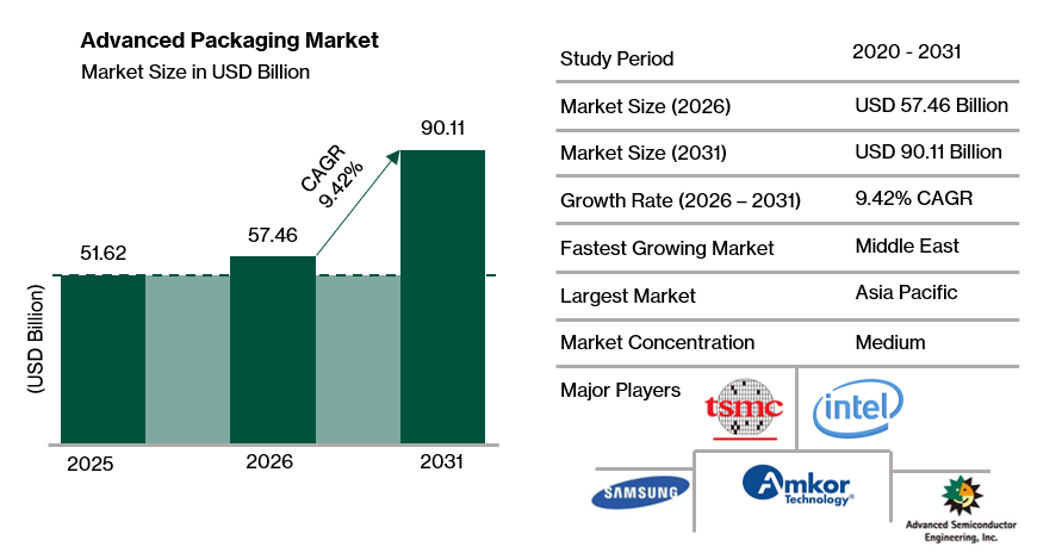
The global advanced packaging market was estimated at around US$50 billion to US$52 billion in 2025 and is projected to reach about US$90 billion by 2031.
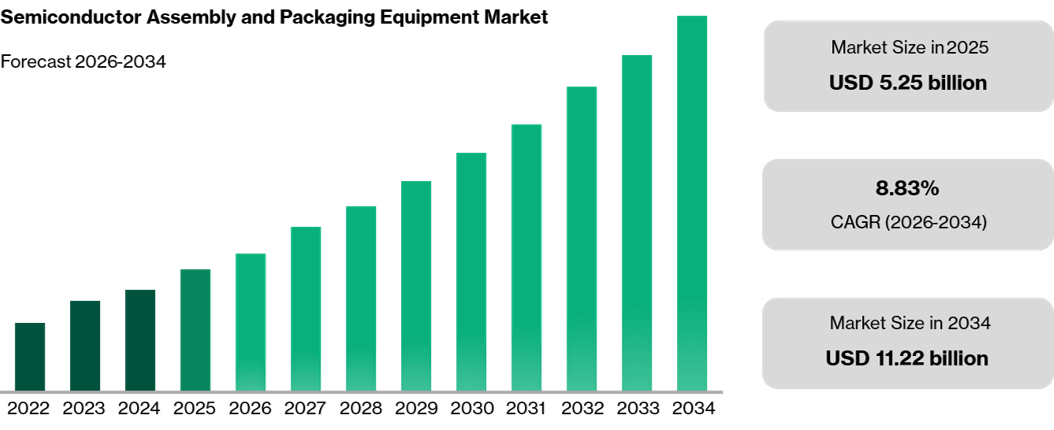
The global semiconductor assembly and packaging equipment market was estimated at about US$5.3 billion in 2025 and is projected to reach about US$11.2 billion by 2034.
A global aircraft backlog of more than 17,000 aircraft could support years of production, while a larger installed fleet should also create recurring demand for maintenance, repair and overhaul services, according to International Air Transport Association (IATA), as of 9 December 2025.
The global space economy is projected to grow from around US$630 billion in 2023 to US$1.8 trillion by 2035.
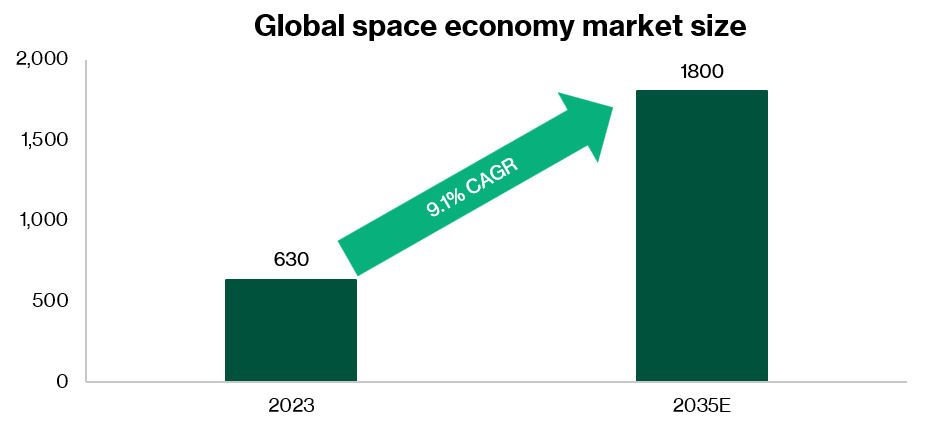
Taken together, these trends suggest that advanced manufacturing is not dependent on a single semiconductor cycle. The opportunity spans AI, data centres, chiplets, electric vehicles, automation, aerospace and the space economy.
Why is Singapore important in advanced manufacturing?
Singapore has built an established manufacturing base across semiconductors, precision engineering and aerospace.
Its role has developed over decades through investment, engineering capabilities and the presence of global manufacturers.
The semiconductor ecosystem includes companies such as GlobalFoundries, Micron, United Microelectronics Corporation (UMC), STMicroelectronics, Siltronic, Applied Materials, Lam Research and KLA. Having manufacturers, equipment suppliers and engineers within the same ecosystem can make it easier to attract further investment and talent.
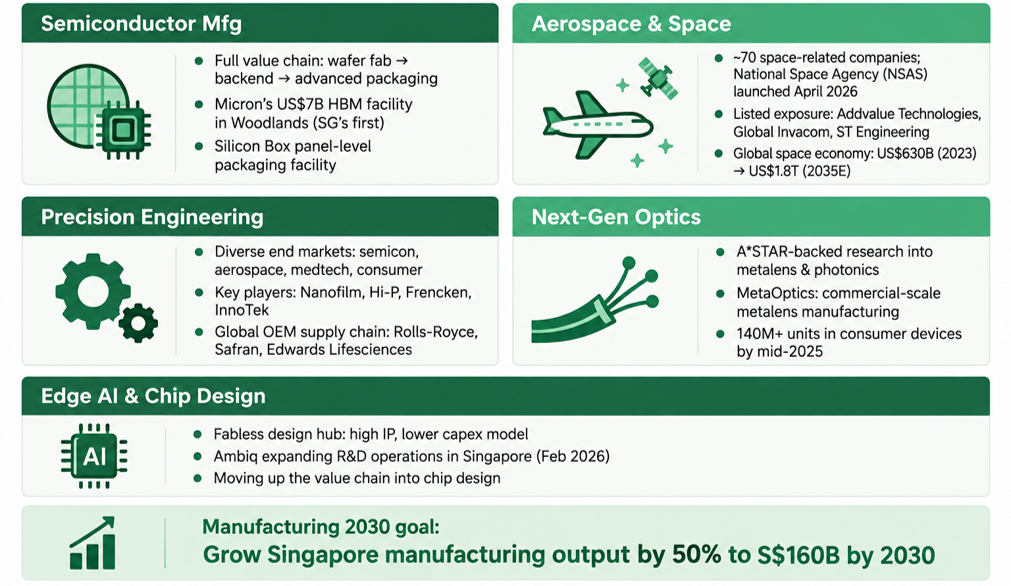
Singapore is also moving further into advanced packaging and AI-related memory.
Micron’s high-bandwidth memory packaging facility and Silicon Box’s panel-level packaging facility increase local exposure to areas linked to AI semiconductor demand.
There is also a push into activities higher up the value chain, including chip design and research and development (R&D).
These activities can create intellectual property and skilled employment without requiring the same physical manufacturing footprint.
Precision engineering provides another source of diversification.
Local companies serve industries including semiconductors, medical technology, industrial equipment and aerospace, reducing their dependence on any single end market.
According to Singapore Economic Development Board, Singapore services roughly 10% of the world’s aircraft and close to 20% of its aircraft engines, as of 27 Feb 2026.
Newer areas include photonics, precision optics, edge AI and satellite communications. The launch of the National Space Agency of Singapore in 2026 adds another part to this developing ecosystem.
Which Singapore companies have exposure to advanced manufacturing?
For investors, the listed opportunity set covers several different business models. That matters because two companies can both be described as advanced manufacturing stocks while having very different earnings drivers.
| Segment | Companies | Main exposure |
|---|---|---|
| Semiconductor testing and equipment | AEM Holdings, Kulicke & Soffa, ASMPT | System-level testing, burn-in, assembly, packaging and semiconductor production equipment |
| Semiconductor components and manufacturing | UMS Integration, GlobalFoundries | Precision components for semiconductor equipment and wafer manufacturing |
| Precision engineering and electronics manufacturing | Frencken Group, Venture Corporation, Aztech Global, Valuetronics, InnoTek | Precision engineering, electronics manufacturing and diversified industrial production |
| Advanced materials | Nanofilm Technologies | Advanced materials and surface technologies |
| Optics and emerging technologies | MetaOptics | Metalens technology and next-generation optical applications |
| Aerospace | ST Engineering | Aircraft maintenance, repair and engineering services |
| Space technologies | Addvalue Technologies, Global Invacom | Satellite communications technologies and equipment |
| AI hardware | PC Partner | GPUs and developing AI server exposure |
The investment case differs by company.
A semiconductor equipment supplier may be highly sensitive to capital spending, while a diversified manufacturer may have steadier end-market exposure but less direct upside from a single growth theme.
This is why I would look beyond the label and ask where revenue and profit actually come from. The stronger investment case is usually the one where industry growth is already translating into orders, margins and cash flow.
How do valuations compare for advanced manufacturing stocks?
Valuations across advanced manufacturing stocks are mixed rather than uniformly cheap.
Some companies may trade at higher multiples because investors are pricing in stronger expectations for AI, semiconductor recovery or new technology growth.
A higher valuation is not automatically a problem if earnings can grow into it.
The risk is paying for several years of expected growth before there is enough evidence that the company can deliver.
I would therefore compare valuation with the stage of the industry cycle, the company’s earnings growth and how much of its business is genuinely exposed to the growth area being discussed.
A company with only limited AI-related revenue, for example, should not necessarily be valued like a pure AI beneficiary.
What should investors look at when evaluating advanced manufacturing stocks?
The sector can grow while individual stocks still disappoint. I would focus on the factors that show whether industry demand is reaching the company’s financials.
| What to watch | Why it matters |
|---|---|
| Revenue and earnings growth | Shows whether stronger industry demand is translating into financial growth. For cyclical companies, compare current earnings with previous peaks and troughs. |
| Order book and bookings | Can provide an early indication of future revenue and whether demand is improving or slowing. |
| Customer concentration | Heavy reliance on one or two customers can make earnings more volatile if orders are delayed or reduced. |
| Exposure to growth areas | Check how much revenue or profit actually comes from AI, advanced packaging, aerospace or other themes rather than relying on management commentary alone. |
| Margins | Revenue growth is more valuable when operating leverage also improves profitability. |
| Cash flow | Rising inventories, working capital or capital expenditure can weaken free cash flow even when reported earnings are growing. |
| Balance sheet | Financial strength gives companies more flexibility through downturns and investment cycles. |
| Technology capability | R&D, intellectual property and qualification for new programmes can determine whether a supplier remains relevant as customer requirements change. |
| Valuation | Strong industry growth does not make every share price attractive. The more growth already reflected in the price, the more execution matters. |
What are the key risks of investing in advanced manufacturing?
Advanced manufacturing has long-term growth drivers, but many of the companies remain cyclical and can experience sharp swings in orders and earnings.
Semiconductor cyclicality. Demand can move from shortages to inventory corrections quickly. Different parts of the supply chain can also recover at different speeds, so equipment suppliers may remain weak even when headline chip demand improves.
Geopolitical risk. Export controls, restrictions on semiconductor equipment and US-China technology tensions can affect customers and supply chains. Singapore may benefit from diversification, but it would not be insulated from a broader technology conflict.
Taiwan Strait risk. A significant share of advanced semiconductor manufacturing remains concentrated in Taiwan. A serious disruption could affect suppliers and customers across the global semiconductor value chain. [EDITOR: Add source/date if this concentration claim is retained.]
Trade policy uncertainty. Changes in tariffs or rules of origin can affect sourcing, pricing and where customers choose to manufacture. Singapore-based suppliers may still be affected if their customers shift production strategies.
Customer concentration. Some manufacturing companies depend heavily on a small number of customers. A delayed programme or lower spending by one large customer can have a material impact on revenue and profit.
Technology transition risk. Advanced packaging, chip design and production processes continue to change. Companies that fail to invest in the next generation of technology risk losing relevance.
Talent constraints. Advanced manufacturing requires specialised engineers and technicians. Growth can be harder to sustain if companies cannot recruit and retain enough skilled workers.
Learn more about the advanced manufacturing sector by downloading our guide for investors here.
Follow us on Telegram, Youtube, Facebook and Instagram to get the latest financial insights.
Important Disclosures
Analyst Certification and Disclosures
The analyst(s) named in this report certifies that (i) all views expressed in this report accurately reflect the personal views of the analyst(s) with regard to any and all of the subject securities and companies mentioned in this report and (ii) no part of the compensation of the analyst(s) was, is, or will be, directly or indirectly, related to the specific views expressed by that analyst herein. The analyst(s) named in this report (or their associates) does not have a financial interest in the corporation(s) mentioned in this report.
An associate is defined as (i) the spouse, or any minor child (natural or adopted) or minor step-child, of the analyst; (ii) the trustee of a trust of which the analyst, his spouse, minor child (natural or adopted) or minor step-child, is a beneficiary or discretionary object; or (iii) another person accustomed or obliged to act in accordance with the directions or instructions of the analyst.
Company Disclosure
Global Wealth Technology Pte Ltd (“Beansprout”) does not have any financial interest in the corporation(s) mentioned in this report.
Beansprout was appointed by Singapore Exchange Limited via a third party platform provider and received monetary compensation from SGX via such third party platform provider to provide independent research. Beansprout is solely responsible for the contents of this document. Singapore Exchange Limited and/or its affiliates, including Singapore Exchange Regulation Pte. Ltd. (collectively, SGX Group Companies) assume no responsibility (whether under contract, tort (including negligence) or otherwise), directly or indirectly, for the contents of this document. The general disclaimers and jurisdiction specific disclaimers found on SGX’s website at http://www.sgx.com/terms-use are also incorporated into and applicable to this document.
Disclaimer
This report is provided by Beansprout for the use of intended recipients only and may not be reproduced, in whole or in part, or delivered or transmitted to any other person without our prior written consent. By accepting this report, the recipient agrees to be bound by the terms and limitations set out herein.
You acknowledge that this document is provided for general information purposes only. Nothing in this document shall be construed as a recommendation to purchase, sell, or hold any security or other investment, or to pursue any investment style or strategy. Nothing in this document shall be construed as advice that purports to be tailored to your needs or the needs of any person or company receiving the advice. The information in this document is intended for general circulation only and does not constitute investment advice. Nothing in this document is published with regard to the specific investment objectives, financial situation and particular needs of any person who may receive the information.
Nothing in this document shall be construed as, or form part of, any offer for sale or subscription of or solicitation or invitation of any offer to buy or subscribe for any securities. The data and information made available in this document are of a general nature and do not purport, and shall not in any way be deemed, to constitute an offer or provision of any professional or expert advice, including without limitation any financial, investment, legal, accounting or tax advice, and shall not be relied upon by you in that regard. You should at all times consult a qualified expert or professional adviser to obtain advice and independent verification of the information and data contained herein before acting on it. Any financial or investment information in this document are intended to be for your general information only. You should not rely upon such information in making any particular investment or other decision which should only be made after consulting with a fully qualified financial adviser. Such information do not nor are they intended to constitute any form of financial or investment advice, opinion or recommendation about any investment product, or any inducement or invitation relating to any of the products listed or referred to. Any arrangement made between you and a third party named on or linked to from these pages is at your sole risk and responsibility.
You acknowledge that Beansprout is under no obligation to exercise editorial control over, and to review, edit or amend any data, information, materials or contents of any content in this document. You agree that all statements, offers, information, opinions, materials, content in this document should be used, accepted and relied upon only with care and discretion and at your own risk, and Beansprout shall not be responsible for any loss, damage or liability incurred by you arising from such use or reliance.
This document (including all information and materials contained in this document) is provided “as is”. Although the material in this document is based upon information that Beansprout considers reliable and endeavours to keep current, Beansprout does not assure that this material is accurate, current or complete and is not providing any warranties or representations regarding the material contained in this document. All opinions contained herein constitute the views of the analyst(s) named in this report, they are subject to change without notice and are not intended to provide the sole basis of any evaluation of the subject securities and companies mentioned in this report. Any reference to past performance should not be taken as an indication of future performance. To the fullest extent permissible pursuant to applicable law, Beansprout disclaims all warranties and/or representations of any kind with regard to this document, including but not limited to any implied warranties of merchantability, non-infringement of third-party rights, or fitness for a particular purpose.
Beansprout does not warrant, either expressly or impliedly, the accuracy or completeness of the information, text, graphics, links or other items contained in this document. Neither Beansprout nor any of its affiliates, directors, employees or other representatives will be liable for any damages, losses or liabilities of any kind arising out of or in connection with the use of this document. To the best of Beansprout’s knowledge, this document does not contain and is not based on any non-public, material information. The information in this document is not intended for distribution to, or use by, any person or entity in any jurisdiction where such distribution or use would be contrary to law or regulation, or which would subject Beansprout to any registration requirement within such jurisdiction or country. Beansprout is not licensed or regulated by any authority in any jurisdiction or country to provide the information in this document.
As a condition of your use of this document, you agree to indemnify, defend and hold harmless Beansprout and its affiliates, and their respective officers, directors, employees, members, managing members, managers, agents, representatives, successors and assigns from and against any and all actions, causes of action, claims, charges, cost, demands, expenses and damages (including attorneys’ fees and expenses), losses and liabilities or other expenses of any kind that arise directly or indirectly out of or from, arising out of or in connection with violation of these terms, use of this document, violation of the rights of any third party, acts, omissions or negligence of third parties, their directors, employees or agents. To the extent permitted by law, Beansprout shall not be liable to you, any other person, or organization, for any direct, indirect, special, punitive, exemplary, incidental or consequential damages, whether in contract, tort (including negligence), or otherwise, arising in any way from, or in connection with, the use of this document and/or its content. This includes, without limitation, liability for any act or omission in reliance on the information in this document. Beansprout expressly disclaims and excludes all warranties, conditions, representations and terms not expressly set out in this User Agreement, whether express, implied or statutory, with regard to this document and its content, including any implied warranties or representations about the accuracy or completeness of this document and the content, suitability and general availability, or whether it is free from error.
If these terms or any part of them is understood to be illegal, invalid or otherwise unenforceable under the laws of any state or country in which these terms are intended to be effective, then to the extent that they are illegal, invalid or unenforceable, they shall in that state or country be treated as severed and deleted from these terms and the remaining terms shall survive and remain fully intact and in effect and will continue to be binding and enforceable in that state or country.
These terms, as well as any claims arising from or related thereto, are governed by the laws of Singapore without reference to the principles of conflicts of laws thereof. You agree to submit to the personal and exclusive jurisdiction of the courts of Singapore with respect to all disputes arising out of or related to this Agreement. Beansprout and you each hereby irrevocably consent to the jurisdiction of such courts, and each Party hereby waives any claim or defence that such forum is not convenient or proper.
Read also
Gain financial insights in minutes
Subscribe to our free weekly newsletter for more insights to grow your wealth
Most Popular

Comments
0 comments