
Singapore stocks reach record highs. How investors can gain exposure
ETFs
Powered by

By Nicole Ng • 24 Feb 2026
Why trust Beansprout? We’ve been awarded Best Investment Website at the SIAS Investors’ Choice Awards 2025
Singapore’s Straits Times Index (STI) has reached record highs recently. We explore what’s driving the rally, what’s next, and how investors can gain exposure.

This post was created in partnership with Amova Asset Management. All views and opinions expressed in this article are Beansprout's objective and professional opinions.
What happened?
Singapore’s stock market is back in the spotlight once again.
On 3 February 2026 Singapore’s benchmark Straits Times Index (STI) surged to a record high of 4,944 (Yahoo Finance).
This would bring its 1-year return to about 29%, as of 30 January 2026 (Yahoo Finance).
Whether you are looking for long-term growth opportunities or looking to build passive income, you are probably wondering if this is the start of longer-term growth for Singapore equities.
In this article, we’ll explore what’s driving the rally, how investors can gain exposure through the Amova Singapore STI ETF, and key considerations before investing.
What’s driving the rally in the STI?
The Straits Times Index (STI) tracks the performance of the 30 largest and most actively traded companies listed on the Singapore Exchange (SGX), serving as a key benchmark for the Singapore stock market.
Let’s take a closer look at what has been driving the recent rally in the STI and the key sectors contributing to its strength.
#1 – Banking strength: DBS, UOB, OCBC earnings resilience
DBS, UOB, and OCBC together make up slightly more than 50% of the STI, as of 31 January 2026 (SGX ).
This makes the banks a key driver of the STI, which means that their performance has a major influence on how the broader market moves.
| Stock/Index | 1-year Performance |
| DBS | +35.38% |
| STI | +29.7% |
| OCBC | +24% |
| UOB | -3.2% |
| Source: Yahoo Finance as of 30 January 2026 | |
Their 2Q25 earnings results show that Singapore’s banks remain remarkably resilient, even as margins come under pressure from a lower interest rate environment and loan growth remains modest.
All three banks also saw their assets under management (AUM) grow in the second quarter of 2025. See chart below.
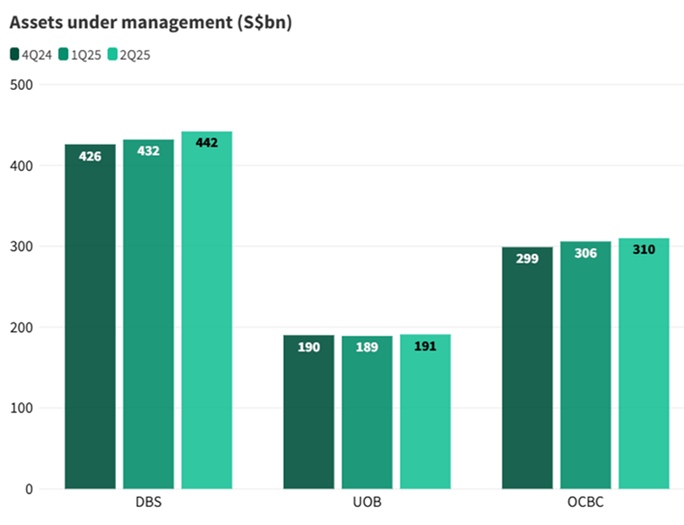
The steady growth in AUM underscores how wealth management has become a key long-term growth engine and return-on-equity (ROE)* driver for Singapore banks.
*ROE is a metric that tells you how efficiently a company uses shareholders’ money to generate profits
Dividends have remained an important source of support for the banks’ share prices.
Dividend yields among the 3 Singapore banks currently range between about 3.8% and 4.8%, reflecting their strong capital positions and consistent shareholder returns (Source: SGX stock screener, as of 5 February 2026).
This combination of solid profitability, stable asset quality, and consistent dividend track record has reinforced confidence in the local banking sector.
This, in turn, has been a key pillar behind the STI’s recent rally.
#2 – REIT recovery hopes with rate cuts
After two years of weakness driven by higher borrowing costs, REITs are making a comeback as expectations of global interest rate cuts grow stronger.
In 2024, real estate was among the weakest performers, dragging the STI down by 8.1% , according to data from FTSE Russell.
But the sector turned around in 2025, contributing +21.3% year-to-date, as of 6 August 2025, ranking the third-best performer in the index, as data from FTSE Russell showed.
As of 31 January 2026 , REITs make up about 16.24% of STI, with major names such as CapitaLand Ascendas REIT, CapitaLand Integrated Commercial Trust, Keppel DC REIT, and Mapletree Industrial Trust among the constituents (FTSE Russell Straits Times Index (STI) Factsheet)).
The broader Singapore REIT market has rebounded by about 12% in the past 1 year as of 5 February 2026, reflecting the improved sentiment across the sector as shown in the chart below.
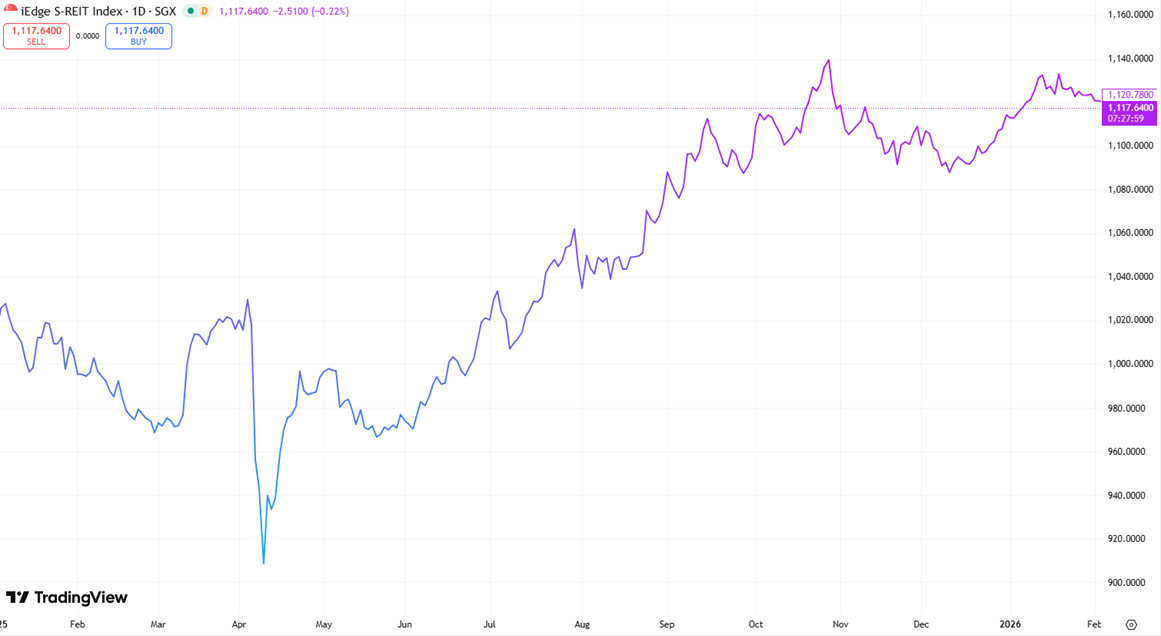
The 3-month compounded Singapore Overnight Rate Average (SORA) has continued to drift lower, falling to 1.15% on 29 Jan 2026 from 3.07% on 31 December 2024 (Source: MAS).
As a result, some Singapore REITS have started to report lower finance costs from the third quarter of 2025.
The improving outlook for REITs has supported the STI’s recent performance as investors rotate back into yield-focused assets.
#3 – Dividend appeal: STI’s enduring yield advantage
Another reason Singapore stocks remain popular, especially among investors building passive income, is the STI’s reliable dividend yield.
The index currently offers an average dividend yield of around 3.92% % as of 30 January 2026 , slightly lower than its long-term average of 4% after the recent rally, but it is still higher than other regional benchmarks such as Hong Kong’s Hang Seng Index or Japan’s Nikkei 225. See table below.
| Index | Dividend Yield |
| FTSE Straits Times Index | 3.92%* |
| Hang Seng Index | 3.09%^ |
| Nikkei 225 | 1.49%^ |
| Source: Respective indexes factsheet as of 30 January 2026* and 31 December 2025^. *Dividend yield of the Straits Times Index is not the same as that of the Amova Singapore STI ETF. Past dividend yields are not indicative of future dividend yields. | |
Many Singapore companies, particularly the banks, telcos, and REITs, have maintained consistent dividend payouts throughout different market cycles.
#4 – Measures to boost the Singapore stock market
Policy measures and market initiatives are also helping to enhance the appeal of Singapore’s capital markets.
Policymakers and industry players have introduced steps to boost liquidity, attract new listings, and broaden investor participation.
Initiatives from the Monetary Authority of Singapore (MAS), such as the S$5 billion Equity Market Development Programme (EQDP) and the launch of the ‘Next 50’ indices, are helping to anchor asset managers, increase market depth, and build long-term liquidity.
MAS has also introduced complementary measures, such as tax exemptions on fund managers’ income from Singapore-listed equities and updates to the Global Investor Programme (GIP), which now requires a minimum S$50 million investment in qualifying local assets, and are also attracting greater capital inflows.
Together, these efforts reflect a longer-term strategy to make Singapore’s capital markets more vibrant, liquid, and globally competitive.
This, in turn, reinforces the STI’s foundation and creates broader opportunities beyond traditional blue-chip names.
What is the Amova Singapore STI ETF (SGX: G3B)?
For retail investors like me, it can take time to keep up with company updates, and building a diversified portfolio of Singapore blue-chips can get expensive.
That’s why I’ve been looking into exchange-traded funds (ETFs), which let me invest in a diversified basket of companies through a single trade.
For exposure to the Singapore market, one option worth considering is the Amova Singapore STI ETF (SGX: G3B).
The Amova Singapore STI ETF tracks the performance of the Straits Times Index, giving investors exposure to Singapore’s largest and most established companies, including leaders across the banking, real estate, and telecommunications sectors.
Here are some of the key highlights to know about the Amova Singapore STI ETF:
#1 – Diversified exposure
The Amova Singapore STI ETF holds all the top 30 companies that make up the STI, giving me instant diversification across key sectors.
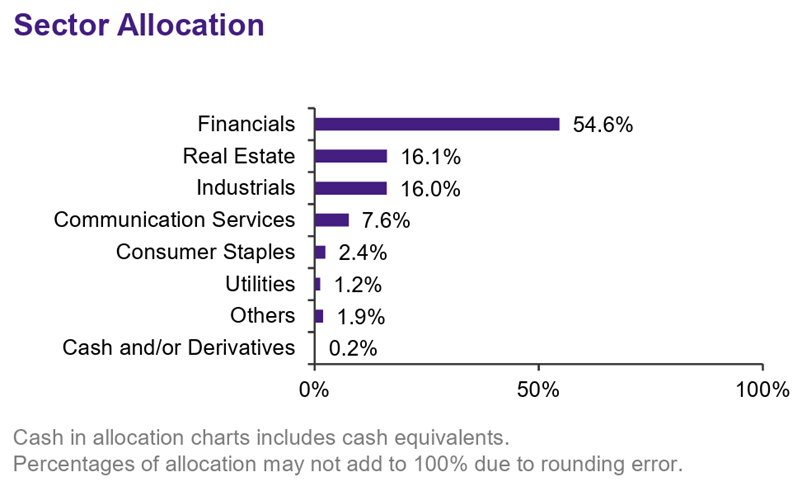
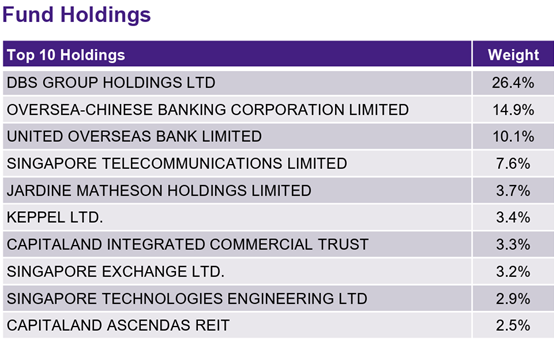
That means with just one trade, I can invest in some of Singapore’s most established names like DBS, OCBC, UOB, Singtel, Keppel, ST Engineering, and even blue-chip S-REITs.
As of 31 December 2025, the top three holdings of the ETF are DBS, OCBC, and UOB.
#2 – Low fees
The Amova Singapore STI ETF is a passively managed fund. This means that the expense ratio is lower than an actively managed fund, which lessens the impact on your overall return.
The management fee of the Amova Singapore STI ETF is 0.20% per annum with a trustee fee of up to 0.045% per annum.
The total expense ratio (TER) which includes the management fee, trustee fee, and other fees like administrative and distribution fees, is 0.25% per annum, which means for every $100 you invest in this ETF, a maximum of only 25 cents will go into the cost.
#3 – Reputable fund manager
Established in 1959, Amova Asset Management (formerly Nikko Asset Management), is a well-established fund manager with decades of experience in managing both retail and institutional assets.
As of 30 June 2025, the Group manages about US$260 billion in assets globally.
The Amova Singapore STI ETF launched in February 2009, has grown steadily over the years and recently crossed S$1 billion in assets under management as of 30 September 2025, reflecting its strong investor following and continued relevance in the Singapore market.
#4 – Dividend payout for regular income
The Amova Singapore STI ETF is a distributing ETF, which means it pays out the dividends it receives from the underlying companies directly to investors in cash instead of reinvesting them.
For investors who value a steady passive income stream, this may be an appealing feature.
The ETF distributes dividends twice a year, in January and July, and is in line with the STI’s dividend yield.
However, do note that the payouts are not guaranteed and are entirely at the fund manager’s discretion.*
*Disclaimer: Any distribution is expected to result in an immediate reduction of Fund’s NAV. Distributions may be paid out of capital which will result in capital erosion and reduction in the Fund’s NAV, which will be reflected in the redemption price of the Units.
#5 – Accessibility
Last but not least, the Amova Singapore STI ETF trades on the Singapore Exchange (SGX) just like any other stock, offering real-time prices and liquidity during Singapore market hours.
You can buy or sell it anytime the market is open, making it flexible and convenient to manage.
It also has a minimum board lot size of just one share, which lowers the barrier to entry and makes it easy for anyone to start building exposure to the Singapore market with smaller investment amounts.
Find out more about the Amova Singapore STI ETF here
Factors to keep in mind
Even with these tailwinds, it’s important to stay grounded and mindful of potential risks. Here are some factors to keep in mind:
#1 – Global macro uncertainty
The Singapore market remains sensitive to global economic data and central bank policy shifts.
Changes in inflation expectations or interest rate decisions may quickly shift investor sentiment and affect market direction in the short term.
Broader economic slowdowns, geopolitical tensions, or sector-specific challenges may all weigh on the performance of the index.
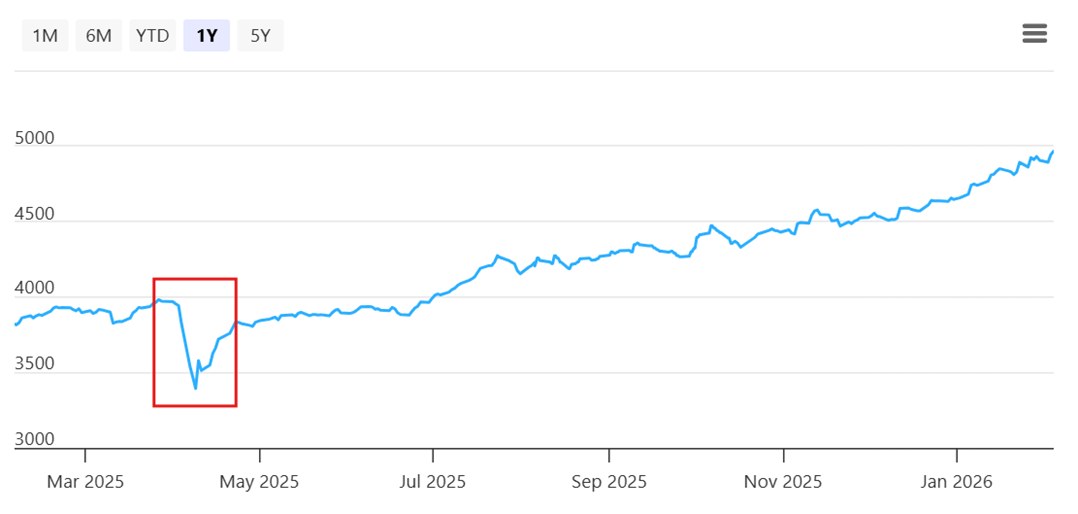
For instance, the STI fell by more than 13% in April 2025 during the “Liberation Day” sell-off, before recovering by July 2025 to reach new highs.
FTSE Straits Times Index 1-Year Price Chart (as of 5 February 2026)
#2 – Stock market volatility
After such a strong run, periods of profit-taking or short-term corrections are common. It’s natural for markets to experience ups and downs, even within a broader upward trend.
Like any stock investment, the Amova Singapore STI ETF’s value may fluctuate with market movements.
But because the Amova Singapore STI ETF provides a diversified exposure, it helps mitigate concentration risk compared to holding a few individual stocks.
What would Beansprout do?
The STI’s record highs reflect a mix of strong fundamentals and improving sentiment.
Singapore’s banks have continued to post resilient earnings, optimism has returned to REITs as investors anticipate potential rate cuts ahead, and the STI’s consistent dividend yield continues to draw investors seeking steady passive income.
For investors looking to stay invested in the Singapore market in a simple, low cost way, without taking on too much concentration risk, the Amova Singapore STI ETF (SGX: G3B) stands out as an accessible and cost-efficient option to gain exposure to Singapore’s top companies.
For investors seeking passive income, the Amova Singapore STI ETF allows you to participate in Singapore’s long-term growth.
Plus, it’s easy to trade directly on the stock market, and you can start with as little as one share, lowering the barrier to entry even for newer investors.
On top of its existing distribution* share class, which intends to pay dividends* every six months, Amova has also launched a new accumulation share class for investors who prefer to re-invest their dividends.
Unlike the existing distribution share class, which pays dividends semi-annually in cash, this accumulation share class automatically reinvests dividend payouts into the fund and accumulates towards the investors’ holdings.
By doing so, it helps investors compound returns over time without needing to manage the cash payouts on their own.
This offers greater convenience and may be particularly attractive for long-term investors who prefer capital accumulation.
| Features | Distribution Share Class | Accumulation Share Class |
| Dividends | Paid out to investors in cash | Automatically reinvested back into the fund and accumulates towards the investors’ holdings |
| Investor Suitability | Suitable for those seeking regular income | Suitable for those seeking long-term wealth accumulation |
| Potential Return on Dividends | Dependent on how investors’ reinvest dividends on their own (if desired) | Automatically reinvested into the ETF i.e. compounding at ETF’s return rate |
| Advantage | Flexible management of dividend payouts | Seamless reinvestment of dividend payouts |
*Distributions are not guaranteed and are at the absolute discretion of the Manager. Any distribution is expected to result in an immediate reduction of the Fund’s NAV. Distributions may be paid out of capital which will result in capital erosion and reduction in the Fund’s NAV, which will be reflected in the redemption price of the Units.
Learn more about the Amova Singapore STI ETF here.
Important Information by Amova Asset Management Asia Limited:
This document is purely for informational purposes only with no consideration given to the specific investment objective, financial situation and particular needs of any specific person. It should not be relied upon as financial advice. Any securities mentioned herein are for illustration purposes only and should not be construed as a recommendation for investment. You should seek advice from a financial adviser before making any investment. In the event that you choose not to do so, you should consider whether the investment selected is suitable for you. Investments in funds are not deposits in, obligations of, or guaranteed or insured by Amova Asset Management Asia Limited (“Amova Asia”).
Past performance or any prediction, projection or forecast is not indicative of future performance. The Fund or any underlying fund may use or invest in financial derivative instruments. The value of units and income from them may fall or rise. Investments in the Fund are subject to investment risks, including the possible loss of principal amount invested. You should read the relevant prospectus (including the risk warnings) and product highlights sheet of the Fund, which are available and may be obtained from appointed distributors of Amova Asia or our website (https://sg.amova-am.com) before deciding whether to invest in the Fund.
The information contained herein may not be copied, reproduced or redistributed without the express consent of Amova Asia. While reasonable care has been taken to ensure the accuracy of the information, Amova Asia does not give any warranty or representation, either express or implied, and expressly disclaims liability for any errors or omissions. Information may be subject to change without notice. Amova Asia accepts no liability for any loss, indirect or consequential damages, arising from any use of or reliance on this document. This advertisement has not been reviewed by the Monetary Authority of Singapore.
The performance of the ETF’s price on the Singapore Exchange Securities Trading Limited (“SGX-ST”) may be different from the net asset value per unit of the ETF. The ETF may also be suspended or delisted from the SGX-ST. Listing of the units does not guarantee a liquid market for the units. Investors should note that the ETF differs from a typical unit trust and units may only be created or redeemed directly by a participating dealer in large creation or redemption units.
The Central Provident Fund (“CPF”) Ordinary Account (“OA”) interest rate is the legislated minimum 2.5% per annum, or the 3-month average of major local banks' interest rates, whichever is higher, reviewed quarterly. The interest rate for Special Account (“SA”) is currently 4% per annum or the 12-month average yield of 10-year Singapore Government Securities plus 1%, whichever is higher, reviewed quarterly. Only monies in excess of $20,000 in OA and $40,000 in SA can be invested under the CPF Investment Scheme (“CPFIS”). Please refer to the website of the CPF Board for further information. Investors should note that the applicable interest rates for the CPF accounts and the terms of CPFIS may be varied by the CPF Board from time to time.
The units of Amova AM Singapore STI ETF are not in any way sponsored, endorsed, sold or promoted by FTSE International Limited ("FTSE"), the London Stock Exchange Plc (the "Exchange"), The Financial Times Limited ("FT") SPH Data Services Pte Ltd ("SPH") or Singapore Press Holdings Ltd ("SGP") (collectively, the "Licensor Parties") and none of the Licensor Parties make any warranty or representation whatsoever, expressly or impliedly, either as to the results to be obtained from the use of the Straits Times Index ("Index") and/or the figure at which the said Index stands at any particular time on any particular day or otherwise. The Index is compiled and calculated by FTSE. None of the Licensor Parties shall be under any obligation to advise any person of any error therein. "FTSE®", "FT-SE®" are trade marks of the Exchange and the FT and are used by FTSE under license. "STI" and "Straits Times Index" are trade marks of SPH and are used by FTSE under licence. All intellectual property rights in the ST index vest in SPH and SGP.
Amova Asset Management Asia Limited. Registration Number 198202562H.
Enjoyed this insight? Follow Beansprout on Telegram, Youtube, Facebook and Instagram, and add Beansprout as your preferred source on Google so you never miss an update.
Read also
Gain financial insights in minutes
Subscribe to our free weekly newsletter for more insights to grow your wealth
Most Popular

Comments
0 comments