
ASEAN Tech Sector - What Grab and Sea’s 2Q26 results reveal about ASEAN fintech
Singapore Depository Receipts
Powered by
By Ng Hui Min • 26 Aug 2026
Why trust Beansprout? We’ve been awarded Best Investment Website at the SIAS Investors’ Choice Awards 2025
'%3e%3cpath%20fill-rule='evenodd'%20clip-rule='evenodd'%20d='M17.64%209.20455C17.64%208.56637%2017.5827%207.95273%2017.4764%207.36364H9V10.845H13.8436C13.635%2011.97%2013.0009%2012.9232%2012.0477%2013.5614V15.8195H14.9564C16.6582%2014.2527%2017.64%2011.9455%2017.64%209.20455V9.20455Z'%20fill='%234285F4'/%3e%3cpath%20fill-rule='evenodd'%20clip-rule='evenodd'%20d='M9%2018C11.43%2018%2013.4673%2017.1941%2014.9564%2015.8195L12.0477%2013.5614C11.2418%2014.1014%2010.2109%2014.4205%209%2014.4205C6.65591%2014.4205%204.67182%2012.8373%203.96409%2010.71H0.957275V13.0418C2.43818%2015.9832%205.48182%2018%209%2018V18Z'%20fill='%2334A853'/%3e%3cpath%20fill-rule='evenodd'%20clip-rule='evenodd'%20d='M3.96409%2010.71C3.78409%2010.17%203.68182%209.59318%203.68182%209C3.68182%208.40682%203.78409%207.83%203.96409%207.29V4.95818H0.957273C0.347727%206.17318%200%207.54773%200%209C0%2010.4523%200.347727%2011.8268%200.957273%2013.0418L3.96409%2010.71V10.71Z'%20fill='%23FBBC05'/%3e%3cpath%20fill-rule='evenodd'%20clip-rule='evenodd'%20d='M9%203.57955C10.3214%203.57955%2011.5077%204.03364%2012.4405%204.92545L15.0218%202.34409C13.4632%200.891818%2011.4259%200%209%200C5.48182%200%202.43818%202.01682%200.957275%204.95818L3.96409%207.29C4.67182%205.16273%206.65591%203.57955%209%203.57955V3.57955Z'%20fill='%23EA4335'/%3e%3c/g%3e%3cdefs%3e%3cclipPath%20id='clip0_0_2849'%3e%3crect%20width='18'%20height='18'%20fill='white'/%3e%3c/clipPath%3e%3c/defs%3e%3c/svg%3e)
Make Beansprout your preferred source on Google
Add us on Google to see more of our insights in your search results
ASEAN’s digital economy is shifting from user growth towards deeper monetisation, with Grab and Sea increasingly using payments, lending and other financial services to strengthen their ecosystems. We look at what their Q2 2026 results reveal about this shift, and how Singapore investors can access both stocks through the new Grab and Sea SDRs on SGX.

What happened
Grab and Sea reported continued growth in financial services alongside their core mobility, delivery and e-commerce businesses.
But the latest results from Grab and Sea suggest the next phase of growth may look different.
Instead of simply adding more users, both companies are increasingly focused on deepening relationships with existing users through financial services.
This includes payments, lending and, in Grab’s case, digital banking and wealth management.
These services can make the platforms more useful to consumers and merchants, while also creating new revenue streams beyond mobility, delivery and e-commerce.
In this report, we look at what Grab and Sea’s Q2 2026 results tell us about this shift in ASEAN fintech.
We also explain how Singapore investors can access both companies through the new Grab and Sea US SDRs listed on SGX.
Grab trades under the SGX SDR ticker UGBD, while Sea trades under UGGD.
Both SDRs began trading on 22 July 2026.

What Grab and Sea’s 2Q26 results reveal about ASEAN fintech
#1 - Financial services continued to grow
Grab and Sea’s core platforms remain resilient.
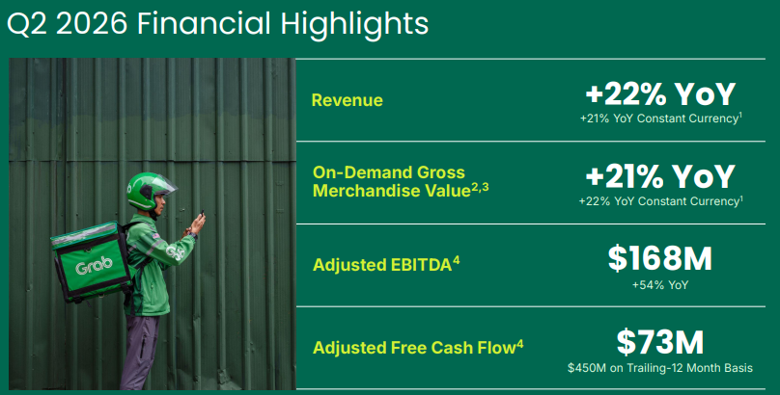
Grab’s on-demand GMV grew 21% year-on-year to US$6.5 billion, while adjusted EBITDA rose 54% to US$168 million.
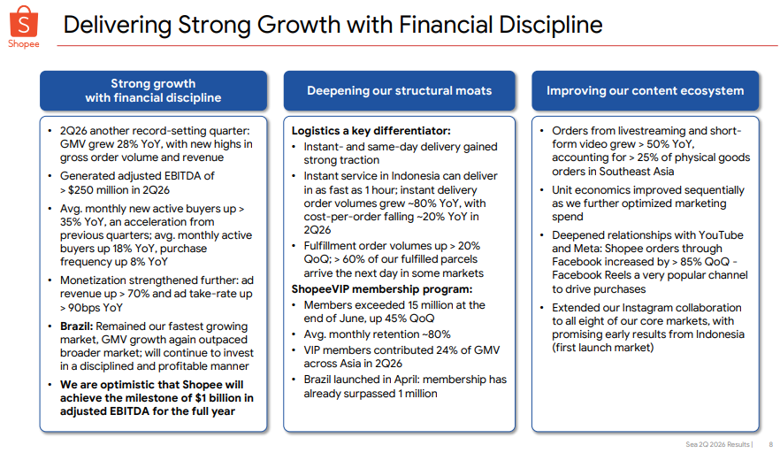
Sea’s Shopee GMV also grew 28% year-on-year to US$38.3 billion.
Financial services are becoming a distinct growth engine for both companies.
At Grab, Financial Services is now the fastest-growing segment.
Revenue grew 59% year-on-year, while the gross loan portfolio across GrabFin, GxS Bank, GX Bank and Superbank rose 197% to US$2.3 billion.
Management also guided for the segment to reach adjusted EBITDA profitability in 2H2026.
The Superbank deal added more than 7 million customers, with over 60% of them also using Grab or OVO.
Grab’s proposed acquisition of Stash would add a wealth-management pillar, with Stash managing more than US$5 billion of assets, according to management.
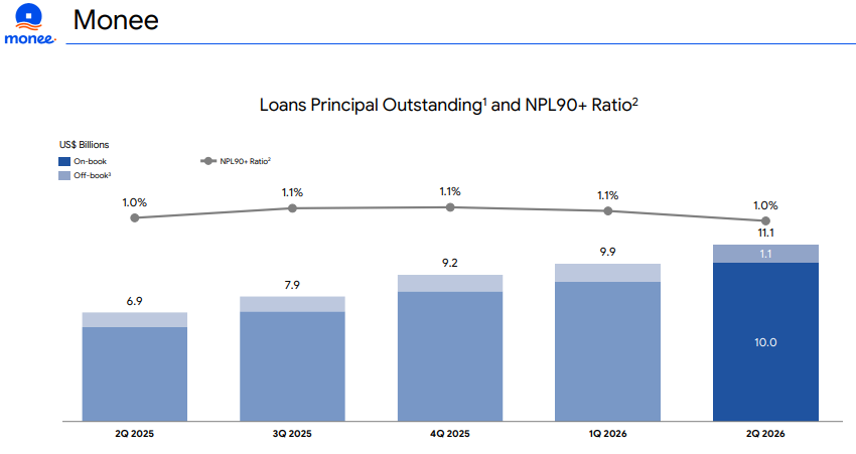
Sea’s fintech arm, Monee, is also scaling quickly. Its loan book reached US$11.1 billion, up 62% year-on-year.
Monee generated US$288 million of adjusted EBITDA, while keeping its 90-day non-performing loan ratio at around 1%.
Both companies are using payments, lending, digital banking and wealth management to deepen their ecosystems and monetise their existing user bases more effectively.
#2 — How Grab and Sea use transaction data in lending
Payments are becoming the entry point into lending for both Grab and Sea.
Both platforms sit close to where transactions happen, giving them access to behavioural data that can help assess credit risk.
Grab underwrites loans using proprietary transaction data from its ecosystem.
It also funds loans partly through low-cost deposits from its digital banks, which could improve the economics of lending as the business scales.
Sea’s Monee uses a similar data-driven approach.
It analyses the sequence of a user’s actions over time, rather than relying only on static credit information.
Recent underwriting improvements lifted approval rates by around 10%, without increasing risk.
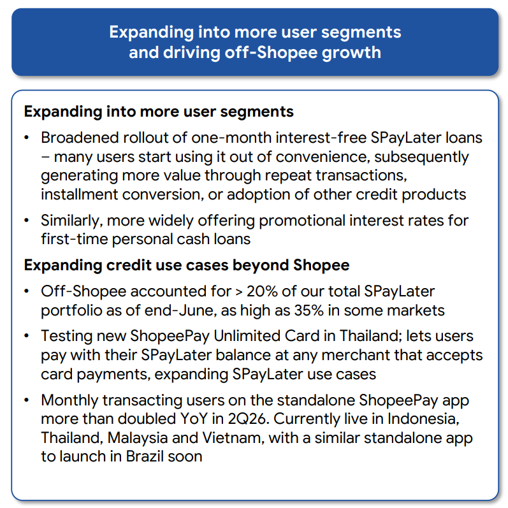
Sea is also showing that its fintech business is moving beyond Shopee.
More than 20% of its SPayLater portfolio now comes from transactions outside Shopee.
Its standalone ShopeePay app also more than doubled its monthly transacting users during the quarter.
Sea added 5.3 million first-time borrowers, while active credit users rose 34% year-on-year to more than 40 million.
More transactions create more data. More data improves credit underwriting. Better credit access then deepens user engagement across the ecosystem.
#3 — Profitability metrics improved alongside growth
Both Grab and Sea are now emphasising profitable growth, rather than growth at any cost.
For Grab, overall adjusted EBITDA margin expanded from 13.3% to 16.9%.
Superbank’s cost-to-income ratio declined to 55%. Management is targeting a cost-to-income ratio of below 50% by the end of 2026.
For Sea, Shopee’s profitability continues to improve even as the platform grows.
Shopee generated US$255 million of adjusted EBITDA in the quarter.
Management is also guiding for Shopee to reach around US$1 billion of adjusted EBITDA for the full year.
At the same time, Sea’s Monee loan book continues to scale while maintaining credit discipline.
This is important because fintech growth can look attractive on the way up, but credit quality matters when lending books grow quickly.
Both companies reported growth in financial services alongside profitability and credit-quality metrics.
#4 —Grab and Sea have different core ecosystems
Grab and Sea are approaching fintech from different starting points.
Grab’s ecosystem includes mobility and delivery services.
Its digital banking operations also provide funding and financial infrastructure to support lending and other financial products.
Management describes this as an ecosystem flywheel, where Financial Services increases customer lifetime value through cross-selling.
Sea starts from e-commerce. Shopee gives Sea access to a large pool of buyers, sellers and transaction data.
ShopeePay and SPayLater then extend that relationship beyond the marketplace.
The underlying model is similar for both companies. Build a large digital consumer ecosystem. Capture transaction data. Use that data to improve underwriting. Then use financial products to deepen engagement and monetisation.
The difference is in the entry point: Grab begins with mobility and deliveries, while Sea begins with e-commerce.
How Grab and Sea compare on valuation and profitability

Based on FactSet data as of 19 August 2026, Grab traded at 23.5x forward P/E compared with Sea at 32.7x.
Grab's ROE was 4.1% compared with Sea's 15.1%.
Grab's Financial Services segment is guided to reach adjusted EBITDA profitability in 2H2026.
Both companies were in net cash positions, with net debt-to-equity ratios of -0.7x for Grab and -0.8x for Sea.
Key risks
Credit and asset quality
Grab's loan portfolio grew 197% and Sea's Monee book grew 62% year-on-year. A larger loan book does not automatically mean better earnings if credit losses rise or economic conditions weaken across ASEAN. Credit losses and NPL ratios may affect profitability as the loan portfolios expand.
Regulatory risk
Both companies operate digital banks and lending across multiple ASEAN jurisdictions, each with its own rules on digital banking licences, lending caps and data-sharing. Tighter regulation in any one market could slow loan growth or raise compliance costs. Both companies have financial-services exposure to Indonesia, including through Superbank and Monee.
Competitive intensity
Grab and Sea compete with each other, with incumbent banks expanding into digital lending, and with other regional super-apps and platforms such as TikTok Shop in e-commerce. Intensifying competition could pressure customer acquisition costs, loan pricing and take rates.
Macro and execution risk
Softer consumer spending across Southeast Asia would reduce the transaction volumes that feed both companies' underwriting models. Failure to hit stated profitability targets could also weigh on sentiment. For Grab, the key milestone is whether Financial Services can reach adjusted EBITDA breakeven in 2H2026. Sea's management has guided for Shopee to generate around US$1 billion of adjusted EBITDA for FY2026.
Download the full report here.
Check out Beansprout's guide to the best stock trading platforms in Singapore with the latest promotions to invest in Singapore Depositary Receipts.
Join the Beansprout Telegram group for the latest insights on Singapore stocks, REITs, bonds and ETFs.
Important Disclosures
Analyst Certification and Disclosures
The analyst(s) named in this report certifies that (i) all views expressed in this report accurately reflect the personal views of the analyst(s) with regard to any and all of the subject securities and companies mentioned in this report and (ii) no part of the compensation of the analyst(s) was, is, or will be, directly or indirectly, related to the specific views expressed by that analyst herein. The analyst(s) named in this report (or their associates) does not have a financial interest in the corporation(s) mentioned in this report.
An associate is defined as (i) the spouse, or any minor child (natural or adopted) or minor step-child, of the analyst; (ii) the trustee of a trust of which the analyst, his spouse, minor child (natural or adopted) or minor step-child, is a beneficiary or discretionary object; or (iii) another person accustomed or obliged to act in accordance with the directions or instructions of the analyst.
Company Disclosure
Global Wealth Technology Pte Ltd (“Beansprout”) does not have any financial interest in the corporation(s) mentioned in this report.
Beansprout received monetary compensation from Singapore Exchange (SGX) to provide independent research on Singapore Depository Receipts (SDRs).
Disclaimer
This report is provided by Beansprout for the use of intended recipients only and may not be reproduced, in whole or in part, or delivered or transmitted to any other person without our prior written consent. By accepting this report, the recipient agrees to be bound by the terms and limitations set out herein.
You acknowledge that this document is provided for general information purposes only. Nothing in this document shall be construed as a recommendation to purchase, sell, or hold any security or other investment, or to pursue any investment style or strategy. Nothing in this document shall be construed as advice that purports to be tailored to your needs or the needs of any person or company receiving the advice. The information in this document is intended for general circulation only and does not constitute investment advice. Nothing in this document is published with regard to the specific investment objectives, financial situation and particular needs of any person who may receive the information.
Nothing in this document shall be construed as, or form part of, any offer for sale or subscription of or solicitation or invitation of any offer to buy or subscribe for any securities. The data and information made available in this document are of a general nature and do not purport, and shall not in any way be deemed, to constitute an offer or provision of any professional or expert advice, including without limitation any financial, investment, legal, accounting or tax advice, and shall not be relied upon by you in that regard. You should at all times consult a qualified expert or professional adviser to obtain advice and independent verification of the information and data contained herein before acting on it. Any financial or investment information in this document are intended to be for your general information only. You should not rely upon such information in making any particular investment or other decision which should only be made after consulting with a fully qualified financial adviser. Such information do not nor are they intended to constitute any form of financial or investment advice, opinion or recommendation about any investment product, or any inducement or invitation relating to any of the products listed or referred to. Any arrangement made between you and a third party named on or linked to from these pages is at your sole risk and responsibility.
You acknowledge that Beansprout is under no obligation to exercise editorial control over, and to review, edit or amend any data, information, materials or contents of any content in this document. You agree that all statements, offers, information, opinions, materials, content in this document should be used, accepted and relied upon only with care and discretion and at your own risk, and Beansprout shall not be responsible for any loss, damage or liability incurred by you arising from such use or reliance.
This document (including all information and materials contained in this document) is provided “as is”. Although the material in this document is based upon information that Beansprout considers reliable and endeavours to keep current, Beansprout does not assure that this material is accurate, current or complete and is not providing any warranties or representations regarding the material contained in this document. All opinions contained herein constitute the views of the analyst(s) named in this report, they are subject to change without notice and are not intended to provide the sole basis of any evaluation of the subject securities and companies mentioned in this report. Any reference to past performance should not be taken as an indication of future performance. To the fullest extent permissible pursuant to applicable law, Beansprout disclaims all warranties and/or representations of any kind with regard to this document, including but not limited to any implied warranties of merchantability, non-infringement of third-party rights, or fitness for a particular purpose.
Beansprout does not warrant, either expressly or impliedly, the accuracy or completeness of the information, text, graphics, links or other items contained in this document. Neither Beansprout nor any of its affiliates, directors, employees or other representatives will be liable for any damages, losses or liabilities of any kind arising out of or in connection with the use of this document. To the best of Beansprout’s knowledge, this document does not contain and is not based on any non-public, material information. The information in this document is not intended for distribution to, or use by, any person or entity in any jurisdiction where such distribution or use would be contrary to law or regulation, or which would subject Beansprout to any registration requirement within such jurisdiction or country. Beansprout is not licensed or regulated by any authority in any jurisdiction or country to provide the information in this document.
As a condition of your use of this document, you agree to indemnify, defend and hold harmless Beansprout and its affiliates, and their respective officers, directors, employees, members, managing members, managers, agents, representatives, successors and assigns from and against any and all actions, causes of action, claims, charges, cost, demands, expenses and damages (including attorneys’ fees and expenses), losses and liabilities or other expenses of any kind that arise directly or indirectly out of or from, arising out of or in connection with violation of these terms, use of this document, violation of the rights of any third party, acts, omissions or negligence of third parties, their directors, employees or agents. To the extent permitted by law, Beansprout shall not be liable to you, any other person, or organization, for any direct, indirect, special, punitive, exemplary, incidental or consequential damages, whether in contract, tort (including negligence), or otherwise, arising in any way from, or in connection with, the use of this document and/or its content. This includes, without limitation, liability for any act or omission in reliance on the information in this document. Beansprout expressly disclaims and excludes all warranties, conditions, representations and terms not expressly set out in this User Agreement, whether express, implied or statutory, with regard to this document and its content, including any implied warranties or representations about the accuracy or completeness of this document and the content, suitability and general availability, or whether it is free from error.
If these terms or any part of them is understood to be illegal, invalid or otherwise unenforceable under the laws of any state or country in which these terms are intended to be effective, then to the extent that they are illegal, invalid or unenforceable, they shall in that state or country be treated as severed and deleted from these terms and the remaining terms shall survive and remain fully intact and in effect and will continue to be binding and enforceable in that state or country.
These terms, as well as any claims arising from or related thereto, are governed by the laws of Singapore without reference to the principles of conflicts of laws thereof. You agree to submit to the personal and exclusive jurisdiction of the courts of Singapore with respect to all disputes arising out of or related to this Agreement. Beansprout and you each hereby irrevocably consent to the jurisdiction of such courts, and each Party hereby waives any claim or defence that such forum is not convenient or proper.
Read also
Gain financial insights in minutes
Subscribe to our free weekly newsletter for more insights to grow your wealth
Most Popular

Comments
0 comments