
kopi-C with Charge+: The 5,000-kilometre bet on an electric Southeast Asia
Stocks
Powered by

By Julian Wong • 01 Jul 2026
Why trust Beansprout? We’ve been awarded Best Investment Website at the SIAS Investors’ Choice Awards 2025
'%3e%3cpath%20fill-rule='evenodd'%20clip-rule='evenodd'%20d='M17.64%209.20455C17.64%208.56637%2017.5827%207.95273%2017.4764%207.36364H9V10.845H13.8436C13.635%2011.97%2013.0009%2012.9232%2012.0477%2013.5614V15.8195H14.9564C16.6582%2014.2527%2017.64%2011.9455%2017.64%209.20455V9.20455Z'%20fill='%234285F4'/%3e%3cpath%20fill-rule='evenodd'%20clip-rule='evenodd'%20d='M9%2018C11.43%2018%2013.4673%2017.1941%2014.9564%2015.8195L12.0477%2013.5614C11.2418%2014.1014%2010.2109%2014.4205%209%2014.4205C6.65591%2014.4205%204.67182%2012.8373%203.96409%2010.71H0.957275V13.0418C2.43818%2015.9832%205.48182%2018%209%2018V18Z'%20fill='%2334A853'/%3e%3cpath%20fill-rule='evenodd'%20clip-rule='evenodd'%20d='M3.96409%2010.71C3.78409%2010.17%203.68182%209.59318%203.68182%209C3.68182%208.40682%203.78409%207.83%203.96409%207.29V4.95818H0.957273C0.347727%206.17318%200%207.54773%200%209C0%2010.4523%200.347727%2011.8268%200.957273%2013.0418L3.96409%2010.71V10.71Z'%20fill='%23FBBC05'/%3e%3cpath%20fill-rule='evenodd'%20clip-rule='evenodd'%20d='M9%203.57955C10.3214%203.57955%2011.5077%204.03364%2012.4405%204.92545L15.0218%202.34409C13.4632%200.891818%2011.4259%200%209%200C5.48182%200%202.43818%202.01682%200.957275%204.95818L3.96409%207.29C4.67182%205.16273%206.65591%203.57955%209%203.57955V3.57955Z'%20fill='%23EA4335'/%3e%3c/g%3e%3cdefs%3e%3cclipPath%20id='clip0_0_2849'%3e%3crect%20width='18'%20height='18'%20fill='white'/%3e%3c/clipPath%3e%3c/defs%3e%3c/svg%3e)
Make Beansprout your preferred source on Google
Add us on Google to see more of our insights in your search results
Singapore's largest EV charging operator was built on personal frustration, a road trip across three countries, and a bet that most of the opportunity hasn't fully materialised yet.
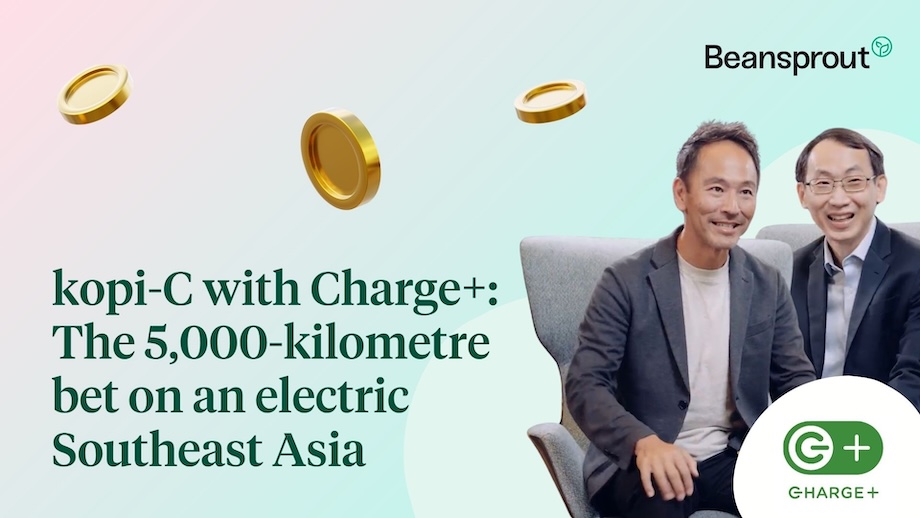
In 2018, Ong Tze Boon drove his electric vehicle from Singapore to Phuket. His goal: to find out what it felt like to be an EV driver navigating Southeast Asia without a charging network designed for the journey.
What he discovered was, in his own words, “a business opportunity hiding inside a mess”.
In Malaysia, to sidestep energy retail licensing requirements, charging operators were selling a charging service packaged as parking. In Thailand, many charging apps required a Thai mobile number to register, which meant foreign drivers simply could not use it.
"I got all the way to Thailand and was stuck," Ong recalls. "That was the business opportunity."
Today, Charge+ is Singapore's largest electric vehicle charging operator, with about 6,000 charging points globally, including more than 4,000 charging points across the island. The company was founded by Ong—the current chairman—and is led by CEO Goh Chee Kiong, who spent years tracking and promoting the EV sector from his position inside the Economic Development Board (EDB), before joining Charge+ around 2020 as both an executive and a shareholder.
Together, they are building what the company describes as the longest EV charging corridor in Southeast Asia: a 5,000-kilometre highway spanning Singapore, Malaysia, Thailand, Cambodia and Vietnam.
Born out of frustration
Ong has been an EV driver since around 2012, in the days EVs were still seen as a novelty in Singapore. He had chargers installed at home and at the office, but found that ordinary trips—picking someone up from the airport, dropping them at a hotel—would exhaust the battery before he could return.
He began asking questions. Was it a technology problem? A regulatory problem? A consumer mindset problem?
This led to a connection with Frank Phuan, founder of Sunseap, Singapore's then-largest renewable energy company. And it was, in Ong's description, a "categorical synergy". After all, both solar panels and EV chargers connect to the same grid.
While the early Charge+ operated from Sunseap's meeting rooms, with Sunseap as an early-stage shareholder, Ong insists that, "To be more accurate, the company was born out of frustration."
What followed was a journey to source for a contract manufacturer partner, for what would become Charge+'s proprietary hardware—a charger they codenamed 'Marvel' that was designed to be the world’s slimmest EV charger.
Two sides of the same wave
While Ong was lobbying agencies from the outside, Goh was watching the same story unfold from within. At EDB, he had been involved in promoting EV adoption since 2010, and had watched the sector's first mini-wave of global interest rise between 2010 and 2013, then die off. He went on to conceptualise and run national EV pilot programmes until 2017 when he moved to SP Group.
When he encountered Ong again around 2020, the timing aligned.
"I've seen how this space evolved and the inflection point was near," he says. "So I put my own money in. Both Boon and I shared the same belief in this business."
One challenge they were both navigating, from their different positions, was a fundamental regulatory ambiguity: which agency owned the mandate to promote EV adoption as well as EV charging in Singapore? Was it a transport matter, which would then be under the Land Transport Authority, or an electrical system, which would involve the Energy Market Authority?
Charge+ made the case for LTA to lead this.
"We said it's basically a smart battery on wheels," Ong recalls.
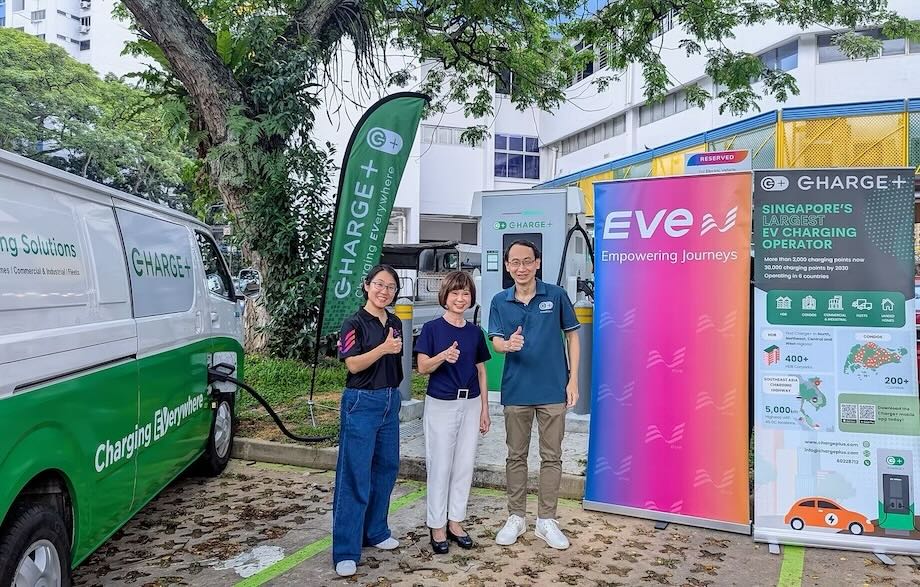
Today, LTA is leading a whole-of-government approach towards promoting EVs, and has established a dedicated team known as National Electric Vehicle Centre (NEVC) and a subsidiary called EVe to coordinate the national efforts in EV charging.
Back then, both Ong and Goh physically carried a prototype charger to the Ministry of Transport at Alexandra Road to show officials what one looked like.
"It was so nascent," Ong says. “We had to show them what it looked like and share our considerations as an EV charging company.”
The inflection point came in 2020, when the Singapore government made its Green Plan commitments public and decisive. Charge+ was already manufacturing and had the business blueprint.
"When the government made that clarity, people were entering this business around a year after us," Ong says. "We were geared up, ready to go."
The hardware and vertical integration edge
Goh points to vertical integration as one source of Charge+'s margin defence. The company designs its own hardware, operates its own software platform, and handles its own maintenance—a combination he says most competitors do not have.
"A lot of charging companies are not integrated," he says. "We do our own hardware design, our own software, our own maintenance. That full end-to-end capability is how we optimise our margin."
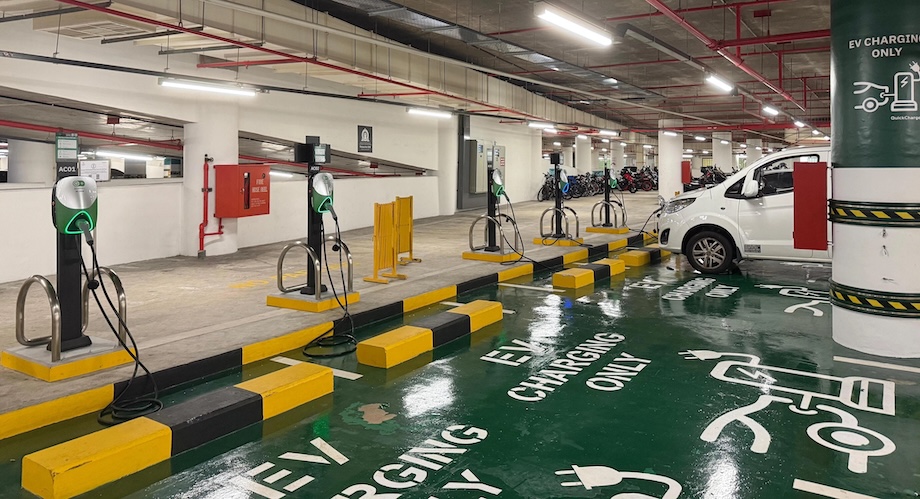
Charge+’s proprietary dual-gun charger is specifically engineered for Singapore's space-constrained carparks: it can be mounted on a narrow column, serves two adjacent bays from a single installation, and requires only one set of cables and one set of circuit breakers for the equivalence of two chargers. In all, it commands roughly half the capital cost of two separate charger units.
Goh draws a distinction from the solar infrastructure model: solar installations are capital intensive, with 25-year lifespans and very low recurring costs. EV chargers last around ten years, and software and maintenance—relative to upfront capital—becomes a meaningful cost component. Therefore, a fully integrated operator has a structural cost advantage.
That cost discipline also shapes where the company had chosen to play. As a comprehensive charging provider, Charge+ serves HDB carparks, condominiums, commercial buildings, shopping malls, and fleet operators, and Goh is particularly focused on the fleet segment.
A taxi or private hire driver covers two to three times the daily distance of a typical commuter, which means such a driver charges far more frequently and depends on reliable fast-charging infrastructure for his livelihood.
"The mileage goes up," Goh says, "and therefore we need fast charging in the right locations."
What comes next
Charge+ completed a Series A round of US$8 million in 2024, led by TRIVE Venture Capital with participation from TNB Aura, followed soon after by a S$21 million green loan from DBS Bank. A Series B of about US$20 million is in preparation for 2026.
The SEA highway, meanwhile, is roughly halfway complete—gaps remain in southern Thailand and parts of Vietnam—with Ong expecting substantial completion by end of 2026.
The market context Goh returns to is the gap between new car sales and the total car population. As of early 2026, about 60% of new car registrations in Singapore are electric. But only around 8% of the total car population has electrified as of now.
"We are serving only 8% per cent of Singapore's car population," Goh says. "This means 92% of cars on the road are still conventional engines. The growth upside for Charge+ is tremendous."
On where the company goes from here, Ong is unambiguous.
"Whether it's a public listing or a direct investment, we welcome our options, he says. “We're going places."
About Charge+
Charge+ is a leading integrated EV charging solution provider serving Southeast Asia, with the mission to catalyse the proliferation of electric mobility in the region. Its suite of integrated solutions includes a proprietary ultra-slim charger, smart charging software and innovative business models.
With about 6,000 EV charging points across Southeast Asia today, Charge+ is the largest EV charging operator in Singapore and a key player across the region. It aims to operate 30,000 charging points globally by 2030. Charge+ is also uniquely placed as a comprehensive charging operator serving the public housing, condominium, commercial and industrial building segments.
With Singapore as the springboard, Charge+ also operates in Malaysia, Thailand, Vietnam, Indonesia and Cambodia. It is also implementing a 5,000km EV charging highway in Southeast Asia that connects Singapore to Hanoi.
To find out more, please visit www.chargeplus.com
About kopi-C: the Company brew
kopi-C is a regular column by SGX Research in collaboration with Beansprout, Singapore’s trusted investment intelligence platform which helps everyday investors build the knowledge and confidence to make decisions that matter. kopi-C features C-level executives of leading companies. These interviews are profiles of senior management aimed at helping investors better understand the individuals who run these corporations.
Read also
Gain financial insights in minutes
Subscribe to our free weekly newsletter for more insights to grow your wealth
Most Popular

Comments
0 comments