
DBS profit rises 9% and declares S$0.81 in total dividends in 2Q26: Our Quick Take
Stocks
By Gerald Wong, CFA • 05 Aug 2026
Global Wealth Technology Pte. Ltd. is regulated by the Monetary Authority of Singapore (MAS) as a licensed Financial Adviser.
'%3e%3cpath%20fill-rule='evenodd'%20clip-rule='evenodd'%20d='M17.64%209.20455C17.64%208.56637%2017.5827%207.95273%2017.4764%207.36364H9V10.845H13.8436C13.635%2011.97%2013.0009%2012.9232%2012.0477%2013.5614V15.8195H14.9564C16.6582%2014.2527%2017.64%2011.9455%2017.64%209.20455V9.20455Z'%20fill='%234285F4'/%3e%3cpath%20fill-rule='evenodd'%20clip-rule='evenodd'%20d='M9%2018C11.43%2018%2013.4673%2017.1941%2014.9564%2015.8195L12.0477%2013.5614C11.2418%2014.1014%2010.2109%2014.4205%209%2014.4205C6.65591%2014.4205%204.67182%2012.8373%203.96409%2010.71H0.957275V13.0418C2.43818%2015.9832%205.48182%2018%209%2018V18Z'%20fill='%2334A853'/%3e%3cpath%20fill-rule='evenodd'%20clip-rule='evenodd'%20d='M3.96409%2010.71C3.78409%2010.17%203.68182%209.59318%203.68182%209C3.68182%208.40682%203.78409%207.83%203.96409%207.29V4.95818H0.957273C0.347727%206.17318%200%207.54773%200%209C0%2010.4523%200.347727%2011.8268%200.957273%2013.0418L3.96409%2010.71V10.71Z'%20fill='%23FBBC05'/%3e%3cpath%20fill-rule='evenodd'%20clip-rule='evenodd'%20d='M9%203.57955C10.3214%203.57955%2011.5077%204.03364%2012.4405%204.92545L15.0218%202.34409C13.4632%200.891818%2011.4259%200%209%200C5.48182%200%202.43818%202.01682%200.957275%204.95818L3.96409%207.29C4.67182%205.16273%206.65591%203.57955%209%203.57955V3.57955Z'%20fill='%23EA4335'/%3e%3c/g%3e%3cdefs%3e%3cclipPath%20id='clip0_0_2849'%3e%3crect%20width='18'%20height='18'%20fill='white'/%3e%3c/clipPath%3e%3c/defs%3e%3c/svg%3e)
Make Beansprout your preferred source on Google
Add us on Google to see more of our insights in your search results
DBS reported a 9% increase in profit and maintained its 2Q26 ordinary dividend of S$0.66, alongside a S$0.15 capital return, bringing total dividends to S$0.81.

DBS 2Q26 earnings and dividend highlights
DBS has announced its earnings for the second quarter of 2026. Key highlights include:
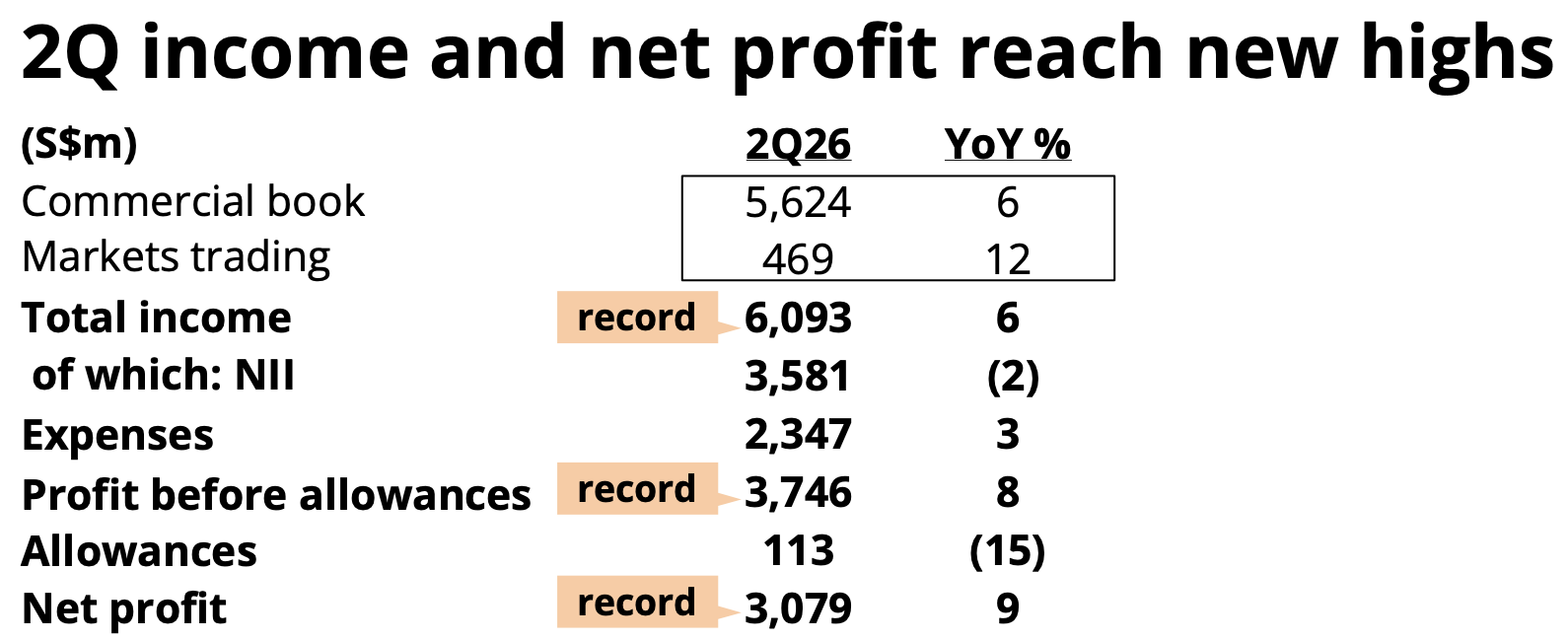
- 2Q 2026 net profit: SGD 3.08 billion (+9% year-on-year, +5% quarter-on-quarter), a new record
- 2Q 2026 total income: SGD 6.09 billion, crossing SGD 6 billion for the first time (+6% year-on-year)
- 1H 2026 net profit: SGD 6.01 billion (+5% year-on-year), a new high
- 1H 2026 total income: SGD 12.0 billion (+3% year-on-year), a new high
- 2Q Return on equity: 17.9% (1H ROE at 17.5%)
- Interim dividend of 66 cents per share for 2Q 2026
- Capital Return dividend of 15 cents per share for 2Q 2026
Source: Company data
What we learnt from DBS 2Q26 earnings
#1 - Record quarter with total income crossing S$6 billion for the first time
2Q26 net profit rose 9% year-on-year to a record S$3.08 billion, as record wealth management performance, record treasury customer sales and stronger markets trading income more than offset the impact of lower interest rates.
Compared to the previous quarter, net profit was 5% higher.
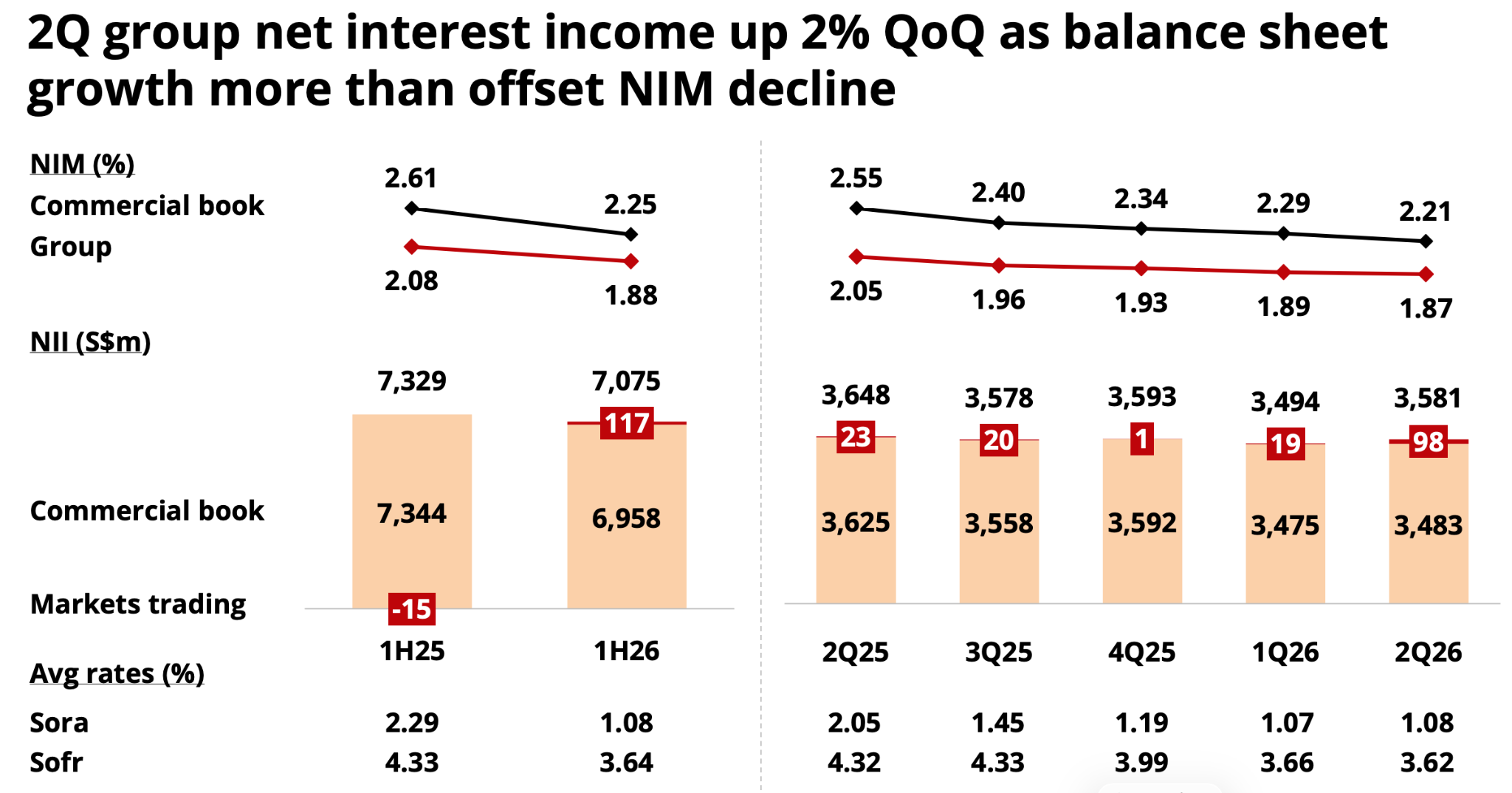
Group net interest income declined 2% year-on-year to S$3.58 billion, as net interest margin (NIM) narrowed 18 basis points to 1.87% on lower interest rates.
Strong loan and deposit growth as well as proactive hedging mitigated most of the impact.
On a quarter-on-quarter basis, group net interest income rose 2% as balance sheet growth more than offset a two-basis-point NIM decline.
Source: Company data
Loans grew S$35 billion (+8% year-on-year) in constant-currency terms to S$469 billion, led by broad-based growth in lending to large corporates.
On a quarter-on-quarter basis, loans rose 3% or S$15 billion, led by non-trade corporate loans.
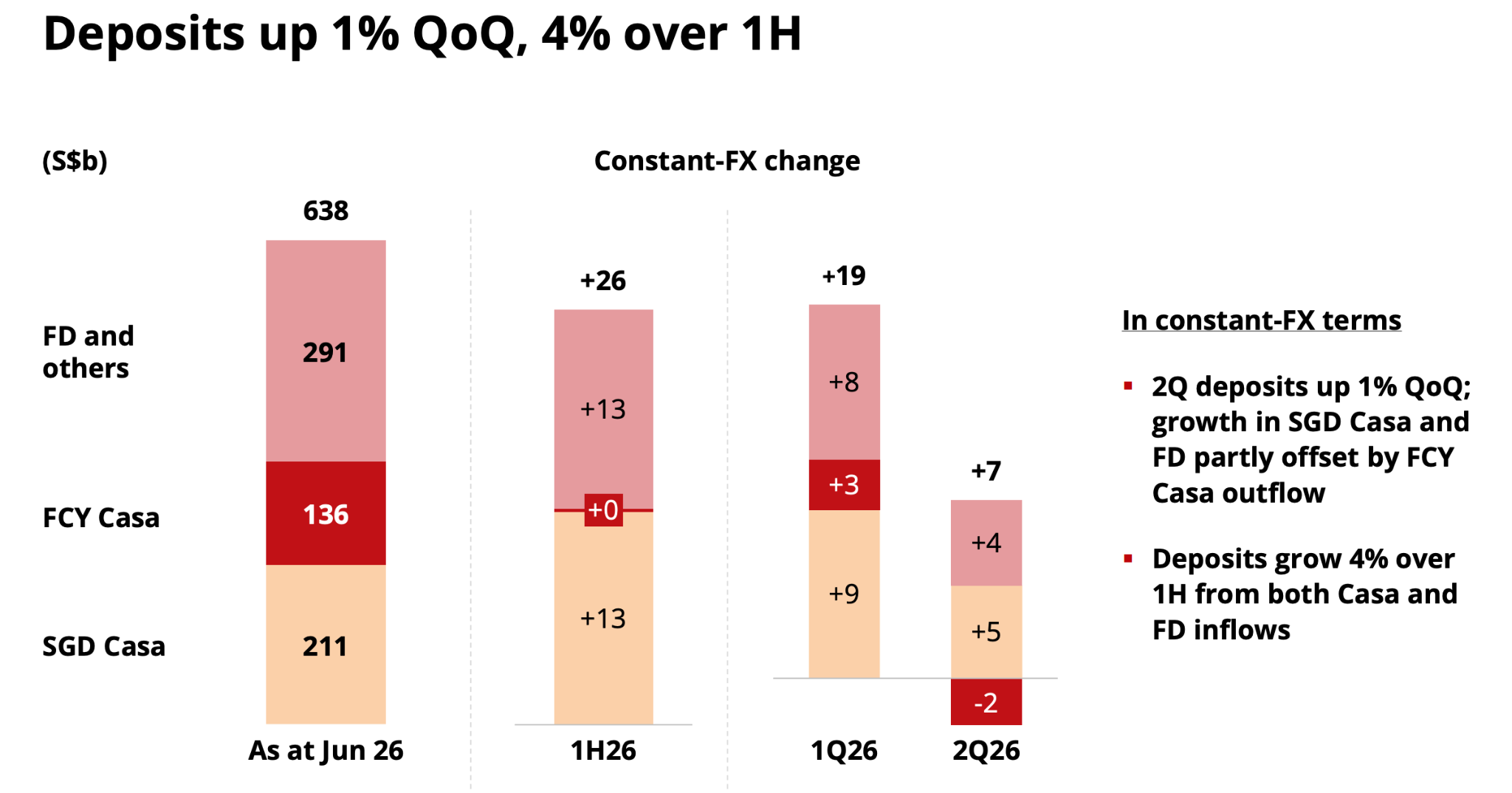
Deposits rose S$61 billion (+11% year-on-year) to S$638 billion, with CASA balances accounting for about three-quarters of the increase.
On a quarter-on-quarter basis, deposits grew 1% or S$7 billion.
Source: Company data
#2 - Wealth segment AUM crosses S$500 billion for the first time
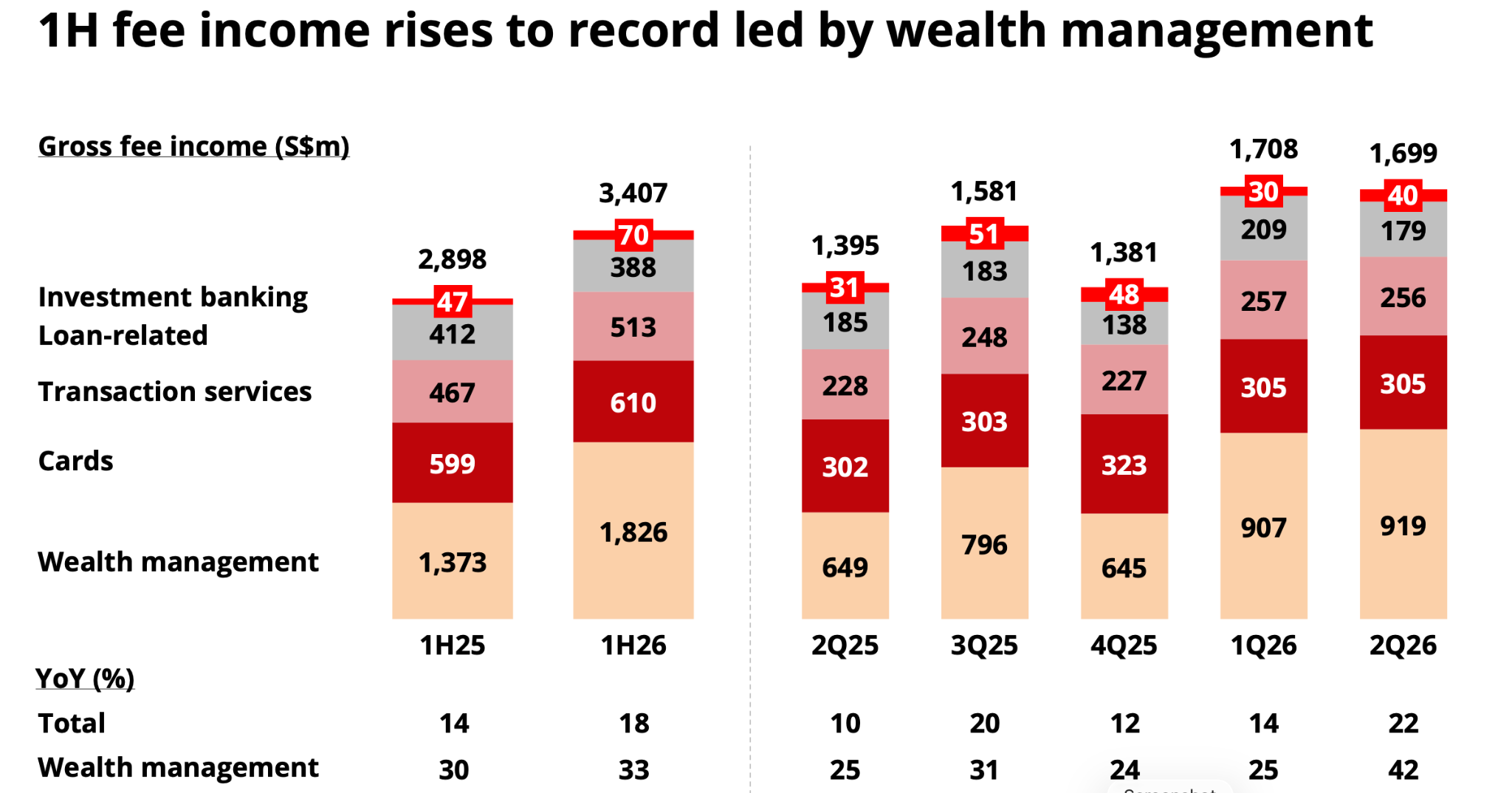
Net fee income rose 25% year-on-year to S$1.46 billion in 2Q26, the second-highest quarterly level on record, 1% lower from the record 1Q26 level.
Wealth management fees rose 42% year-on-year to a record S$919 million, driven by higher customer investment activity.
Wealth segment assets under management crossed the half-trillion mark for the first time, rising 16% year-on-year in constant-currency terms to S$516 billion.
Wealth segment total income reached a record S$1.71 billion in 2Q26.
Commercial book other non-interest income rose 30% year-on-year to a record S$681 million, driven by treasury customer sales to both wealth management and corporate customers.
Markets trading income rose 12% year-on-year to S$469 million, benefiting from volatile markets and lower funding costs, and delivered its strongest first-half performance in five years.
For the first half, investment banking, transaction services and card fees also increased, more than offsetting lower loan-related fees.
Source: Company data
#3 - Asset quality resilient, allowance reserves remain prudent
DBS' non-performing loan (NPL) ratio remained stable at 1.0%.
Non-performing assets were little changed from the previous quarter at S$4.76 billion, as new NPA formation was offset by repayments and write-offs.
Specific allowances were S$188 million in 2Q26 (or 16 basis points of loans), bringing the first-half total to S$345 million or 15 basis points, in line with management's guided range. Allowance coverage stood at 130% (or 196% after considering collateral).
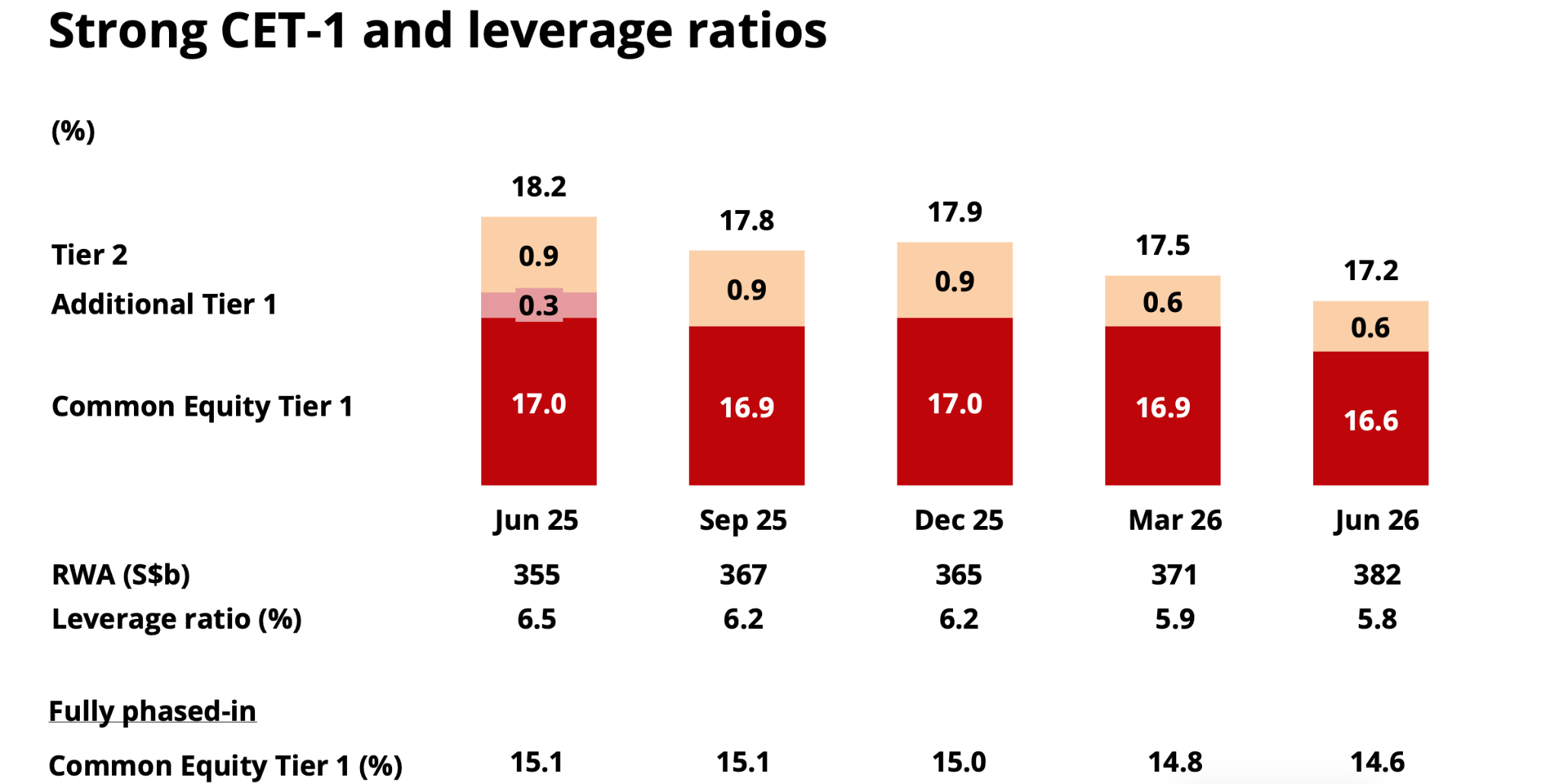
The reported Common Equity Tier-1 ratio was 16.6% based on transitional arrangements, while the pro-forma ratio on a fully phased-in basis was 14.6%.
Source: Company data
#4 - Dividend maintained at 81 cents per quarter
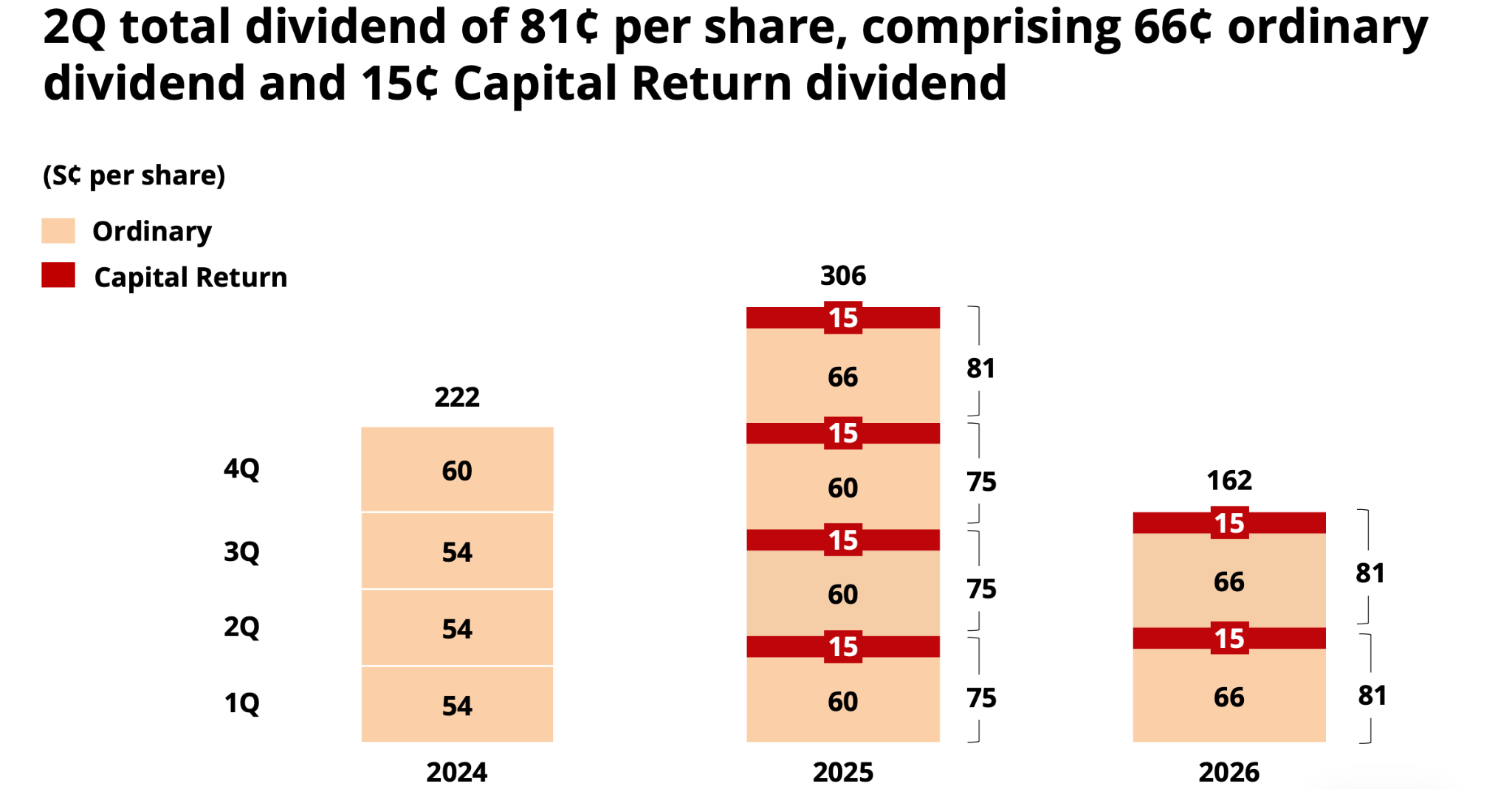
The board declared an interim dividend of SGD 66 cents per share and a Capital Return dividend of SGD 15 cents per share for 2Q 2026, in line with the previous quarter.
This brings the 1H 2026 total to S$1.32 per share in ordinary dividends and S$0.30 per share in Capital Return dividends, or S$1.62 per share in aggregate.
Source: Company data
#5 - Full-year 2026 guidance raised on strong 1H performance
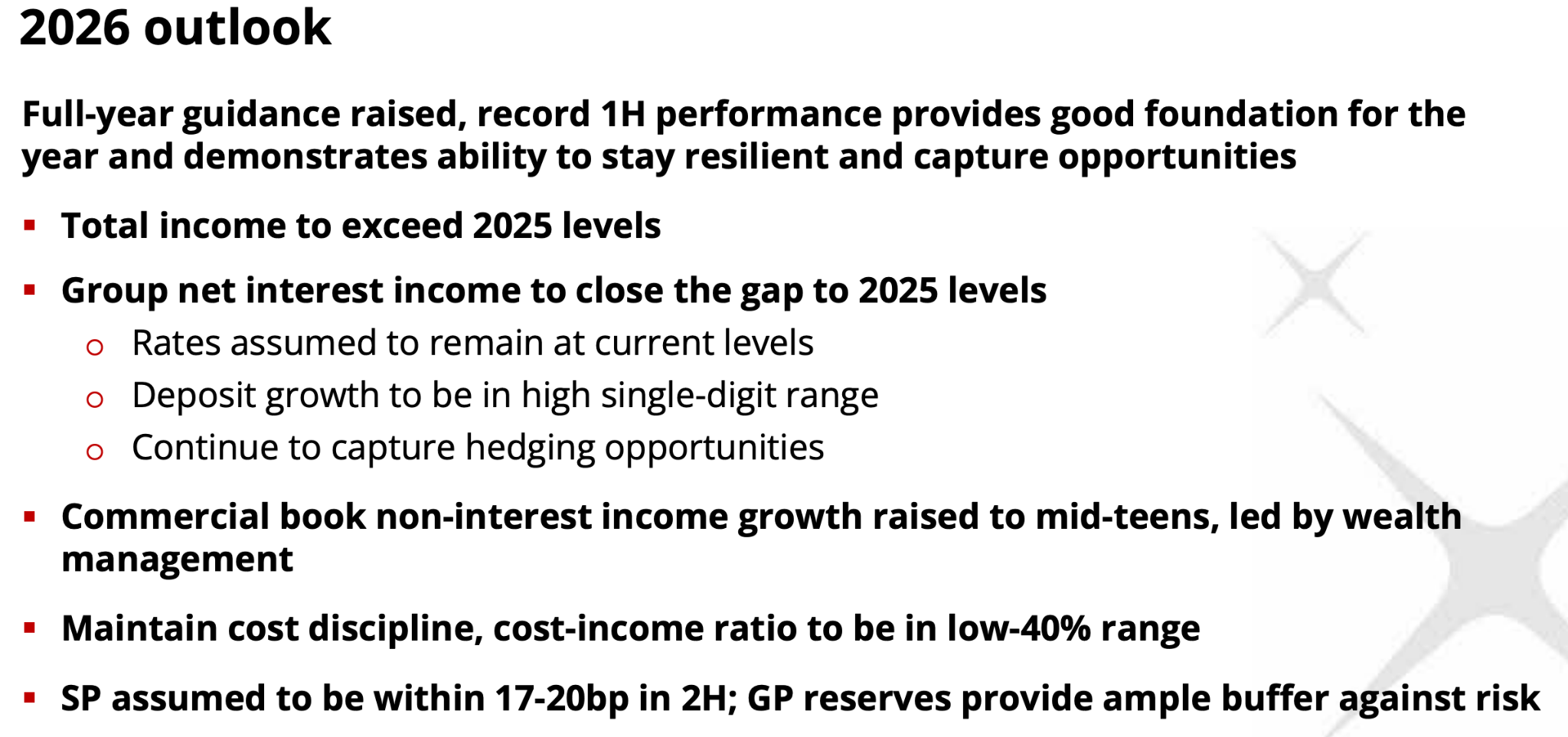
DBS raised its FY2026 guidance following the record first-half performance.
Total income is now expected to exceed 2025 levels, versus its earlier guidance for total income to be around 2025 levels.
Group net interest income is now expected to close the gap to 2025 levels, as rate headwinds are mitigated by hedging and balance sheet growth.
Rates are assumed to remain at current levels, with deposit growth expected to remain in the high single-digit range.
Commercial book non-interest income growth guidance was raised to mid-teens (from high single digits previously), led by wealth management.
The cost-income ratio is expected to remain in the low-40% range, while specific provisions are assumed at 17–20bp in the second half, with general provision reserves providing an ample buffer against risk.
CEO Tan Su Shan noted that DBS also completed its inaugural synthetic securitisation transaction during the quarter, the first by a Singapore-headquartered bank, which expands its capital management toolkit and enhances capacity to support customer financing needs.
Source: Company data
Beansprout’s Quick Take on DBS earnings
DBS delivered a strong set of results, with 2Q26 net profit rising 9% year-on-year to a record S$3.08 billion and total income crossing S$6 billion for the first time.
Record wealth management performance, record treasury customer sales and stronger markets trading income more than offset the drag from lower interest rates.
The standout was the Wealth segment AUM crossing the half-trillion mark for the first time, up 16% year-on-year in constant-currency terms to S$516 billion.
This structural growth in the wealth franchise, alongside proactive balance sheet management, has enabled DBS to navigate the challenging interest rate environment while delivering a return on equity of 17.9% in 2Q (and 17.5% for 1H).
Importantly, management has raised its FY2026 guidance, with total income now expected to exceed 2025 levels (versus around 2025 levels previously) and commercial book non-interest income growth raised to mid-teens (from high single digits).
DBS declared a 2Q total dividend of 81 cents, which translates to an annualised total dividend per share of $3.24.
Based on the closing price of S$73.55 (as of 5 August 2026), this implies a dividend yield of about 4.4%.
DBS currently trades at a price-to-book valuation of about 3.0x, above its historical average of 1.5x.
DBS is one of the stocks in Beansprout’s Opportunity Pot Portfolio, where our analyst team highlights the opportunities we believe stand out in the market today. See the stocks in the portfolio, how much we allocate to each, and what we are watching next.
Related links:
Check out Beansprout's guide to the best stock trading platforms in Singapore with the latest promotions to invest in DBS.
Follow us on Telegram, Youtube, Facebook and Instagram to get the latest financial insights.
Read also
Gain financial insights in minutes
Subscribe to our free weekly newsletter for more insights to grow your wealth
Most Popular

Comments
0 comments