
Property, passive income, or a high salary: What actually gets you to financial freedom?
CPF & Retirement
By Gerald Wong, CFA • 17 Sep 2026
Why trust Beansprout? We’ve been awarded Best Investment Website at the SIAS Investors’ Choice Awards 2025
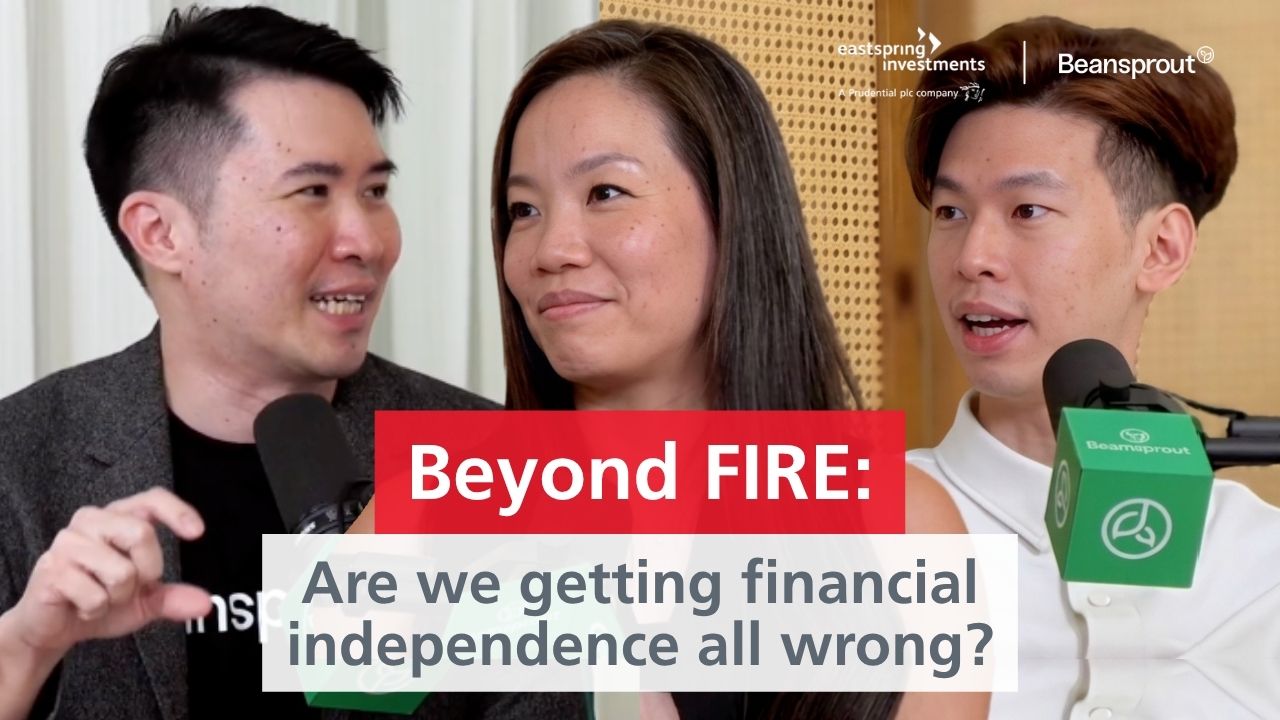
What does financial freedom really mean? Eastspring Investments’ Christina Woon and serial entrepreneur Sebastian Ang debate property, income streams, risk, and building wealth on the Beansprout Podcast.
What happened?
Financial freedom is something many of us aspire towards.
But what does it actually mean?
Is it about reaching a certain amount of wealth? Building enough passive income that you no longer need to work? Or simply having enough financial security to make choices without money getting in the way?
In this episode, we put some commonly held beliefs about money and wealth to the test.
Joining us are Christina Woon, Head of Core and Income Equities at Eastspring Investments, and Sebastian Ang, serial entrepreneur and founder of brands including Mama Diam, Synthesis, Lou Shang and Amacha.
Rather than a typical interview, we gave Christina and Sebastian a series of statements and asked them one simple question: agree or disagree?
We discuss:
- Is financial freedom more important than retiring early?
- Is owning property the only way to become wealthy in Singapore?
- Are multiple income streams more important than earning a higher salary?
- Is keeping money harder than making it?
- Can you build wealth without taking risk?
- Why do great businesses take decades to build?
- Is financial freedom ultimately about having more money — or more choices?
What emerged were two very different perspectives on building wealth: one from an investor who spends her career analysing businesses and constructing portfolios, and another from an entrepreneur who has built, grown, and sometimes lost money through businesses.
To hear the full discussion, watch the video above to hear Christina and Sebastian share their perspectives on financial freedom, investing, risk, and building wealth.
Here are our key takeaways from the conversation.
Key takeaways for investors: What does financial freedom really mean?
1. Financial freedom is about resilience, not simply retiring early (0:00 to 4:28)
For Sebastian, retirement itself is not currently the goal. He enjoys building businesses and sees work as something driven by passion rather than purely by money.
Financial freedom matters because it gives him the ability to continue doing what he enjoys while building enough wealth to eventually have more options.
Christina similarly cautioned against thinking about financial independence as simply reaching a predetermined number and then stopping work.
After all, even if you reach your target, your financial needs may change. Inflation could turn out higher than expected, unexpected large expenses could arise, or markets could perform differently from what you had assumed.
That means financial independence is not just about accumulating enough money.
It is also about building enough financial resilience to withstand uncertainty without having your plans derailed.
In other words, rather than asking only, “When can I retire?”, it may be more useful to ask: “How resilient is my financial position if life does not go according to plan?”
2. Property can build wealth, but it does not have to be your only route (4:29 to 9:24)
Property has historically been an important way for many Singaporeans to grow their wealth.
Sebastian has experienced this himself.
He shared how a property he bought for around S$1.2 million just before the circuit breaker eventually generated a gain of about S$300,000 when the development was completed.
Yet he disagreed that property is the only way to become wealthy.
One reason is opportunity cost.
Money invested into a property could potentially have been invested in a business, equities or other assets instead. Each comes with a different level of potential return, liquidity and risk.
Christina also pointed to the wider range of investment choices available today, from equities and funds to other asset classes.
Diversification becomes important here.
A property represents a relatively large investment concentrated in a single asset and, for many Singapore investors, a single market.
Investing through equities or funds can provide exposure to multiple companies, sectors and countries instead.
For example, Christina highlighted how investing across Asia provides exposure to very different economic and market cycles. Technology opportunities can be found in markets such as China and Taiwan, while financial companies can be found beyond Singapore.
The takeaway is not that property is necessarily better or worse.
Rather, building wealth does not have to depend on one asset class, one company or even one country.
3. Before chasing multiple income streams, build a strong financial base (9:25 to 13:42)
Another common piece of financial advice is to build multiple sources of income.
But are multiple income streams really more important than earning a higher salary?
This was one of the areas where the guests were more divided.
Sebastian believes that having a strong and stable primary income should come first.
His reasoning is straightforward: before allocating money across investments and new ventures, you first need sufficient surplus cash to invest.
Even as a business owner, Sebastian sees himself as having a job to perform.
He shared that he had previously stepped aside from running one of his businesses after not achieving his KPIs, allowing someone better suited to the role to take over.
For him, generating reliable income provides the foundation from which additional investments can be made.
Christina took a more nuanced view.
In everyday life, trying to maintain several jobs, businesses, or side hustles can require enormous amounts of time and attention.
Investing, however, can allow investors to participate in multiple sources of return without personally running multiple businesses.
This is where a diversified portfolio, or having an investment manager make those decisions, can play a role.
So rather than interpreting “multiple income streams” as needing five different side hustles, investors can also think about how their savings and investments might create additional sources of growth or income alongside their main career.
4. Making money and keeping money require different skills (13:42 to 18:09)
Sebastian described making money and keeping money as two different skill sets.
He learnt this through his own businesses.
After investing S$150,000 into Mama Diam, he was able to recover his initial capital and later deploy around S$300,000 into Synthesis.
That investment subsequently grew to around S$600,000, which he then put towards Lou Shang.
Three years later, he said he had lost the money.
Looking back, Sebastian recognised that there were other ways he could have funded the expansion. He might have brought in investors, borrowed from a bank or simply committed less capital.
The lesson was that being good at generating wealth does not automatically mean being good at protecting it.
Christina approached the same issue from a portfolio perspective.
If an investor has S$100 and places the entire amount into a single stock, the portfolio may be far more vulnerable than if that S$100 were spread across several investments.
She uses the analogy of a kueh lapis to explain how she thinks about building an income portfolio.
One layer might consist of more stable dividend-paying companies, such as financials, utilities or telecommunications companies.
Another could contain companies with greater growth potential, including technology businesses whose dividends may increase as their earnings grow.
A further layer might contain more cyclical companies that currently offer lower yields but could see stronger dividend growth as their industries recover.
No single layer has to do all the work.
Put together, these different sources of return can potentially create a more resilient portfolio.
5. Building wealth involves taking calculated risks (18:09 to 23:15)
When asked whether “you can't build wealth without taking risk,” everyone agreed.
Sebastian has seen this first-hand as an entrepreneur.
Opening a new restaurant involves uncertainty around everything from location and staffing to consumer demand and the wider F&B environment.
Some decisions work. Others do not.
But his experience has also taught him that taking risk does not mean taking risk blindly.
“You can really do your homework and minimise this risk,” he explained.
Christina sees investing in much the same way.
Risk is unavoidable, but investors can decide which risks they take, how much they take and whether the potential reward justifies them.
That starts with understanding what you are investing in.
It also means diversifying rather than concentrating too much of your portfolio in one company or one type of investment.
Different investments can also have different risks.
For a mature dividend-paying company, an investor might focus on whether its dividend is sustainable.
For a cyclical company, the bigger question might be whether the expected business recovery will actually materialise.
The goal is therefore not to eliminate risk altogether.
It is to understand and manage the risks you are taking before committing your money.
6. Great businesses take time to build (23:15 to 27:48)
Sebastian shared that even five years into building his businesses, his team is still refining processes and figuring out how the brands can eventually expand beyond Singapore.
Building something lasting involves more than coming up with a good idea.
There are systems to improve, people to develop, responsibilities to delegate and mistakes to learn from.
Christina sees many of the same characteristics when analysing companies as an investor.
Many established companies across Asia took decades to reach their current scale.
When identifying companies that might continue compounding over time, she looks beyond near-term financial performance.
One important consideration is the durability of the company's fundamentals. Another is management.
Who is making the decisions? How do they respond when something goes wrong? Are they able to learn from mistakes and build a stronger business afterwards?
As investors, this can be a useful reminder that compounding rarely happens overnight.
Whether we are building a business or investing in one, patience can be just as important as identifying the opportunity in the first place.
7. Financial freedom ultimately means having more choices (27:48 to 34:35)
For Christina, financial independence ultimately creates freedom over your time and attention.
If your finances and investments can sustainably support your needs, you may have more flexibility to decide what you want to do rather than allowing every decision to be dictated by money.
Sebastian views this from both a personal and business perspective.
For his companies, having more financial resources and diversified sources of income could make the business more resilient if another major shock similar to COVID were to occur.
Personally, financial stability would give him the freedom to pursue more passion projects, including projects that may never generate much money at all.
That may be one of the most useful ways to think about financial freedom.
The objective is not necessarily to maximise the amount of money sitting in an account.
It is to build enough financial security that money gives you more choices rather than fewer ones.
As Christina put it during the conversation, ultimately, your money should work for you so that you have the freedom to live the life you want.
If you’d like to learn more about Eastspring Investments and its income solutions, you can also visit Eastspring Investments for more information.
This document is solely for information and may not be published, circulated, reproduced or distributed in whole or part to any other person without the prior written consent of Eastspring Investments (Singapore) Limited (“Eastspring Singapore”) (Company Reg No. 199407631H). This advertisement has not been reviewed by the Monetary Authority of Singapore. This document is not an offer, solicitation of an offer, or a recommendation to transact in the investment units/ shares in the Fund(s). The information contained herein does not have any regard to the specific investment objectives, financial situation or particular needs of any person. A prospectus or other fund documents in relation to the Fund(s) are available and a copy may be obtained from Eastspring Singapore or its distribution partners. Investors should read the prospectus and seek professional advice before making any investment decision. In the event that investor chooses not to seek advice, he should consider carefully whether the Fund in question is suitable for him. Past performance is not indicative of future results. An investment is subject to investment risks, including the possible loss of the principal amount invested. The value of shares in the Fund and the income accruing to the shares, if any, may fall or rise.
The Fund(s)/ underlying Fund(s) may use derivative instruments for efficient portfolio management and/or hedging purposes.
The fund may directly or indirectly invest in instruments with loss absorption features such as Additional Tier 1 capital and Tier 2 capital instruments with mechanical triggers which are subject to greater risks when compared to traditional debt instruments.
Eastspring Singapore is an ultimately wholly-owned subsidiary of Prudential plc of the United Kingdom. Eastspring Singapore and Prudential plc are not affiliated in any manner with Prudential Financial, Inc., a company whose principal place of business is in the United States of America or with the Prudential Assurance Company Limited, a subsidiary of M&G plc, a company incorporated in the United Kingdom.
Read also
Gain financial insights in minutes
Subscribe to our free weekly newsletter for more insights to grow your wealth
Most Popular

Comments
0 comments