
Global stocks sell off: What’s driving the decline and what to look for next
Stocks
By Gerald Wong, CFA • 06 Nov 2026
Why trust Beansprout? We’ve been awarded Best Investment Website at the SIAS Investors’ Choice Awards 2025

Make Beansprout your preferred source on Google
Add us on Google to see more of our insights in your search results
Global stocks fell sharply on 5 November as concerns over AI investment, data centre expansion and market positioning grew. We look at whether the sell-off changes the investment outlook and what investors can do next.

What happened?
Global stock markets have come under renewed selling pressure.
Just as markets were trying to recover from October's correction, another wave of selling hit US stocks on 5 November.
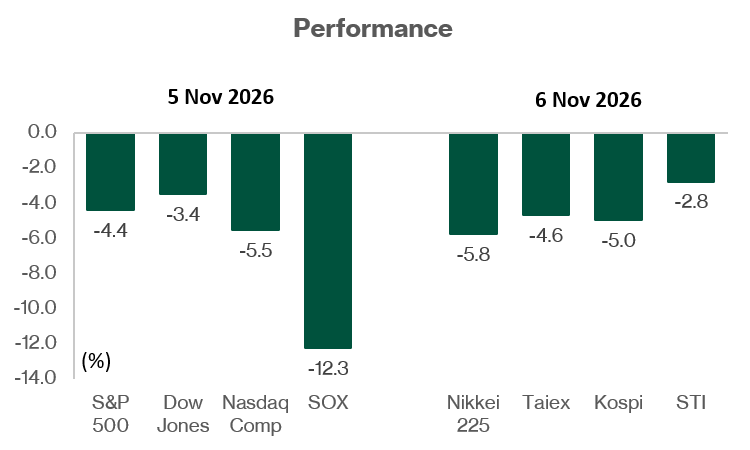
The Dow Jones Industrial Average fell 3.4%, the S&P 500 declined 4.4%, and the Nasdaq Composite dropped 5.5%. The Philadelphia Semiconductor Index fell even more sharply by 12.2%.
The selling subsequently spread across Asia on 6 November, with South Korea's Kospi falling as much as 8.6%, Japan's Nikkei declining around 5.1%, and Taiwan's stock market dropping more than 8% during intraday trading.
The latest decline comes amid growing concerns over AI infrastructure spending, higher bond yields and political uncertainty following the US midterm elections.
In our November Monthly Brew, we highlighted how higher bond yields and questions about the returns on AI investments could weigh on equity valuations.
We also shared in our November Beansprout Investment Climate that while corporate earnings remain resilient, inflation and elevated valuations continue to pose risks to the market.
With global stocks falling sharply, the question for investors is whether this is a temporary correction or a sign that the investment outlook is deteriorating.
Why are global stock markets falling?
We see three developments adding to the latest selling pressure.
#1 - AI and data centre investment is facing more scrutiny
One of the biggest changes is that investors are becoming less willing to assume that AI infrastructure spending will keep rising without interruption.
The US midterm elections have also brought more attention to AI regulation and data centre development.
Across the US, local communities have raised objections to new data centres because of their electricity consumption, water usage and the potential impact on household utility bills.
At the same time, the planned data centre build-out remains substantial.
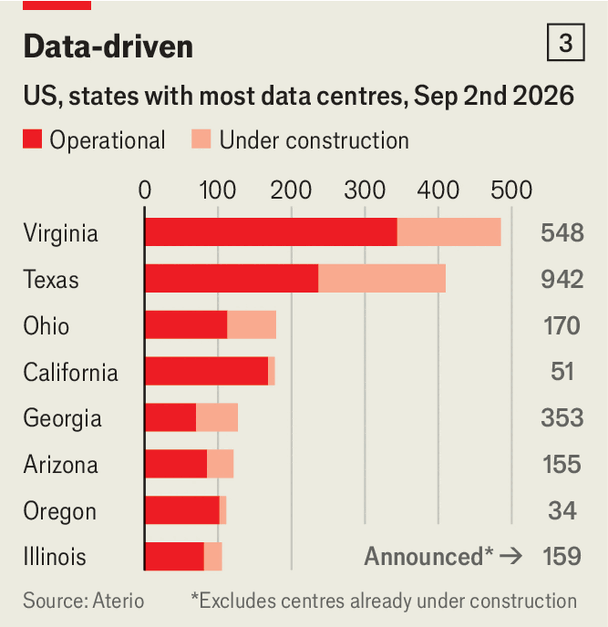
The chart shows Virginia and Texas with the largest number of operational and under-construction data centres among the states shown.
It also illustrates the size of the future pipeline. Texas had 942 announced centres and Virginia had 548, excluding centres already under construction.
For investors, the important question is therefore not whether there is demand to build more data centres. It is how much of the announced pipeline ultimately moves into construction.
According to MSCI Research, at least 75 US data centre projects were delayed or cancelled in the first quarter of 2026, matching the total for the whole of 2025.
MSCI also found that 52% of US data centre projects under development were located in counties where previous projects had been withdrawn or data centre-specific restrictions had been introduced. Around 80% of planned or under-construction projects were in jurisdictions with active or pending data centre-related legislation.
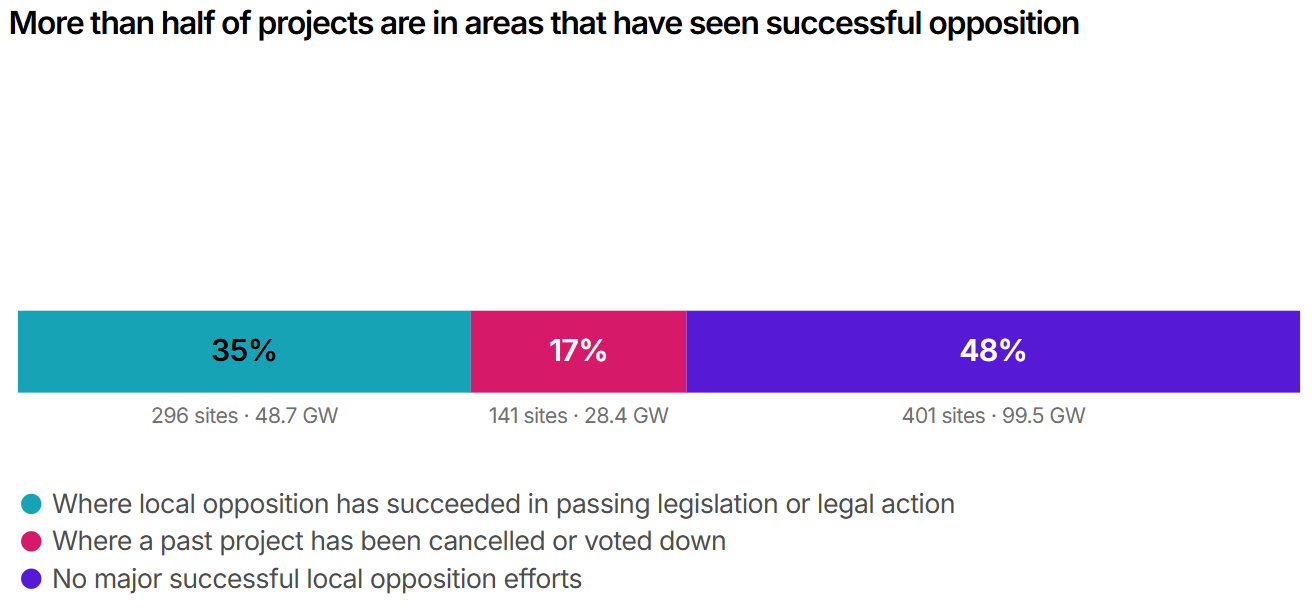
This matters because many semiconductor, equipment and infrastructure companies have benefited from expectations of continued rapid growth in AI investment.
If data centre projects are delayed, some spending may be pushed into later years. That could affect the pace at which these companies grow their earnings.
However, we would distinguish between slower construction and weaker long-term demand for AI services.
Recent earnings have already shifted the conversation towards whether heavy AI spending can translate into sustainable profits and cash flow. That is a more useful question, in our view, than simply tracking how much companies are spending.
Read our analysis of the impact of the US mid-term elections here.
#2 - US political gridlock adds another layer of uncertainty
The US midterm elections have also changed the political backdrop.
The Democrats won control of Congress while the White House remains under Republican leadership, increasing the prospect of political gridlock over the next two years.
For businesses, greater disagreement over government spending, taxation and regulation could make the policy outlook less predictable.
That may lead some companies to become more cautious about making large investment commitments.
However, political gridlock is not necessarily negative for markets.
If it limits additional government spending, it could reduce some pressure on inflation and government borrowing. In turn, this could help bond yields ease.
That would matter because higher bond yields have been one of the key risks we have been watching for equities.
Lower bond yields could support stock valuations, particularly for companies where a large proportion of their expected earnings lies further in the future.
For now, we would treat the political situation as another source of uncertainty rather than the main explanation for the sell-off.
Read our analysis of the impact of the US mid-term elections here.
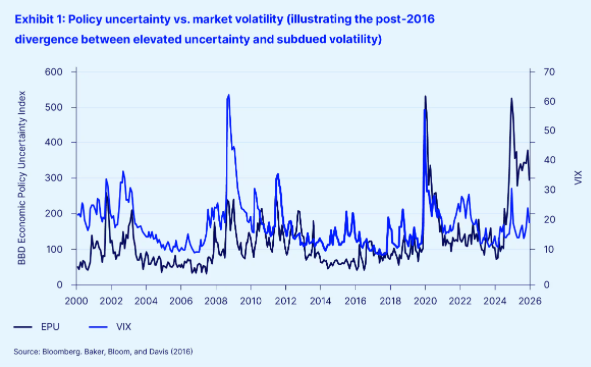
US economic policy uncertainty remains a risk for investors
#3 - Forced selling can make a market decline move faster
Another factor may be the way some institutional investors are positioned.
Reports of hedge funds reducing their exposure to AI-related stocks have raised concerns that falling prices could trigger additional selling.
Some investment funds borrow money to increase the size of their positions. This can increase gains when markets rise, but it can also magnify losses when share prices fall.
When losses grow, funds may need to reduce their positions to manage risk or meet borrowing requirements. This process is often referred to as deleveraging.
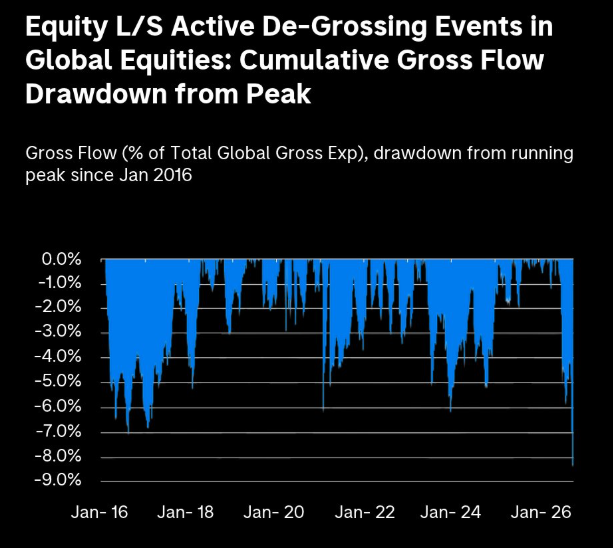
If many investors are reducing positions at the same time, share prices can fall much faster than company fundamentals are changing.
One sign of the increase in market anxiety is the Cboe Volatility Index (VIX), commonly referred to as Wall Street's fear index.
The VIX rose from 16.61 on 4 November to 28.18 on 5 November, an increase of nearly 70%.
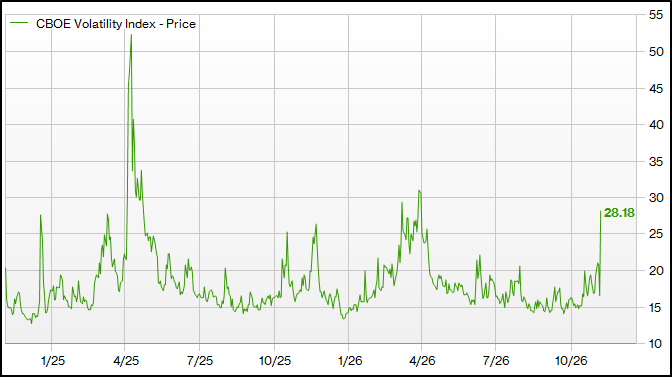
However, the VIX does not directly tell us how much hedge fund selling is taking place.
We would therefore be careful about attributing the entire decline to deleveraging. The more relevant point is that when many investors become more risk-averse at the same time, even fundamentally resilient companies can experience large share-price declines.
Has our investment view changed?
In our November Beansprout Investment Climate, we highlighted five indicators that help us assess whether market risks are increasing or opportunities are improving.
The latest sell-off makes some of these risks more visible, but it has not yet changed our overall view.
Indicator | Our assessment | What we're watching |
Inflation | Concerning | Whether higher oil prices keep inflation and interest rates elevated |
Economic growth | Resilient, but moderating | Whether consumers and businesses begin spending less |
Corporate earnings | Resilient | Whether companies can continue growing profits |
Valuations | More reasonable | Whether lower share prices make investments more attractive |
AI investments | Still supportive, but worth watching | Whether AI spending can generate sustainable profits |
Source: Beansprout Investment Climate, 5 November 2026.
Inflation remains our biggest concern.
If inflation stays elevated, interest rates and bond yields could remain high for longer. That would make it harder for equity valuations to rise.
At the same time, the broader corporate earnings outlook remains resilient.
S&P 500 companies are expected to increase earnings by 16.3% in 2027, according to FactSet estimates cited in our November Investment Climate.
The decline in share prices has also made valuations more reasonable.
But with bond yields still elevated, I would not expect investors to keep paying increasingly high valuations simply because companies are growing.
Future equity returns may therefore depend more heavily on companies actually delivering earnings and cash-flow growth.
For AI-related companies, the same principle applies.
The question is gradually shifting from “How much are companies spending on AI?” to “What returns are they earning from that spending?”
Companies that can demonstrate sustainable earnings and cash-flow growth should be in a stronger position even if the broader AI sector remains volatile.
Overall, the investment environment has become more challenging. But we have not yet seen enough deterioration in economic growth or corporate earnings to turn outright defensive.
Read our Investment Climate assessment for November here.
What would Beansprout do?
The latest market correction reinforces why we use our Four Pots of Wealth framework to manage our investments based on their different purposes.
Rather than reacting to short-term market movements, we would focus on maintaining sufficient liquidity, staying invested for long-term growth, earning sustainable income and keeping cash available for opportunities.
For our Liquidity Pot, we would continue keeping our near-term savings in relatively low-risk instruments such as savings accounts, fixed deposits and Singapore T-bills.
For our Growth Pot, we would continue dollar-cost averaging into diversified investments rather than trying to predict when markets will bottom.
For our Income Pot, we are gradually becoming more constructive on bonds as higher yields offer potentially better income opportunities, although further increases in yields could still weigh on bond prices.
Where we would be more selective is with our Opportunity Pot, as lower share prices do not necessarily mean that stocks have become attractively valued.
We would focus on companies with resilient earnings, healthy cash flows and strong balance sheets, while assessing whether their valuations offer sufficient potential returns for the risks.
For now, we would stay disciplined with our Four Pots of Wealth approach, remain invested for the long term and keep some cash ready for opportunities, without taking on unnecessary risk to chase a market rebound.
Check out the best stock trading platforms in Singapore with the latest promotions to start investing.
Enjoyed this insight? Follow Beansprout on Telegram, Youtube, Facebook and Instagram, and add Beansprout as your preferred source on Google so you never miss an update.
Read also
Gain financial insights in minutes
Subscribe to our free weekly newsletter for more insights to grow your wealth
Most Popular

Comments
0 comments