
Dollar-Cost Averaging (DCA): A beginner's guide for Singapore investors
ETFs
By Gerald Wong, CFA • 10 Aug 2026
Why trust Beansprout? We’ve been awarded Best Investment Website at the SIAS Investors’ Choice Awards 2025
'%3e%3cpath%20fill-rule='evenodd'%20clip-rule='evenodd'%20d='M17.64%209.20455C17.64%208.56637%2017.5827%207.95273%2017.4764%207.36364H9V10.845H13.8436C13.635%2011.97%2013.0009%2012.9232%2012.0477%2013.5614V15.8195H14.9564C16.6582%2014.2527%2017.64%2011.9455%2017.64%209.20455V9.20455Z'%20fill='%234285F4'/%3e%3cpath%20fill-rule='evenodd'%20clip-rule='evenodd'%20d='M9%2018C11.43%2018%2013.4673%2017.1941%2014.9564%2015.8195L12.0477%2013.5614C11.2418%2014.1014%2010.2109%2014.4205%209%2014.4205C6.65591%2014.4205%204.67182%2012.8373%203.96409%2010.71H0.957275V13.0418C2.43818%2015.9832%205.48182%2018%209%2018V18Z'%20fill='%2334A853'/%3e%3cpath%20fill-rule='evenodd'%20clip-rule='evenodd'%20d='M3.96409%2010.71C3.78409%2010.17%203.68182%209.59318%203.68182%209C3.68182%208.40682%203.78409%207.83%203.96409%207.29V4.95818H0.957273C0.347727%206.17318%200%207.54773%200%209C0%2010.4523%200.347727%2011.8268%200.957273%2013.0418L3.96409%2010.71V10.71Z'%20fill='%23FBBC05'/%3e%3cpath%20fill-rule='evenodd'%20clip-rule='evenodd'%20d='M9%203.57955C10.3214%203.57955%2011.5077%204.03364%2012.4405%204.92545L15.0218%202.34409C13.4632%200.891818%2011.4259%200%209%200C5.48182%200%202.43818%202.01682%200.957275%204.95818L3.96409%207.29C4.67182%205.16273%206.65591%203.57955%209%203.57955V3.57955Z'%20fill='%23EA4335'/%3e%3c/g%3e%3cdefs%3e%3cclipPath%20id='clip0_0_2849'%3e%3crect%20width='18'%20height='18'%20fill='white'/%3e%3c/clipPath%3e%3c/defs%3e%3c/svg%3e)
Make Beansprout your preferred source on Google
Add us on Google to see more of our insights in your search results
Learn how dollar-cost averaging (DCA) works, its pros and cons, and how Singapore investors can use this strategy to build wealth over the long term.
What happened?
One of the most frequent questions investors ask is: "Is now a good time to invest?"
Most investors know the importance of investing but are afraid to invest their hard-earned money only to see markets fall the next day.
Some may feel anxious if they invested a large lump sum amount hoping to catch the cheapest price, only for the market to continue its decline the next day.
The challenge is that consistently predicting short-term market movements is extremely difficult even for professional investors.
That's where dollar-cost averaging (DCA) comes in.
Instead of trying to pick the perfect time to invest, DCA involves investing a fixed amount at regular intervals, regardless of whether markets are rising or falling. It takes the guesswork out of investing and helps you compound wealth steadily over time.
For many Singaporeans who receive a monthly salary, DCA can be an easy way to make long term investing into a regular habit. Setting aside part of each paycheck for investing can help make wealth building a habit, similar to contributing regularly to your CPF.
DCA can often form the backbone of the growth pot or income pot, as part of Beansprout’s Four Pots of Wealth Framework, once we have set aside sufficient emergency funds for the liquidity pot.
In this article, I will explain more about the DCA strategy, how to do it, and its advantages and disadvantages.
What is dollar-cost averaging (DCA)?
DCA is an investment strategy where you invest a fixed amount of money into an investment at regular intervals.
The goal of DCA is to start compounding your investment, build discipline, remove emotions and guesswork, and stay invested throughout the market cycles.
For example, instead of investing S$12,000 all at once, you could use DCA to split the investment into S$1,000 every month, $500 every fortnight, or S$3,000 every quarter.
DCA isn’t fixed to only a monthly schedule, but the key principle of DCA is to invest consistently at a fixed schedule, regardless of the overall market sentiment.
Because you're investing the same dollar amount each time, when prices are high you buy fewer shares and when prices are low you buy more shares.
Over time, this helps smooth out your average purchase price while removing the guesswork and anxiety of trying to time the market.
Many Singapore investors use DCA to build a diversified portfolio through investments in ETFs that track the Straits Times Index (STI), S&P 500, or the MSCI World Index.
Learn more about ETF investing by reading our guide to ETFs.
How does dollar-cost averaging (DCA) work?
DCA works by investing a fixed dollar amount regularly no matter what the current share price is.
To effectively utilize the DCA strategy, you will need to set three fixed rules and apply them consistently.
#1 - Decide on the amount invested each time
DCA can work with any amount of money. However, if your invested amount is small for each time you buy, the transaction costs can eat into your capital.
So, instead of S$100 a week, you might consider S$400 a month or S$800 every two months which may be a more efficient way to deploy your money.
#2 - Decide on your investing frequency
DCA can work with many different schedules. For example, you can decide to invest weekly, monthly or even quarterly.
The important point is that once you decide a schedule for your DCA plan, you should stick to it.
However, you need to be aware of the transaction costs if you decide to use a schedule that is too frequent, as transaction costs may end up becoming a significant drag on performance.
For many Singaporeans, a monthly schedule fits in seamlessly with the payroll cycle. So you can immediately set aside some money to DCA whenever you receive your salary.
#3 - Decide which asset you want to invest in
For people who are just beginning, a diversified ETF that tracks a broad based market index would be a good starting point and candidate for a DCA strategy.
For example, ETFs like Amova Singapore STI ETF (SGX: G3B) or SPDR Straits Times Index (STI) ETF (SGX: ES3) which track the Singapore Straits Times Index (STI), SPDR S&P 500 ETF Trust (SGX: S27) which tracks the US S&P 500 index, or Vanguard FTSE All-World UCITS ETF USD Acc (LSE: VWRA) which invests in companies across the world.
Case study of implementing DCA on an ETF tracking the STI
Suppose you invested “S$1,000” (#1) every “month” (#2) into the “Amova Singapore STI ETF (G3B)” (#3) over 12 months starting from June 2025 to May 2026.
| Month | G3B Closing Price on first week of the month (S$) | Invested Amount (S$) | Shares Acquired | Cumulative Investment (S$) | Cumulative Shares Acquired |
| 25-Jun | 4.07 | 997.15 | 245 | 997.15 | 245 |
| 25-Jul | 4.15 | 996 | 240 | 1,993.15 | 485 |
| 25-Aug | 4.33 | 995.9 | 230 | 2,989.05 | 715 |
| 25-Sep | 4.44 | 999 | 225 | 3,988.05 | 940 |
| 25-Oct | 4.59 | 996.03 | 217 | 4,984.08 | 1,157 |
| 25-Nov | 4.59 | 996.03 | 217 | 5,980.11 | 1,374 |
| 25-Dec | 4.71 | 998.52 | 212 | 6,978.63 | 1,586 |
| 26-Jan | 4.82 | 997.74 | 207 | 7,976.37 | 1,793 |
| 26-Feb | 5.03 | 995.94 | 198 | 8,972.31 | 1,991 |
| 26-Mar | 4.96 | 996.96 | 201 | 9,969.27 | 2,192 |
| 26-Apr | 5.1 | 999.6 | 196 | 10,968.87 | 2,388 |
| 26-May | 5.09 | 997.64 | 196 | 11,966.51 | 2,584 |
| Source: Beansprout | |||||
After twelve months of investing, you would have invested S$11,966 and accumulated 2,584 shares of Amova Singapore STI ETF (SGX: G3B), with an average price of about S$4.63 per unit, excluding any transaction costs.
The monthly investment doesn’t add up exactly to S$1,000 because the minimum purchase size is 1 unit per transaction and Amova Singapore STI ETF (SGX: G3B) doesn’t offer fractional shares.
In the same period of time, you would also have received about S$22.46 and S$147.81 in dividends in July 2025 and January 2026 respectively, with one more dividend in July 2026 amounting to S$249.87 on the way.
Even though share prices fluctuated between S$4.07 and S$5.10, your average purchase price will be somewhere in between.
Rather than worrying about buying at the highest or lowest price, DCA spreads your purchases across different market conditions.
You can utilize the same formula to create multiple DCA strategies of your own depending on your financial goals and status.
“I will invest #1 (Amount) every #2 (frequency) into #3 (asset).”
How compounding can work for us over the long term
If you were to utilize the same strategy over a long period of time, the power of compounding becomes more apparent.
You can use Beansprout’s Compound Interest Calculator tool to help visualise how compounding can help us grow our wealth over the long term.
For illustrative purposes only, this is an example of how the DCA strategy can be used and how compounding can help build wealth. The longer the timeframe, the more the compounded interest will grow.
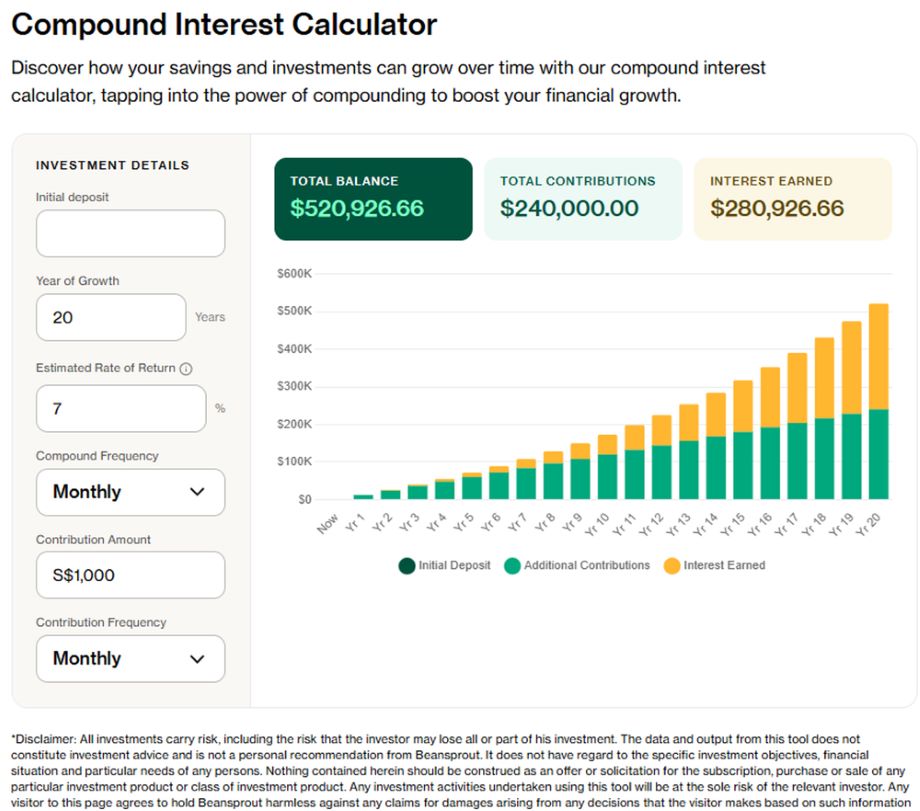
By contributing S$1,000 monthly over 20 years, your total contribution would be S$240,000.
Assuming an annual return of 7%, broadly in line with the historical annualised return of the SPDR Straits Times Index ETF (ES3) from the end of 2005 to the end of 2025, your investments could grow to about S$521,000.
This means you could earn approximately S$280,000 in investment returns, which is even more than the amount you contributed.
Why do investors use DCA?
#1 - You don't need to time the market
Trying to predict when markets will rise or fall is incredibly difficult.
With DCA, you don't have to guess whether today is the "best" day to invest. Regardless of the market conditions, you would invest a fixed amount regularly.
As the saying goes, "Time in the market is often more important than timing the market."
#2 - It builds investing discipline
One of the biggest drivers of long-term investing success is consistency.
By investing every month, you're developing a habit of putting money to work rather than trying to wait for the perfect opportunity.
For salaried employees in Singapore, this can fit naturally alongside monthly budgeting, much like regular CPF contributions.
#3 - It reduces emotional investing
For many investors, trying to time the market can be a cause of rising stress and anxiety. Market downturns can make many investors nervous.
Some stop investing altogether when prices fall, even though lower prices allow them to buy more units with the same amount of money.
Instead of investing everything just before a market correction or trying to buy at the lowest price, DCA spreads your investments over time.
While this doesn't eliminate investment risk, it reduces the worrying about whether you had bought the market peak, or managed to buy the market dip.
Because DCA follows a predetermined schedule, it removes much of the emotion from investing decisions.
#4 - It works well for regular income
Many Singaporeans receive their salary monthly.
Rather than waiting years to accumulate a large sum, you can start investing a part of each month's savings immediately.
This makes DCA one of the easiest investing strategies to adopt.
Which investments are typically used for dollar-cost averaging?
While the DCA strategy can work for any kind of liquid asset, most investors tend to use it for diversified investments intended to be held over the long term.
Some examples include:
- Broad-market ETFs like Amova Singapore STI ETF (SGX: G3B), SPDR Straits Times Index (STI) ETF (SGX: ES3), or SPDR S&P 500 ETF Trust (SGX: S27)
- Global equity index funds like Vanguard FTSE All-World UCITS ETF USD Acc (LSE: VWRA)
- REIT ETFs like Lion-Phillip S-REIT ETF (SGX: CLR)
These types of diversified portfolios remove single stock risk and gain exposure to the broad market and economy, which tends to grow over the long term.
If you are new to ETFs, read our beginner’s guide to ETF investing to learn how ETFs work and what to consider when choosing your first ETF.
What are the disadvantages of dollar-cost averaging?
Lump sum investing has historically delivered higher returns if you already have a large sum of cash available
If you already have a large amount of cash available on hand, investing it immediately has historically outperformed DCA around two-thirds of the time based on calculations made by Vanguard Research using the MSCI World Index.
This is because stock markets have generally risen over the long term, allowing more of your money to spend longer invested.
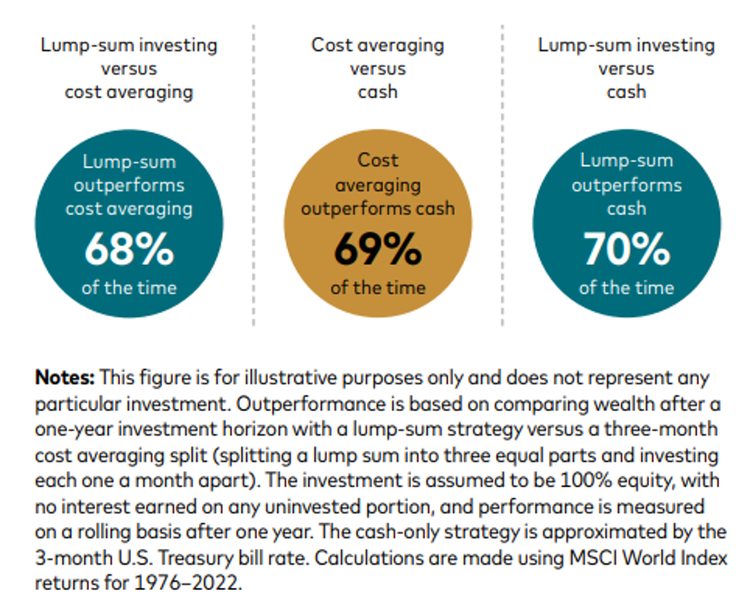
However, lump sum investing also comes with greater short-term risk. If markets fall shortly after you invest, the decline can be psychologically difficult to endure.
For investors who are worried about investing at the wrong time, DCA may provide greater peace of mind and help them stay invested through the ups and downs.
It requires patience
DCA is designed for long-term investing rather than generating quick gains.
Its benefits become more apparent over years rather than weeks or months.
Transaction costs can add up
If your broker charges commissions on every trade, making frequent small purchases could increase your overall costs.
Fortunately, many brokerages and investment platforms in Singapore now offer low-cost or commission-free recurring investment plans.
Check out our best online brokerage & trading platform in Singapore to find the best one for you.
You are still exposed to market risk
DCA helps smoothen market volatility but it doesn’t eliminate market risk.
While broad markets have historically trended higher over time, DCA does not prevent a portfolio from experiencing losses.
Dollar-cost averaging vs lump sum investing
While lump sum investing may outperform DCA mathematically, DCA is still useful for mitigating market-timing risk and managing emotional stress.
Neither approach is universally better than the other, but for most Singapore Investors, DCA is easier to implement.
| Dollar-Cost Averaging | Lump Sum Investing |
| Invests gradually | Invests everything at one go |
| Reduces timing risk | Maximises time in the market |
| Easier emotionally | Requires greater tolerance for volatility |
| Useful if you receive regular income | Useful if you already have a large sum to invest and can tolerate volatility |
Can you automate dollar-cost averaging (DCA)?
You can make DCA even more seamless by setting up a system where it automatically invests a fixed amount of money at regular intervals into your selected asset.
Many brokerages and investment platforms in Singapore allow you to automate your investments through Regular Savings Plans (RSP).
For example, you can instruct your broker to invest S$1,000 every month into your selected ETF automatically.
Platforms such as FSMOne, POEMS RSP, Tiger Brokers, uSMART and DBS Digibank allow you to automate your DCA investments through a Regular Savings Plan.
Webull also offers a Dynamic RSP, which adjusts the amount invested according to market conditions.
The available products, markets, minimum investment amounts and fees may vary across platforms.
For example, some RSPs support only Singapore-listed stocks and ETFs, while others also allow investments in US- or Hong Kong-listed securities. Certain platforms may also let you invest through your CDP account or use CPF and SRS funds, although the eligible products and charges may differ.
Automation removes the temptation to delay investing while helping you stay consistent over the long term.
You can check out our guide to the best online brokerage and trading platform in Singapore to compare their fees, supported markets and recurring investment features.
Can you use CPF or SRS for dollar-cost averaging?
Yes. Besides investing cash, some Singapore investors can also use their CPF Investment Scheme (CPFIS) or Supplementary Retirement Scheme (SRS) funds to invest regularly over time.
Using SRS to dollar-cost average
Many people make SRS contributions annually to enjoy tax relief. Instead of investing the full contribution immediately, you may choose to invest your SRS funds gradually over the following months using the DCA approach.
Investors who contribute to the Supplementary Retirement Scheme (SRS) can use their SRS funds to invest in eligible products such as unit trusts, ETFs, and selected stocks.
This can be particularly helpful for investors who are concerned about short-term market volatility while still wanting to put their retirement savings to work, as idle cash sitting in the SRS accounts earns a very low base interest rate of 0.05% per annum.
Explore ways to invest your SRS funds to help grow your retirement savings here.
Using CPF to dollar-cost average
If you have investible savings in your CPF Ordinary Account (OA), you may be able to invest them through the CPF Investment Scheme (CPFIS), subject to CPF's eligibility rules and the investment products available.
Read our CPFIS guide to learn how to invest your CPF savings and the options available.
Rather than investing your entire investible CPF balance at once, you could choose to deploy it gradually over several months. This can help reduce the risk of investing just before a market downturn, while allowing you to build your investment portfolio progressively.
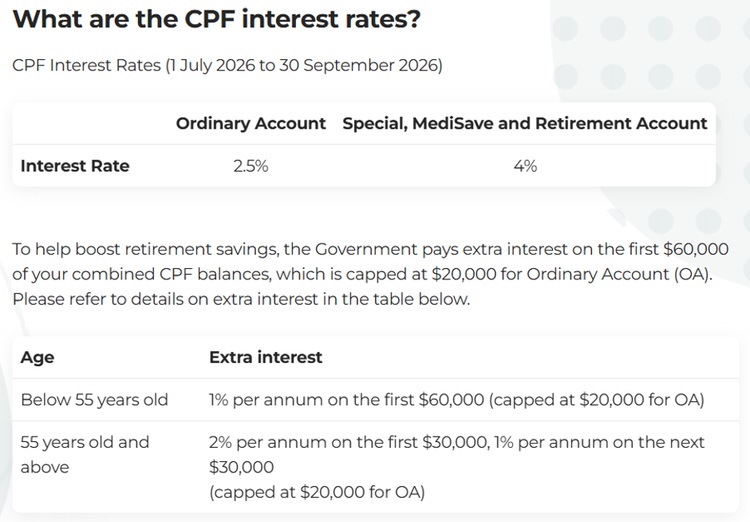
However, before investing your CPF savings, it's worth considering the interest you're giving up. Funds kept in your CPF OA earn a guaranteed interest rate, so any investment should aim to generate returns that justify taking on additional risk.
Common mistakes to avoid when trying to DCA
Stopping investments when markets fall
One of the biggest benefits of DCA is that it encourages you to keep investing through the ups and downs of the market.
When markets are high, you buy fewer units and when markets are low, you buy more units.
However, a common mistake some investors make is to override their DCA rules and stop investing when prices are dropping because they are worried that prices will continue to fall further.
By pausing your investments during market downturns, you miss out on the opportunity to accumulate more units at lower prices and may make the DCA strategy lose its effectiveness.
Investing before building an emergency fund
DCA is most effective for long-term goals, such as building wealth for retirement or growing your investment portfolio over many years.
Therefore, it is important to ensure that you have sufficient emergency savings and short term funds to account for any unexpected situations.
With a sufficient buffer in place, you do not have to worry about being forced to sell long term investments at the wrong time just to cover a short term need.
This is why, at Beansprout, we emphasise building a Liquidity Pot first, so that unexpected expenses can be covered without disrupting your long-term investment plans.
Frequently changing your investment plan
DCA works best when you remain consistent. Constantly switching between different DCA targets can undermine the discipline that DCA is designed to build.
Using DCA for risky assets
DCA is a strategy which can be used for many different kinds of assets. However, we still need to understand what we are investing in.
DCA doesn’t guarantee profits especially if the selected assets are financially weak.
For example, continuing to buy shares in a company that is headed for bankruptcy may risk compounding losses rather than profits.
This is why DCA works best with diversified assets like ETFs which track broad market indices that tend to grow over time.
If you are new to ETFs, read our beginner’s guide to ETF investing to learn how ETFs work and what to consider when choosing your first ETF.
What would Beansprout do?
Dollar-Cost Averaging is a simple and effective strategy for many investors to build and compound their wealth over the long term.
For many Singapore investors, setting aside a fixed amount to invest each month after payday can help remove the temptation to time the market.
Over the long run, staying invested is often more important than finding the perfect entry point.
By investing a fixed amount regularly, we can remove some of the emotion from investing and focus on consistently growing our wealth instead of trying to predict short-term market movements.
You may use our compound interest calculator to see how your regular DCA investments could grow over time.
Before starting a DCA plan, however, I would first make sure that I have built a strong financial foundation with sufficient funds in my liquidity pot to cover emergencies and short-term expenses.
Once my Liquidity Pot is in place, I may consider using DCA to steadily build my Growth Pot by investing regularly in broad-market index funds, such as STI ETFs or S&P 500 ETFs, that align with my long-term financial goals.
I may also use DCA to gradually build an Income Pot through investments such as dividend-paying ETFs or REIT ETFs.
I will remind myself that DCA is about developing the discipline to invest consistently through the market conditions but it does not necessarily guarantee the highest returns.
Rather than worrying about whether today is the perfect time to invest, I would focus on having the right asset allocation, investing regularly, and reviewing my portfolio periodically to ensure it continues to support my long-term financial goals.
To learn more about ETF investing, read our beginner guide to ETF investing here.
If you are planning to start investing and have not yet opened a brokerage account, you can compare the best online brokerage accounts in Singapore and check out the latest Beansprout brokerage promotions.
Have you decided on how you will implement DCA for your portfolio? Share the idea with us in the comments below or in our Telegram group!
If you are new to investing, learn how to start investing in Singapore and grow your money over time.
Follow Beansprout on Telegram, Youtube, Facebook and Instagram, and add Beansprout as your preferred source on Google so you never miss an update.
Read also
Gain financial insights in minutes
Subscribe to our free weekly newsletter for more insights to grow your wealth
Most Popular

Comments
0 comments