
Gold falls from record highs. Should you buy now?
Commodities
By Gerald Wong, CFA • 10 Feb 2026
Why trust Beansprout? We’ve been awarded Best Investment Website at the SIAS Investors’ Choice Awards 2025
'%3e%3cpath%20fill-rule='evenodd'%20clip-rule='evenodd'%20d='M17.64%209.20455C17.64%208.56637%2017.5827%207.95273%2017.4764%207.36364H9V10.845H13.8436C13.635%2011.97%2013.0009%2012.9232%2012.0477%2013.5614V15.8195H14.9564C16.6582%2014.2527%2017.64%2011.9455%2017.64%209.20455V9.20455Z'%20fill='%234285F4'/%3e%3cpath%20fill-rule='evenodd'%20clip-rule='evenodd'%20d='M9%2018C11.43%2018%2013.4673%2017.1941%2014.9564%2015.8195L12.0477%2013.5614C11.2418%2014.1014%2010.2109%2014.4205%209%2014.4205C6.65591%2014.4205%204.67182%2012.8373%203.96409%2010.71H0.957275V13.0418C2.43818%2015.9832%205.48182%2018%209%2018V18Z'%20fill='%2334A853'/%3e%3cpath%20fill-rule='evenodd'%20clip-rule='evenodd'%20d='M3.96409%2010.71C3.78409%2010.17%203.68182%209.59318%203.68182%209C3.68182%208.40682%203.78409%207.83%203.96409%207.29V4.95818H0.957273C0.347727%206.17318%200%207.54773%200%209C0%2010.4523%200.347727%2011.8268%200.957273%2013.0418L3.96409%2010.71V10.71Z'%20fill='%23FBBC05'/%3e%3cpath%20fill-rule='evenodd'%20clip-rule='evenodd'%20d='M9%203.57955C10.3214%203.57955%2011.5077%204.03364%2012.4405%204.92545L15.0218%202.34409C13.4632%200.891818%2011.4259%200%209%200C5.48182%200%202.43818%202.01682%200.957275%204.95818L3.96409%207.29C4.67182%205.16273%206.65591%203.57955%209%203.57955V3.57955Z'%20fill='%23EA4335'/%3e%3c/g%3e%3cdefs%3e%3cclipPath%20id='clip0_0_2849'%3e%3crect%20width='18'%20height='18'%20fill='white'/%3e%3c/clipPath%3e%3c/defs%3e%3c/svg%3e)
Make Beansprout your preferred source on Google
Add us on Google to see more of our insights in your search results
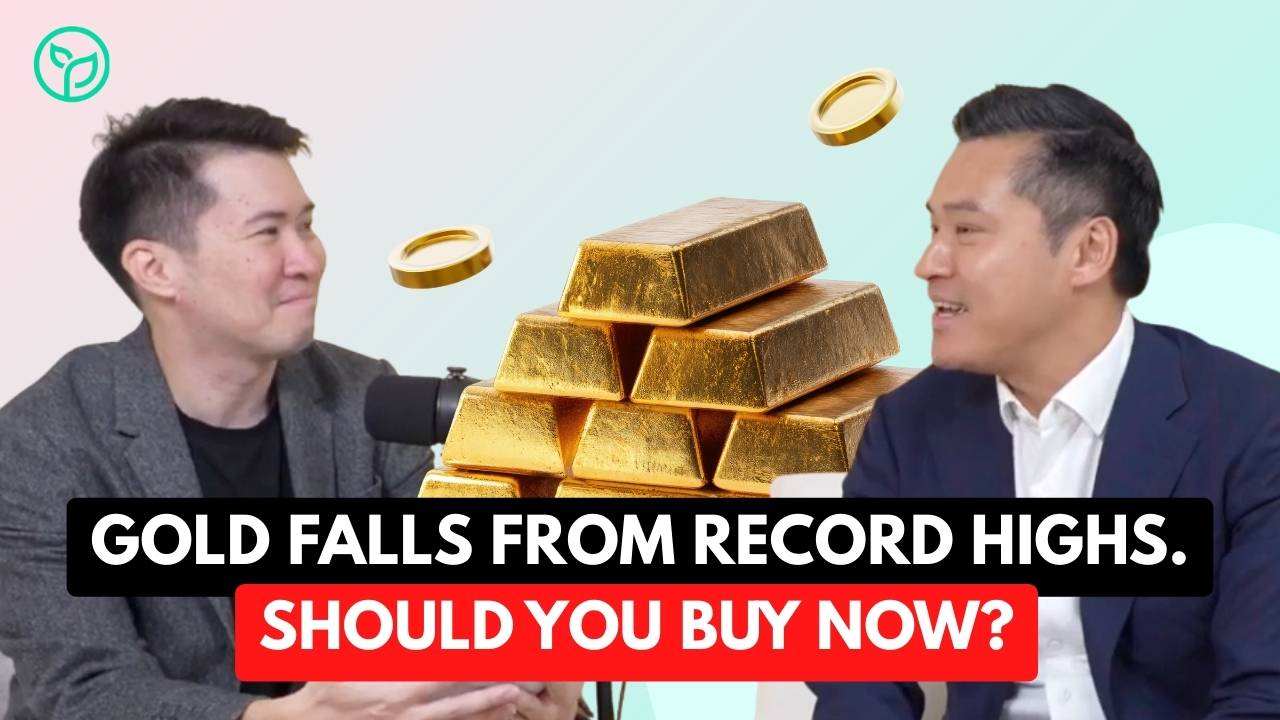
Gold prices have hit record highs before pulling back. We unpack what’s driving gold, the role of central banks and ETFs, and whether investors should consider gold now on the Beansprout Podcast.
What happened?
Gold has been making headlines again.
After surging to record highs of nearly US$5,000 per ounce, gold prices have pulled back slightly in recent weeks.
This has sparked fresh questions from investors about whether it is worth investing in gold, and whether this pullback could be an opportunity to add exposure.
In this week’s Beansprout Podcast, I spoke with Robin Tsui, APAC Gold Strategist at State Street Investment Management, to unpack what is really driving gold prices, how investors should think about recent volatility, and whether gold still deserves a place in portfolios after such a strong run.
We dive into:
- Why gold surged from around US$700 to nearly US$5,000 per ounce
- What could cause gold prices to correct from US$5,000 to US$4,000
- Why gold tends to perform well during periods of uncertainty
- How interest rates and the US dollar affect gold prices
- The role of central banks in sustaining the gold rally
- Gold vs silver – which is better?
- How gold-backed ETFs work and how investors can gain exposure
Robin brings nearly two decades of experience covering gold markets and shares why gold’s role goes far beyond short-term price movements.
Catch the full conversation in the video below.
Key takeaways for investors from the interview with Robin Tsui, APAC Gold Strategist at State Street Investment Management: Gold falls from record highs. Should you buy now?
1. Gold’s rally was driven by powerful structural forces, not just hype
Gold’s surge to record highs did not happen in a vacuum. Robin explains that last year alone, gold delivered exceptionally strong returns, supported by several long-term drivers. These include heightened geopolitical risk, rising global debt levels, and expectations of interest rate cuts by the U.S. Federal Reserve.
When real interest rates fall, the opportunity cost of holding gold declines. At the same time, geopolitical uncertainty such as wars, trade tensions, and sanctions creates an environment where investors seek assets that can protect purchasing power. Gold has increasingly become the preferred safe-haven asset in these situations.
The key takeaway is this: Gold’s rise has been supported by fundamentals that extend beyond short-term speculation, which helps explain why investor interest has remained strong even at higher price levels.
2. Central banks have become one of the most important buyers of gold
One of the most significant changes in the gold market over the past decade has been the behaviour of central banks. Before the global financial crisis, many central banks were net sellers of gold. That has completely reversed.
Today, central banks collectively buy around 1,000 tonnes of gold a year, accounting for roughly 30 percent of annual new supply. According to Robin, without this steady demand, gold prices would likely be far lower than current levels.
Emerging market central banks such as China, India, Turkey, and Poland have been especially active buyers. Many are increasing gold allocations to diversify away from reliance on the U.S. dollar and reduce vulnerability to financial sanctions. This structural demand provides a strong long-term foundation for gold prices.
3. Gold-backed ETFs have transformed how investors access gold
Beyond central banks, investor demand through gold-backed ETFs has surged. These ETFs are designed to track the price of gold one-for-one and are fully backed by physical gold held in secure vaults.
Robin explains that gold-backed ETFs have become increasingly popular because they offer a cost-effective and transparent way to gain exposure without the logistical challenges of storing physical gold. Transaction costs are typically much lower than buying physical bars or coins, where spreads can be significant.
Importantly, strong inflows into gold-backed ETFs directly increase physical demand, as each unit of the ETF must be backed by gold. This makes ETF demand a meaningful driver of the gold market, especially during periods of heightened uncertainty.
4. Gold’s true value lies in diversification, not price prediction
A recurring theme in the conversation is that gold should not be viewed purely as a tactical trade based on price forecasts. Robin encourages investors to think of gold as portfolio insurance.
Historically, gold has shown low correlation with both equities and bonds. Over more than five decades, its long-term annualised returns have been comparable to global equities and higher than bonds, while also helping to reduce overall portfolio volatility.
For most long-term investors, a strategic allocation of around 5 to 10 percent to gold has been shown to improve risk-adjusted returns. The goal is not to guess whether gold will move from $5,000 to $4,500 or back again, but to build a portfolio that is more resilient across market cycles.
5. Gold behaves differently from other precious metals during downturns
Investors often ask whether silver or platinum can play a similar role to gold. While these metals have sometimes outperformed gold during economic upswings, Robin highlights a crucial difference.
Silver and platinum are much more closely tied to industrial demand and tend to have higher volatility and higher correlation with equities. During market stress, they often fall more sharply than gold.
Gold stands apart because it is held by central banks as a reserve asset and consistently acts as a hedge during periods of financial distress. This makes gold uniquely suited as a defensive diversifier, especially when markets become unstable.
6. Buying gold at high prices feels uncomfortable, but timing is not the point
One of the hardest challenges for investors is buying gold when prices are already high. Robin acknowledges that corrections are possible, especially if the U.S. dollar strengthens sharply or if interest rates rise unexpectedly.
However, he also notes that any meaningful pullback is likely to attract large buyers, particularly central banks that remain price sensitive. This dynamic helps limit downside risks over the long term.
For new investors, Robin suggests starting small, such as gaining exposure through a gold-backed ETF. Once investors see how gold behaves within their portfolio, it becomes easier to build confidence and adjust allocations over time.
Transcript
0:00 to 2:00 – Introduction: Gold hits record highs
The host introduces the topic of gold prices surging to record levels and welcomes Robin Tsui, APAC Gold Strategist at State Street Investment Management. Robin briefly shares his background and nearly two decades of experience covering gold markets, setting the stage for a deeper discussion on what is driving gold prices today.
2:00 to 5:30 – Why gold prices have surged so sharply
Robin explains the key drivers behind gold’s strong performance, including heightened geopolitical tensions, rising global debt levels, and expectations of U.S. Federal Reserve rate cuts. He highlights how lower interest rates reduce the opportunity cost of holding gold and why uncertainty has pushed investors towards safe-haven assets.
5:30 to 8:15 – Gold as a safe-haven and portfolio hedge
The discussion turns to gold’s historical role as a hedge. Robin explains why gold has low correlation with stocks and bonds and how it has delivered long-term returns comparable to equities while helping to cushion portfolios during market downturns.
8:15 to 12:00 – Central bank buying and its impact on gold prices
Robin dives into one of the most important structural drivers of gold prices: central bank demand. He explains how emerging market central banks such as China, India, Turkey, and Poland have become major buyers, shifting reserves into gold to reduce reliance on the U.S. dollar and manage geopolitical risk.
12:00 to 15:30 – The rise of gold-backed ETFs
The conversation shifts to investor demand through gold-backed ETFs. Robin explains how these ETFs work, why they must be backed by physical gold, and how strong ETF inflows directly increase physical demand in the gold market. He also highlights why ETFs have become a popular alternative to buying physical gold.
15:30 to 18:30 – Physical gold vs gold-backed ETFs
Robin compares buying physical gold with investing through ETFs. He discusses storage, insurance, transaction costs, and liquidity, explaining why ETFs tend to be more cost-effective and convenient for most retail investors, while physical gold may still appeal to long-term holders.
18:30 to 21:45 – Where is ETF gold stored and how safe is it?
The discussion covers where gold backing ETFs is typically stored, including major vaulting centres such as London, New York, and Zurich. Robin explains how investors can verify holdings and why liquidity in these markets is critical during periods of stress.
21:45 to 24:45 – How much gold should investors hold?
Robin outlines how investors should think about allocating gold within a portfolio. He shares research showing that a 5 to 10 percent allocation to gold in a diversified portfolio can improve risk-adjusted returns and reduce volatility over the long term.
24:45 to 27:00 – Gold versus other precious metals
The conversation compares gold with silver and platinum. Robin explains why silver and platinum can outperform during economic expansions but tend to be more volatile during downturns, reinforcing gold’s unique role as a defensive asset held by central banks.
27:00 to 30:00 – Risks of investing in gold at elevated prices
Robin addresses concerns about buying gold near record highs. He discusses scenarios that could lead to a price correction, such as a stronger U.S. dollar or unexpected rate hikes, while noting that central banks remain price-sensitive buyers who may step in during pullbacks.
30:00 to 33:30 – Final lessons and advice for investors
In closing, Robin shares key lessons from his years covering gold. He encourages investors to think about gold in the context of portfolio diversification rather than short-term price moves and suggests starting small, especially for first-time investors, to understand how gold behaves within a broader investment strategy.
Related further reads:
If you’d like to explore gold investing further, here are some helpful guides we’ve put together:
- Learn more about investing in gold here.
- Learn how to buy gold in Singapore here.
- Learn about the best gold ETFs in Singapore here.
- Learn more about the SPDR Gold Shares ETF here
- Track the latest gold prices in Singapore here.
Check out Beansprout's guide to the best stock trading platforms in Singapore with the latest promotions to invest in gold etfs.
Follow Beansprout on Youtube, Facebook and Instagram, and add Beansprout as your preferred source on Google so you never miss an update.
Read also
Gain financial insights in minutes
Subscribe to our free weekly newsletter for more insights to grow your wealth
Most Popular

Comments
0 comments