
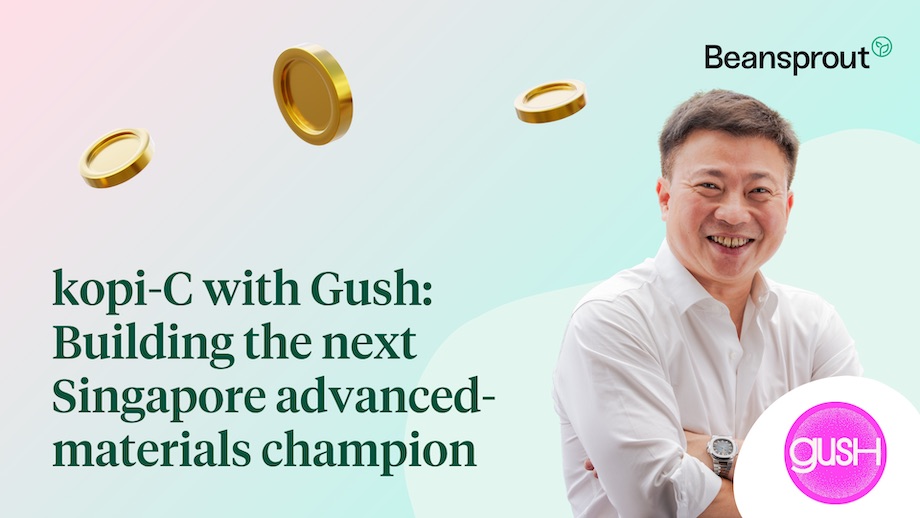
kopi-C with Gush: Building the next Singapore advanced-materials champion
Stocks
Powered by
By Julian Wong • 29 Jul 2026
Why trust Beansprout? We’ve been awarded Best Investment Website at the SIAS Investors’ Choice Awards 2025
'%3e%3cpath%20fill-rule='evenodd'%20clip-rule='evenodd'%20d='M17.64%209.20455C17.64%208.56637%2017.5827%207.95273%2017.4764%207.36364H9V10.845H13.8436C13.635%2011.97%2013.0009%2012.9232%2012.0477%2013.5614V15.8195H14.9564C16.6582%2014.2527%2017.64%2011.9455%2017.64%209.20455V9.20455Z'%20fill='%234285F4'/%3e%3cpath%20fill-rule='evenodd'%20clip-rule='evenodd'%20d='M9%2018C11.43%2018%2013.4673%2017.1941%2014.9564%2015.8195L12.0477%2013.5614C11.2418%2014.1014%2010.2109%2014.4205%209%2014.4205C6.65591%2014.4205%204.67182%2012.8373%203.96409%2010.71H0.957275V13.0418C2.43818%2015.9832%205.48182%2018%209%2018V18Z'%20fill='%2334A853'/%3e%3cpath%20fill-rule='evenodd'%20clip-rule='evenodd'%20d='M3.96409%2010.71C3.78409%2010.17%203.68182%209.59318%203.68182%209C3.68182%208.40682%203.78409%207.83%203.96409%207.29V4.95818H0.957273C0.347727%206.17318%200%207.54773%200%209C0%2010.4523%200.347727%2011.8268%200.957273%2013.0418L3.96409%2010.71V10.71Z'%20fill='%23FBBC05'/%3e%3cpath%20fill-rule='evenodd'%20clip-rule='evenodd'%20d='M9%203.57955C10.3214%203.57955%2011.5077%204.03364%2012.4405%204.92545L15.0218%202.34409C13.4632%200.891818%2011.4259%200%209%200C5.48182%200%202.43818%202.01682%200.957275%204.95818L3.96409%207.29C4.67182%205.16273%206.65591%203.57955%209%203.57955V3.57955Z'%20fill='%23EA4335'/%3e%3c/g%3e%3cdefs%3e%3cclipPath%20id='clip0_0_2849'%3e%3crect%20width='18'%20height='18'%20fill='white'/%3e%3c/clipPath%3e%3c/defs%3e%3c/svg%3e)
Make Beansprout your preferred source on Google
Add us on Google to see more of our insights in your search results
What started as an air-purifying interior paint conceived during the 2015 haze has evolved into a portfolio of functional building materials spanning interior walls, exterior façades and windows. The next challenge is no longer proving that the science works. It is turning that science into a scalable, profitable and potentially globally relevant enterprise.
A founder’s idea, born from the haze
Nine years after Gush began with an audacious question—"Can a wall actively improve the environment around it?”—the Singapore company is entering a different phase.
This transition is being led by two entrepreneurs from different generations and with complementary strengths: Lester Leong, Gush’s original founder and CEO, and Paul Lim, the investor-turned-co-founder who is now Executive Chairman. Leong built the technology and early market conviction. Lim brought the operating discipline, commercial network and capital-markets experience to help convert a promising start-up into a company designed for scale.
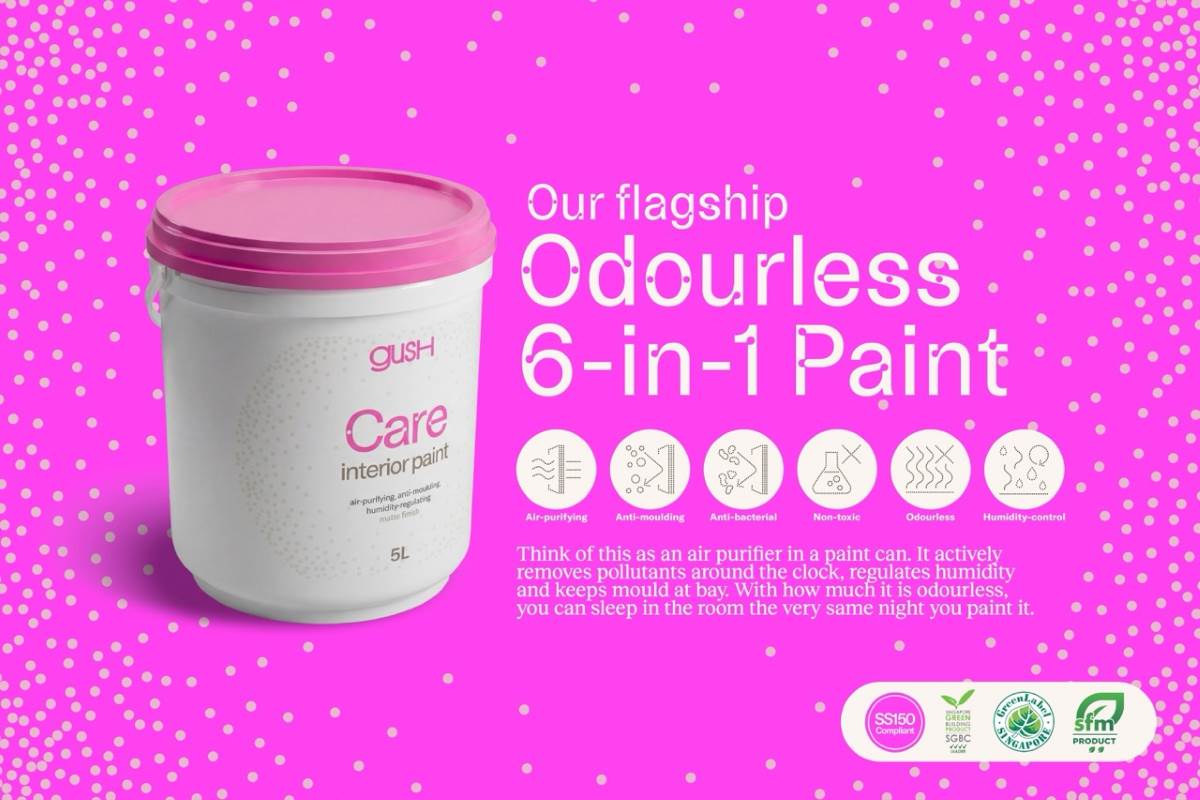
Gush’s origin goes back to Singapore’s severe haze episode in 2015. Leong and members of the founding team suffered from respiratory sensitivities and were frustrated by conventional air purifiers: bulky appliances that consumed electricity and required filters to be replaced. Their insight was simple but powerful. In any room, the walls and ceiling form the largest available surface. What if those surfaces could become passive air purifiers?
Working with professors and research partners, the team spent roughly two years developing an interior coating that was odourless, zero-VOC, formaldehyde-free and able to break down airborne pollutants. The technology eventually became Gush Care and CleanCare, supported by accredited testing and designed for tropical conditions, including humidity and mould.
“Lester and the original team saw something the established industry had largely overlooked,” Lim says. “Paint had been treated mainly as colour and protection. They saw the wall as infrastructure; a surface that could improve air quality, manage moisture and contribute to the health of the people inside.”
Why Paul Lim moved from investor to operator
Lim first invested in Gush in 2018. By then, he had already built and listed an integrated security solutions group on SGX Catalist, after expanding the business across multiple countries and operating subsidiaries. After leaving the listed company, he began investing in and mentoring younger businesses. Gush stood out because it had what many start-ups lacked: proprietary technology, a genuine customer problem and founders willing to listen.
“I did not join because the company needed another person with a title,” Lim says. “I joined because I believed the product deserved a much bigger commercial platform. The founders had created something special, but innovation alone does not build an enduring company. You need strategy, governance, distribution, working capital discipline and the ability to win large institutional customers.”
His involvement deepened over time, from investor and mentor to executive leader and, ultimately, co-founder and Executive Chairman. The division of labour is deliberate. Leong remains responsible for the company’s vision, innovation engine and day-to-day leadership. Lim focuses on strategy, enterprise growth, partnerships, governance and preparing the organisation for its next stage.
“Lester is the original founder, and that must always be recognised,” Lim says. “My role was to help turn the invention into an institution. The strongest companies are rarely built by one person. They are built when different capabilities come together at the right time.”
The hard lesson: enthusiasm is not the same as revenue
Gush’s early product attracted strong interest from homeowners, architects and property developers. Yet the company discovered a structural problem. A developer constructing a property for sale may appreciate a healthier premium coating, but does not necessarily capture the long-term benefit. The resident does, and the resident often enters the picture only after the material specification has been decided.
For several years, Gush concentrated on direct-to-consumer sales and avoided conventional retail distribution to protect margins. The consumer business built brand credibility and thousands of real-world installations, but customer acquisition was expensive and scaling across countries required more capital than the model could comfortably support.
“One of the most important disciplines in business is knowing when the original route to market is not enough,” Lim says. “The product was working. Customers loved the lack of smell and the healthier indoor environment. But a good product sold one home at a time was not going to create the scale we wanted.”
The enterprise pivot
The leadership team therefore made a decisive pivot toward enterprise and project customers: MCSTs, town councils, HDB upgrading and repainting programmes, hospitals, hospitality operators, transport infrastructure and commercial asset owners. That required Gush to move beyond a single flagship interior paint and develop a complete family of products that contractors and consultants could specify across an entire building.
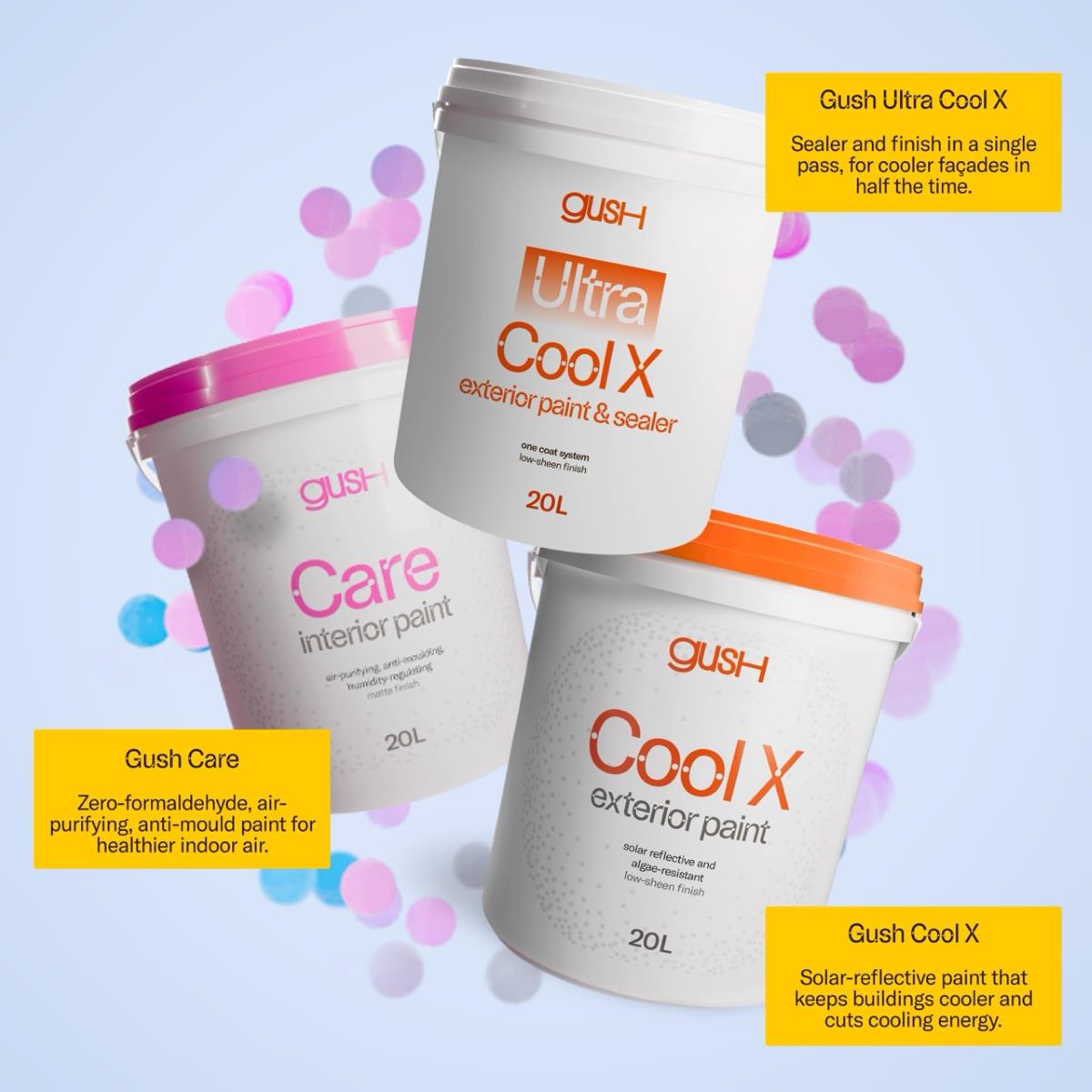
The portfolio now includes air-purifying and anti-mould interior coatings, solar-reflective exterior systems, sealers, water-based enamels and window films. Gush manufactures in China, Malaysia and Singapore. It sells through consumer channels and a trade network of contractor partners, while also tendering and bidding directly for large-scale projects. These may be supply-only contracts, or full supply-and-apply projects delivered together with accredited application partners.
“The pivot changed the economics of the company,” Lim says. “Instead of relying mainly on individual transactions, we could pursue recurring repaint cycles and large projects where our technology directly reduces labour, downtime, energy use and maintenance. Sustainability becomes far more compelling when it also saves money.”
From fixed labour to networked capacity
As part of the strategic review led by Lim in 2024, Gush sold its in-house painting operation, which had employed 55 painters, and moved to an application-partner model. Lim describes the manoeuvre as a shift from fixed labour to networked capacity, replacing ownership of a single painting crew with access to the industry’s wider execution base.
Instead of being constrained by the size and availability of one in-house team, Gush can now assemble application capacity according to each project’s location, scale, technical requirements and timetable. The model allows the company to undertake several supply-and-apply projects concurrently while retaining control over product specifications, technical support, quality assurance and customer accountability.
“We moved from owning a workforce to orchestrating an ecosystem,” Lim says. “With our own team, capacity stopped at 55 painters. With the partner model, we can tap a Singapore-wide pool that management estimates at more than 3,000 painters, deploy different teams across multiple sites and scale without carrying a large fixed labour base. We did not shrink our execution capability; we multiplied it.”
One coat instead of three
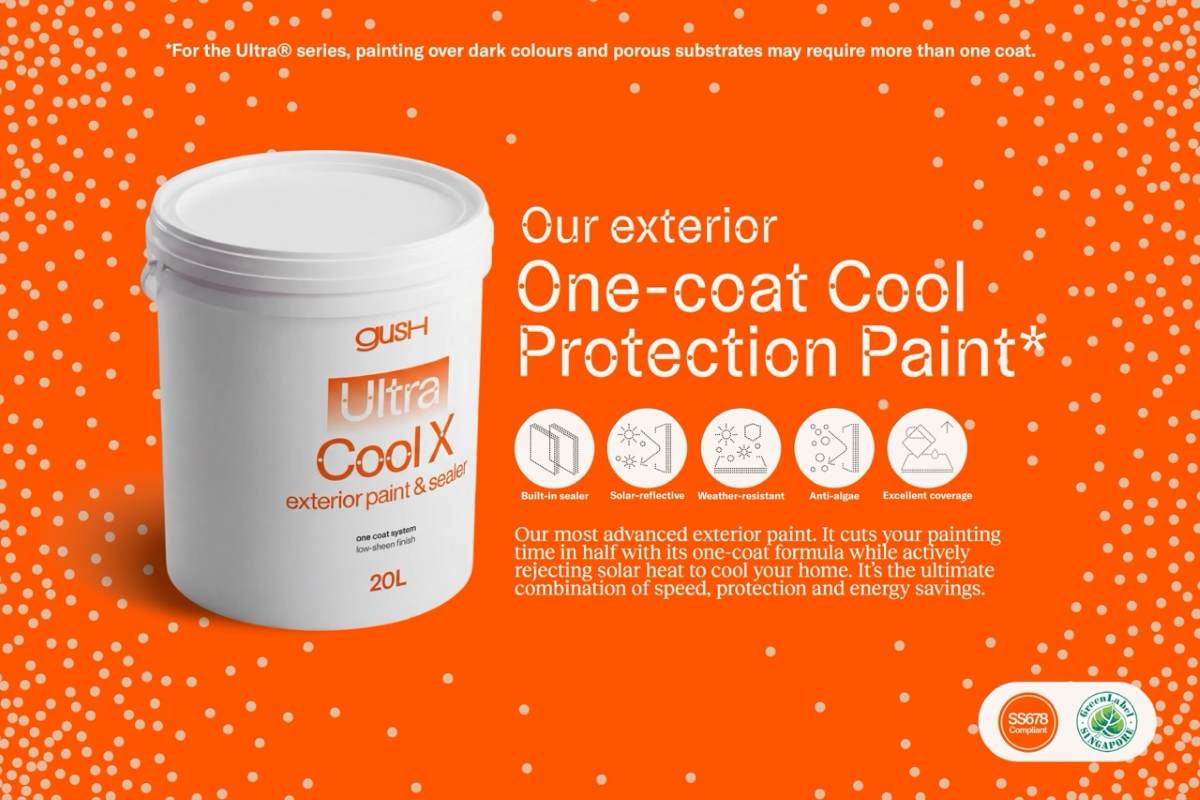
One of the company's recent pivotal invention is the Gush’s Ultra series. The company drew inspiration from one-coat cosmetic foundation systems and asked whether the same formulation principle could simplify conventional painting. Traditional wall systems commonly require a sealer followed by two finishing coats. Gush’s sealer-integrated approach is designed to consolidate those steps into a single application for suitable surfaces and project conditions.
The commercial impact is significant. Labour and access equipment account for a large share of project cost. On a condominium façade, a three-coat system can require workers or gondolas to traverse the building repeatedly. Reducing application cycles can shorten project duration, lower disruption to residents and improve contractor productivity. Gush estimates that, on appropriate projects, its full solution can reduce total tender cost by up to 30% and cut completion time roughly in half.
“This is where our proposition becomes much bigger than paint,” Lim says. “We are selling time, labour efficiency and lower disruption. For a building owner, those are highly tangible benefits. Green products do not have to carry a green premium. The best sustainable technology should help customers do more with less.”
Regulation is catching up with the company
Two policy shifts have strengthened Gush’s market position. First, Singapore has moved to prohibit formaldehyde in interior paints from 2026. Gush’s interior coatings have been formaldehyde-free since the beginning, meaning the company did not need to reformulate to meet the new baseline.
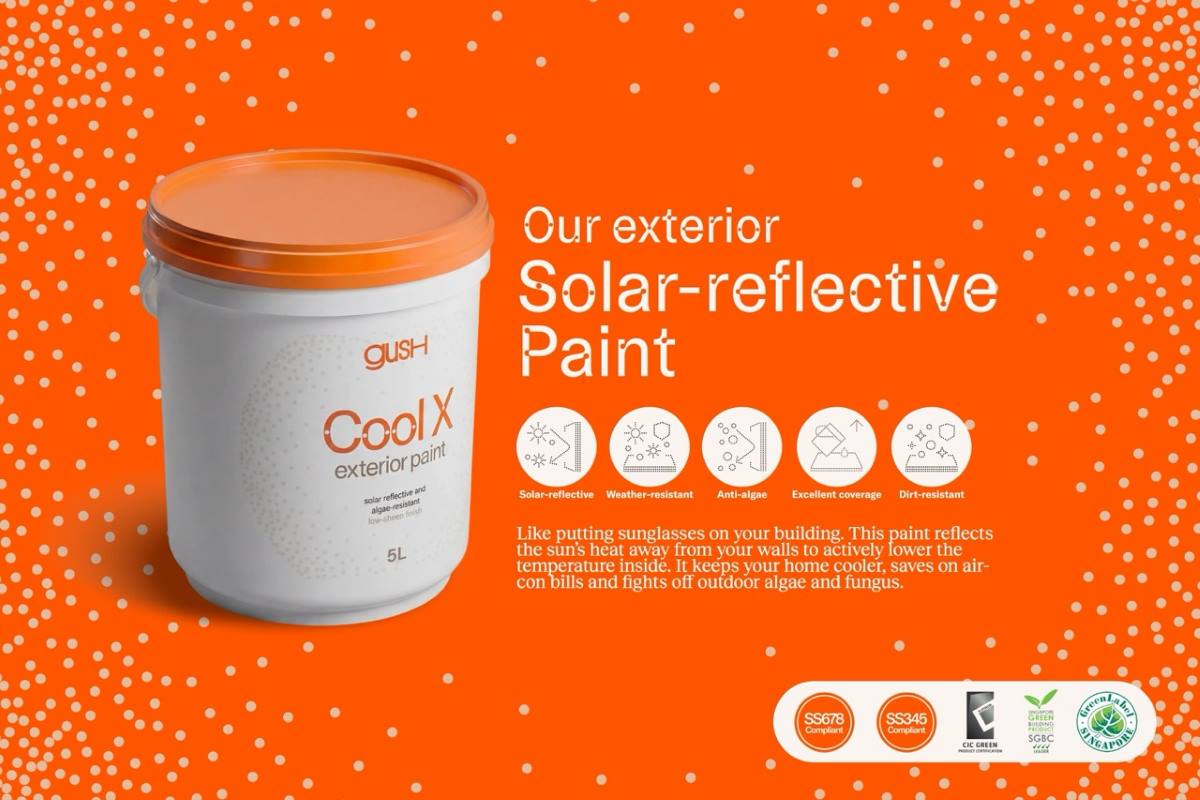
Second, heat-reflective coatings are gaining importance as Singapore addresses the urban heat island effect. Gush’s Cool X holds HDB materials-list approval and has demonstrated an 11.6% reduction in cooling energy consumption. Singapore also imposes recurring maintenance obligations on building owners: under the Building Maintenance and Strata Management regulations, painted external walls must generally be repainted at intervals of not more than five years, unless the Commissioner of Buildings permits a longer interval. This creates a durable demand base for approved products and contractors that can deliver better performance at lower total project cost.
“For years, we were educating the market about indoor air quality and heat mitigation,” Leong says. “Now regulation and procurement standards are moving in the same direction. That does not remove the need to compete, but it validates the problems we set out to solve.”
From proof of concept to institutional credibility
Gush says it has completed more than 8,000 residential and commercial projects across Singapore and selected overseas markets. Its references include healthcare, hospitality, residential estates and public-sector related projects. The company has also worked with strategic investor City Developments Limited, which provided both early validation and opportunities to deploy Gush products in operating properties.
Healthcare projects are an especially useful proof point. Conventional paint fumes can force facilities to close rooms or schedule works around operations. Gush’s odourless systems have allowed repainting to take place with substantially less disruption; a benefit that matters in hospitals, eldercare facilities, schools and hotels where downtime carries a real cost.
“Winning the first major reference is always the hardest,” Lim says. “An unknown brand is asking a consultant or building owner to depart from decades of habit. Once the product performs on a real site, the conversation changes. You are no longer selling a promise; you are presenting evidence.”
The chairman’s playbook: governance before glamour
Lim’s previous listing experience shapes how he is building Gush. He is candid that capital markets are not a substitute for a viable business. Before contemplating any major transaction, a company needs repeatable revenue, credible margins, strong controls and a management team that can operate without depending on one or two individuals.
“A listing should be the consequence of a strong company, not the cure for a weak one,” he says. “My priority is to make Gush investible in the broadest sense: clear strategy, disciplined reporting, a defensible product portfolio and a route to sustainable profitability. When those fundamentals are in place, the company has options.”
Those options could include organic growth, strategic partnerships, selective capital raising or, at the appropriate time, access to public markets. For now, Lim says the company is focused on execution and would consider additional capital only where it serves a clear strategic purpose and accelerates value creation.
A Singapore platform for regional growth
Gush’s international strategy is intentionally selective. Rather than recreate a costly direct-to-consumer operation in every country, it looks for markets where the pain points are obvious: tropical heat, humidity, mould, expensive labour and recurring repaint cycles. The United States, Hong Kong and Gulf Cooperation Council markets are among those being developed through partners, while Singapore remains the proving ground.
“The lesson from expanding my previous business into more than six countries within six years is that a Singapore team should not pretend it understands every overseas market better than the people who live and operate there,” Lim says. “Local partners understand the regulations, business culture, contracting ecosystem and demography far better than we do. Our role is to provide the product, technical knowledge, systems and brand platform, then scale with the right partner rather than impose a Singapore template.”
What success looks like
Independent industry research values Singapore’s architectural or decorative coatings supply market at about US$159 million in 2025, equivalent to roughly S$210 million to S$220 million. Management believes the broader addressable supply market could be higher when the full range of interior and exterior decorative systems, primers, sealers and professional channels is included. Because paint typically represents only a minority of the total cost of a professional painting project, the corresponding ‘supply and apply’ market is plausibly around S$1.0 billion to S$1.4 billion annually. Gush’s current share remains small, leaving considerable room for growth even before meaningful regional expansion.
The company’s ambition is not merely to become another paint brand. It wants to define a broader category of functional surfaces: materials that improve indoor air, reduce heat gain, resist mould, shorten construction time and lower the lifecycle cost of buildings. Paint is the entry point, not the boundary.
“The first chapter was about proving that walls could do more,” Leong says. “The next is about making that performance standard across many more buildings.”
Lim adds: “We have the technology, references and timing. Now the task is to scale with discipline. Our market share is still below 5% in the segments we are pursuing. That means the opportunity is not theoretical, but it is squarely in front of us.”
About Gush
Gush is a Singapore-based advanced building materials company developing cost-, maintenance- and energy-efficient solutions for interior walls, exterior façades and windows. Its portfolio includes air-purifying and anti-mould interior coatings, solar-reflective exterior systems, sealers, enamels and window films, as well as a proprietary 3-in-1 single-coat painting system that combines the functions of sealer, primer and finish coat in one application for suitable surfaces. The company’s mission is to turn passive surfaces into functional infrastructure that contributes to healthier, more efficient and more sustainable building.
About kopi-C: the Company brew
kopi-C is a regular column by SGX Research in collaboration with Beansprout, Singapore’s trusted investment intelligence platform which helps everyday investors build the knowledge and confidence to make decisions that matter. kopi-C features C-level executives of leading companies. These interviews are profiles of senior management aimed at helping investors better understand the individuals who run these corporations.
Read also
Gain financial insights in minutes
Subscribe to our free weekly newsletter for more insights to grow your wealth
Most Popular

Comments
0 comments