
Singapore Next 50 Indices - Explore opportunities beyond blue chips
Stocks
By Gerald Wong, CFA • 13 Aug 2026
Why trust Beansprout? We’ve been awarded Best Investment Website at the SIAS Investors’ Choice Awards 2025
'%3e%3cpath%20fill-rule='evenodd'%20clip-rule='evenodd'%20d='M17.64%209.20455C17.64%208.56637%2017.5827%207.95273%2017.4764%207.36364H9V10.845H13.8436C13.635%2011.97%2013.0009%2012.9232%2012.0477%2013.5614V15.8195H14.9564C16.6582%2014.2527%2017.64%2011.9455%2017.64%209.20455V9.20455Z'%20fill='%234285F4'/%3e%3cpath%20fill-rule='evenodd'%20clip-rule='evenodd'%20d='M9%2018C11.43%2018%2013.4673%2017.1941%2014.9564%2015.8195L12.0477%2013.5614C11.2418%2014.1014%2010.2109%2014.4205%209%2014.4205C6.65591%2014.4205%204.67182%2012.8373%203.96409%2010.71H0.957275V13.0418C2.43818%2015.9832%205.48182%2018%209%2018V18Z'%20fill='%2334A853'/%3e%3cpath%20fill-rule='evenodd'%20clip-rule='evenodd'%20d='M3.96409%2010.71C3.78409%2010.17%203.68182%209.59318%203.68182%209C3.68182%208.40682%203.78409%207.83%203.96409%207.29V4.95818H0.957273C0.347727%206.17318%200%207.54773%200%209C0%2010.4523%200.347727%2011.8268%200.957273%2013.0418L3.96409%2010.71V10.71Z'%20fill='%23FBBC05'/%3e%3cpath%20fill-rule='evenodd'%20clip-rule='evenodd'%20d='M9%203.57955C10.3214%203.57955%2011.5077%204.03364%2012.4405%204.92545L15.0218%202.34409C13.4632%200.891818%2011.4259%200%209%200C5.48182%200%202.43818%202.01682%200.957275%204.95818L3.96409%207.29C4.67182%205.16273%206.65591%203.57955%209%203.57955V3.57955Z'%20fill='%23EA4335'/%3e%3c/g%3e%3cdefs%3e%3cclipPath%20id='clip0_0_2849'%3e%3crect%20width='18'%20height='18'%20fill='white'/%3e%3c/clipPath%3e%3c/defs%3e%3c/svg%3e)
Make Beansprout your preferred source on Google
Add us on Google to see more of our insights in your search results
The iEdge Singapore Next 50 Indices track the next tier of large and liquid mainboard companies beyond the 30 constituents of the Straits Times Index (STI).

What happened?
The Straits Times Index (STI) has pulled back from its record high.
Investor attention has also extended beyond the 30 companies in the STI, amid efforts to broaden participation in Singapore's equity market.
One such development was the launch of the iEdge Singapore Next 50 Index in September 2025, which tracks the next 50 large and liquid companies listed on the SGX Mainboard outside the 30 largest companies.
This comes alongside other initiatives to deepen Singapore's equities market, including the Equity Market Development Programme (EQDP), which has since been expanded from S$5 billion to S$6.5 billion.
Investors now have another way to access this segment following the listing of the CGS Fullgoal Singapore Next 50 Active ETF (SGX: Q50) on 3 September 2026, although the actively managed fund does not simply replicate the index.
In this article, I look at what the iEdge Singapore Next 50 Index is, its latest constituents and rebalancing, and the different ways investors can gain exposure to this segment of the Singapore market.
What are the iEdge Singapore Next 50 indices?
The iEdge Singapore Next 50 indices were created to give investors a clearer view of opportunities beyond Singapore’s 30 largest listed companies, which make up the Straits Times Index (STI).
They track the performance of the next tier of large and liquid companies on the SGX Mainboard, essentially the “next in line” after the blue chips. There are two versions of the index:
- iEdge Singapore Next 50 Index
- iEdge Singapore Next 50 Liquidity Weighted Index
Both indices contain the same 50 companies, but their individual stock weightings differ.
The standard iEdge Singapore Next 50 Index gives a higher weighting to companies with a larger free-float market capitalisation, while the Liquidity Weighted Index gives a higher weighting to stocks that are more actively traded.
Both aim to highlight this broader market segment and provide visibility into companies that might one day grow into the STI.
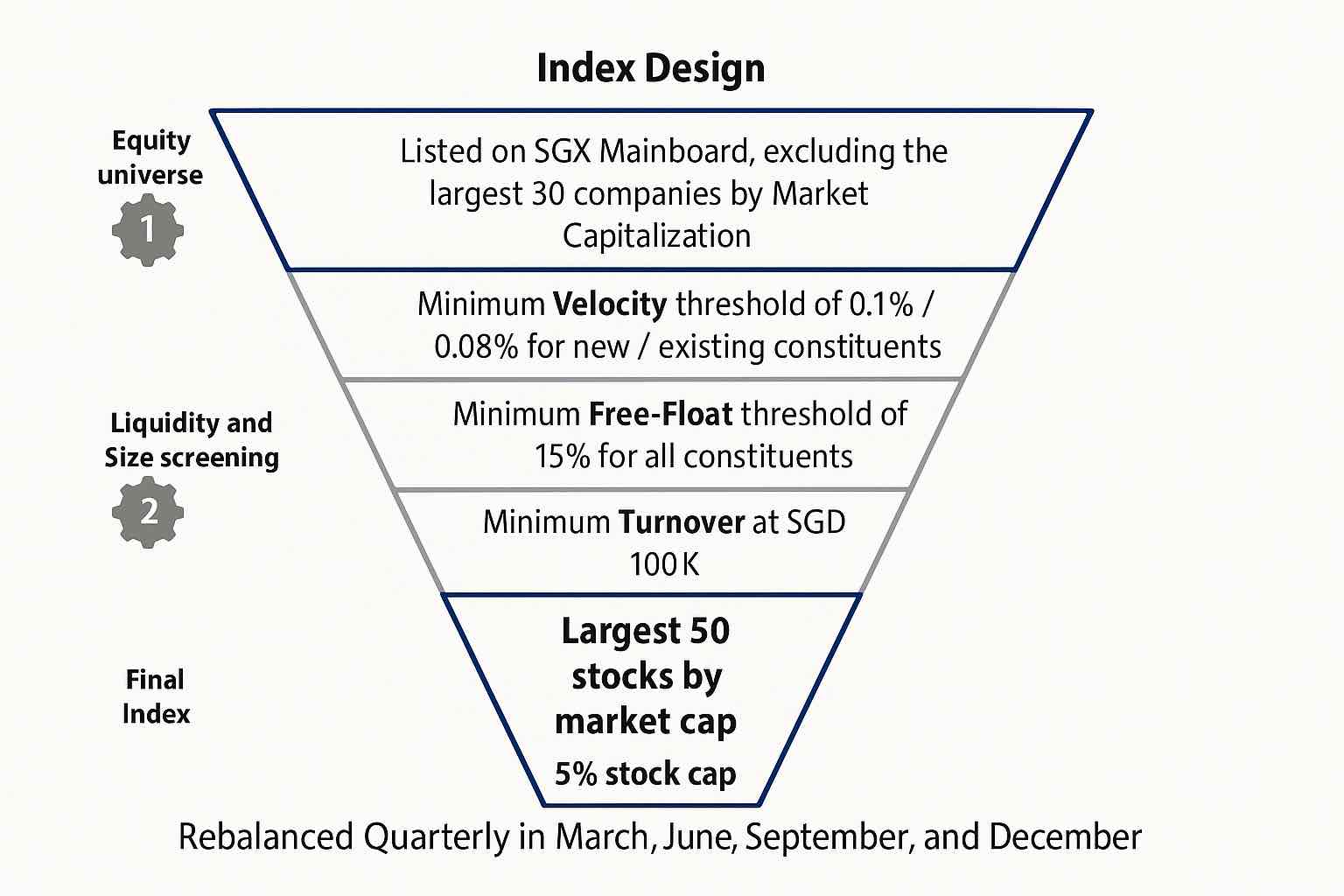
To be included, companies must meet several requirements:
- Listed on the SGX Mainboard (excluding the largest 30 companies by market cap)
- Minimum market capitalisation of SGD 100 million
- Minimum trading turnover of SGD 100,000
- At least 15% free float
- Meet minimum trading velocity thresholds
From this screened universe, the largest 50 stocks by market cap are selected, with each stock capped at 5% of the respective index at each rebalance.
The indices are reviewed quarterly in March, June, September and December.
What changed in the latest iEdge Singapore Next 50 rebalancing?
The September 2026 quarterly review resulted in one addition and one removal from both the iEdge Singapore Next 50 Index and the iEdge Singapore Next 50 Liquidity Weighted Index.
The changes took effect when trading began on 28 September 2026.
| Addition/Inclusions | Removal/Exclusions |
| SBS Transit Ltd | GuocoLand Ltd |
The next rebalancing of the iEdge Singapore Next 50 indices is scheduled for December 2026.
Which stocks are in the iEdge Singapore Next 50 indices?
There are 50 stocks in the iEdge Singapore Next 50 indices.
Each constituent is subject to a 5% weighting cap at rebalancing.
However, due to strong price performance between rebalancing periods, several top holdings may drift above this threshold.
As of 30 September 2026, the stocks with the largest weightings in the iEdge Singapore Next 50 Index are AEM Holdings at 5.09%, NetLink NBN Trust at 4.99%, Keppel REIT at 4.98%, ComfortDelGro at 4.95%, Suntec REIT at 4.67%, and Keppel Infrastructure Trust at 4.66%
Driven by market movement since the last rebalance, the stocks with the largest weighting on the iEdge Singapore Next 50 Liquidity Weighted index Frencken Group at 5.69%, followed by AEM Holdings at 5.62%, CSE Global at 5.29%, and UMS Integration at 5.17%. Other leading constituents include ComfortDelGro at 4.96% and Keppel REIT at 4.93%, both close to the 5% rebalancing cap.
| Company | Sector | iEdge Singapore Next 50 Index weight | Liquidity Weighted Index weight |
|---|---|---|---|
| AEM Holdings | Electronic Components and Manufacturing | 5.09% | 5.62% |
| NetLink NBN Trust | Telecommunications | 4.99% | 2.58% |
| Keppel REIT | Real Estate | 4.98% | 4.93% |
| ComfortDelGro | Industrial Services | 4.95% | 4.96% |
| Suntec REIT | Real Estate | 4.67% | 4.63% |
| Keppel Infrastructure Trust | Chemical, Plastic and Rubber Materials | 4.66% | 1.88% |
| Sheng Siong | Food and Staples Retail | 4.14% | 4.42% |
| CapitaLand Ascott Trust | Real Estate | 4.05% | 2.45% |
| Golden Agri-Resources | Food and Tobacco Production | 3.85% | 2.28% |
| iFAST | Specialty Finance and Services | 3.40% | 4.42% |
| Parkway Life REIT | Real Estate | 3.20% | 1.72% |
| UMS Integration | Electronic Components and Manufacturing | 3.19% | 5.17% |
| Haw Par | Biopharmaceuticals | 3.19% | 1.89% |
| First Resources | Chemical, Plastic and Rubber Materials | 2.68% | 4.00% |
| Lendlease Global Commercial REIT | Real Estate | 2.60% | 3.44% |
| Olam Group | Food and Tobacco Production | 2.44% | 2.99% |
| ESR-REIT | Real Estate | 2.27% | 0.88% |
| Top Glove Corporation | Healthcare Equipment | 2.17% | 0.57% |
| UOB-Kay Hian Holdings | Investment Services | 1.80% | 1.30% |
| CapitaLand India Trust | Real Estate | 1.79% | 1.91% |
| Centurion Accommodation REIT | Real Estate | 1.78% | 2.04% |
| NTT DC REIT | Real Estate | 1.69% | 1.00% |
| PC Partner Group | Hardware | 1.49% | 3.25% |
| UI Boustead REIT | Real Estate | 1.49% | 2.24% |
| Frencken Group | Electronic Components and Manufacturing | 1.47% | 5.69% |
| AIMS APAC REIT | Real Estate | 1.45% | 1.13% |
| SIA Engineering | Industrial Services | 1.43% | 1.25% |
| Starhill Global REIT | Real Estate | 1.34% | 0.35% |
| CapitaLand China Trust | Real Estate | 1.33% | 0.50% |
| Yangzijiang Maritime Development | Specialty Finance and Services | 1.32% | 1.60% |
| CSE Global | Industrial Services | 1.19% | 5.29% |
| StarHub | Telecommunications | 1.17% | 0.52% |
| CDL Hospitality Trusts | Real Estate | 1.13% | 0.45% |
| Raffles Medical Group | Healthcare Services | 1.08% | 0.76% |
| Hong Leong Asia | Industrial Manufacturing | 1.04% | 2.30% |
| Centurion Corporation | Real Estate | 1.03% | 0.47% |
| Far East Hospitality Trust | Real Estate | 0.96% | 0.22% |
| Boustead Singapore | Industrial Services | 0.85% | 0.61% |
| Food Empire Holdings | Food and Tobacco Production | 0.81% | 1.53% |
| Pan-United Corporation | Mining and Mineral Products | 0.75% | 0.32% |
| Riverstone Holdings | Consumer Goods | 0.73% | 0.95% |
| Yangzijiang Financial Holding | Investment Services | 0.66% | 0.83% |
| Sasseur REIT | Real Estate | 0.63% | 0.33% |
| China Aviation Oil | Industrial Services | 0.59% | 1.02% |
| SBS Transit | Industrial Services | 0.54% | 0.26% |
| Yanlord Land Group | Real Estate | 0.52% | 0.86% |
| PropNex | Real Estate | 0.50% | 0.71% |
| UltraGreen.ai | Healthcare Equipment | 0.34% | 1.23% |
| BRC Asia | Mining and Mineral Products | 0.33% | 0.13% |
| ValueMax Group | Specialty Finance and Services | 0.26% | 0.11% |
| Source: SGX as of 30 September 2026 | |||
Which sectors have a more significant weighting in the iEdge Singapore Next 50 indices?
Real estate makes up a significant portion of both iEdge Singapore Next 50 indices.
As of 30 September 2026, Real Estate accounts for 37.40% of the iEdge Singapore Next 50 Index, making it by far the largest sector exposure.
This is followed by Electronic Components and Manufacturing at 9.76%, Industrial Services at 9.55%, and Chemical, Plastic and Rubber Materials at 7.33%.
The sector mix is somewhat different for the iEdge Singapore Next 50 Liquidity Weighted Index.
Real Estate remains the largest sector at 30.26%, but Electronic Components and Manufacturing has a higher weighting of 16.48%, while Industrial Services makes up 13.40%.
This reflects the different ways the two indices are constructed. The iEdge Singapore Next 50 Index is weighted by free-float market capitalisation, while the Liquidity Weighted Index is weighted based on trading turnover.
How has the iEdge Singapore Next 50 Index performed?
As of 30 September 2026, the iEdge Singapore Next 50 indices have lagged the Straits Times Index (STI) over both the short and longer periods shown below.
On a total return basis, the iEdge Singapore Next 50 Index returned 1.77% year-to-date, while the iEdge Singapore Next 50 Liquidity Weighted Index returned 6.36%, compared with 26.53% for the STI.
Between 2021 and 2025, the STI outperformed both iEdge Singapore Next 50 indices in 3 out of 5 years.
That said, there have been periods when the Next 50 indices performed better, most notably in 2019, when the standard index gained 24.1% and the Liquidity Weighted Index gained 27.7%, compared with 9.4% for the STI.
In 2025, the iEdge Singapore Next 50 Index gained 27.0%, and the Liquidity Weighted Index rose 27.4%, both slightly below the STI’s 28.6% gain.
| Year / period | iEdge Singapore Next 50 Index (i) | iEdge Singapore Next 50 Liquidity Weighted Index (ii) | Straits Times Index (iii) | Outperformance vs STI (i)−(iii), pp | Outperformance vs STI (ii)−(iii), pp |
|---|---|---|---|---|---|
| 2015 | -8.5% | -11.1% | -11.2% | 2.7 | 0.1 |
| 2016 | 0.5% | -10.2% | 3.8% | -3.3 | -14.0 |
| 2017 | 21.6% | 17.6% | 22.1% | -0.5 | -4.5 |
| 2018 | -13.3% | -17.1% | -6.4% | -6.9 | -10.7 |
| 2019 | 24.1% | 27.7% | 9.4% | 14.7 | 18.3 |
| 2020 | -5.0% | -1.6% | -8.1% | 3.1 | 6.5 |
| 2021 | 16.7% | 19.0% | 13.6% | 3.1 | 5.4 |
| 2022 | -11.2% | -13.8% | 8.4% | -19.6 | -22.2 |
| 2023 | 4.6% | 5.3% | 4.8% | -0.2 | 0.5 |
| 2024 | -0.9% | -6.2% | 23.5% | -24.4 | -29.7 |
| 2025 | 27.0% | 27.4% | 28.6% | -1.6 | -1.2 |
| 6 months | 2.34% | 5.51% | 19.84% | -17.50 | -14.33 |
| YTD | 1.77% | 6.36% | 26.53% | -24.76 | -20.17 |
| 1 year | 4.90% | 9.43% | 37.52% | -32.62 | -28.09 |
| 3 years, annualised | 10.49% | 10.12% | 26.76% | -16.27 | -16.64 |
| 5 years, annualised | 3.93% | 3.23% | 18.35% | -14.42 | -15.12 |
Sources: SGX; State Street Investment Management, FTSE. Latest period returns are as of 30 September 2026. Calendar-year returns cover the respective full years. All figures are total returns. Outperformance is calculated from the displayed returns and expressed in percentage points (pp); negative figures indicate underperformance. The Next 50 indices launched in September 2025. Performance before launch reflects historical index calculations rather than a live investment track record. Past performance is not indicative of future returns. | |||||
What is the objective of the iEdge Singapore Next 50 indices?
The iEdge Singapore Next 50 indices were created to broaden the investment universe in Singapore by tracking 50 of the most liquid and sizable companies beyond the Straits Times Index (STI).
Their key objectives are:
- Enhancing market engagement – Provide new benchmarks for investors and fund managers, helping to draw more attention and liquidity to the wider market.
- Spotlighting mid-cap companies – Increase visibility for quality but often overlooked names, which can in turn attract greater institutional and retail interest.
- Broadening investment options – Pave the way for ETFs or funds that make it easier and more cost-effective to gain diversified exposure beyond the STI.
- Revitalising capital markets – Support SGX’s efforts, alongside initiatives like the S$5 billion EQDP, to boost vibrancy and diversify investor interest.
Can you buy the iEdge Singapore Next 50 indices?
At this point, getting exposure to the iEdge Singapore Next 50 indices is not entirely straightforward, as investors cannot invest directly in the indices themselves.
There is currently no passive Singapore ETF or passively managed mutual fund that tracks the index.
Investors who want to closely replicate the index would therefore generally need to buy its individual constituents and adjust their holdings as index weights change. This can be time-consuming and costly for retail investors.
However, investors can now gain exposure to this market segment through the CGS Fullgoal Singapore Next 50 Active ETF (SGX: Q50), which listed on the SGX Mainboard on 3 September 2026.
However, it is important to note that Q50 is an actively managed ETF, rather than a passive ETF that simply replicates the index.
Under normal market conditions, at least 80% of its portfolio will be invested in constituents of the iEdge Singapore Next 50 Index, while up to 20% can be invested in companies from the broader SGX-listed investable universe.
The fund is expected to hold around 30 to 50 stocks and rebalance its portfolio monthly using a multi-factor investment approach.
Its current management fee is 0.65% per annum, while the manager intends to cap the fund's total expense ratio at 1.50% per annum.
For investors, this provides a more convenient way to gain diversified exposure to companies within the Singapore Next 50 universe through a single investment.
However, because Q50 is actively managed, its holdings and returns can differ from those of the iEdge Singapore Next 50 Index.
What would Beansprout do?
The iEdge Singapore Next 50 Index gives me another way to look beyond the largest Singapore blue-chip stocks.
By expanding the investable universe to 50 mid-cap names, the new indices bring attention to companies that may have been overlooked.
However, these stocks tend to be smaller and less liquid than STI constituents, which means higher volatility and liquidity risks.
With the launch of the CGS Fullgoal Singapore Next 50 Active ETF, it is now easier to gain diversified exposure to this segment without buying dozens of individual stocks.
At the same time, I would keep in mind that Q50 is actively managed and does not simply replicate the index, so its returns will also depend on the manager's stock selection and the fees charged.
If you are keen to gain exposure to the index, it is also important to first understand how the iEdge Singapore Next 50 Index differ from the Straits Times Index (STI), and whether they suit your investment objectives and risk appetite.
I would still consider my investment objective, portfolio exposure and risk tolerance before deciding whether to invest through an ETF or research selected Next 50 stocks individually.
To find out which Singapore stocks we would hold, in our model portfolio, check out how we would invest $100,000 in Singapore today.
Overall, we see that Singapore stocks are still worth looking at in 2026. You can find out more about the 4 growth themes we are watching in Singapore stocks here.
If you are looking to gain broad Singapore equity exposure, you can do so through an STI ETF or Singapore mutual fund.
If you are looking for greater clarity on the markets and the investment decisions that matter, explore Beansprout Pro for our latest views, portfolio thinking and the reasoning behind each opportunity.
Learn more about Beansprout's four pots of wealth framework to grow your wealth with clarity here.
If you have a question about the Singapore Next 50 Indices, leave us a comment below or ask away in the Beansprout telegram group.
Check out Beansprout guide to the best stock trading platforms in Singapore with the latest promotions to invest in the Singapore market.
Enjoyed this insight? Follow Beansprout on Telegram, Youtube, Facebook and Instagram, and add Beansprout as your preferred source on Google so you never miss an update.
Read also
Gain financial insights in minutes
Subscribe to our free weekly newsletter for more insights to grow your wealth
Most Popular

Comments
0 comments