
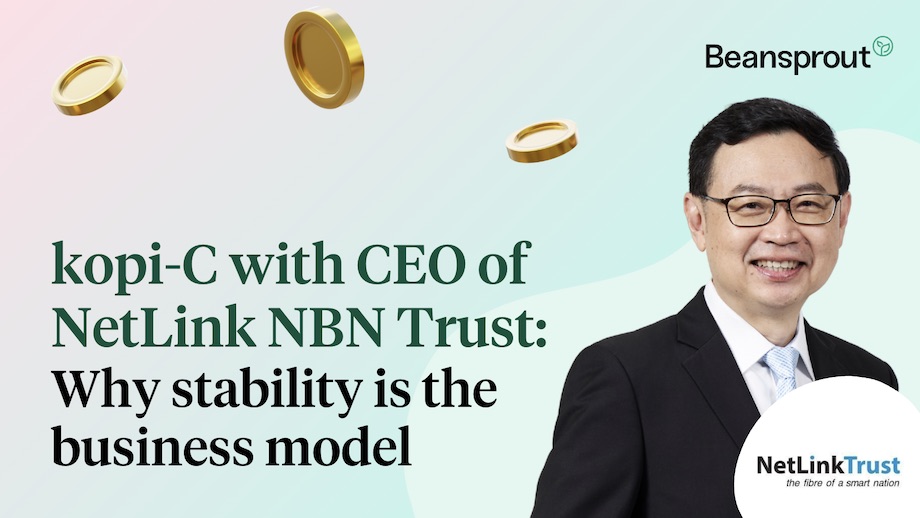
kopi-C with CEO of NetLink NBN Trust: Why stability is the business model
Stocks
Powered by
By Julian Wong • 26 Aug 2026
Why trust Beansprout? We’ve been awarded Best Investment Website at the SIAS Investors’ Choice Awards 2025
'%3e%3cpath%20fill-rule='evenodd'%20clip-rule='evenodd'%20d='M17.64%209.20455C17.64%208.56637%2017.5827%207.95273%2017.4764%207.36364H9V10.845H13.8436C13.635%2011.97%2013.0009%2012.9232%2012.0477%2013.5614V15.8195H14.9564C16.6582%2014.2527%2017.64%2011.9455%2017.64%209.20455V9.20455Z'%20fill='%234285F4'/%3e%3cpath%20fill-rule='evenodd'%20clip-rule='evenodd'%20d='M9%2018C11.43%2018%2013.4673%2017.1941%2014.9564%2015.8195L12.0477%2013.5614C11.2418%2014.1014%2010.2109%2014.4205%209%2014.4205C6.65591%2014.4205%204.67182%2012.8373%203.96409%2010.71H0.957275V13.0418C2.43818%2015.9832%205.48182%2018%209%2018V18Z'%20fill='%2334A853'/%3e%3cpath%20fill-rule='evenodd'%20clip-rule='evenodd'%20d='M3.96409%2010.71C3.78409%2010.17%203.68182%209.59318%203.68182%209C3.68182%208.40682%203.78409%207.83%203.96409%207.29V4.95818H0.957273C0.347727%206.17318%200%207.54773%200%209C0%2010.4523%200.347727%2011.8268%200.957273%2013.0418L3.96409%2010.71V10.71Z'%20fill='%23FBBC05'/%3e%3cpath%20fill-rule='evenodd'%20clip-rule='evenodd'%20d='M9%203.57955C10.3214%203.57955%2011.5077%204.03364%2012.4405%204.92545L15.0218%202.34409C13.4632%200.891818%2011.4259%200%209%200C5.48182%200%202.43818%202.01682%200.957275%204.95818L3.96409%207.29C4.67182%205.16273%206.65591%203.57955%209%203.57955V3.57955Z'%20fill='%23EA4335'/%3e%3c/g%3e%3cdefs%3e%3cclipPath%20id='clip0_0_2849'%3e%3crect%20width='18'%20height='18'%20fill='white'/%3e%3c/clipPath%3e%3c/defs%3e%3c/svg%3e)
Make Beansprout your preferred source on Google
Add us on Google to see more of our insights in your search results
NetLink NBN Trust owns and operates the fibre network that provides nationwide coverage to homes and businesses across Singapore, generating recurring wholesale revenue from fibre services provided to telcos. CEO Tong Yew Heng explains why the trust does not position itself as a "data centre play," how a five-yearly regulatory review sets its returns, and why operating cash flow—not net profit—is the number that matters for distributions.
Most Singaporeans have never had a reason to think about who owns the infrastructure that makes our Zoom calls, food delivery orders, or social media content consumption possible. It shows up as a single line item on a broadband bill, disappearing into the general category of "internet."
Yet somewhere behind every retailer's technician and every router blinking to life for the first time, one company has already done the invisible work.
That company is NetLink NBN Trust (NetLink).
Its CEO, Tong Yew Heng, sums up what it actually does in plain terms: "NetLink is the owner and operator of the nationwide fibre network in Singapore. This fibre network is connected to homes and businesses across the island in Singapore. What we don't do is offer an internet package to the end user."
Crucially, it does not sell broadband packages to end users. Instead, it provides wholesale fibre services to the telcos, who in turn sell data packages to the consumer.
Who actually pays, and how much
This distinction matters for understanding NetLink's revenue.
Tong explains that end users effectively pay for the service, but not directly to NetLink. Instead, telcos pay NetLink for every connection they activate.
"Today, they will pay us $13.50 a month for every fibre connection that they activate,” he says.
“That's how we get our residential revenue ... for other services, they will pay a different rate, because, for example, non-residential is $55 per month."
Residential connections alone make up about 60% of total revenue, a share that has stayed relatively stable, and which Tong attributes to the fact that once a household is connected to broadband, it rarely gives up the connection.
"Once an end user gets connected to a broadband, hardly anyone will give it up, even if they move house to a new home, they will reconnect with a new connection," he points out.
Since Singapore's fibre penetration is already high, Tong is candid about this ceiling for NetLink.
Residential connections growth from here will be incremental rather than a step change, driven mainly by the roughly 25,000 new homes built in Singapore each year.
The non-residential segment remains competitive, since businesses can switch operators or consolidate connections, and other telcos can lay their own fibre to office buildings.
Tong notes this segment has seen some quarter-to-quarter softness but frames it in proportion: non-residential connections contribute only about 8% of total revenue, versus 60% from residential, and would only be a real concern if the decline turned structural over multiple years.
Not a "data centre play"
Given how much investor attention data centres and AI infrastructure attract, it's worth noting how Tong positions NetLink relative to the theme.
His answer is intentional and modest. He says, "I would say NetLink is not a data centre play," but notes that rising data centre and AI-related activity is still significant, since it drives more demand for fibre connections between data centres, enterprises, and cloud servers.
This extends to satellite broadband as well.
Asked whether services like Starlink pose a long-term threat, Tong argues Singapore's geography works against that thesis: "It's very different in Singapore where we don't need that because everyone has access to high-quality fibre connectivity, and at a very high speed."
In addition, he highlights that satellite speed is lower, latency is higher, and the cost is greater than fibre broadband in Singapore.
The regulatory framework that sets the return
The single mechanism most central to how NetLink makes money is what Tong calls the regulated asset base (RAB) framework, reviewed once every five years by the regulator (the Infocomm Media Development Authority, in this case).
The framework lets NetLink recover both the capital expenditure (capex) and operational expenditure (opex) it invests in the network, plus a return on that capex, providing stability for investment and cash flow over the long life of the fibre assets.
The most recent review was completed in 2024, resulting in a 7% pre-tax weighted average cost of capital (WACC)—essentially, the rate of return the regulator allows NetLink to earn on the money it has invested in the network.
Regulators typically set a lower allowed return for lower-risk businesses, since less compensation is needed to justify the investment. Tong sees the number in that light: "It is pretty good for the current environment and for a business of NetLink’s risk profile, since we generally have a lower risk profile."
The next review is expected to be completed in 2029, and Tong says that the trust treats the process as an ongoing conversation with the regulator rather than something to prepare for only when it arrives.
Watch our podcast episode with NetLink Trust CEO Tong Yew Heng here
Reading the distribution: what the numbers actually mean
For income-focused investors, the most important thing to understand is that NetLink's distribution is not paid out of net profit. It's paid out of cash available for distribution.
Last financial year, NetLink brought in $259 million in operating cash flow, (the actual cash generated by running the business). Of that, it paid out $210 million to unitholders and kept the remaining $49 million or so to help fund new construction (capex), topped up where needed with borrowing.
Net profit, by contrast, was only around $80 million. It’s a much smaller number, and one that might understandably worry investors comparing it to $210 million in distributions.
But the gap is explained by a single, non-cash accounting item: depreciation.
NetLink's accounts recognise about $185 million a year in depreciation and amortisation, which spreads the cost of building the fibre network over its decades-long useful life. It's a real accounting charge, but no cash actually leaves the business when it's recorded.
As Tong puts it: "We have a lot of cash right after taking out all the costs, so it's important not to focus on the smaller number, but to focus on the operating cash flows."
In other words: if you only look at net profit, NetLink's payout looks like it exceeds what the company earns. If you look at operating cash flow instead—the money that actually moves through the business—the distribution is comfortably covered, with room left over to invest in the network.
The risks and the reality
Asked what could most affect the trust's ability to sustain distributions, Tong doesn't hesitate.
"The most significant risk for NetLink, actually, is regulatory risk," he says, since the rate of return set at each five-yearly review determines how much cash flow the trust generates.
He points to the trust's track record—both the 2016 and 2024 reviews landed within expectations—as evidence that ongoing engagement with the regulator has managed that risk so far, while stopping short of guaranteeing future outcomes.
One structural feature Tong flags as easy to overlook: NetLink is a business trust with an internalised trustee-manager. "There is no external owner of the trustee manager. There are no performance fees to be paid to someone else or management fee to be paid to someone else. So, there's total alignment of the trustee manager and the unitholders, and you save a ton of money."
Asked to sum up what investors should know before putting money into NetLink, Tong returns to a single idea: "It's very important to understand that NetLink is the owner and operator of the fibre network, and that this fibre network is of high quality. It has a very long, useful life, and therefore will continue to generate cash flow over a long period of time."
About NetLink NBN Trust
The NetLink Group’s nationwide network is the foundation of Singapore’s Nationwide Broadband Network (NBN), over which ultra-high-speed internet access is delivered throughout mainland Singapore and its connected islands.
The NetLink Group designs, builds, owns, and operates the passive fibre network infrastructure (comprising ducts, manholes, fibre cables and Central Offices) of Singapore’s NBN. The NetLink Group’s extensive network provides nationwide coverage to residential homes and non-residential premises in mainland Singapore and its connected islands.
NetLink NBN Trust was listed on the Main Board of the Singapore Exchange Securities Trading Limited (SGX-ST) on 19 July 2017. It is a constituent of several key indices, including the FTSE ST Large & Mid Cap Index, FTSE ST Singapore Shariah Index, iEdge Singapore Next 50 Index, and the iEdge Singapore Next 50 Liquidity Weighted Index.
About kopi-C: the Company brew
kopi-C is a regular column by SGX Research in collaboration with Beansprout, Singapore’s trusted investment intelligence platform which helps everyday investors build the knowledge and confidence to make decisions that matter. kopi-C features C-level executives of leading companies listed on SGX. These interviews are profiles of senior management aimed at helping investors better understand the individuals who run these corporations.
Read also
Gain financial insights in minutes
Subscribe to our free weekly newsletter for more insights to grow your wealth
Most Popular

Comments
0 comments