
SpaceX US SDR 100to1: The Infrastructure of the Future
Stocks, Singapore Depository Receipts
Powered by
By Ng Hui Min • 21 Jul 2026
Why trust Beansprout? We’ve been awarded Best Investment Website at the SIAS Investors’ Choice Awards 2025
'%3e%3cpath%20fill-rule='evenodd'%20clip-rule='evenodd'%20d='M17.64%209.20455C17.64%208.56637%2017.5827%207.95273%2017.4764%207.36364H9V10.845H13.8436C13.635%2011.97%2013.0009%2012.9232%2012.0477%2013.5614V15.8195H14.9564C16.6582%2014.2527%2017.64%2011.9455%2017.64%209.20455V9.20455Z'%20fill='%234285F4'/%3e%3cpath%20fill-rule='evenodd'%20clip-rule='evenodd'%20d='M9%2018C11.43%2018%2013.4673%2017.1941%2014.9564%2015.8195L12.0477%2013.5614C11.2418%2014.1014%2010.2109%2014.4205%209%2014.4205C6.65591%2014.4205%204.67182%2012.8373%203.96409%2010.71H0.957275V13.0418C2.43818%2015.9832%205.48182%2018%209%2018V18Z'%20fill='%2334A853'/%3e%3cpath%20fill-rule='evenodd'%20clip-rule='evenodd'%20d='M3.96409%2010.71C3.78409%2010.17%203.68182%209.59318%203.68182%209C3.68182%208.40682%203.78409%207.83%203.96409%207.29V4.95818H0.957273C0.347727%206.17318%200%207.54773%200%209C0%2010.4523%200.347727%2011.8268%200.957273%2013.0418L3.96409%2010.71V10.71Z'%20fill='%23FBBC05'/%3e%3cpath%20fill-rule='evenodd'%20clip-rule='evenodd'%20d='M9%203.57955C10.3214%203.57955%2011.5077%204.03364%2012.4405%204.92545L15.0218%202.34409C13.4632%200.891818%2011.4259%200%209%200C5.48182%200%202.43818%202.01682%200.957275%204.95818L3.96409%207.29C4.67182%205.16273%206.65591%203.57955%209%203.57955V3.57955Z'%20fill='%23EA4335'/%3e%3c/g%3e%3cdefs%3e%3cclipPath%20id='clip0_0_2849'%3e%3crect%20width='18'%20height='18'%20fill='white'/%3e%3c/clipPath%3e%3c/defs%3e%3c/svg%3e)
Make Beansprout your preferred source on Google
Add us on Google to see more of our insights in your search results
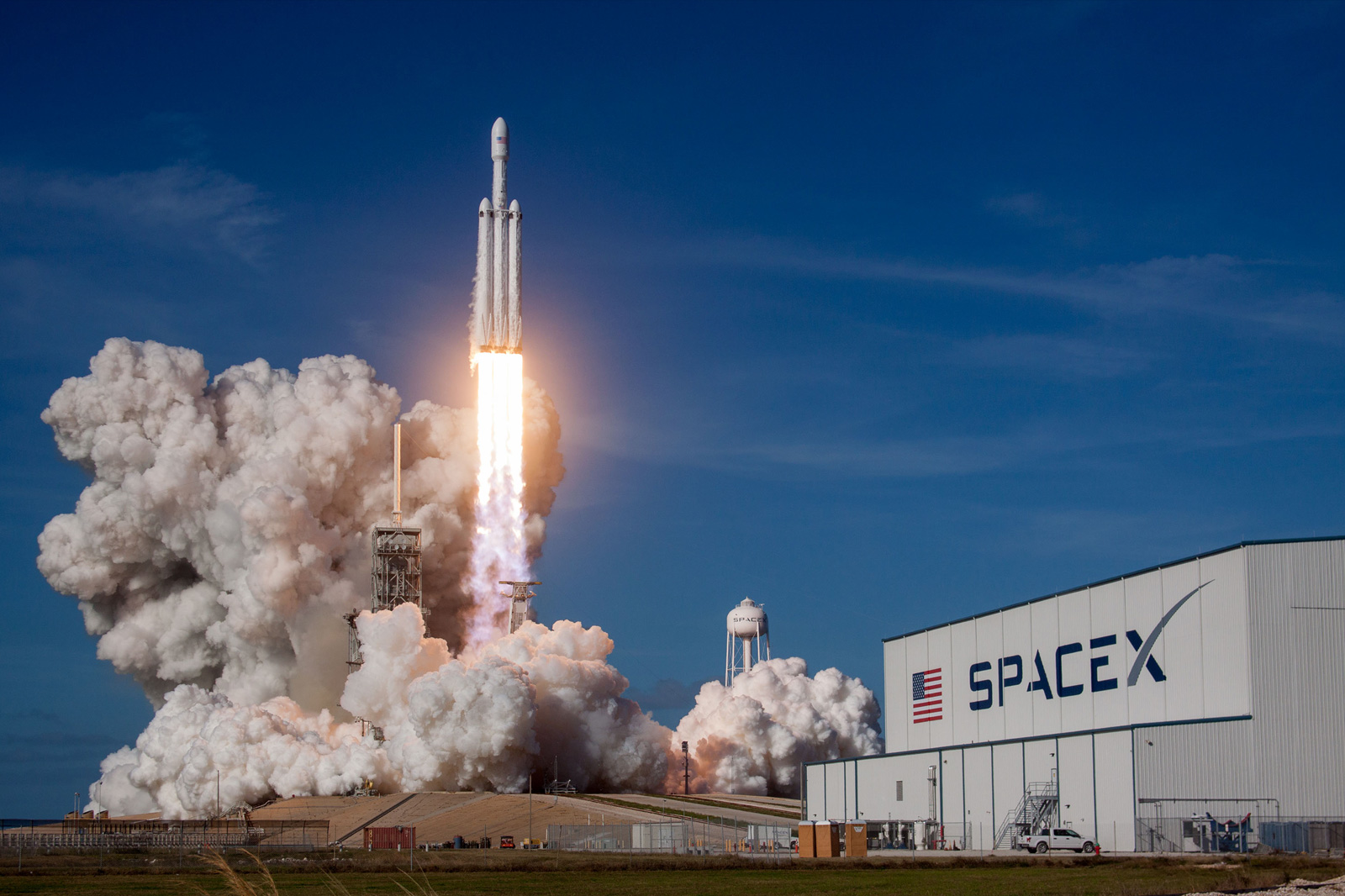
SpaceX is an American aerospace and technology company founded by Elon Musk in 2002.
Space Exploration Technologies Corp (UXSD)
How to access SpaceX through SGX
SGX is launching three new US Singapore Depository Receipts, or US SDRs, linked to Grab, Sea and SpaceX.
The SDRs will trade in Singapore dollars and in board lots of just 10 units, allowing investors to gain exposure to these US-listed companies with a minimum investment of less than S$30, based on their indicative launch prices.
The SDR ratios for Sea and SpaceX also mean that each SDR represents only a fraction of one underlying US share. This lowers the amount investors need to commit compared with buying a full share directly in the US market.

What is SpaceX?
SpaceX is an American aerospace and technology company founded by Elon Musk in 2002.
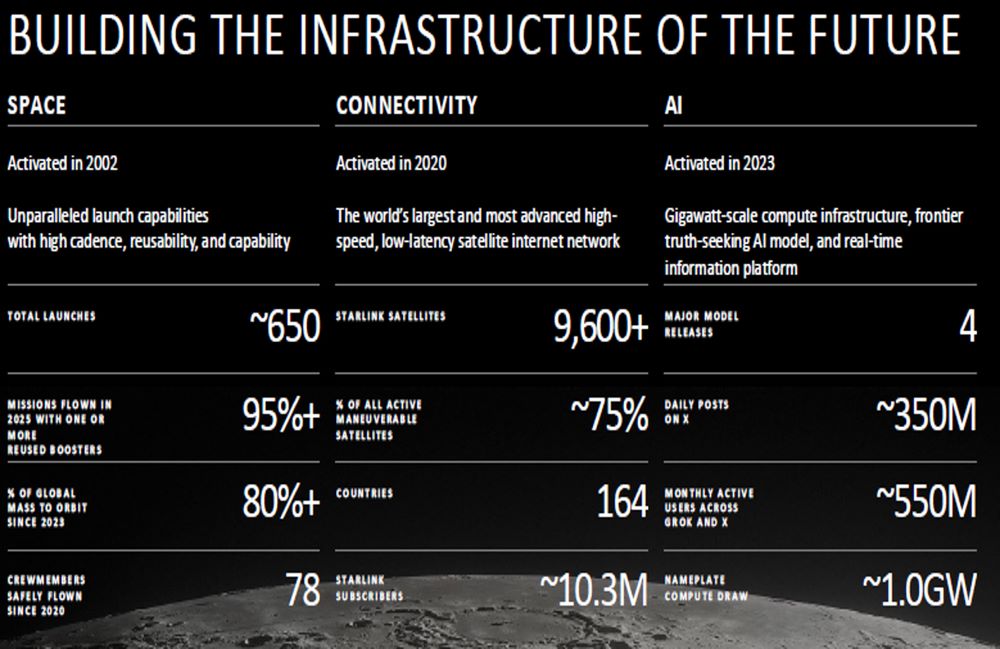
For much of its history, SpaceX was best known for building rockets, especially Falcon 9, the world’s first reusable orbital rocket.
Reusable rockets helped lower the cost of reaching space and changed the economics of the launch industry.
But SpaceX is no longer just a rocket company.
Since 2019, it has also built Starlink, the world’s largest satellite internet network, providing broadband connectivity from space.
Following the merger with xAI in early 2026, SpaceX has also added artificial intelligence to its business, including the Grok chatbot and the X social media platform.
In simple terms, SpaceX today is three businesses in one: a rocket company, a global satellite internet provider and an AI technology group.
Its long-term mission is to make life multiplanetary, but its near-term commercial ambition is to become a key infrastructure company for space, connectivity and AI compute.
How does SpaceX make money?
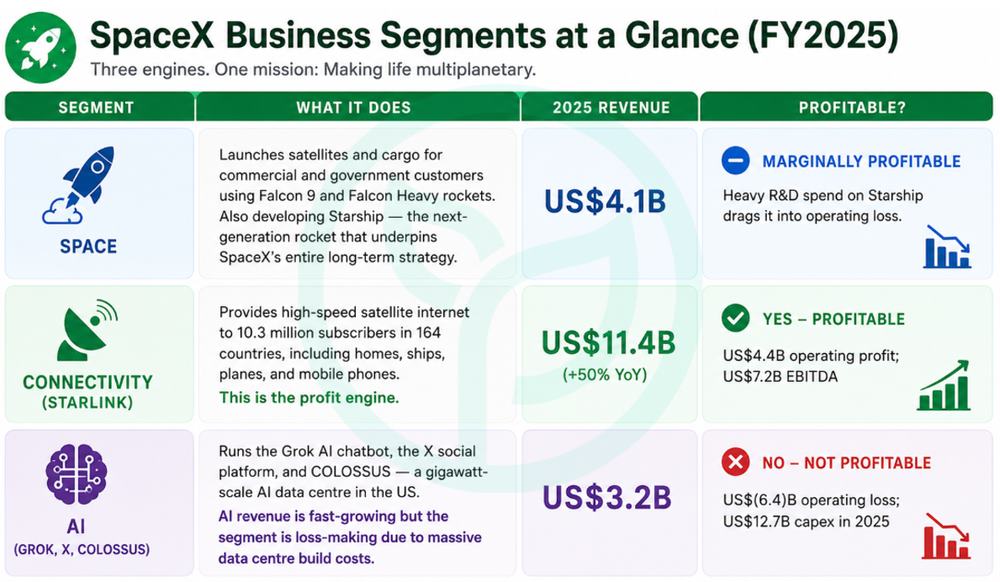
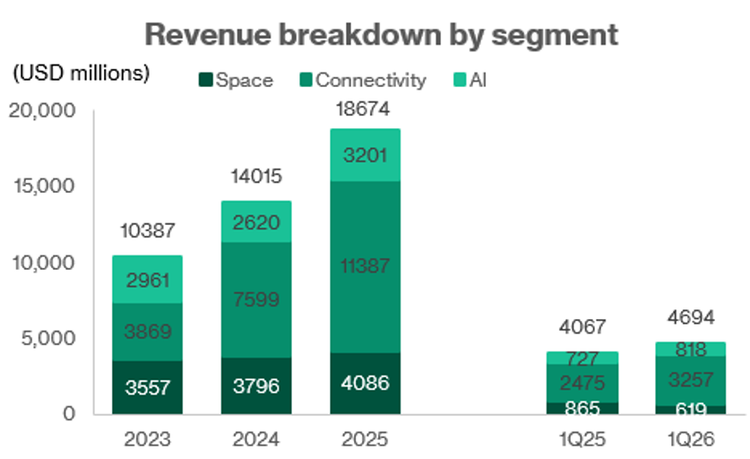
SpaceX reports three business segments: Space, Connectivity and AI. The key point for investors is that only one segment is clearly profitable today.
SpaceX’s Space segment provides launch services for commercial and government customers using Falcon 9 and Falcon Heavy rockets.
It also includes Starship, the next-generation rocket that underpins SpaceX’s long-term strategy.
In 2025, the Space segment generated US$4.1 billion of revenue, but profitability was weighed down by heavy research and development spending on Starship.
Connectivity, mainly Starlink, is the profit engine today.
Starlink provides satellite internet to about 10.3 million subscribers across 164 countries, including homes, ships, aircraft and mobile users.
In 2025, Connectivity revenue grew about 50% year-on-year to US$11.4 billion, with operating profit of US$4.4 billion and EBITDA of US$7.2 billion.
The AI segment includes Grok, the X social platform and COLOSSUS, SpaceX’s gigawatt-scale AI data centre infrastructure.
This segment generated US$3.2 billion of revenue in 2025, but remained heavily loss-making because of massive investment in AI data centres and compute capacity.
The AI segment recorded an operating loss of US$6.4 billion and capex of US$12.7 billion in 2025.
The key takeaway is that Starlink is funding SpaceX today.
It is already profitable and growing quickly, while Space and AI remain heavy investment areas.
SpaceX recorded a US$2.6 billion operating loss in 2025 despite generating US$18.7 billion of revenue, mainly because it is spending aggressively on Starship development and AI infrastructure.
In other words, Starlink is funding the present, while Starship and AI are bets on SpaceX’s future.
6 things investors should know about SpaceX
#1 - SpaceX has taken on US$25 billion in debt
On 23 June 2026, just 11 days after its IPO, SpaceX raised US$25 billion through a corporate bond offering.
Demand was strong, with the deal reportedly attracting nearly US$90 billion of investor interest.
However, equity investors reacted negatively, and SpaceX’s share price fell more than 13% that week.
The bond proceeds were used to repay a US$20 billion short-term loan that SpaceX had taken on to fund its AI data centre build-out before the IPO.
This does not suggest that SpaceX is in financial distress.
The company had about US$100.8 billion of cash on its balance sheet at the time.
However, the debt raise is a reminder that SpaceX’s AI ambitions are extremely capital-intensive.
The key question is whether Starlink’s cash flow, IPO proceeds and debt funding can support the investment needed for AI data centres and Starship without putting too much pressure on the balance sheet.
#2 - COLOSSUS II lawsuit is a near-term AI risk
SpaceX’s AI segment depends heavily on its COLOSSUS data centre infrastructure, including COLOSSUS II in Southaven, Mississippi.
In April 2026, the National Association for the Advancement of Colored People (NAACP) filed a lawsuit alleging that gas turbines powering the facility were operating without the required environmental permits under the US Clean Air Act.
The court has been asked to order the turbines to shut down.
This matters because SpaceX has a major compute agreement with Anthropic, the AI company behind Claude, to provide access to COLOSSUS compute capacity.
If COLOSSUS II is disrupted, even temporarily, SpaceX’s AI compute revenue could be affected.
SpaceX has set aside US$399 million for potential legal losses. The stock fell more than 5% when this risk resurfaced in early July 2026.
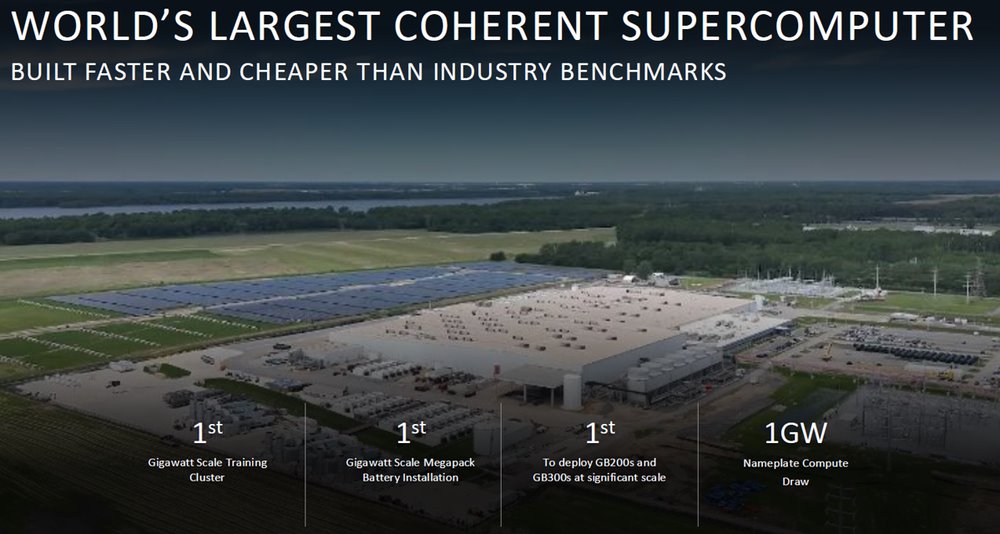
The key point is that SpaceX’s AI revenue is not just a demand story.
It also depends on power availability, environmental approvals, data centre execution and customer concentration.
#3 - Price-to-sales valuation above peers’ average
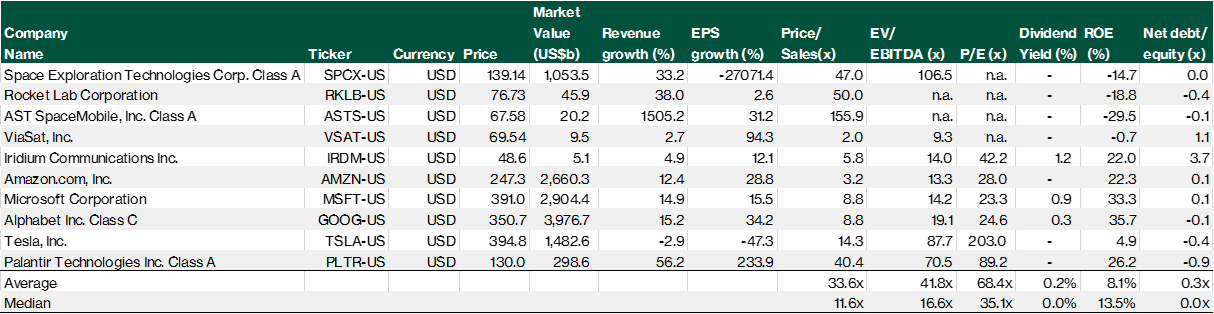
SpaceX is valued at US$1.1 trillion, making it one of the largest companies in the group and below only Alphabet, Microsoft and Amazon by market value.
Its valuation multiples are also elevated. SpaceX trades at 47.0 times price-to-sales and 106.5 times EV/EBITDA, well above the peer average of 33.6 times sales and 41.8 times EV/EBITDA, and significantly above the median of 11.6 times sales and 16.6 times EV/EBITDA.
Compared with other space-related peers, SpaceX trades at a similar sales multiple to Rocket Lab, but at a much higher scale and with positive EBITDA. However, its valuation is still significantly above more mature satellite communications peers such as ViaSat and Iridium, which trade at much lower sales and EBITDA multiples.
#4 - Elon Musk controls 79% of the vote
SpaceX has a dual-class share structure.
The Class A shares listed on Nasdaq carry one vote each, while Elon Musk’s unlisted Class B shares carry ten votes each.
As a result, Musk controls about 79% of SpaceX’s voting power after the IPO.
This means public shareholders have limited influence over major corporate decisions.
They cannot outvote Musk on matters such as board appointments, mergers, acquisitions or capital allocation.
SpaceX is also classified as a “controlled company” under Nasdaq rules, which means it is exempt from some standard governance requirements.
Investors should also note that SpaceX has a mandatory arbitration clause, which may limit shareholders’ ability to bring disputes in open court.
Buying SpaceX shares means accepting that Elon Musk will continue to control the company.
#5 - The lock-up schedule
When a company goes public, insiders such as employees and early investors are usually restricted from selling their shares for a period of time.
For SpaceX, the lock-up expires in stages, meaning shares will become tradeable in waves rather than all at once.
The key date to watch is around 6 August 2026, when SpaceX is expected to report its first quarterly earnings as a public company.
After two full trading days following the first public quarterly report, about 20% of total shares are expected to become eligible for sale.
This could roughly triple the amount of stock available for trading overnight, making it the biggest near-term supply risk for the share price.
After that, smaller tranches of around 7% are expected to unlock each month through October 2026.
By December 2026, about 60% of shares are expected to be freely tradeable.
Elon Musk’s founder shares remain locked up until June 2027.
For investors, the key point is that SpaceX’s current share price is still being shaped by a very tight float.
As more shares become available, liquidity should improve, but the stock could also face selling pressure if insiders choose to take profits.
#6 - SpaceX joined the Nasdaq-100 in record time
SpaceX was added to the Nasdaq-100 on 7 July 2026, just 15 trading days after its IPO. This made it the fastest-ever company to join the index.
The inclusion was made possible by a Nasdaq rule change introduced in March 2026, which allowed newly listed companies to qualify for fast-track inclusion without waiting the usual 12 months.
Key Risks
Starship execution risk
SpaceX’s long-term plan depends on Starship becoming reliable, reusable and scalable. This affects cheaper satellite launches, V3 Starlink deployment, orbital AI compute, and eventually Moon and Mars missions. So far, Starship has completed 11 test flights, but has not yet delivered a commercial payload. Any major delay would affect all three business segments.
Concentrated governance and voting structure
Governance is highly concentrated. Elon Musk controls about 79% of SpaceX’s voting power, which means public shareholders have limited influence over major decisions. His roles across Tesla, SpaceX and AI-related ventures also create management and focus risks.
Lock-up expiry and float overhang
The 6 August earnings and lock-up date is a major event. SpaceX is expected to report its first quarterly results as a public company around the same time that the first major wave of insider shares becomes eligible for sale. If results disappoint and insiders sell, the stock could face pressure from both fundamentals and supply. Investors should also watch whether the stock crosses US$175.50 before then, as this determines whether an additional performance-based tranche unlocks.
AI segment integration and competition risk
The AI segment is still burning cash. SpaceX spent US$12.7 billion on AI data centre capex in 2025, and analysts expect further heavy cash burn in 2026. This is being funded by Starlink profits, IPO proceeds and bond financing. The key question is whether AI revenue can eventually justify this level of investment.
Download the full report here.
Check out Beansprout's guide to the best stock trading platforms in Singapore with the latest promotions to invest in SpaceX US SDR 100to1 .
Join the Beansprout Telegram group for the latest insights on Singapore stocks, REITs, bonds and ETFs.
Important Disclosures
Analyst Certification and Disclosures
The analyst(s) named in this report certifies that (i) all views expressed in this report accurately reflect the personal views of the analyst(s) with regard to any and all of the subject securities and companies mentioned in this report and (ii) no part of the compensation of the analyst(s) was, is, or will be, directly or indirectly, related to the specific views expressed by that analyst herein. The analyst(s) named in this report (or their associates) does not have a financial interest in the corporation(s) mentioned in this report.
An associate is defined as (i) the spouse, or any minor child (natural or adopted) or minor step-child, of the analyst; (ii) the trustee of a trust of which the analyst, his spouse, minor child (natural or adopted) or minor step-child, is a beneficiary or discretionary object; or (iii) another person accustomed or obliged to act in accordance with the directions or instructions of the analyst.
Company Disclosure
Global Wealth Technology Pte Ltd (“Beansprout”) does not have any financial interest in the corporation(s) mentioned in this report.
Beansprout received monetary compensation from Singapore Exchange (SGX) to provide independent research on Singapore Depository Receipts (SDRs).
Disclaimer
This report is provided by Beansprout for the use of intended recipients only and may not be reproduced, in whole or in part, or delivered or transmitted to any other person without our prior written consent. By accepting this report, the recipient agrees to be bound by the terms and limitations set out herein.
You acknowledge that this document is provided for general information purposes only. Nothing in this document shall be construed as a recommendation to purchase, sell, or hold any security or other investment, or to pursue any investment style or strategy. Nothing in this document shall be construed as advice that purports to be tailored to your needs or the needs of any person or company receiving the advice. The information in this document is intended for general circulation only and does not constitute investment advice. Nothing in this document is published with regard to the specific investment objectives, financial situation and particular needs of any person who may receive the information.
Nothing in this document shall be construed as, or form part of, any offer for sale or subscription of or solicitation or invitation of any offer to buy or subscribe for any securities. The data and information made available in this document are of a general nature and do not purport, and shall not in any way be deemed, to constitute an offer or provision of any professional or expert advice, including without limitation any financial, investment, legal, accounting or tax advice, and shall not be relied upon by you in that regard. You should at all times consult a qualified expert or professional adviser to obtain advice and independent verification of the information and data contained herein before acting on it. Any financial or investment information in this document are intended to be for your general information only. You should not rely upon such information in making any particular investment or other decision which should only be made after consulting with a fully qualified financial adviser. Such information do not nor are they intended to constitute any form of financial or investment advice, opinion or recommendation about any investment product, or any inducement or invitation relating to any of the products listed or referred to. Any arrangement made between you and a third party named on or linked to from these pages is at your sole risk and responsibility.
You acknowledge that Beansprout is under no obligation to exercise editorial control over, and to review, edit or amend any data, information, materials or contents of any content in this document. You agree that all statements, offers, information, opinions, materials, content in this document should be used, accepted and relied upon only with care and discretion and at your own risk, and Beansprout shall not be responsible for any loss, damage or liability incurred by you arising from such use or reliance.
This document (including all information and materials contained in this document) is provided “as is”. Although the material in this document is based upon information that Beansprout considers reliable and endeavours to keep current, Beansprout does not assure that this material is accurate, current or complete and is not providing any warranties or representations regarding the material contained in this document. All opinions contained herein constitute the views of the analyst(s) named in this report, they are subject to change without notice and are not intended to provide the sole basis of any evaluation of the subject securities and companies mentioned in this report. Any reference to past performance should not be taken as an indication of future performance. To the fullest extent permissible pursuant to applicable law, Beansprout disclaims all warranties and/or representations of any kind with regard to this document, including but not limited to any implied warranties of merchantability, non-infringement of third-party rights, or fitness for a particular purpose.
Beansprout does not warrant, either expressly or impliedly, the accuracy or completeness of the information, text, graphics, links or other items contained in this document. Neither Beansprout nor any of its affiliates, directors, employees or other representatives will be liable for any damages, losses or liabilities of any kind arising out of or in connection with the use of this document. To the best of Beansprout’s knowledge, this document does not contain and is not based on any non-public, material information. The information in this document is not intended for distribution to, or use by, any person or entity in any jurisdiction where such distribution or use would be contrary to law or regulation, or which would subject Beansprout to any registration requirement within such jurisdiction or country. Beansprout is not licensed or regulated by any authority in any jurisdiction or country to provide the information in this document.
As a condition of your use of this document, you agree to indemnify, defend and hold harmless Beansprout and its affiliates, and their respective officers, directors, employees, members, managing members, managers, agents, representatives, successors and assigns from and against any and all actions, causes of action, claims, charges, cost, demands, expenses and damages (including attorneys’ fees and expenses), losses and liabilities or other expenses of any kind that arise directly or indirectly out of or from, arising out of or in connection with violation of these terms, use of this document, violation of the rights of any third party, acts, omissions or negligence of third parties, their directors, employees or agents. To the extent permitted by law, Beansprout shall not be liable to you, any other person, or organization, for any direct, indirect, special, punitive, exemplary, incidental or consequential damages, whether in contract, tort (including negligence), or otherwise, arising in any way from, or in connection with, the use of this document and/or its content. This includes, without limitation, liability for any act or omission in reliance on the information in this document. Beansprout expressly disclaims and excludes all warranties, conditions, representations and terms not expressly set out in this User Agreement, whether express, implied or statutory, with regard to this document and its content, including any implied warranties or representations about the accuracy or completeness of this document and the content, suitability and general availability, or whether it is free from error.
If these terms or any part of them is understood to be illegal, invalid or otherwise unenforceable under the laws of any state or country in which these terms are intended to be effective, then to the extent that they are illegal, invalid or unenforceable, they shall in that state or country be treated as severed and deleted from these terms and the remaining terms shall survive and remain fully intact and in effect and will continue to be binding and enforceable in that state or country.
These terms, as well as any claims arising from or related thereto, are governed by the laws of Singapore without reference to the principles of conflicts of laws thereof. You agree to submit to the personal and exclusive jurisdiction of the courts of Singapore with respect to all disputes arising out of or related to this Agreement. Beansprout and you each hereby irrevocably consent to the jurisdiction of such courts, and each Party hereby waives any claim or defence that such forum is not convenient or proper.
Read also
Gain financial insights in minutes
Subscribe to our free weekly newsletter for more insights to grow your wealth
Most Popular

Comments
0 comments