
UOB reports 10% increase in 2Q26 profit and higher interim dividend: Our Quick Take
Stocks
By Gerald Wong, CFA • 07 Aug 2026
Global Wealth Technology Pte. Ltd. is regulated by the Monetary Authority of Singapore (MAS) as a licensed Financial Adviser.
'%3e%3cpath%20fill-rule='evenodd'%20clip-rule='evenodd'%20d='M17.64%209.20455C17.64%208.56637%2017.5827%207.95273%2017.4764%207.36364H9V10.845H13.8436C13.635%2011.97%2013.0009%2012.9232%2012.0477%2013.5614V15.8195H14.9564C16.6582%2014.2527%2017.64%2011.9455%2017.64%209.20455V9.20455Z'%20fill='%234285F4'/%3e%3cpath%20fill-rule='evenodd'%20clip-rule='evenodd'%20d='M9%2018C11.43%2018%2013.4673%2017.1941%2014.9564%2015.8195L12.0477%2013.5614C11.2418%2014.1014%2010.2109%2014.4205%209%2014.4205C6.65591%2014.4205%204.67182%2012.8373%203.96409%2010.71H0.957275V13.0418C2.43818%2015.9832%205.48182%2018%209%2018V18Z'%20fill='%2334A853'/%3e%3cpath%20fill-rule='evenodd'%20clip-rule='evenodd'%20d='M3.96409%2010.71C3.78409%2010.17%203.68182%209.59318%203.68182%209C3.68182%208.40682%203.78409%207.83%203.96409%207.29V4.95818H0.957273C0.347727%206.17318%200%207.54773%200%209C0%2010.4523%200.347727%2011.8268%200.957273%2013.0418L3.96409%2010.71V10.71Z'%20fill='%23FBBC05'/%3e%3cpath%20fill-rule='evenodd'%20clip-rule='evenodd'%20d='M9%203.57955C10.3214%203.57955%2011.5077%204.03364%2012.4405%204.92545L15.0218%202.34409C13.4632%200.891818%2011.4259%200%209%200C5.48182%200%202.43818%202.01682%200.957275%204.95818L3.96409%207.29C4.67182%205.16273%206.65591%203.57955%209%203.57955V3.57955Z'%20fill='%23EA4335'/%3e%3c/g%3e%3cdefs%3e%3cclipPath%20id='clip0_0_2849'%3e%3crect%20width='18'%20height='18'%20fill='white'/%3e%3c/clipPath%3e%3c/defs%3e%3c/svg%3e)
Make Beansprout your preferred source on Google
Add us on Google to see more of our insights in your search results
UOB reported a 10% increase year-on-year in 2Q26 net profit and a higher interim dividend of S$0.88 per share.
UOB 2Q26 earnings highlights
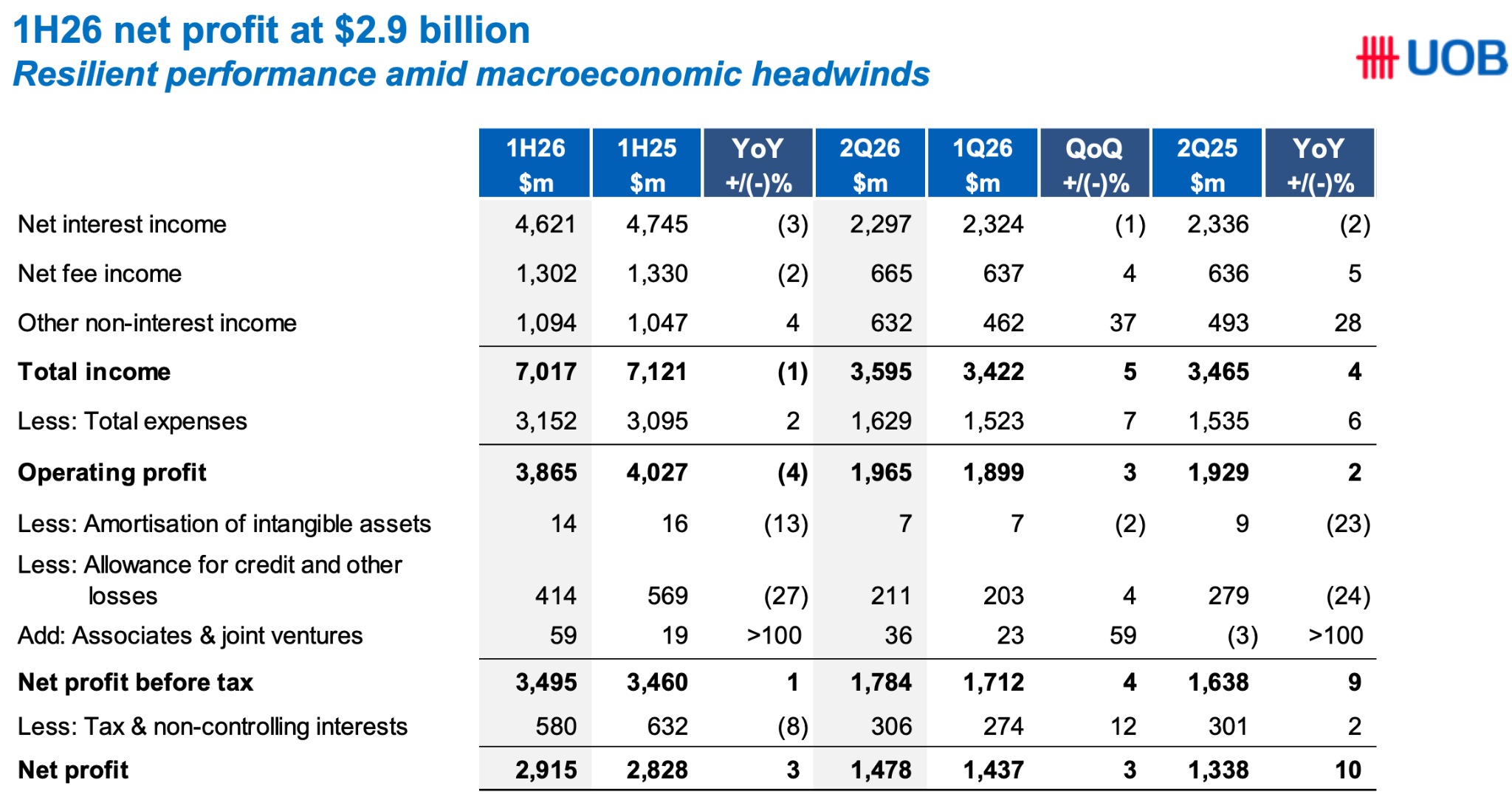
UOB Group announced its earnings for the second quarter of 2026. Key highlights include:
- Net profit of S$1.48 billion in 2Q26, up 10% year-on-year
- Net profit of S$2.92 billion in 1H26, up 3% year-on-year
- Interim dividend of S$0.88 per ordinary share, up from S$0.85 a year ago
Source: Company data, 1H26 results presentation
What you need to know about UOB 2Q26 results
UOB Group has reported net profit of S$1.48 billion for 2Q26. This represents a 10% increase compared to the previous year.
#1 - Net interest margin stepped down further
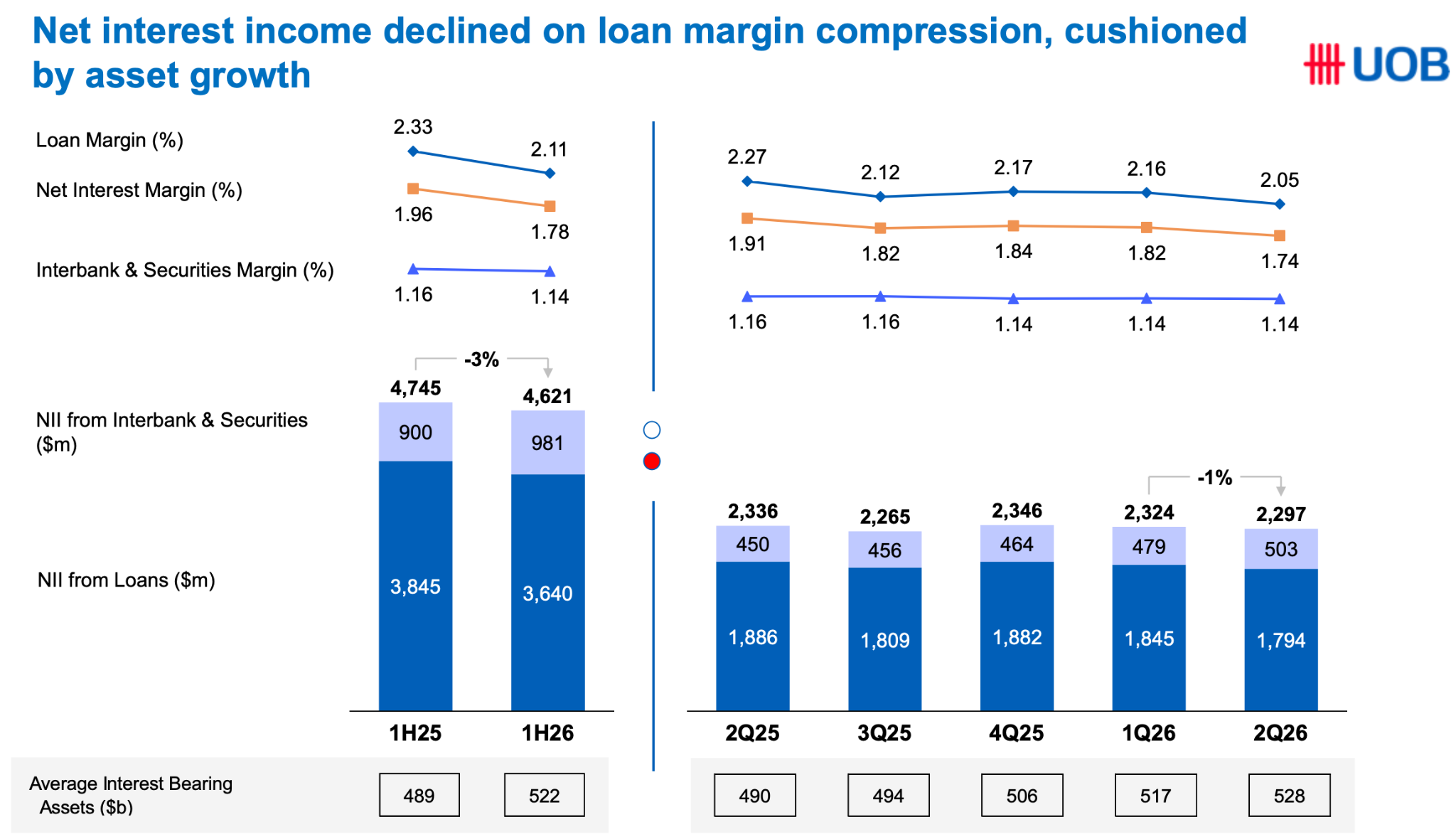
Net interest income eased 1% quarter-on-quarter and 2% year-on-year to S$2.30 billion, as margin pressures continued to weigh on the top line even with healthy loan growth of 5% year-on-year.
Net interest margin narrowed by 8 basis points (0.08%) to 1.74% in 2Q26, from 1.82% in 1Q26, on lower asset repricing and the deployment of surplus funds into liquid assets.
The 3-month SORA average fell 7 basis points (0.07%) during the quarter, while the 3-month SOFR average dropped 15 basis points (0.15%).
For the first half, NIM averaged around 1.78%, which is within UOB's full-year guidance range of 1.75%–1.80% but at the lower end.
Source: Company data, 1H26 results presentation
#2 - Record wealth fees drive fee income higher
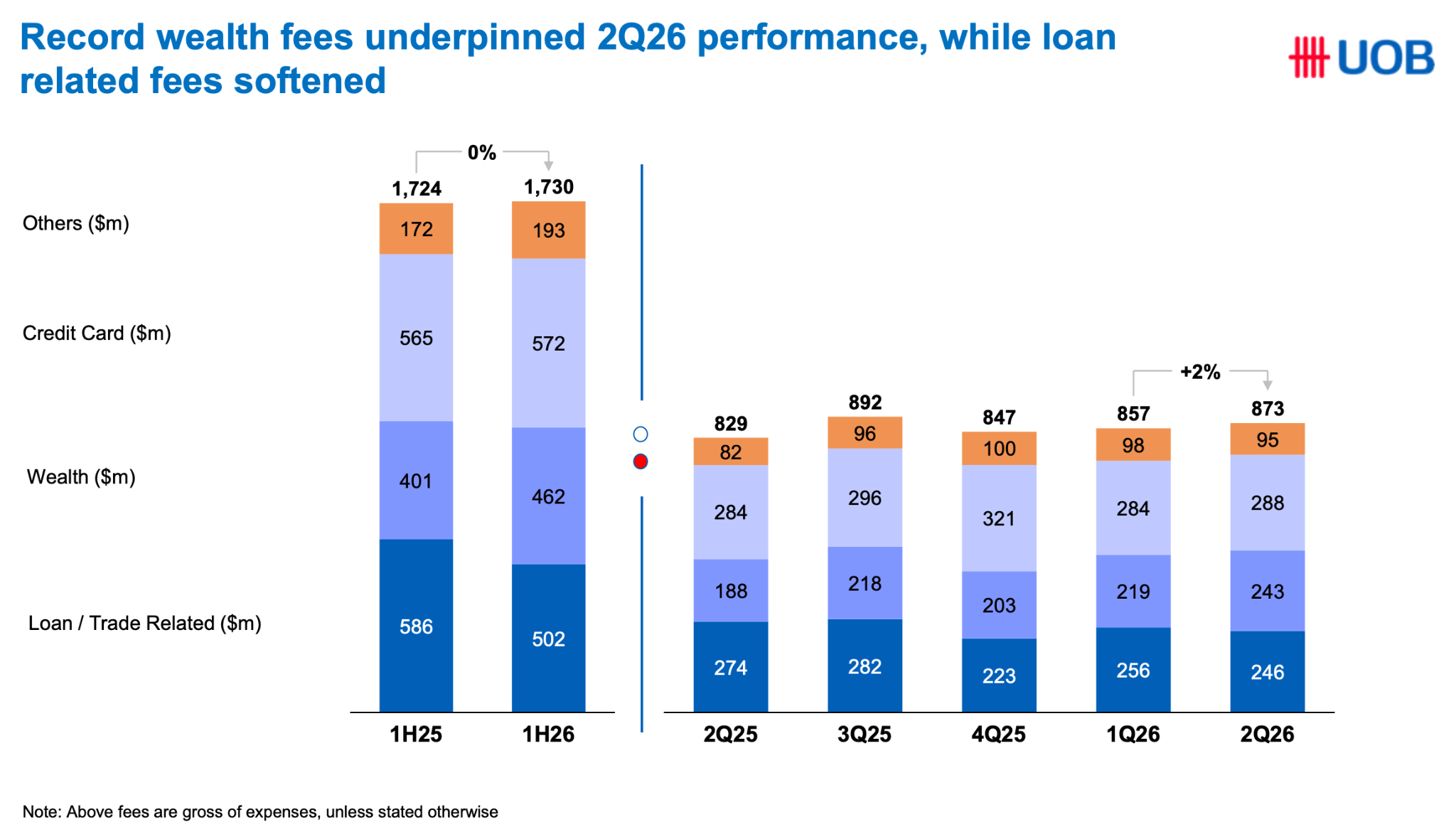
Net fee income rose to S$665 million in 2Q26, up 4% quarter-on-quarter and 5% year-on-year, driven by record wealth management fees on the back of sustained client engagement and higher demand for investment products.
For the first half, wealth management income grew 16% year-on-year, with the ASEAN-4 markets of Malaysia, Indonesia, Thailand and Vietnam delivering wealth income growth of 30%. High-net-worth AUM reached S$204 billion, up 7% year-on-year.
However, loan-related and investment banking fees remained softer, reflecting the more cautious market backdrop.
Other non-interest income jumped 37% quarter-on-quarter to S$632 million, boosted by non-recurring gains from asset divestments.
Trading and investment income moderated to S$379 million as market opportunities and liquidity management activities were more limited.
Source: Company data, 1H26 results presentation
#3 - Greater China exposure drives NPL uptick
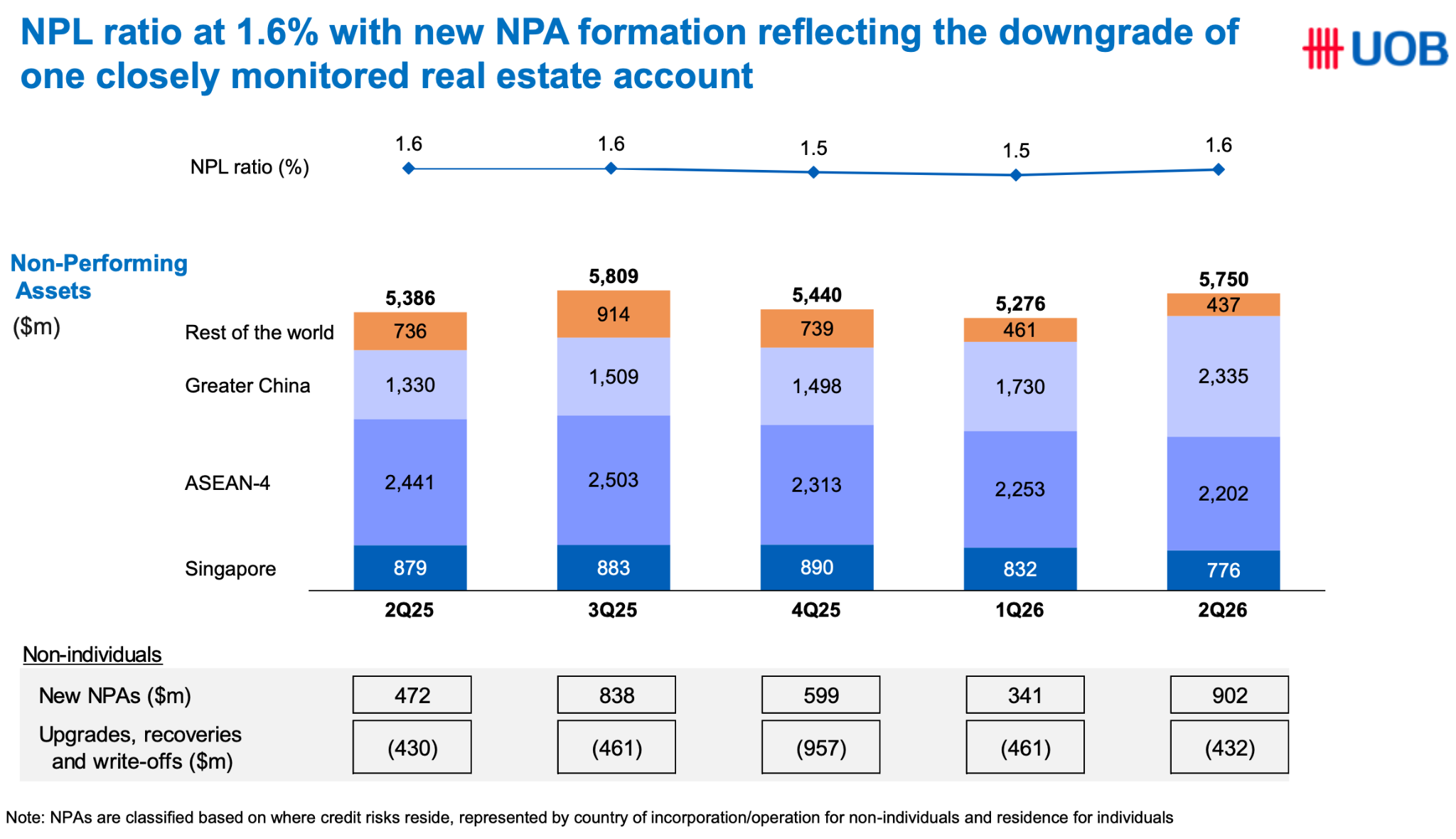
Total allowance rose slightly to S$211 million in 2Q26 (from S$203 million in 1Q26), reflecting the downgrade of a single closely monitored real estate account in Greater China.
The increase in specific allowance was partly offset by a release of general allowance.
Total credit costs on loans came in at 28 basis points, still within UOB's full-year guidance of 25–30 basis points.
The non-performing loan (NPL) ratio ticked up to 1.6% from 1.5% in the prior quarter, with the Greater China NPL ratio rising more visibly to 4.8% from 3.5%.
NPA coverage stood at 88% or 306% after taking collateral into account, with unsecured NPA coverage strengthening from 272% in 1Q26.
Source: Company data, 1H26 results presentation
#4 - Interim dividend raised to S$0.88 per share
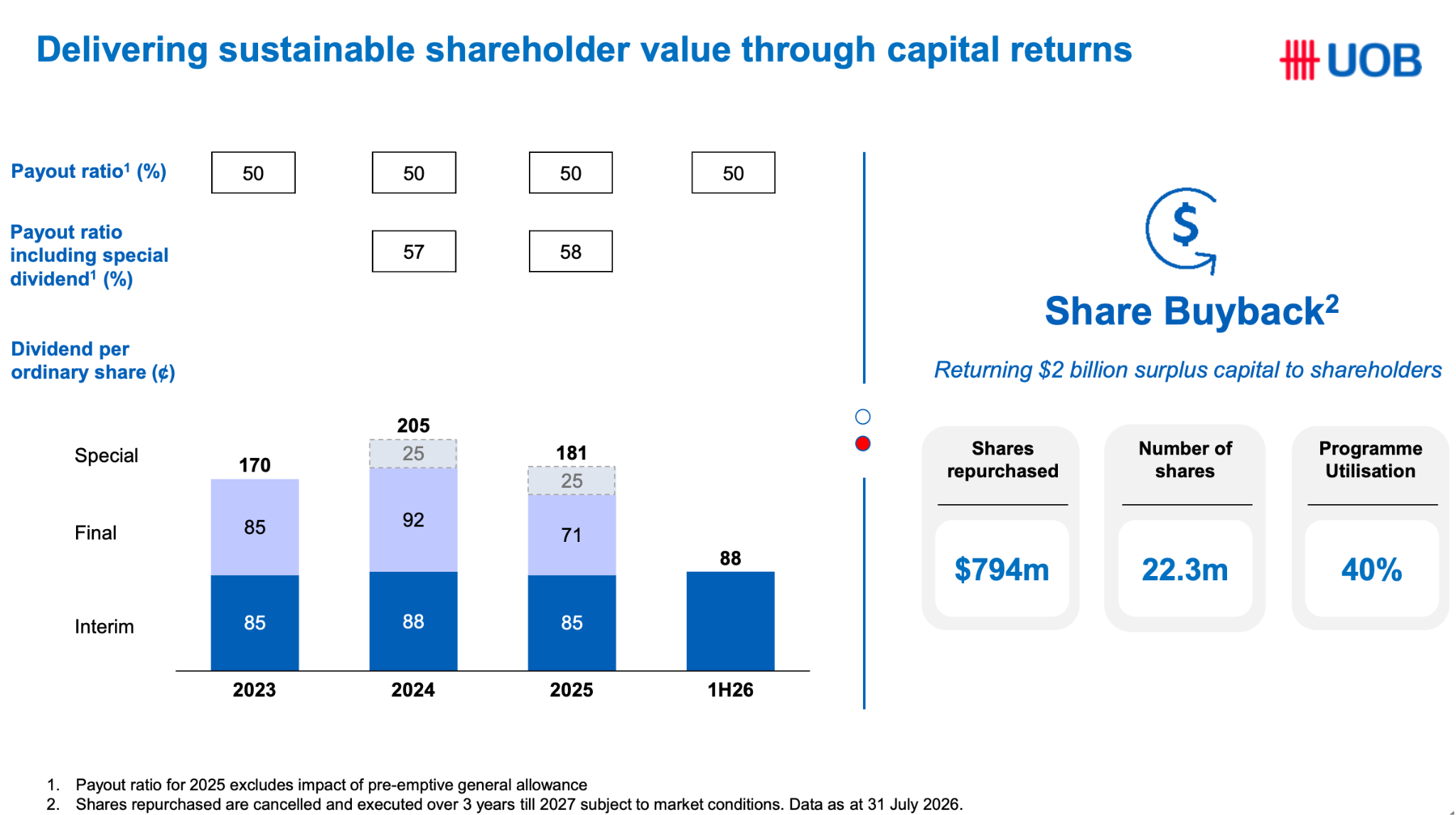
UOB proposed an interim dividend of S$0.88 per ordinary share, up from S$0.85 a year ago, representing a payout ratio of approximately 50%.
The bank also continued to execute on its S$2 billion share buyback programme, with 40% completed as at 31 July 2026. This included the repurchase of 22.3 million shares for around S$794 million, which are being cancelled.
Common Equity Tier 1 (CET1) ratio remained robust at 15.4% post dividend payout, up slightly from 15.3% in the prior quarter.
Source: Company data, 1H26 results presentation
#5 - Fee income guidance lowered for 2026; new tie-up with Allianz Global Investors
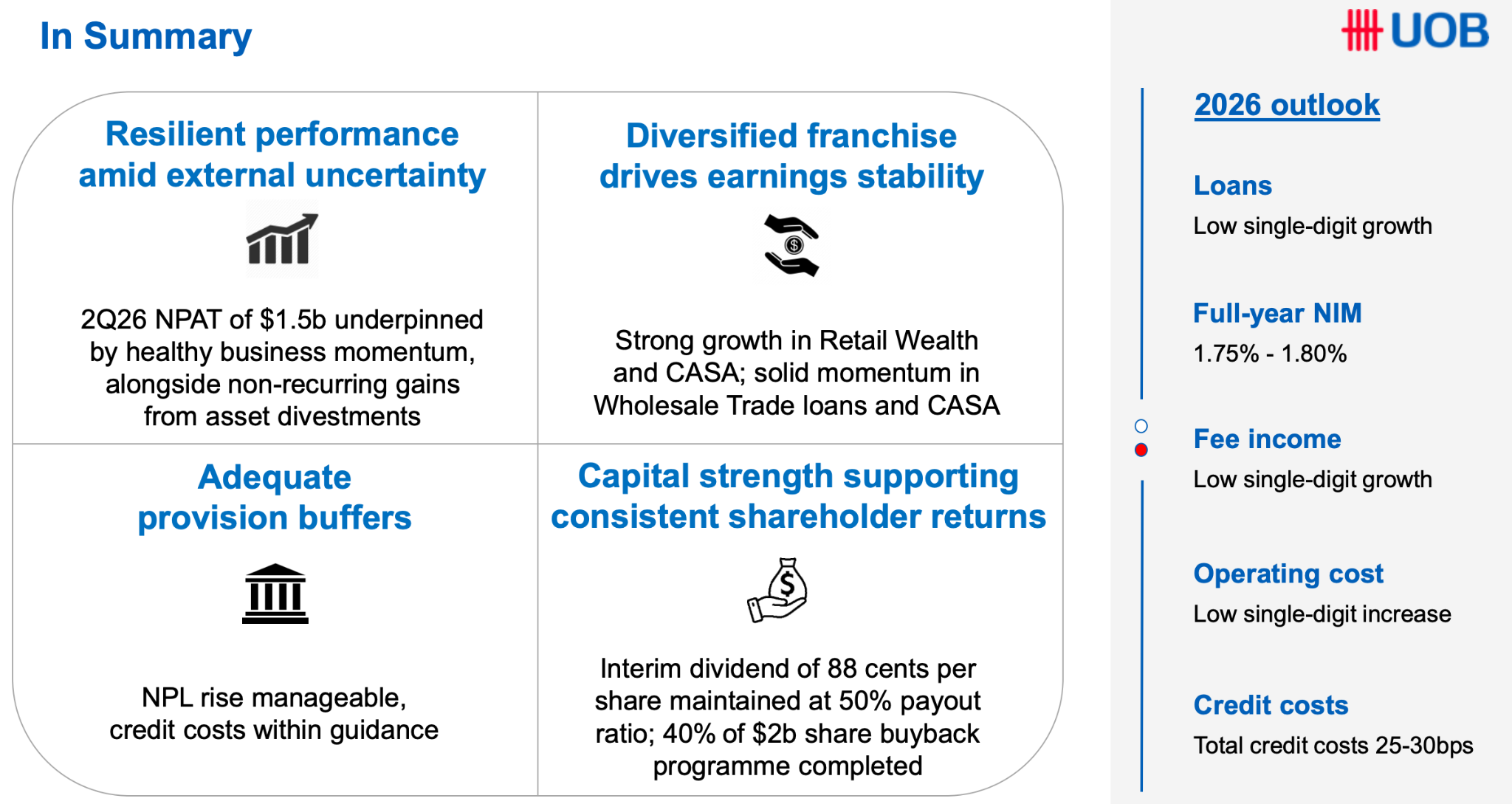
UOB revised down its 2026 fee income guidance to low single-digit growth, from the earlier high single-digit guidance issued at the start of the year, reflecting the softer investment banking and loan-related fee environment.
Other guidance items were retained: low single-digit loan growth, full-year net interest margin of 1.75%–1.80%, low single-digit operating cost growth, and total credit costs in the 25–30 basis points range.
Source: Company data, 1H26 results presentation
Separately, on 5 August 2026, UOB announced a strategic partnership with Allianz Global Investors, under which AGI will acquire UOB Asset Management (UOBAM) for S$555 million across eight Asian markets.
The deal is expected to complete in 2027 subject to regulatory approvals, and UOB expects it to generate a pre-tax gain of approximately S$330 million and lift the Group's CET1 ratio by around 14 basis points upon completion.
Beansprout's Quick Take on UOB earnings
UOB’s 2Q2026 headline numbers looked strong.
Net profit rose 10% year-on-year, while the interim dividend was raised by 3 cents to S$0.88 per share.
However, the underlying picture was more mixed.
Part of the profit growth was supported by non-recurring gains from asset divestments, which boosted other non-interest income during the quarter.
Excluding these gains, operating trends were softer.
Net interest margin fell 8 basis points to 1.74%, while full-year fee income guidance was cut from high-single-digit growth to low-single-digit growth.
The bright spot remains wealth management.
UOB reported record wealth fees in the quarter, with wealth fees up 16% year-on-year in the first half.
ASEAN-4 wealth income also grew 30%, showing that UOB’s regional wealth franchise is gaining scale.
The separately announced tie-up with Allianz Global Investors also fits UOB’s ambition to double wealth income between 2025 and 2030.
By divesting UOB Asset Management, UOB frees up capital while positioning itself more clearly as an open-architecture wealth distributor.
On asset quality, Greater China remains the main area to watch.
The Greater China NPL ratio rose to 4.8% from 3.5% in a single quarter.
Management attributed this to one closely monitored real estate account, but investors will want to see whether the issue remains contained.
UOB shares have already re-rated meaningfully since its 1Q results.
The stock closed at S$43.58 on 6 August 2026, before the 2Q2026 release.
If we annualise the 1H26 interim dividend of $0.88 per share, this would imply a dividend yield of 4.0%.
UOB is currently trading at 1.48x price to book, higher than its historical average of 1.14x.
UOB is one of the stocks in Beansprout’s Opportunity Pot Portfolio, where our analyst team highlights the opportunities we believe stand out in the market today. See the stocks in the portfolio, how much we allocate to each, and what we are watching next.
Related links:
Check out Beansprout's guide to the best stock trading platforms in Singapore with the latest promotions to invest in UOB.
Enjoyed this insight? Follow Beansprout on Telegram, Youtube, Facebook and Instagram, and add Beansprout as your preferred source on Google so you never miss an update.
Read also
Gain financial insights in minutes
Subscribe to our free weekly newsletter for more insights to grow your wealth
Most Popular

Comments
0 comments