
US-Israel-Iran conflict - What we're doing with our portfolios
Stocks
By Gerald Wong, CFA • 02 Mar 2026
Why trust Beansprout? We’ve been awarded Best Investment Website at the SIAS Investors’ Choice Awards 2025
'%3e%3cpath%20fill-rule='evenodd'%20clip-rule='evenodd'%20d='M17.64%209.20455C17.64%208.56637%2017.5827%207.95273%2017.4764%207.36364H9V10.845H13.8436C13.635%2011.97%2013.0009%2012.9232%2012.0477%2013.5614V15.8195H14.9564C16.6582%2014.2527%2017.64%2011.9455%2017.64%209.20455V9.20455Z'%20fill='%234285F4'/%3e%3cpath%20fill-rule='evenodd'%20clip-rule='evenodd'%20d='M9%2018C11.43%2018%2013.4673%2017.1941%2014.9564%2015.8195L12.0477%2013.5614C11.2418%2014.1014%2010.2109%2014.4205%209%2014.4205C6.65591%2014.4205%204.67182%2012.8373%203.96409%2010.71H0.957275V13.0418C2.43818%2015.9832%205.48182%2018%209%2018V18Z'%20fill='%2334A853'/%3e%3cpath%20fill-rule='evenodd'%20clip-rule='evenodd'%20d='M3.96409%2010.71C3.78409%2010.17%203.68182%209.59318%203.68182%209C3.68182%208.40682%203.78409%207.83%203.96409%207.29V4.95818H0.957273C0.347727%206.17318%200%207.54773%200%209C0%2010.4523%200.347727%2011.8268%200.957273%2013.0418L3.96409%2010.71V10.71Z'%20fill='%23FBBC05'/%3e%3cpath%20fill-rule='evenodd'%20clip-rule='evenodd'%20d='M9%203.57955C10.3214%203.57955%2011.5077%204.03364%2012.4405%204.92545L15.0218%202.34409C13.4632%200.891818%2011.4259%200%209%200C5.48182%200%202.43818%202.01682%200.957275%204.95818L3.96409%207.29C4.67182%205.16273%206.65591%203.57955%209%203.57955V3.57955Z'%20fill='%23EA4335'/%3e%3c/g%3e%3cdefs%3e%3cclipPath%20id='clip0_0_2849'%3e%3crect%20width='18'%20height='18'%20fill='white'/%3e%3c/clipPath%3e%3c/defs%3e%3c/svg%3e)
Make Beansprout your preferred source on Google
Add us on Google to see more of our insights in your search results
How the US-Israel-Iran conflict may impact markets and practical portfolio moves to help investors stay disciplined and informed.
What happened?
Over the weekend of 28 February 2026, the United States and Israel carried out coordinated military strikes on Iran.
US President Donald Trump said the operation was intended to “eliminate imminent threats from the Iranian regime.” Iranian state media later confirmed that Supreme Leader Ayatollah Ali Khamenei was killed in the attacks.
Iran has since responded with retaliatory strikes across the region. Saudi Arabia, Bahrain, Kuwait and Qatar have reported incoming missiles, drones or explosions. President Trump has indicated that combat operations could continue for four to five weeks, raising the risk of a prolonged escalation.
Financial markets have reacted swiftly to the headlines. Across Asia, major indices moved lower, with Japan’s Nikkei down 1.35%, Singapore’s Straits Times Index falling 2.32%, and Hong Kong’s Hang Seng Index declining 2.14%. U.S. equity futures slipped in overnight trading, European markets opened in the red, and Gulf exchanges that were open saw sharp selloffs. Oil prices jumped sharply amid concerns about potential supply disruptions.
In this article, we examine what the US–Israel strikes on Iran could mean for global markets and how we would position our portfolios in response.
What the US-Israel strike on Iran means for markets
#1 — Oil: The Immediate Pressure Point
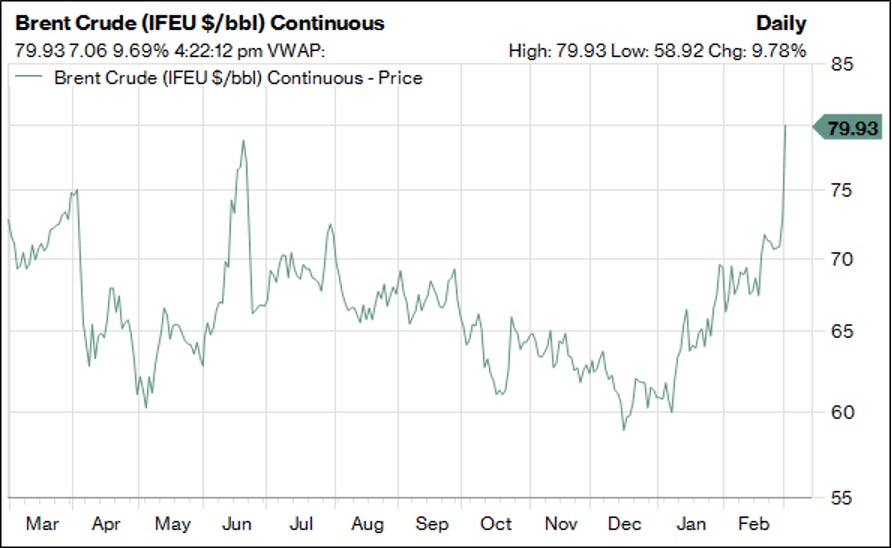
U.S. crude (WTI) jumped more than 7% in Sunday evening trading, marking its largest single-session gain in four years.
Brent crude had already risen about 19% year-to-date before the weekend, and global LNG prices are also climbing sharply. Some analysts are warning that prices could revisit the record highs last seen in 2022 if tensions escalate further.
This matters for the broader economy, and for investors, because oil affects far more than just what we pay at the petrol station. It is a key cost input across the economy, from food production and transportation to manufacturing and everyday consumer goods.
When oil prices surge, businesses face higher costs, which can feed through into higher inflation. If inflation picks up again, central banks may have less room to cut interest rates, or may need to keep rates elevated for longer.
Higher interest rates tend to slow economic growth, and equity markets, especially higher-growth and rate-sensitive stocks, can come under pressure in such an environment.
#2- The key variable: the Strait of Hormuz
The Strait of Hormuz, the narrow channel at the entrance of the Persian Gulf which Iran borders, is one of the most critical energy chokepoints in the world. Roughly 20% of global daily oil consumption, about 20 million barrels a day, passes through it.
Iran has repeatedly warned that it could mine or block the Strait in the event of a direct military confrontation. While no closure has occurred, reports suggest that some oil tankers are already slowing or hesitating before entering the waterway.
Risk perceptions have risen sharply. Marine war-risk insurance premiums have jumped by an estimated 25–50% over the weekend. The U.S. Navy’s Fifth Fleet, based in Bahrain, has also moved to heightened alert.
As former White House energy advisor Bob McNally has cautioned, a prolonged closure of the Strait of Hormuz would almost certainly tip the global economy into recession.
#3 — Safe Havens: Gold, USD, Treasuries
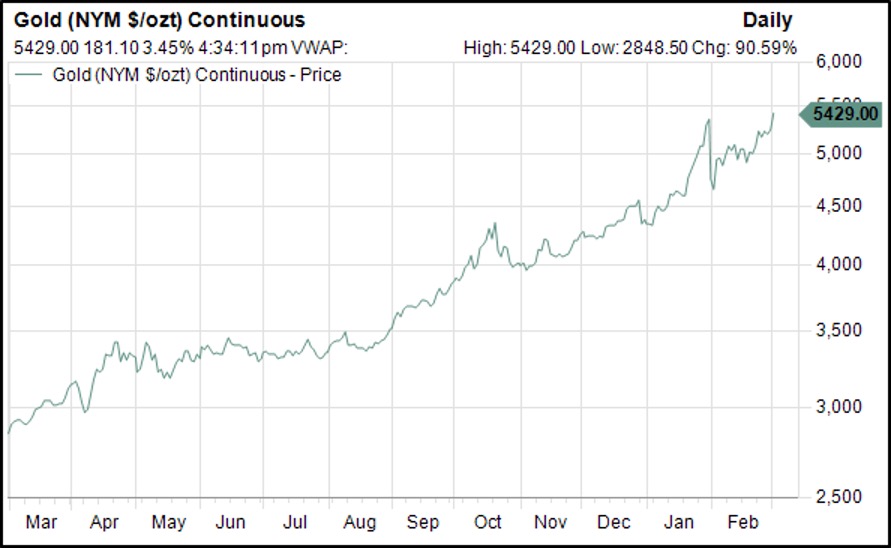
In periods of geopolitical shock, markets often follow a familiar pattern. Investors tend to move away from riskier assets and shift towards traditional safe havens. We are already seeing signs of this rotation taking place.
The initial moves typically include a stronger U.S. dollar, gains in the Japanese yen, and renewed buying interest in gold.
U.S. Treasuries may also see short-term rallies, as investors seek the perceived safety of government bonds, pushing bond yields lower in a classic “risk-off” response.
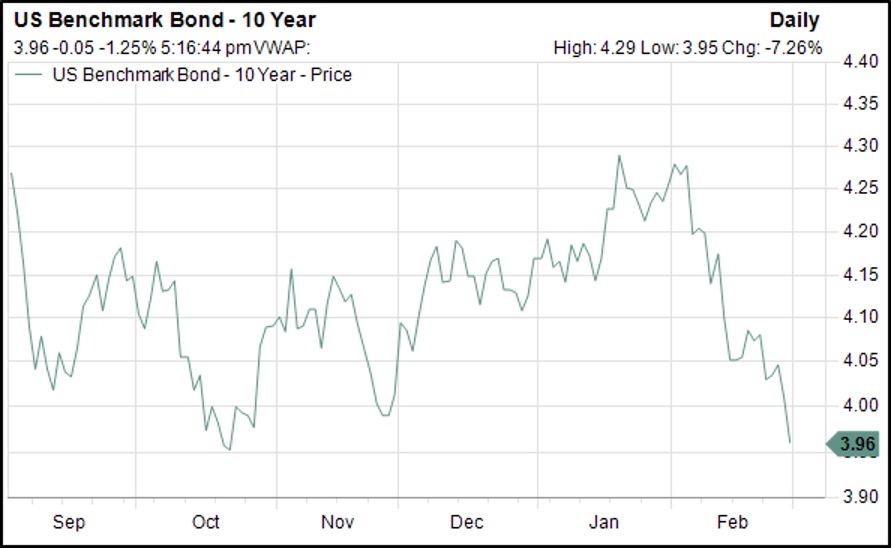
Safe haven assets often serve as a real-time gauge of market stress. When gold and the U.S. dollar rise while Treasury yields fall, it usually signals that investors are becoming more cautious, which can put pressure on equities.
From a portfolio perspective, maintaining some exposure to defensive assets can help cushion volatility and reduce the likelihood of making emotional decisions during market swings.
For investors looking at safe havens, learn how to buy gold in Singapore and what we’re looking out for when investing in gold.
Read also: A simpler way to invest in physical gold in Singapore.
What would Beansprout do?
This latest conflict is unfolding at a time when markets were already on edge.
Even before the escalation, investors were dealing with renewed concerns about how artificial intelligence could disrupt business models and valuations, particularly in software, as well as lingering uncertainty around tariffs and global trade.
The developments in Iran now add a fresh layer of geopolitical risk on top of an already fragile backdrop.
We will be watching closely how Iran responds next, and in particular whether there is any disruption to the Strait of Hormuz.
In the meantime, here is how we are positioning our portfolios to navigate the uncertainty.
1. Stay disciplined and stick to your core thesis.
Volatility can be uncomfortable, but reacting out of fear rarely improves outcomes.
Most long-term investment theses already assume a certain level of geopolitical and economic risk.
Selling purely because headlines feel alarming often locks in losses and derails a well-thought-out plan.
Discipline matters most when markets are unsettled.
2. Selectively trim cyclical exposure where there are gains.
When the global environment becomes more uncertain, investors tend to demand higher returns for taking on risk.
This makes it sensible to consider taking some profit on stocks that move with the economy (like cyclical sectors) if they already have gains, especially if it allows us to sleep better at night.
3. Use volatility to build quality positions gradually.
Market selloffs often drag down strong companies along with weaker ones.
If the long-term fundamentals of a business remain intact, lower prices can offer more attractive entry points.
The key is to build positions gradually rather than all at once, focus on companies you understand well, and avoid chasing short-term rebounds.
4. Avoid trying to time the exact bottom.
This is not a routine headline-driven wobble.
It is the most serious military escalation in the region in decades.
The uncertainty around energy supply routes, especially the Strait of Hormuz, makes short-term market timing particularly difficult.
Attempting to pinpoint a precise bottom in such an environment is rarely productive.
5. Consider dollar-cost averaging if you wish to remain invested.
For those who want to remain invested but are concerned about volatility, spreading investments over time rather than doing a lump-sum entry can help manage timing risk.
Regular, disciplined deployment of capital reduces the pressure of trying to make a perfect entry decision.
6. Watch how the situation evolves.
The path of this conflict will determine whether markets stabilise or reprice more significantly.
A credible move toward de-escalation would likely support a recovery in stocks and other risky assets.
Further escalation, however, could lead to a broader reassessment of global risk and a further selloff.
7. Be prepared for longer-term economic effects if tensions persist.
If the conflict drags on, the macroeconomic consequences may become more meaningful. Higher energy prices and prolonged uncertainty could weigh on global growth, leading to downward revisions in economic forecasts.
Portfolio positioning may need to adapt if that scenario unfolds.
To sum up., periods like this are when discipline matters most.
Rather than reacting to headlines, take a step back, review your portfolio calmly, and ensure it still aligns with your long-term goals.
In uncertain markets, informed and measured decisions are your greatest advantage.
Check out the best stock trading platforms in Singapore with the latest promotions to start investing.
Enjoyed this insight? Follow Beansprout on Telegram, Youtube, Facebook and Instagram, and add Beansprout as your preferred source on Google so you never miss an update.
Read also
Gain financial insights in minutes
Subscribe to our free weekly newsletter for more insights to grow your wealth
Most Popular

Comments
0 comments