
ASEAN’s Consumer Boom: A $5 Trillion Growth Story in the Making
Stocks
Powered by

By Gerald Wong, CFA • 29 May 2026
Why trust Beansprout? We’ve been awarded Best Investment Website at the SIAS Investors’ Choice Awards 2025
ASEAN consumer spending could reach US$5 trillion by 2035. Discover the key trends and investment opportunities across Southeast Asia.
Southeast Asia’s consumer story is rapidly evolving.
Consumers are spending more, and how they spend is also changing.
As income rises and the middle class expands across the region, consumers are prioritising convenience, trading up to better quality, and increasingly living and shopping online.
These shifts are shaping companies across ASEAN markets that are best positioned to gain from the trend.
Yet despite the momentum, many investors remain underexposed to the ASEAN consumer theme.
Part of the reason is simple: there is no single ASEAN story, but six distinct markets with different levels of income, spending and digital adoption.
Here are the key drivers behind the changing consumer landscape in ASEAN and where the opportunities may lie.
Why invest in the ASEAN consumer theme?
The ASEAN consumer story isn’t short-term spending growth.
It reflects a set of long-term structural shifts that continue to reshape demand across Southeast Asia.
Private consumption across the six largest ASEAN economies is projected to grow by around 8% annually, potentially reaching US$5 trillion by 2035 (Bain & Company, 2025).
At the same time, changing consumer behaviours, from trading up to shopping online, are influencing which companies are best positioned to capture this growth.
1. A rapidly expanding middle class
Income growth has been a key driver of ASEAN’s consumer story.
As households move up the income ladder, spending increases and evolves.
Consumers tend to spend more on higher-quality products, trusted brands, and lifestyle upgrades.
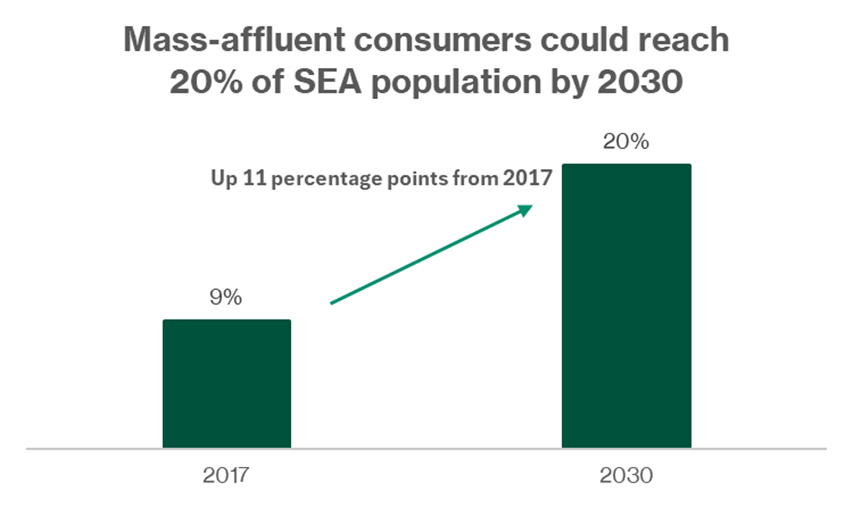
This is reflected in the growth of ASEAN’s middle and mass-affluent population.
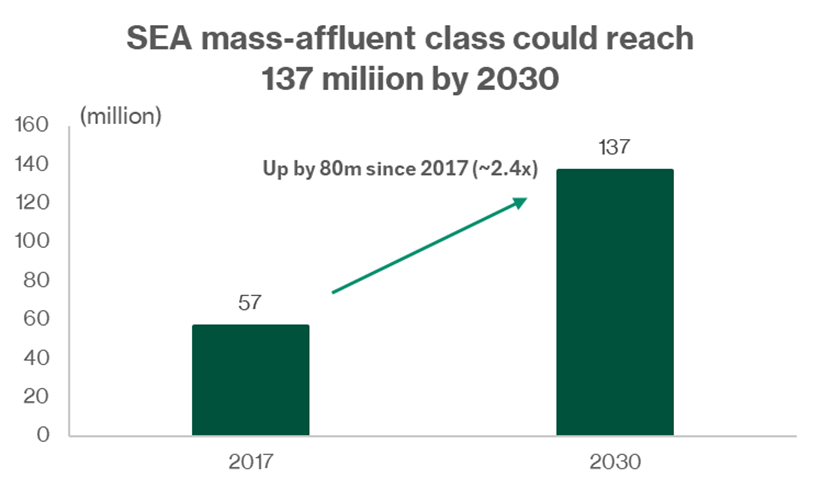
Boston Consulting Group estimates that this segment could expand from 57 million people in 2017 to 137 million by 2030, with the largest increases in Indonesia, the Philippines, Vietnam, and Thailand.
In Vietnam, the middle class is expected to expand rapidly according to Vietnam’s Ministry of Labour, Invalids and Social Affairs.
Meanwhile, Indonesia’s middle class is projected to make up more than half of the population by 2030.
With this rise in income levels, the opportunity set for investors expands across a wide range of sectors from everyday staples to discretionary spending and premium consumer brands.
2. Young demographics and rapid urbanisation
Southeast Asia has one of the youngest populations globally, and younger consumers tend to adopt new products, brands, and platforms more quickly.
By 2030, Gen Z and Millennials are expected to make up about half of consumers in Asia Pacific (Roland Berger, 2024).
Urbanisation is reinforcing this shift.
As more people move into cities, spending patterns change from traditional retail formats to modern trade, convenience-led consumption, and lifestyle services.
Indonesia, for example, is projected to be 60 percent urbanised by 2045 (UN, 2024), while Vietnam’s urban population continues to grow steadily.
This shift from rural to urban living is one of the strongest long-term tailwinds for ASEAN consumer companies.
3. The rise of e-commerce and social commerce
ASEAN’s consumer journey is also becoming increasingly digital.
This trend is evident in Southeast Asia’s e-commerce market, where platform gross merchandise value reached US$128.4 billion in 2024, up 12% year on year.
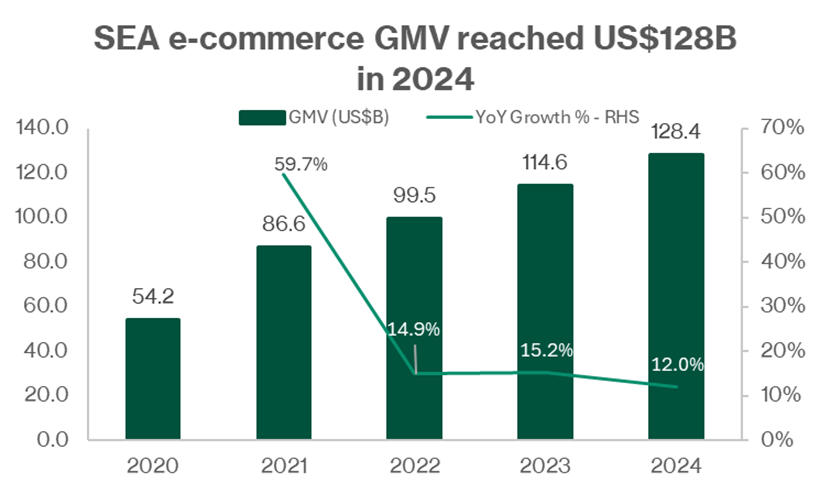
*GMV estimation covers only transactions on Shopee, Lazada, Tokopedia, TikTok Shop, Bukalapak, Tiki, Blibli, and Amazon SG. GMV estimated here includes all paid orders, including cancelled, returned and refunded orders.
According to Momentum Works’ Ecommerce in Southeast Asia 3.0 report, Shopee, TikTok Shop and Lazada accounted for more than 84 percent of platform e-commerce GMV in the region in 2024, with Shopee alone holding a 52 percent market share.
When we include non-platform channels such as brand websites, social media storefronts and messaging apps, Southeast Asia’s total e-commerce GMV reached US$145.2 billion in 2024, making up 12.8 percent of total retail. (Momentum Works, Ecommerce in Southeast Asia 3.0, June 2025).
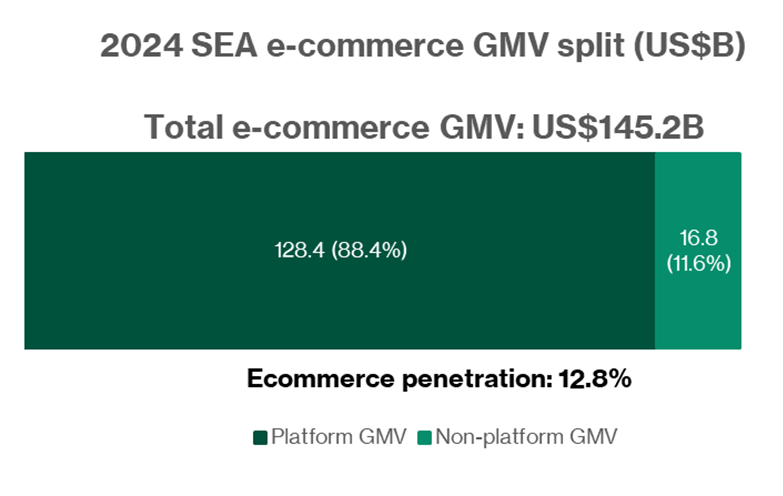
*Non-platform GMV includes transactions that happen on open-loop social platforms (e.g. Facebook), brand.com, multi-brand retailer sites/apps, cross border channels, as well as orders placed via chat platforms such as Whatsapp.
Thailand and Malaysia were the fastest-growing markets, with e-commerce GMV rising 21.7 percent and 19.5 percent, respectively.
Despite this growth, most retail spending still occurs offline, suggesting there is still significant room for further digital penetration.
4. Premiumisation
As incomes rise, ASEAN consumers are increasingly trading up across many categories, from premium instant noodles and artisan coffee to health supplements, imported skincare, and branded fashion.
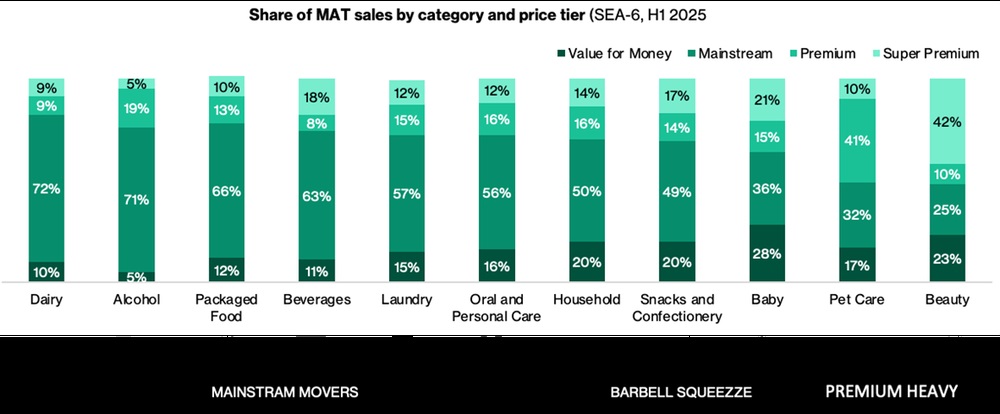
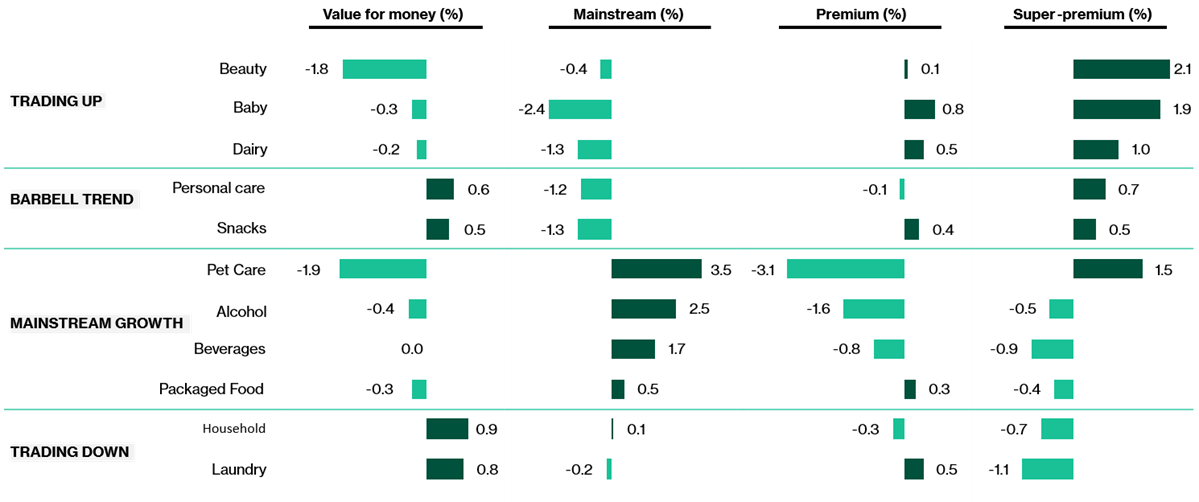
Bain and Company found that the luxury goods market in Southeast Asia grew at 6 percent annually between 2015 and 2021, and the trend has accelerated since (Bain and Company).
This matters for investors because companies that build strong premium brands often enjoy better margins, more loyal customers, and stronger pricing power over time.
5. Resilient domestic demand
One of the most attractive parts of the ASEAN consumer story is its resilience.
Even when external conditions weaken, domestic consumption has often helped support growth and recovery across the region.
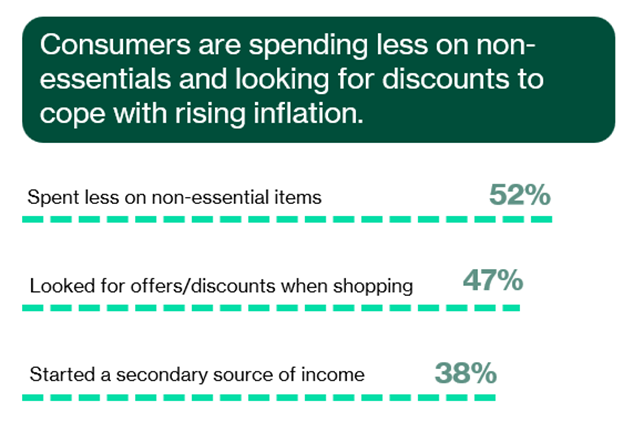
UOB’s ASEAN Consumer Sentiment Study 2024 found that 52 percent of consumers said they were spending less on non-essential items. That may be a near term headwind, but it sits against a much larger long-term trend driven by demographics, rising wages, and the aspirations of a growing middle class.
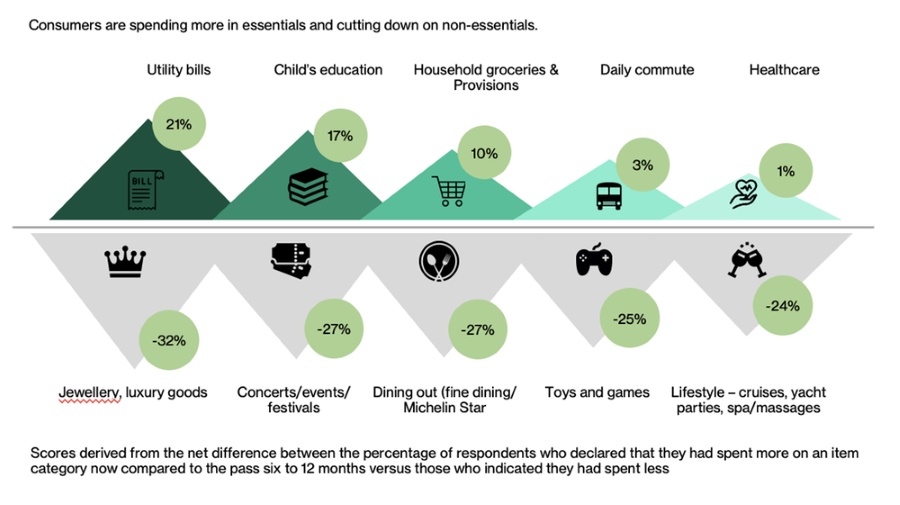
For long term investors, periods of weaker consumer sentiment can sometimes create more attractive entry points into strong consumer franchises.
What are the investment opportunities in ASEAN consumer stocks?
The ASEAN consumer theme is not a single, uniform investment idea.
It plays out across different sectors and at different stages of development in each market.
Rather than focusing on identifying one “perfect” stock, it can be more useful to map the theme across a range of listed companies that offer exposure to key shifts such as convenience-led spending, digital commerce, and premiumisation.
Below are two to three listed companies from each of the six major ASEAN markets that provide exposure to these trends.
These are shared for educational purposes only and do not constitute investment recommendations.
Singapore
Singapore is the most developed consumer market in ASEAN.
With high income levels and steady tourist inflows, consumer spending here is supported not just by local demand, but also by visitors' spending on shopping, dining, and personal care.
DFI Retail Group Holdings (SGX: DFIR)
DFI Retail gives investors broad exposure to everyday consumer spending across Asia through a single SGX-listed stock. Its brands span supermarkets, health and beauty, convenience stores, and food services, including Cold Storage, Giant, Guardian, 7-Eleven, and Maxim’s.
Sheng Siong Group (SGX: OV8)
Sheng Siong is one of Singapore’s best-known supermarket operators, with a strong presence in heartland neighbourhoods. Its focus on affordable fresh and dry groceries makes it a direct way to gain exposure to resilient household spending.
CapitaLand Integrated Commercial Trust (SGX: C38U)
For investors looking for exposure to Singapore retail spending through property, CapitaLand Integrated Commercial Trust, or CICT, stands out as the clearest listed proxy.
Its retail portfolio includes some of Singapore’s best-known malls, such as IMM, Bugis Junction, Tampines Mall, Funan, and ION Orchard. This gives investors exposure to both suburban and tourist-linked retail traffic.
Malaysia
Malaysia’s consumer backdrop has been relatively supportive.
The economy grew 5.2 percent in 2025, while household incomes continued to rise.
A stronger ringgit has also helped improve purchasing power and made Malaysian consumer stocks more attractive to foreign investors.
Padini Holdings Berhad (Bursa Malaysia: PADINI)
Padini is one of Malaysia’s best-known homegrown fashion retailers, with brands spanning footwear, apparel and children’s wear. Its different formats allow it to serve both mainstream and more value-focused shoppers.
Oriental Kopi Holdings Berhad (Bursa Malaysia: KOPI)
Oriental Kopi is one of Malaysia’s newer consumer listings and offers exposure to the growing appeal of lifestyle dining brands. Its kopitiam style cafés are located in high-traffic malls and popular urban destinations, giving it exposure to both local consumer spending and tourism.
CCK Consolidated Holdings Berhad (Bursa Malaysia: CCK)
CCK is an integrated food group with core strengths in poultry, seafood and food retailing, supported by a fully integrated supply chain from farming and processing to distribution. Its CCK Fresh Mart and CCK Local outlets provide a strong retail footprint, particularly in East Malaysia, allowing the group to capture recurring consumer spending on fresh and affordable protein. Beyond Malaysia, CCK has built a meaningful regional presence, with roughly 20% of sales coming from Indonesia and around 5% from Japan, providing geographic diversification.
The company is a constituent of the Bursa Malaysia Quality 50 Index.
Indonesia
Indonesia is ASEAN’s largest consumer market, with a population of about 280 million and household spending contributing more than half of GDP.
That makes it one of the clearest ways to gain exposure to rising incomes, urbanisation, and a growing middle class in the region.
PT Mayora Indah Tbk (IDX: MYOR)
Mayora is one of Indonesia’s best known consumer companies, with brands such as Kopiko, Roma, Torabika, and Energen sold both at home and overseas. Its products sit in everyday categories, which gives investors exposure to resilient household spending, while its export reach adds another layer of growth.
PT Mitra Adiperkasa Tbk (IDX: MAPI)
Mitra Adiperkasa, or MAP, is Indonesia’s leading lifestyle retailer. It operates a large network of stores across the country and carries a broad mix of international brands spanning fashion, sports, department stores, food and beverage, and lifestyle. Its brand roster includes Starbucks, Zara, Marks & Spencer, SOGO, SEIBU, Mango, and Converse.
PT MAP Aktif Adiperkasa Tbk (IDX: MAPA)
MAP Active is the sporting goods and active lifestyle arm of the broader MAP group. It gives investors more focused exposure to categories such as sportswear, footwear, and active lifestyle brands including Sports Station, Planet Sports, The Athlete's Foot, Golf House, Kidz Station, and Payless across Indonesia, the Philippines, Thailand, Malaysia, Vietnam, and Cambodia.
Thailand
Thailand’s consumer story is supported by both tourism and domestic spending, although the backdrop has become more mixed.
In 2024, the market enjoyed a strong recovery as international tourist arrivals rose to 35.5 million and tourism revenue climbed sharply. But 2025 has been softer, with foreign arrivals declining and GDP growth expected to slow. Even so, retail consumption has remained relatively supported by government measures and a still resilient domestic spending base.
CP All Public Company Limited (SET: CPALL)
CP All is Thailand’s dominant convenience retailer, operating the 7-Eleven network across the country. With nearly 16,000 stores, it is deeply embedded in the daily habits of Thai consumers.
Singapore-based investors can access CP All through its Singapore Depository Receipt (SGX: TCPD).
Central Retail Corporation (SET: CRC)
Central Retail is Thailand’s leading multi-format retailer, with exposure across department stores, supermarkets, wholesale, DIY, electronics, sports retail, and Vietnam’s GO! hypermarket network. Across Thailand, it operates Central and Robinson department stores, Tops supermarkets, GO Wholesale, Thaiwatsadu DIY, Power Buy electronics, and Supersports.
Singapore investors can access CRC via its Singapore Depository Receipt (SGX: CRCD).
Thai Beverage Public Company Limited (SGX: Y92 / SET: TBEV)
ThaiBev is one of Southeast Asia’s largest beverage companies, with exposure across spirits, beer, non-alcoholic drinks, and food. Its portfolio spans spirits (Chang, Ruang Khao, Hong Thong), beer (Chang, Sabeco brands in Vietnam), non-alcoholic beverages (Oishi, est cola), and food (KFC and Starbucks franchises in Thailand).
ThaiBev is primarily listed on SGX (SGX: Y92) and also on SET (SET: TBEV), making it one of the most accessible Thai consumer names for Singapore-based investors.
Through its 53.6% indirect ownership of Sabeco, ThaiBev also provides exposure to Vietnam's beer market.
Philippines
The Philippines is one of ASEAN’s more dynamic consumer markets, supported by a young population, steady remittance inflows, and strong brand loyalty.
Jollibee Foods Corporation (PSE: JFC)
Jollibee is the Philippines’ most recognisable consumer brand and one of Asia’s largest restaurant groups. Beyond its core Jollibee brand, it also owns a broad portfolio that includes Chowking, Mang Inasal, Greenwich, Coffee Bean & Tea Leaf, Highlands Coffee, Smashburger and Tim Ho Wan.
Puregold Price Club (PSE: PGOLD)
Puregold is one of the Philippines’ leading grocery retail groups, best known for its Puregold supermarkets and hypermarkets that serve both household consumers and small business owners such as sari-sari stores. The group also owns S&R Membership Shopping, a warehouse club format targeting middle- to higher-income consumers, giving it exposure across both value-oriented grocery retail and bulk membership-based retail.
Universal Robina Corporation (PSE: URC)
URC is one of the Philippines’ largest branded food and beverage companies, with products spanning snacks (Jack 'n Jill), biscuits, chocolates, beverages (C2), coffee (Great Taste) and noodles. Its brands are sold not only in the Philippines, but also across Southeast Asia.
Vietnam
Vietnam remains one of Asia’s most compelling consumer growth stories. As incomes rise and urbanisation continues, spending is shifting steadily from basic necessities towards modern retail, branded products, and lifestyle consumption.
Mobile World Investment Corporation (HOSE: MWG)
Mobile World is one of Vietnam’s leading retail groups, with exposure across electronics, home appliances, grocery, pharmacies, and baby products through brands such as The Gioi Di Dong, Dien May Xanh, Bach Hoa Xanh, An Khang, and AvaKids.
Vietnam Dairy Products Joint Stock Company, Vinamilk (HOSE: VNM)
Vinamilk is Vietnam’s leading dairy company and one of the country’s strongest consumer brands. Its products are sold widely across Vietnam and exported to dozens of overseas markets. According to Kantar Worldpanel, Vinamilk has been the most purchased dairy brand in Vietnam for 12 consecutive years.
Saigon Beer–Alcohol–Beverage Corporation, Sabeco (HOSE: SAB)
Sabeco is Vietnam's largest brewer and the maker of its most consumed beer brands — Bia Saigon, 333, and Bia Lac Viet. The company operates 26 plants with a total designed capacity of approximately 3 billion litres per year.
Key risks to watch out for
Even with a strong long term case, ASEAN consumer stocks can still be volatile because the region is exposed to several risks at once.
1) Macroeconomic and demand risks
ASEAN economies remain sensitive to slower growth in major markets such as China and the US, swings in commodity prices, and the impact of higher global interest rates on borrowing costs and consumer confidence. When conditions weaken, discretionary spending is usually hit first.
2) Regulatory and policy risks
Rules differ widely across ASEAN, and policy changes can be sudden. Shifts in import tariffs, wages, foreign investment rules, or sector regulations can quickly affect industry profitability. Vietnam’s tighter enforcement of drink driving laws, for example, created a near term headwind for beverage companies.
3) Currency and repatriation risks
For investors buying across the region, returns are also affected by moves in currencies such as the Thai baht, Indonesian rupiah, Philippine peso, Vietnamese dong, and Malaysian ringgit. A stronger US dollar can reduce USD-based returns when profits are converted back.
Putting the ASEAN consumer theme into perspective
The ASEAN consumer theme offers a broad and evolving set of opportunities, shaped by long-term structural shifts across income growth, demographics, and digital adoption.
Rather than treating it as a single investment idea, it can be helpful to build exposure across different markets and sectors, recognising that each country is at a different stage of development.
One approach is to invest directly in listed consumer companies on the respective ASEAN exchanges. The companies highlighted in this article, from DFI Retail and Sheng Siong in Singapore to MWG and Vinamilk in Vietnam, provide exposure to different parts of the region’s consumer growth story.
For Singapore-based investors, Singapore Depository Receipts listed on SGX can offer access to selected regional consumer stocks without needing to trade in multiple local markets.
For those seeking broader diversification, ETFs focused on ASEAN or individual country markets can also provide exposure to consumer growth alongside other sectors.
Regardless of the approach, it remains important to start with the fundamentals, including reviewing company announcements, financial results, and market data from official exchange websites such as SGX, Bursa Malaysia, IDX, SET, PSE and HOSE, before making any investment decision.
About ASEAN Exchanges
ASEAN Exchanges is a collaboration among the exchanges in the ASEAN countries with the objectives of promoting greater integration of the ASEAN capital markets, enhancing the visibility of ASEAN as an asset class, and strengthening ASEAN as an attractive investment destination for both ASEAN and global investors.
Current participating ASEAN exchanges (“Member Exchanges”) are Bursa Malaysia Berhad, Indonesia Stock Exchange, The Philippine Stock Exchange, Singapore Exchange, The Stock Exchange of Thailand, and Vietnam Exchange.
More information about ASEAN Exchanges can be found here.
Join the Beansprout Telegram group and Facebook group for the latest insights on Singapore stocks, REITs, bonds and ETFs.
Follow Beansprout on Youtube, Facebook and Instagram, and add Beansprout as your preferred source on Google so you never miss an update.
This article is for informational and educational purposes only and does not constitute investment advice. Investors should conduct their own due diligence and consult a qualified financial adviser before making any investment decisions.
Read also
Gain financial insights in minutes
Subscribe to our free weekly newsletter for more insights to grow your wealth
Most Popular

Comments
0 comments