
Attika Group - Singapore's interior fit-out specialist
Stocks
By Ng Hui Min • 21 Jul 2026
Global Wealth Technology Pte. Ltd. is regulated by the Monetary Authority of Singapore (MAS) as a licensed Financial Adviser.
'%3e%3cpath%20fill-rule='evenodd'%20clip-rule='evenodd'%20d='M17.64%209.20455C17.64%208.56637%2017.5827%207.95273%2017.4764%207.36364H9V10.845H13.8436C13.635%2011.97%2013.0009%2012.9232%2012.0477%2013.5614V15.8195H14.9564C16.6582%2014.2527%2017.64%2011.9455%2017.64%209.20455V9.20455Z'%20fill='%234285F4'/%3e%3cpath%20fill-rule='evenodd'%20clip-rule='evenodd'%20d='M9%2018C11.43%2018%2013.4673%2017.1941%2014.9564%2015.8195L12.0477%2013.5614C11.2418%2014.1014%2010.2109%2014.4205%209%2014.4205C6.65591%2014.4205%204.67182%2012.8373%203.96409%2010.71H0.957275V13.0418C2.43818%2015.9832%205.48182%2018%209%2018V18Z'%20fill='%2334A853'/%3e%3cpath%20fill-rule='evenodd'%20clip-rule='evenodd'%20d='M3.96409%2010.71C3.78409%2010.17%203.68182%209.59318%203.68182%209C3.68182%208.40682%203.78409%207.83%203.96409%207.29V4.95818H0.957273C0.347727%206.17318%200%207.54773%200%209C0%2010.4523%200.347727%2011.8268%200.957273%2013.0418L3.96409%2010.71V10.71Z'%20fill='%23FBBC05'/%3e%3cpath%20fill-rule='evenodd'%20clip-rule='evenodd'%20d='M9%203.57955C10.3214%203.57955%2011.5077%204.03364%2012.4405%204.92545L15.0218%202.34409C13.4632%200.891818%2011.4259%200%209%200C5.48182%200%202.43818%202.01682%200.957275%204.95818L3.96409%207.29C4.67182%205.16273%206.65591%203.57955%209%203.57955V3.57955Z'%20fill='%23EA4335'/%3e%3c/g%3e%3cdefs%3e%3cclipPath%20id='clip0_0_2849'%3e%3crect%20width='18'%20height='18'%20fill='white'/%3e%3c/clipPath%3e%3c/defs%3e%3c/svg%3e)
Make Beansprout your preferred source on Google
Add us on Google to see more of our insights in your search results
Attika Group is a Singapore-based commercial interior fit-out and Mechanical, Electrical and Plumbing (MEP) engineering services provider, helping to turn empty building spaces into usable offices, shops and commercial units.
Company Overview
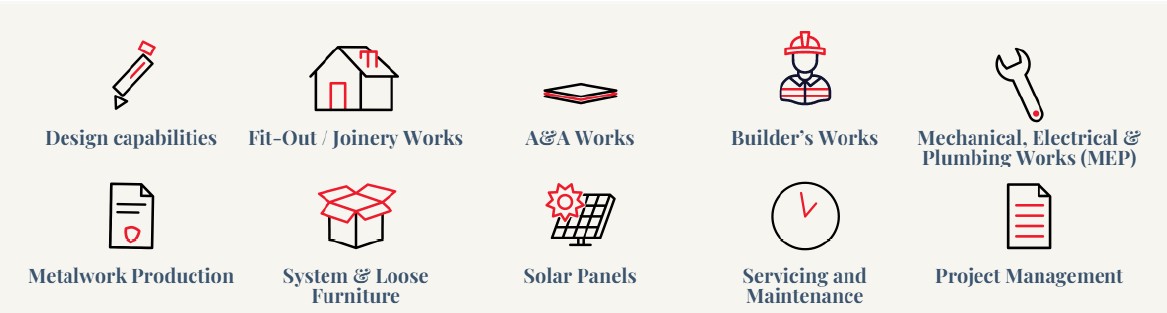
Attika Group is a Singapore-based company that provides commercial interior fit-out and Mechanical, Electrical and Plumbing (MEP) engineering services.
In simple terms, Attika helps turn an empty building space into a usable office, shop or commercial unit. Once the main structure of a building is completed, Attika installs the interiors and essential systems such as flooring, ceilings, lighting, air-conditioning, electrical wiring, plumbing and built-in furniture.
The company was founded in 2014 by Mr Steven Tan and was listed on the SGX Catalist board in November 2024.
One strength of Attika is that it can manage the entire fit-out process under one contract, from design to completion. This may make it more convenient for customers compared to working with multiple contractors.
Attika also holds nine BCA workhead registrations. Its highest grade is L6 in Interior Decoration and Finishing Works, which is the top tier in Singapore and allows the company to tender for public sector projects of any size.
This gives Attika an advantage over smaller competitors, which may not qualify for larger government projects due to lower BCA grades.
Client base and project profile
Attika serves two main groups of clients.
The first is the public sector, including government agencies and Singapore state-linked agencies such as the LTA, NLB, MND and MPA. The second is multinational corporations, including banks, law firms and large corporate occupiers.
Both groups contribute roughly equally to the company’s business.
Management has said that it avoids retail fit-out projects, such as luxury brands and F&B outlets, as well as hospital interior work. These segments are viewed as more commoditised and less attractive.
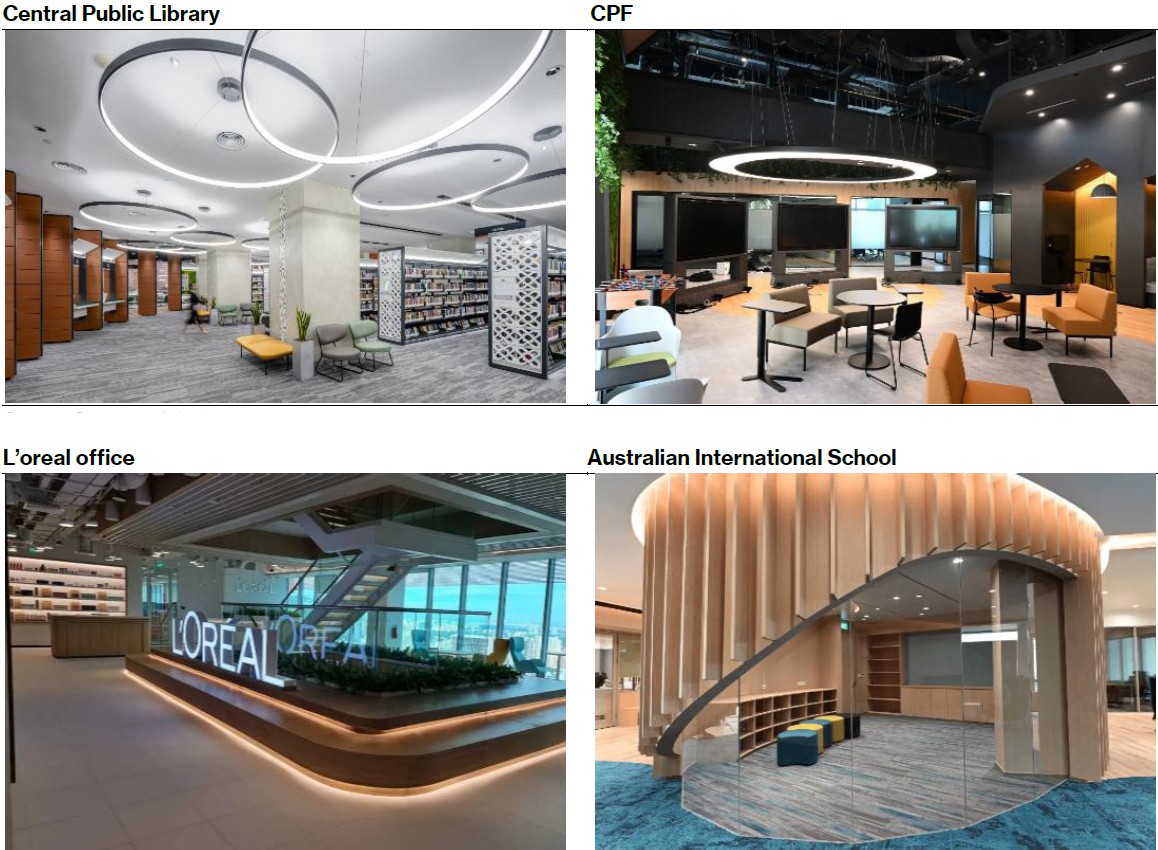
Attika’s typical project size ranges from about S$4 million to S$5 million for smaller jobs, and S$20 million to S$30 million for larger projects.
At any point in time, the company usually manages around five active projects, which management sees as the optimal workload.
Smaller projects typically take four to six months to complete, while larger projects of around S$20 million can take about a year.
What makes Attika different
Quality-weighted project selection, not price competition
Attika’s operating approach is to avoid competing mainly on price.
Management does not usually target public tenders where price makes up 70% to 80% of the evaluation score. Instead, it focuses on projects where quality carries a higher weighting, typically around 50% to 60%.
This matters because it allows Attika to compete on execution, design capability and reliability, rather than simply offering the lowest price.
It also helps the company protect its margins and avoid the intense price competition often seen in mass-market tenders.
Attika has an 8-person tendering team that reviews each opportunity based on its profit potential before deciding whether to bid.
If the expected margin is not attractive, the company is prepared to walk away rather than take on low-return work.
Data centre expertise, a higher-margin niche
Attika has built up experience in data centre fit-out over the past decade.
Its first major project in this segment was a S$40 million data centre in Singapore. Although Attika’s bid was higher than competitors, it was eventually awarded the job after other bidders were disqualified on technical or qualification grounds.
Data centre projects are different from standard office fit-out work.
They are typically awarded through invited tenders, with only a few qualified bidders. This reduces competition compared to open public tenders, where there may be more than 20 bidders.
Clients also place a high value on reliability because data centres cannot afford downtime or failures in electrical and mechanical systems during installation.
As a result, data centre fit-out work tends to command better margins than general office fit-out projects.
Integrated in-house delivery
Attika does more than just design and manage projects.
The company has its own carpentry workshop and around 100 full-time employees, including in-house carpenters, metalworkers and MEP engineers.
This sets it apart from firms that outsource most of the physical work to subcontractors.
By keeping more capabilities in-house, Attika can have better control over quality, timelines and costs. It also gives the company more flexibility when projects require faster turnaround or more customised work.
Attika also owns a worker dormitory that houses more than 60 employees, as well as a production and warehouse facility in Tuas.
These assets help reduce operating costs and give management closer oversight of its workforce and project execution.
Automated and systematic operations
Despite being a SME, Attika appears to have invested heavily in making its operations more systematic.
Management receives auto-generated financial updates twice a day through WhatsApp, while project progress is tracked through dedicated WhatsApp groups for each site.
The company also uses standardised workflows across departments, which helps reduce reliance on any single person.
FY2025 reported higher profit despite lower revenue
Attika’s FY2025 results show a business that became more profitable despite lower revenue.
Revenue fell 32.4% to S$37.5 million, mainly because FY2024 included the completion of a large corporate office project. This is not unusual for a project-based business, where revenue can be lumpy from year to year.
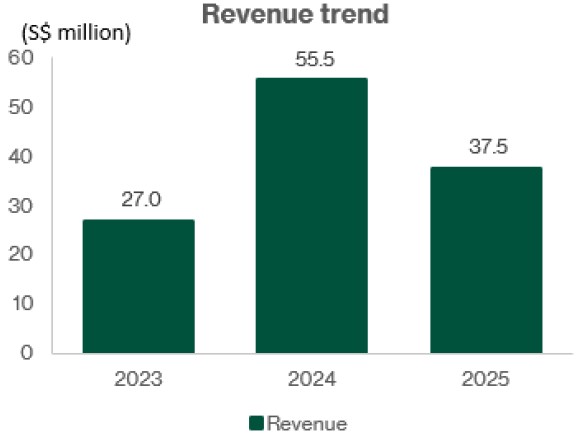
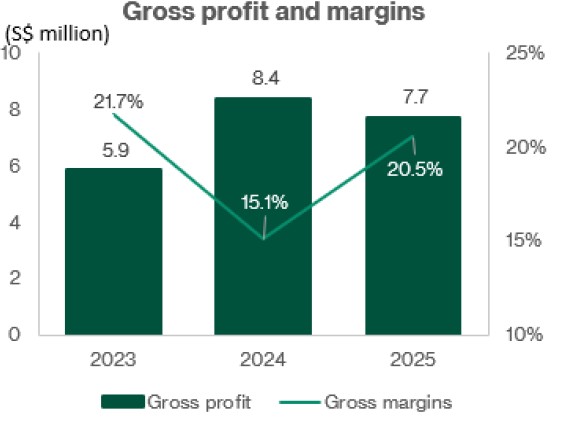
What is more important is that gross profit declined by only 8.0%, while gross margin improved from 15.1% to 20.5%. This suggests that Attika was able to take on better-margin projects and manage costs more effectively.
Administrative expenses also fell 26.3%, partly because FY2024 included about S$1.1 million of one-off IPO listing costs. Finance costs declined 35.0% as trade credit facilities were reduced.
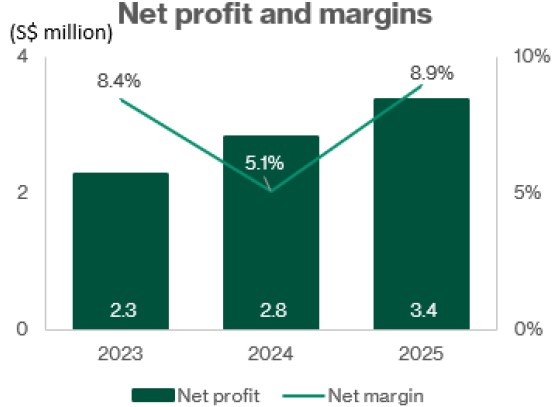
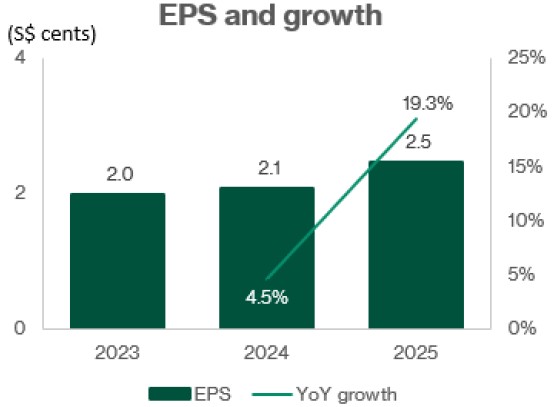
As a result, net profit rose 19.3% to S$3.4 million, even though revenue was lower. Net margin also improved from 5.1% to 8.9%.
In simple terms, Attika chose profitability over chasing revenue growth in FY2025. This is consistent with management’s approach of being selective about projects and avoiding low-margin work.
Free cash flow positive
Attika remained free cash flow positive in FY2025, although cash generation was lower than the previous year.
The business also remains asset-light in terms of ongoing capital expenditure. Capex was just S$51,000 in FY2025, reflecting a business model that relies more on people, skills and project execution than heavy machinery.
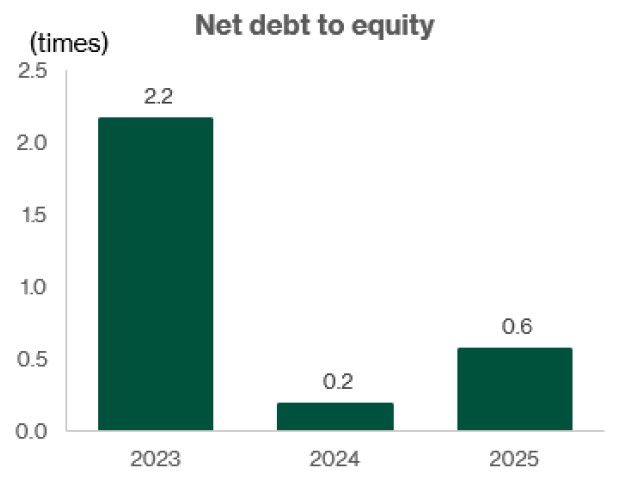
On the balance sheet, cash fell to S$6.8 million, partly due to the deposit paid for the Tagore Lane property. Bank borrowings rose to S$14.0 million, mainly due to the mortgage for this property. Net debt to equity is at 0.6 times.
The company owns industrial and commercial properties with a combined book value of S$8.4 million, as well as a worker dormitory and production facility.
Management has indicated that some industrial properties bought for about S$6.5 million could now be worth around S$15 million to S$16 million.
Order book and growth outlook
After a softer revenue year in FY2025, Attika appears to have rebuilt its growth pipeline.
The management said its order book stood at a record high of around S$76 million, giving the company about one year of revenue visibility.
Recent contract wins include data centre and clean room projects, a large 20-storey commercial office fit-out, a smaller office project, and an LTA-related bus interchange and commercial office project.
These projects are expected to be completed mainly between 2026 and 2027.
Attika’s bid win rate is around 50%, and management said that out of S$150 million to S$200 million of bids submitted, the company typically secures around S$100 million in orders.
Looking ahead, management expects net profit to grow by about 10% to 20% annually over the next three years.
Management and corporate culture
The founder, Mr Steven Tan, is the Executive Chairman, Managing Director and largest shareholder, with a stake of more than 70%. He also provides personal guarantees on the company’s bank loans and appears to play a central role in maintaining key client relationships.
Mr Tan started out as a steelworker before founding Attika in 2014. Since then, he has grown the company from two employees to more than 100 staff.
From our meeting with management, he appears to be deeply involved in operations. He understands how tenders are evaluated, how margins are protected, and how subcontractors are managed.
At the same time, his approach appears conservative. Management avoids aggressive overseas expansion, large acquisitions and revenue growth for its own sake. Instead, the focus is on profitable projects, cost discipline and long-term sustainability.
This can also be seen in Attika’s earlier decisions to buy properties instead of renting, and to own a worker dormitory to reduce long-term costs.
The company culture also appears tightly managed. Management has described a strong focus on attitude and execution, with employees expected to maintain a positive and reliable work ethic.
Staff benefits include annual overseas trips, a guaranteed 13th month salary plus bonuses, and birthday benefits. This suggests that while Attika is still an SME, it has tried to build a more stable and loyal workforce.
Industry and competitive landscape
Singapore’s construction market provides a supportive backdrop for Attika.
BCA expects construction demand in Singapore to remain strong at around S$39 billion to S$46 billion annually from 2027 to 2030. This is supported by major public infrastructure projects such as Changi Airport Terminal 5, Tuas Megaport and MRT extensions, as well as HDB housing, commercial real estate and data centre expansion.
This matters because interior fit-out work usually comes after the main construction phase.
Once a building is structurally completed, companies like Attika are typically brought in to make the interior space usable. This means construction activity today can be a leading indicator of future fit-out demand over the next one to three years.
Management also views BCA construction order data as one of the best proxies for demand in Attika’s niche.
Competitive positioning
Attika operates in a competitive but relatively specialised segment of Singapore’s construction market.
Management estimates that more than 40 companies hold the same BCA CR06 L6 licence, but only about 10 to 20 actively compete for similar interior fit-out projects.
Most of these competitors are local firms. Larger Japanese construction groups may be technically qualified, but they tend to focus on much larger infrastructure projects rather than commercial interior fit-out work.
Attika’s main edge is its ability to combine interior fit-out with MEP engineering, supported by its top-tier L6 licence and in-house delivery capabilities.
Its track record in data centre fit-out is particularly important. Data centres have stricter requirements because power reliability and execution quality are critical, and any downtime can be costly for clients.
Attika’s first major data centre project was a S$40 million assignment, where its bid was higher than competitors that were later disqualified. This suggests that clients in this niche may be willing to pay for technical capability and reliability, rather than simply choosing the lowest-priced bidder.
Growth strategy
Attika’s growth strategy appears deliberately disciplined rather than aggressive.
Disciplined organic growth
Management is targeting 10% to 20% annual net profit growth over the next three years, but this is not based on simply chasing more revenue. The company is constrained by the availability of qualified project managers, safety managers and planners, as new hires take about three months to become productive.
Attika usually manages around five projects at any one time, which management sees as the optimal workload. This helps the company maintain execution quality and protect margins, instead of over-stretching the team.
Bolt-on acquisitions of smaller competitors
The company is also exploring bolt-on acquisitions of smaller interior fit-out firms, each with annual revenue of around S$5 million. The main objective is to acquire experienced project teams, rather than just add revenue.
Management intends to integrate any acquired teams gradually, with existing managers retained for about three years to ensure cultural fit.
No regional expansion
Importantly, Attika does not plan to expand overseas. Management prefers to stay focused on Singapore, where it understands the regulatory environment and believes the market is large enough to support its growth targets.
Real estate as a capital preservation tool
Another part of the strategy is property ownership. Attika has used capital to buy industrial and investment properties, including its carpentry workshop, dormitory and the recently acquired 186 Tagore Lane property.
This helps reduce rental costs, preserve capital and build an asset base over time. Management has indicated that some of its industrial properties may now be worth significantly more than their original purchase cost, although this upside is not fully reflected in book value.
Dividend policy
Attika does not have a fixed dividend policy.
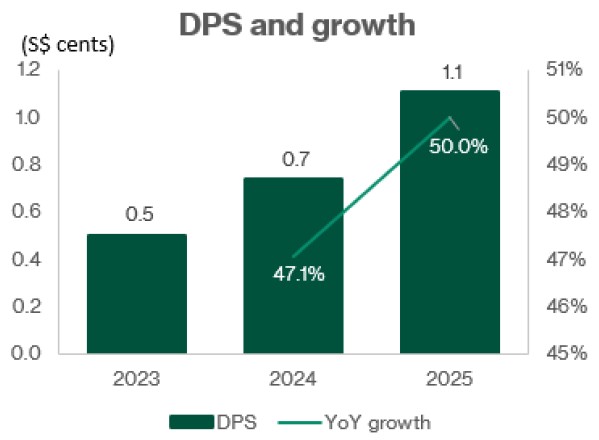
However, the Board has said it intends to recommend dividends of at least 35% of net profit attributable to shareholders for FY2026 and FY2027.
For FY2025, the Board recommended a final one-tier tax-exempt dividend of 1.1029 Singapore cents per share, subject to shareholder approval at the upcoming AGM.
This represents a 50% increase from the previous year.
Valuation
Attika Group trades at 15.8x P/E and 4.2x P/B, higher than peer average P/E of 9.7x but at a discount to the peer average P/B of 7.9x.
Its dividend yield of 2.8% is lower than peer average of 6.4%, while ROE of 26.5% is healthy but below the peer average of 41.2%, which is skewed by Lum Chang Creations’ very high ROE.

Attika on Beansprout's Opportunity Pot framework
Attika recorded an improvement in earnings and profitability in FY2025, alongside a higher order book and increased borrowings following a property acquisition.
FY2025 net profit rose 19.3% to S$3.36 million, despite a 32.4% decline in revenue. Gross margin increased from 15.1% to 20.5%, while net margin rose from 5.1% to 8.9%. Earnings per share increased from 2.07 cents to 2.47 cents.
As at February 2026, Attika’s order book stood at approximately S$76 million, providing visibility over its pipeline of contracted work.
As at December 2025, the company had net debt of approximately S$7.2 million and total equity of S$12.7 million. This represents a net debt-to-equity ratio of approximately 0.57 times, below the Opportunity Pot framework threshold of 1.0 times.
Net debt increased from S$1.9 million a year earlier, mainly due to the S$6.9 million acquisition of a property at Tagore Lane. Attika remained free cash flow positive in FY2025.
Return on equity was 27.3% in FY2024 and 26.6% in FY2025, compared with the framework baseline of 8%. Capital expenditure amounted to S$51,000 in FY2025, and the company has not raised additional equity since its listing.
Across the three areas assessed under the Beansprout Opportunity Pot framework, Attika recorded positive earnings growth, a net debt-to-equity ratio below 1.0 times and return on equity above 8%. However, borrowings increased following the Tagore Lane property acquisition.
Key risks
Key risks for Attika include founder dependence, low trading liquidity, higher property-related debt, personal guarantees on bank loans, and the need to maintain its BCA Grade L6 registration.
Related links:
Download the full report here.
Check out Beansprout guide to the best stock trading platforms in Singapore with the latest promotions to invest in Attika Group.
Join the Beansprout Telegram group for the latest insights on Singapore stocks, REITs, bonds and ETFs.
Important Disclosures
Analyst Certification and Disclosures
The analyst(s) named in this report certifies that (i) all views expressed in this report accurately reflect the personal views of the analyst(s) with regard to any and all of the subject securities and companies mentioned in this report and (ii) no part of the compensation of the analyst(s) was, is, or will be, directly or indirectly, related to the specific views expressed by that analyst herein. The analyst(s) named in this report (or their associates) does not have a financial interest in the corporation(s) mentioned in this report.
An associate is defined as (i) the spouse, or any minor child (natural or adopted) or minor step-child, of the analyst; (ii) the trustee of a trust of which the analyst, his spouse, minor child (natural or adopted) or minor step-child, is a beneficiary or discretionary object; or (iii) another person accustomed or obliged to act in accordance with the directions or instructions of the analyst.
Company Disclosure
Global Wealth Technology Pte Ltd (“Beansprout”) does not have any financial interest in the corporation(s) mentioned in this report.
Disclaimer
This report is provided by Beansprout for the use of intended recipients only and may not be reproduced, in whole or in part, or delivered or transmitted to any other person without our prior written consent. By accepting this report, the recipient agrees to be bound by the terms and limitations set out herein.
You acknowledge that this document is provided for general information purposes only. Nothing in this document shall be construed as a recommendation to purchase, sell, or hold any security or other investment, or to pursue any investment style or strategy. Nothing in this document shall be construed as advice that purports to be tailored to your needs or the needs of any person or company receiving the advice. The information in this document is intended for general circulation only and does not constitute investment advice. Nothing in this document is published with regard to the specific investment objectives, financial situation and particular needs of any person who may receive the information.
Nothing in this document shall be construed as, or form part of, any offer for sale or subscription of or solicitation or invitation of any offer to buy or subscribe for any securities. The data and information made available in this document are of a general nature and do not purport, and shall not in any way be deemed, to constitute an offer or provision of any professional or expert advice, including without limitation any financial, investment, legal, accounting or tax advice, and shall not be relied upon by you in that regard. You should at all times consult a qualified expert or professional adviser to obtain advice and independent verification of the information and data contained herein before acting on it. Any financial or investment information in this document are intended to be for your general information only. You should not rely upon such information in making any particular investment or other decision which should only be made after consulting with a fully qualified financial adviser. Such information do not nor are they intended to constitute any form of financial or investment advice, opinion or recommendation about any investment product, or any inducement or invitation relating to any of the products listed or referred to. Any arrangement made between you and a third party named on or linked to from these pages is at your sole risk and responsibility.
You acknowledge that Beansprout is under no obligation to exercise editorial control over, and to review, edit or amend any data, information, materials or contents of any content in this document. You agree that all statements, offers, information, opinions, materials, content in this document should be used, accepted and relied upon only with care and discretion and at your own risk, and Beansprout shall not be responsible for any loss, damage or liability incurred by you arising from such use or reliance.
This document (including all information and materials contained in this document) is provided “as is”. Although the material in this document is based upon information that Beansprout considers reliable and endeavours to keep current, Beansprout does not assure that this material is accurate, current or complete and is not providing any warranties or representations regarding the material contained in this document. All opinions contained herein constitute the views of the analyst(s) named in this report, they are subject to change without notice and are not intended to provide the sole basis of any evaluation of the subject securities and companies mentioned in this report. Any reference to past performance should not be taken as an indication of future performance. To the fullest extent permissible pursuant to applicable law, Beansprout disclaims all warranties and/or representations of any kind with regard to this document, including but not limited to any implied warranties of merchantability, non-infringement of third-party rights, or fitness for a particular purpose.
Beansprout does not warrant, either expressly or impliedly, the accuracy or completeness of the information, text, graphics, links or other items contained in this document. Neither Beansprout nor any of its affiliates, directors, employees or other representatives will be liable for any damages, losses or liabilities of any kind arising out of or in connection with the use of this document. To the best of Beansprout’s knowledge, this document does not contain and is not based on any non-public, material information. The information in this document is not intended for distribution to, or use by, any person or entity in any jurisdiction where such distribution or use would be contrary to law or regulation, or which would subject Beansprout to any registration requirement within such jurisdiction or country. Beansprout is not licensed or regulated by any authority in any jurisdiction or country to provide the information in this document.
As a condition of your use of this document, you agree to indemnify, defend and hold harmless Beansprout and its affiliates, and their respective officers, directors, employees, members, managing members, managers, agents, representatives, successors and assigns from and against any and all actions, causes of action, claims, charges, cost, demands, expenses and damages (including attorneys’ fees and expenses), losses and liabilities or other expenses of any kind that arise directly or indirectly out of or from, arising out of or in connection with violation of these terms, use of this document, violation of the rights of any third party, acts, omissions or negligence of third parties, their directors, employees or agents. To the extent permitted by law, Beansprout shall not be liable to you, any other person, or organization, for any direct, indirect, special, punitive, exemplary, incidental or consequential damages, whether in contract, tort (including negligence), or otherwise, arising in any way from, or in connection with, the use of this document and/or its content. This includes, without limitation, liability for any act or omission in reliance on the information in this document. Beansprout expressly disclaims and excludes all warranties, conditions, representations and terms not expressly set out in this User Agreement, whether express, implied or statutory, with regard to this document and its content, including any implied warranties or representations about the accuracy or completeness of this document and the content, suitability and general availability, or whether it is free from error.
If these terms or any part of them is understood to be illegal, invalid or otherwise unenforceable under the laws of any state or country in which these terms are intended to be effective, then to the extent that they are illegal, invalid or unenforceable, they shall in that state or country be treated as severed and deleted from these terms and the remaining terms shall survive and remain fully intact and in effect and will continue to be binding and enforceable in that state or country.
These terms, as well as any claims arising from or related thereto, are governed by the laws of Singapore without reference to the principles of conflicts of laws thereof. You agree to submit to the personal and exclusive jurisdiction of the courts of Singapore with respect to all disputes arising out of or related to this Agreement. Beansprout and you each hereby irrevocably consent to the jurisdiction of such courts, and each Party hereby waives any claim or defence that such forum is not convenient or proper.
Read also
Gain financial insights in minutes
Subscribe to our free weekly newsletter for more insights to grow your wealth
Most Popular

Comments
0 comments