
Thinking of investing your CPF? What to know about AutoWealth’s managed portfolios
Robo Advisor
Powered by

By Nicole Ng • 09 Oct 2026
Why trust Beansprout? We’ve been awarded Best Investment Website at the SIAS Investors’ Choice Awards 2025
'%3e%3cpath%20fill-rule='evenodd'%20clip-rule='evenodd'%20d='M17.64%209.20455C17.64%208.56637%2017.5827%207.95273%2017.4764%207.36364H9V10.845H13.8436C13.635%2011.97%2013.0009%2012.9232%2012.0477%2013.5614V15.8195H14.9564C16.6582%2014.2527%2017.64%2011.9455%2017.64%209.20455V9.20455Z'%20fill='%234285F4'/%3e%3cpath%20fill-rule='evenodd'%20clip-rule='evenodd'%20d='M9%2018C11.43%2018%2013.4673%2017.1941%2014.9564%2015.8195L12.0477%2013.5614C11.2418%2014.1014%2010.2109%2014.4205%209%2014.4205C6.65591%2014.4205%204.67182%2012.8373%203.96409%2010.71H0.957275V13.0418C2.43818%2015.9832%205.48182%2018%209%2018V18Z'%20fill='%2334A853'/%3e%3cpath%20fill-rule='evenodd'%20clip-rule='evenodd'%20d='M3.96409%2010.71C3.78409%2010.17%203.68182%209.59318%203.68182%209C3.68182%208.40682%203.78409%207.83%203.96409%207.29V4.95818H0.957273C0.347727%206.17318%200%207.54773%200%209C0%2010.4523%200.347727%2011.8268%200.957273%2013.0418L3.96409%2010.71V10.71Z'%20fill='%23FBBC05'/%3e%3cpath%20fill-rule='evenodd'%20clip-rule='evenodd'%20d='M9%203.57955C10.3214%203.57955%2011.5077%204.03364%2012.4405%204.92545L15.0218%202.34409C13.4632%200.891818%2011.4259%200%209%200C5.48182%200%202.43818%202.01682%200.957275%204.95818L3.96409%207.29C4.67182%205.16273%206.65591%203.57955%209%203.57955V3.57955Z'%20fill='%23EA4335'/%3e%3c/g%3e%3cdefs%3e%3cclipPath%20id='clip0_0_2849'%3e%3crect%20width='18'%20height='18'%20fill='white'/%3e%3c/clipPath%3e%3c/defs%3e%3c/svg%3e)
Make Beansprout your preferred source on Google
Add us on Google to see more of our insights in your search results
What to know about investing your CPF OA through AutoWealth, including its managed portfolios, risks, fees and key trade-offs.
This post was created in partnership with AutoWealth. All views and opinions expressed in this article are Beansprout's objective and professional opinions.
What happened?
I have been thinking about how I can build a more comfortable retirement.
As a result, I have been looking at how I can grow my CPF savings and potentially build a larger retirement nest egg over the long term.
One way is to invest part of my CPF savings for long-term growth, which within our Growth Pot means putting money that I can leave invested for many years to work through compounding.
Earlier, we shared about how the CPF Investment Scheme (CPFIS) works, and some of the considerations when investing using our CPF savings.
Before deciding how to invest my CPF OA, I would first consider whether I may need the savings for housing or other foreseeable needs. I would also weigh the potential for higher long-term returns against giving up the certainty of the CPF OA interest rate and taking on investment risk.
If I decide that investing part of my CPF OA makes sense, the next question is how I want to invest.
One option is to select and manage CPFIS investments myself. Another is to use a managed portfolio service such as AutoWealth.
In this article, I look at how AutoWealth’s managed CPF portfolios work, what they invest in, the fees and risks involved, and where a managed approach may fit compared with managing my CPF investments myself.
What you need to know about investing CPF savings through AutoWealth
#1 – What is AutoWealth?
AutoWealth is a Singapore-based digital wealth management platform that was founded in 2015.
Beyond individual investors, AutoWealth’s wealth management platform is also trusted by Fortune 500 companies to power their employee retirement programs.
For CPF investors, AutoWealth offers managed portfolios under the CPF Investment Scheme, with the portfolio recommendation based on factors such as investment horizon, financial needs and risk profile.
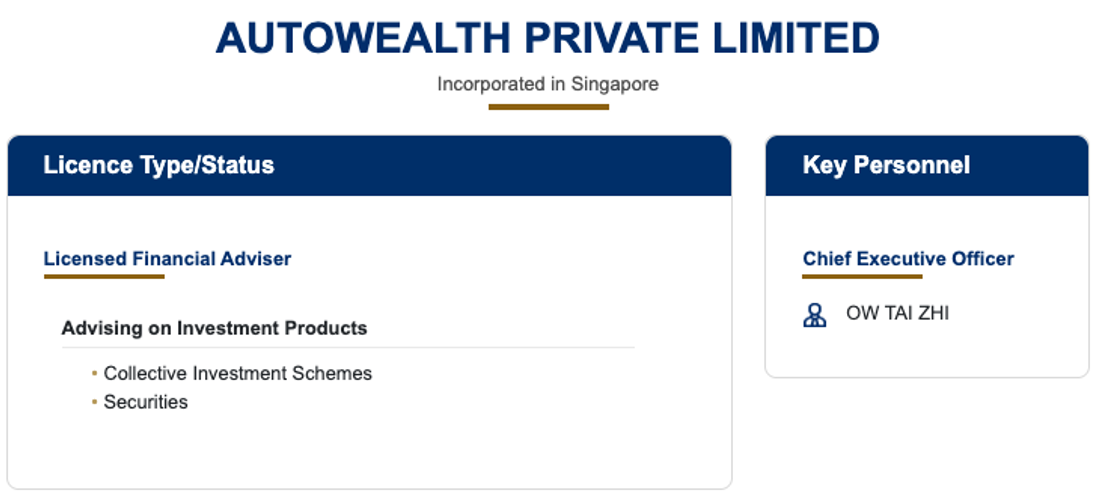
It is also licensed by the Monetary Authority of Singapore to provide financial advisory services.
#2 – How does AutoWealth determine which portfolio I get?
If I decide to invest part of my CPF OA, one of the first questions is how much investment risk I should take.
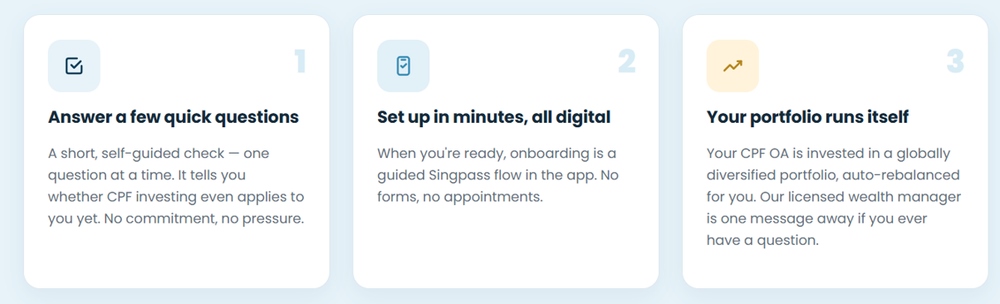
AutoWealth starts by considering factors such as my investment horizon, housing plans, financial goals and comfort with market fluctuations.
Based on these factors and my risk profile, I would then be matched to one of its managed CPF portfolios.
This means I would not need to select individual CPFIS-approved funds or decide on the asset allocation myself.
However, having the portfolio professionally managed does not remove investment risk, and I would still need to be comfortable with the risk level of the portfolio I am matched to.
#3 – What does AutoWealth invest my CPF OA savings in?
AutoWealth currently offers four CPF portfolios, ranging from Risk 2 (Conservative) to Risk 5 (Aggressive). Each portfolio has a different mix of equities and fixed income, depending on the level of investment risk I am comfortable taking.
At the more conservative end, the portfolio holds around 40% in equities and 60% in bonds, while the most aggressive portfolio has 100% equity exposure.
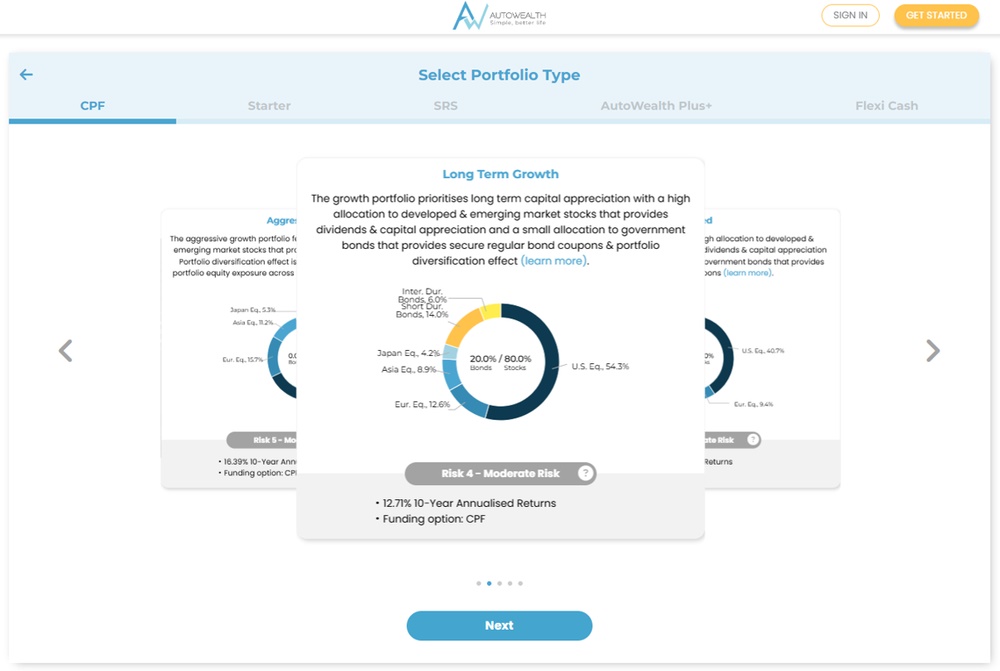
The portfolios are built using CPFIS-approved unit trusts that provide exposure to global stocks and bonds across developed and emerging markets.
This provides exposure across different countries and asset classes. However, I would still look through to the underlying funds and allocations to understand where the portfolio is actually concentrated.
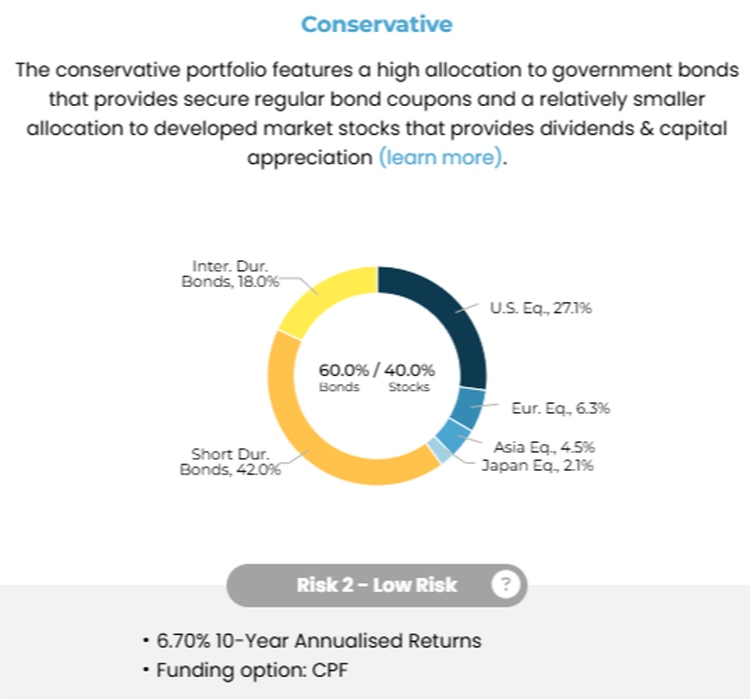
Generally, a higher bond allocation may help reduce portfolio volatility, while a higher equity allocation offers greater long-term growth potential but also comes with larger market swings.
Diversification does not eliminate investment risk, and the portfolio can still fall in value when markets perform poorly.
#4 – How is my portfolio managed over time?
Once I am invested, AutoWealth manages the portfolio on an ongoing basis, including monitoring the investments and rebalancing the asset allocation when needed.
The benefit of a managed approach is that I do not need to decide when to buy, sell or rebalance individual investments myself.
The trade-off is that I delegate more of the portfolio construction and investment decisions rather than making them myself.
At the same time, I can still monitor how my portfolio is performing through AutoWealth’s digital dashboard, giving me visibility over my investments even though the portfolio is professionally managed.
Professional management does not remove investment risk, so I would still need to be comfortable staying invested through market ups and downs.
#5 – How much does it cost to invest my CPF OA with AutoWealth?
Fees are particularly important when investing for retirement because even small annual costs can add up over many years.
AutoWealth charges a flat 0.28% p.a. advisory fee for its CPF portfolio management service. It also states that it absorbs brokerage transaction fees and rebates 100% of trailer fees received from the underlying fund managers back to investors.
There are also fees charged by the underlying unit trusts. AutoWealth currently indicates net underlying fund fees ranging from about 0.32% for its Risk 2 portfolio to 0.40% for its Risk 5 portfolio.
This means the recurring portfolio cost would be roughly 0.60% to 0.68% p.a., before any applicable CPF agent bank charges.
CPF agent bank charges may apply as well, including transaction charges when money is deposited or withdrawn and quarterly service charges.
AutoWealth batches multiple investment purchases into a single CPF transaction where possible. This means that if several investments are purchased for the portfolio at the same time, the applicable CPF agent bank transaction fee would generally be incurred once for the batch, rather than separately for each purchase.
This is why I would look at the total costs together with the CPF OA interest I am giving up, rather than considering the 0.28% advisory fee in isolation.
#6 – What happens if I need the money back in my CPF OA?
Another consideration is what happens if my plans change.
AutoWealth's CPF portfolios do not have a lock-in period.
If my circumstances change, I can request for my investments to be sold and the proceeds returned to my CPF OA, such as if I later need the funds for housing.
The money returned to my CPF OA would continue to be subject to the usual CPF rules on how OA savings can be used.
However, having the ability to sell does not mean I will always get back the amount I invested. If markets are down when I need the money, my portfolio could be worth less than what I initially invested.
I would therefore still treat CPF investing as a longer-term decision and avoid investing money I expect to need soon.
Does AutoWealth’s managed approach fit what I am looking for?
After understanding how AutoWealth works, I would focus on a few practical trade-offs when deciding whether its managed approach fits how I want to invest my CPF OA.
#1 – Does a managed investment approach suit me?
With AutoWealth, I would not need to select individual investments, determine the asset allocation or rebalance the portfolio myself.
This may be useful if I prefer a more hands-off approach.
The trade-off is that I give up some control over individual investment selection and portfolio decisions. If I prefer to choose and manage my CPF investments myself, a more self-directed approach may fit me better.
#2 – Do the investments and diversification fit what I am looking for?
AutoWealth's portfolios invest through CPFIS-approved unit trusts with exposure to equities and fixed income across developed and emerging markets.
I would consider whether these underlying investments and the resulting portfolio exposure match what I am looking for.
Diversification can reduce reliance on any single market or asset class, but it does not prevent losses. I would still want to understand where the underlying portfolio is concentrated.
#3 – Am I comfortable with the level of risk?
The amount of investment risk differs across AutoWealth's portfolios.
Rather than relying only on labels such as “conservative” or “aggressive”, I would consider the actual mix of equities and bonds and whether it matches my investment horizon and comfort with market fluctuations.
A higher equity allocation may offer greater long-term growth potential, but it can also result in larger market swings and losses.
#4 – Does the total cost make sense for the service provided?
AutoWealth's 0.28% p.a. advisory fee is not the only cost involved. Underlying fund fees and applicable CPF agent bank charges also need to be considered.
I would therefore look at the total cost alongside what the managed service provides, including portfolio construction, monitoring and rebalancing.
This matters especially over a long investment horizon, when recurring costs can add up.
What would Beansprout do?
If I decide to invest my CPF OA, I would compare the available CPFIS approaches based on what I am investing in, the level of diversification and risk, the total cost and how much portfolio management I want to do myself.
A managed approach such as AutoWealth may be relevant if I prefer not to select individual funds, determine my own asset allocation or manage portfolio rebalancing myself.
Its CPF portfolios combine CPFIS-approved funds with ongoing portfolio management, while allowing me to monitor my investments through its digital dashboard.
The trade-off is that I give up some control over individual investment selection and pay ongoing advisory and underlying fund fees.
I would also remain mindful that investing my CPF OA means taking on market risk. My investments could earn less than the prevailing CPF OA interest rate or fall in value.
Ultimately, before deciding, I would consider whether I may need my CPF OA for foreseeable needs, whether I am comfortable giving up the certainty of the CPF OA interest rate, how much investment risk I can take, and whether the cost and level of portfolio management suit what I am looking for.
If I am comfortable with those trade-offs, investing part of my CPF OA may give my retirement savings more opportunity to grow over the long term.
Disclaimers and Important Information
Investments always involve risks and the possibility of losses. Any reference to past performance is not necessarily indicative of and is no guarantee to the future or likely performance of your investments. This advertisement has not been reviewed by the Monetary Authority of Singapore.
Read also
Gain financial insights in minutes
Subscribe to our free weekly newsletter for more insights to grow your wealth
Most Popular

Questions and Answers
0 questions