
AI stocks are falling, but demand is still rising: Beansprout AI Tracker November 2026
Stocks
By Gerald Wong, CFA • 20 Nov 2026
Why trust Beansprout? We’ve been awarded Best Investment Website at the SIAS Investors’ Choice Awards
AI stocks have fallen sharply in November despite stronger earnings from Nvidia and cloud companies. We track five indicators to assess the AI investment outlook and rising financing risks.
What happened?
AI stocks have fallen further in November.
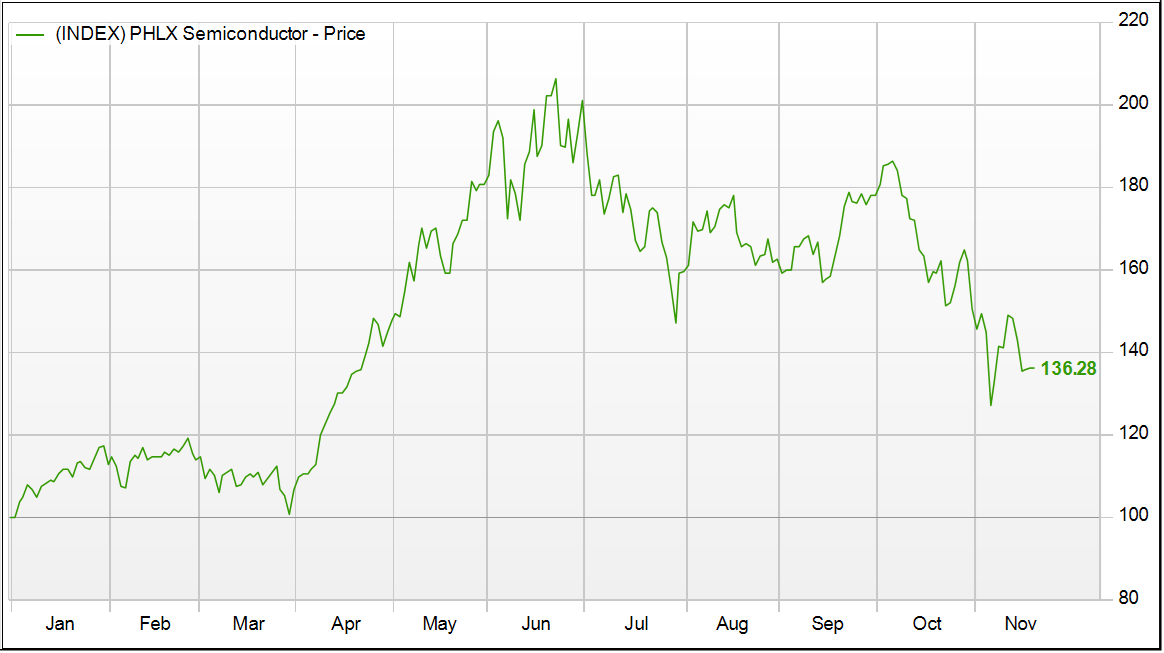
The global stock market sell-off intensified on 5 November, with the Philadelphia Semiconductor Index (SOX) falling about 12% and the Nasdaq Composite declining 5.5%.
The SOX had fallen about 38% from its 22 June peak as of 5 November, compared with the roughly 26% decline we highlighted in our October Beansprout AI Tracker.
Several developments have added to investors' concerns.
Following the US midterm elections, investors are weighing whether greater scrutiny of data centre construction and electricity consumption could affect AI infrastructure investment.
Nvidia has also entered a leadership transition after Jensen Huang stepped down as CEO, while new US export controls have raised uncertainty over AI chip shipments to China and Southeast Asia.
At the same time, the potential Anthropic IPO has brought attention to the rapid growth of AI companies and the substantial computing infrastructure needed to support them.
Yet the latest earnings suggest that demand for AI computing power remains strong. Nvidia reported revenue of US$115.8 billion on 17 November, doubling from a year ago, and raised its longer-term growth outlook.
This leaves us with an important question: are AI stocks falling because demand is slowing, or because investors are becoming more concerned about how the industry will finance its continued growth?
AI investment outlook: What is the Beansprout AI Tracker telling us in November?
We continue to see artificial intelligence (AI) as an important long-term investment theme, but the latest data presents a more mixed picture.
AI adoption, cloud revenue and semiconductor demand have strengthened. However, cash flow and financing indicators have continued to deteriorate.
Here is how our five indicators have changed since October.
| Indicator | October | November | What changed |
| 1. AI adoption and revenue | Supportive | Supportive | Business adoption reached a new high and cloud revenue growth accelerated |
| 2. Hyperscaler capital expenditure | Supportive, but worth watching | Supportive, but worth watching | 2026 spending plans remain intact |
| 3. AI semiconductor demand | Supportive, but worth watching | Supportive (upgraded) | Nvidia raised its outlook and TSMC reported record revenue, although export restrictions have widened |
| 4. Cash flow and financing | Watch | Watch (worsening) | Hyperscaler free cash flow turned negative and neocloud funding is under pressure |
| 5. Credit spreads | Watch | Watch (worsening) | Borrowing costs remain elevated, particularly for Oracle and Nvidia |
The biggest difference from October is that we now have stronger evidence of AI demand, alongside clearer signs that financing the expansion is becoming more challenging.
Let's look at what each indicator is telling us.
1. AI adoption and revenue: Supportive
AI adoption continued to rise in October, while Amazon, Microsoft and Alphabet reported stronger cloud revenue growth.
AI adoption reached another high
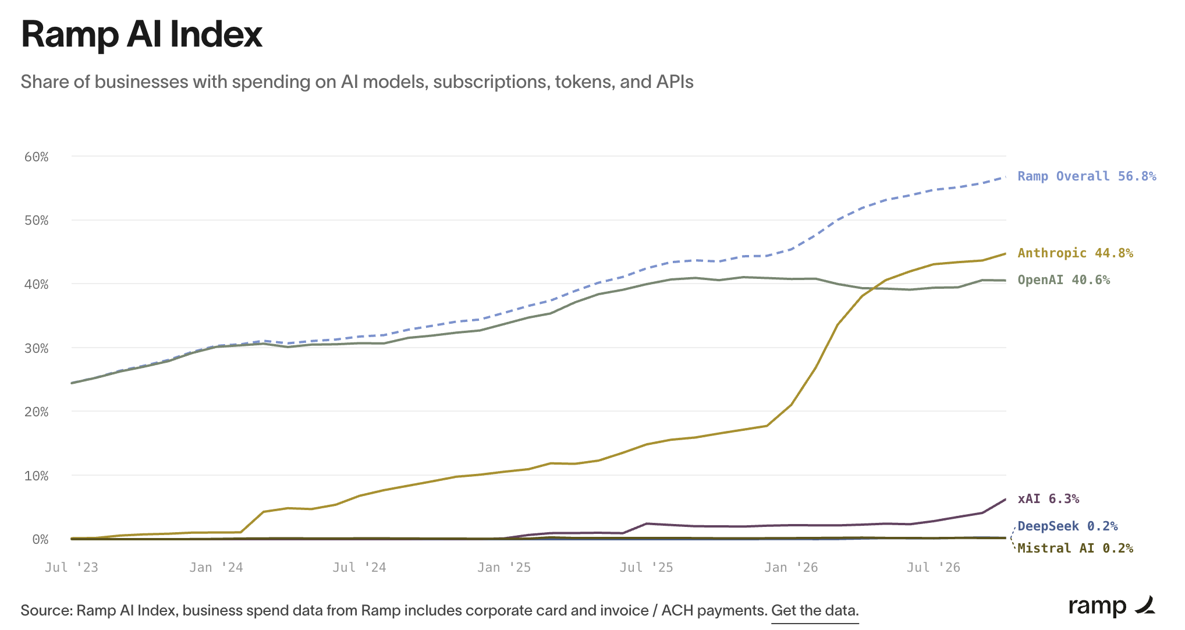
According to the Ramp AI Index, 56.8% of US businesses on Ramp paid for AI products in October, up 1 percentage point from September.
Anthropic adoption increased to 44.8%, while OpenAI remained at 40.6%. Overall AI spending also reached a new high, increasing 1.65% from September.
However, two developments are worth watching.
First, AI spending remains concentrated among larger users. Ramp estimates that the top 1% of businesses account for about 80% of spending on OpenAI and Anthropic.
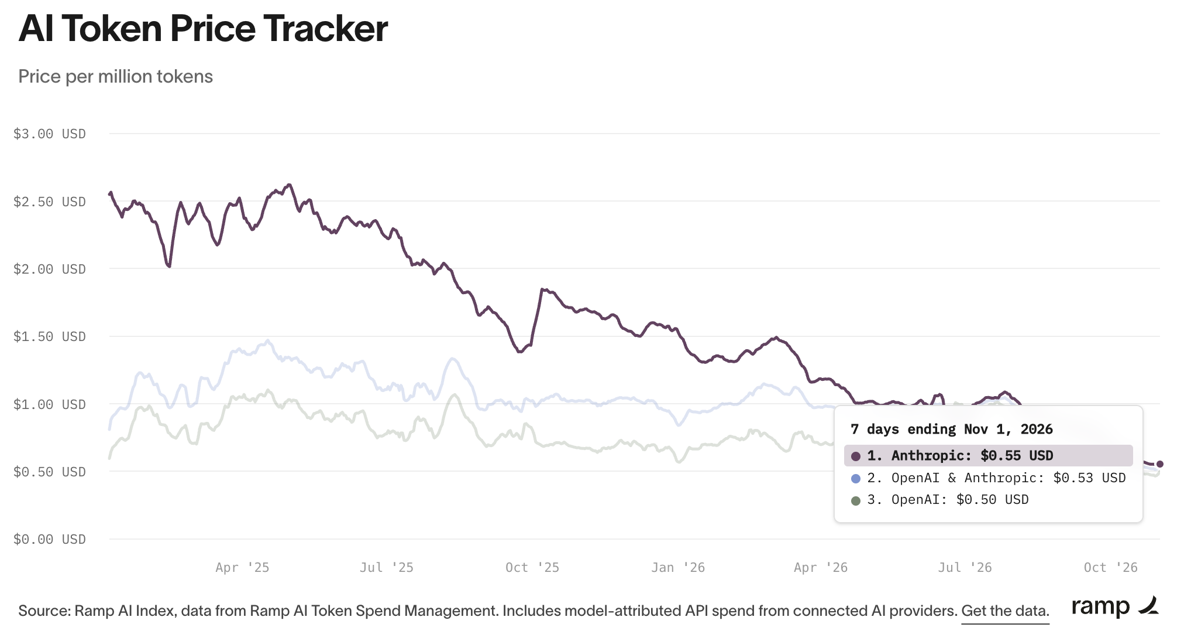
Second, the average price per million tokens fell about 21% in a month.
This suggests that while more businesses are using AI, revenue growth will increasingly depend on whether higher usage can offset lower prices.
Falling token prices are not necessarily negative. Nvidia has noted that cheaper AI computing encourages greater usage, which can lead to more demand for computing capacity.
For investors, the key question is whether this growing usage can translate into sustainable revenue and profits.
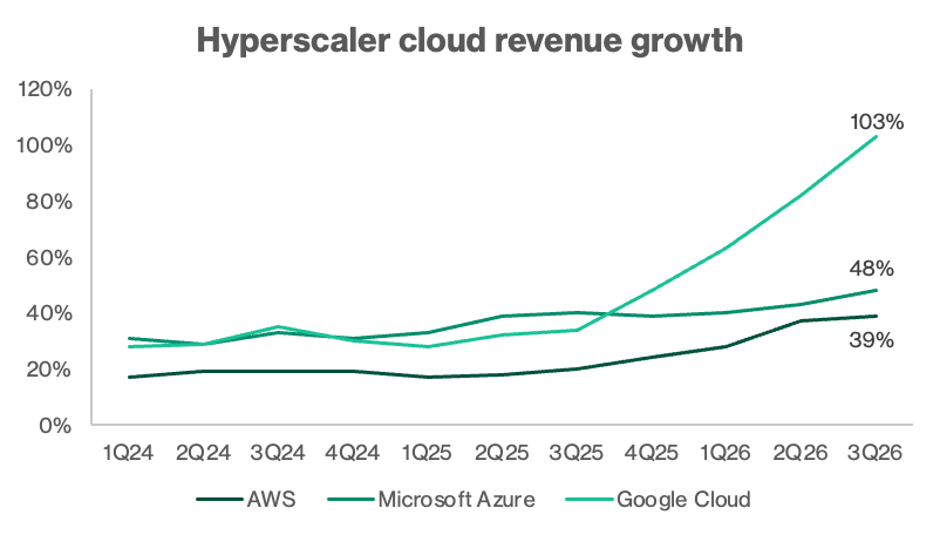
Cloud revenue growth accelerated
The latest results from the three major cloud providers suggest demand for AI infrastructure remains healthy.
| Cloud business | Q3 2026 revenue | Year-on-year growth |
| Amazon Web Services (AWS) | US$46.0 billion | 39% |
| Microsoft Azure | About US$33.2 billion | 48% |
| Google Cloud | US$30.7 billion | 103% |
AWS recorded its fastest growth in nearly five years.
Google Cloud's reported growth includes contributions from Wiz, acquired in March 2026, and sales of tensor processing unit systems, so not all the increase reflects organic cloud services growth.
Nevertheless, the acceleration across all three providers supports the view that demand for computing capacity remains strong.
Nvidia also reported that cloud revenue growth among its hyperscaler customers has accelerated for six consecutive quarters. Industry cloud backlog increased to US$2.5 trillion from US$2 trillion three months earlier.
We would become more cautious if AI adoption slows or if cloud revenue growth weakens while infrastructure spending continues rising.
2. AI capital expenditure: Supportive, but worth watching
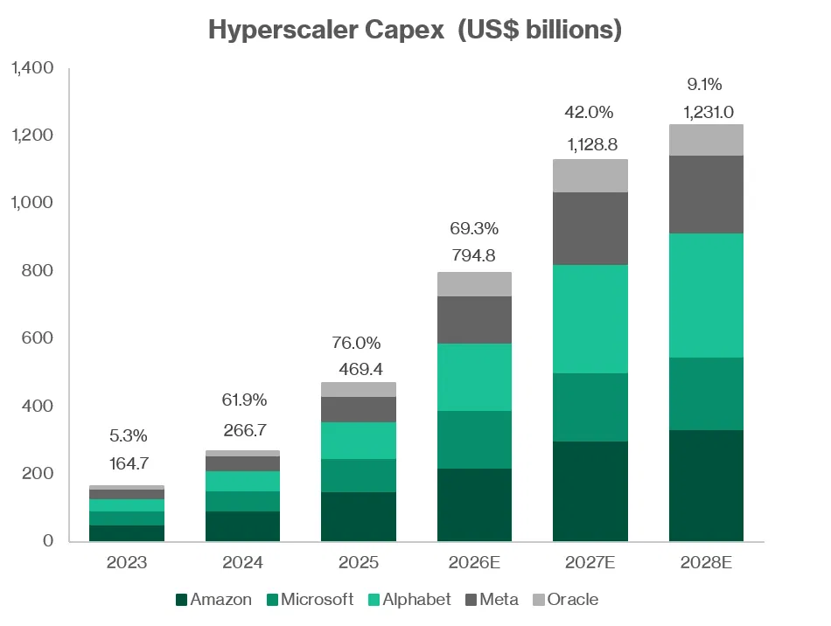
The largest US technology companies continue to invest heavily in AI infrastructure.
Following their third-quarter earnings, Amazon, Alphabet, Microsoft and Meta maintained combined 2026 capital expenditure guidance of approximately US$720 billion to US$740 billion.
| Company | Q3 2026 capital expenditure | 2026 guidance | Latest change |
| Amazon | US$77.3 billion | About US$220 billion | Maintained |
| Alphabet | US$51.4 billion | US$195-205 billion | Maintained; expects significant increase in 2027 |
| Microsoft | US$45.2 billion | About US$170 billion | Reduced from about US$175 billion |
| Meta | US$34.9 billion | US$135-145 billion | Narrowed previous range |
| Microsoft and Meta's figures include finance leases, while Amazon's figure is cash capital expenditure. | |||
Microsoft's small reduction reflected delays in third-party data centre capacity becoming available, rather than weaker demand.
Meanwhile, Alphabet expects its capital expenditure to rise significantly again in 2027.
This suggests that the major technology companies are not yet pulling back from AI infrastructure investment.
Could US politics affect AI investment?
Another risk is the possibility of tighter regulation following the US midterm elections.
Investors are paying closer attention to whether concerns over electricity consumption, data centre construction and local infrastructure could delay future projects.
Nvidia acknowledged the need to address community concerns surrounding data centres, while indicating that demand continues to extend into 2028.
We would turn more cautious if hyperscalers begin delaying projects or reducing spending plans because of weaker expected returns, financing constraints or new regulations.
3. AI semiconductor demand
Both Nvidia and Taiwan Semiconductor Manufacturing Company (TSMC) have reported stronger sales, even as concerns about export controls and Nvidia's leadership transition have increased.
Nvidia: Demand continues to exceed supply
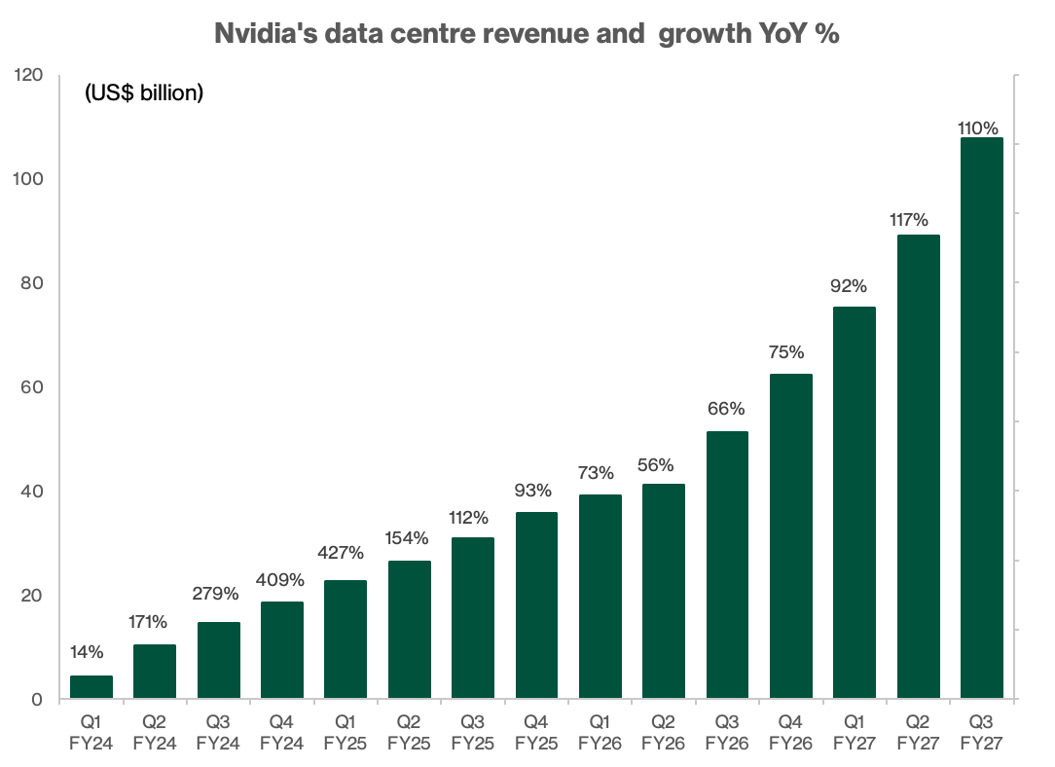
Nvidia reported another strong quarter for fiscal Q3 FY2027, covering August to October 2026.
| Metric | Fiscal Q3 FY2027 | What changed |
| Revenue | US$115.8 billion | Up 100% year on year |
| Data centre revenue | US$108 billion | Up 21% quarter on quarter |
| Non-GAAP gross margin | 74.90% | Above guidance |
| Q4 revenue guidance | US$130 billion, plus or minus 3% | Includes an extra week |
| Fiscal 2028 revenue growth outlook | About 75% | Raised from about 70% |
Three developments stand out.
First, Nvidia's new Vera Rubin platform generated nearly US$20 billion in its first quarter of shipments. Management described this as the fastest product ramp in the company's history.
Second, management indicated that supply remains the main constraint, rather than demand.
Nvidia's purchase commitments increased to US$390 billion as it secured additional manufacturing capacity.
Third, Nvidia reported that some older Hopper graphics processing units (GPUs) have been recontracted at up to twice their original rental prices.
This suggests there is still substantial demand for existing computing infrastructure, not just the latest chips.
Nvidia faces new leadership and export risks
Despite its strong results, Nvidia faces several risks that have become more prominent in November.
Following Jensen Huang's departure, chief financial officer Colette Kress has taken over as interim CEO.
The company has started searching for a permanent replacement, creating uncertainty over its longer-term leadership.
Meanwhile, the US government has expanded export restrictions on advanced AI chips.
These developments have not yet weakened Nvidia's demand outlook, but they could affect where its products can be sold and how quickly customers can build new data centres.
How will the new export controls affect Nvidia and Southeast Asia?
China already accounts for a relatively small share of Nvidia's latest reported revenue.
Nvidia sold US$2.4 billion of licensed Hopper data centre products to China in its fiscal third quarter, equivalent to about 2% of revenue.
Its fourth-quarter guidance assumes no further sales of these products to China.
The new concern is that export restrictions have also been extended to Southeast Asia.
On 16 November, the US Commerce Department introduced an interim rule requiring licences for certain advanced AI chip exports, re-exports and transfers to Singapore, Malaysia, Indonesia and Thailand, as well as Brazil.
The restrictions also seek to prevent Chinese companies from remotely accessing advanced chips installed in overseas data centres.
End users headquartered in the US, or owned by US-headquartered companies, are exempt under the rules described in the supplied material.
This may limit the direct impact on major US hyperscalers, but local data centre operators and non-US cloud providers could face additional licensing requirements.
TSMC reported record monthly revenue
TSMC's October revenue increased 59.7% from a year earlier to a record NT$586.9 billion.
Revenue was also 14.7% higher than September, while revenue for January to October increased 43.3%.
In October, TSMC raised its 2026 revenue growth forecast to approximately 44% in US dollar terms.
It also guided for fourth-quarter revenue of US$52.3 billion to US$54.3 billion.
October's revenue provides an encouraging indication of demand, although the remaining two months will determine whether TSMC meets its quarterly guidance.
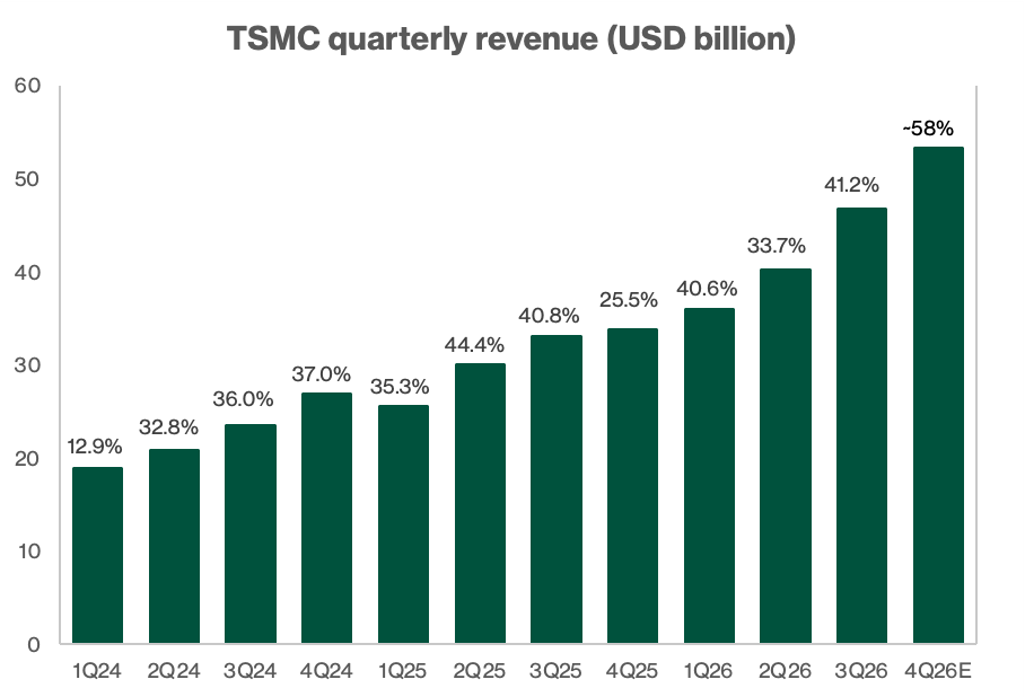
The latest results suggest demand for advanced chips remains strong, despite the market sell-off.
We would become more cautious if Nvidia lowers its outlook, export restrictions materially constrain sales, or TSMC's revenue begins falling short of expectations.
4. Cash flow and financing: Watch, worsening
While AI demand is strengthening, financing the infrastructure expansion is becoming more challenging.
In our October tracker, we highlighted forecasts suggesting that combined free cash flow at the major hyperscalers could turn negative.
That has now happened.
Hyperscaler free cash flow has turned negative
Combined free cash flow for Amazon, Alphabet, Microsoft, Meta and Oracle turned negative in the third quarter.
| Company | Latest quarterly free cash flow | Comment |
| Amazon | About -US$34.8 billion | Capital expenditure exceeded operating cash flow |
| Alphabet | -US$9.1 billion | Second consecutive negative quarter |
| Oracle | About -US$5.4 billion | Fiscal Q1, June to August 2026 |
| Meta | Negative | Capital expenditure exceeded operating cash flow |
| Microsoft | +US$18.6 billion | Only company in the group remaining positive |
Free cash flow is calculated as operating cash flow less purchases of property and equipment.
According to FactSet, combined free cash flow for these five companies is now forecast to fall from US$182.4 billion in 2025 to negative US$45.5 billion in 2026.
It is expected to deteriorate further to negative US$119.4 billion in 2027, before recovering to US$42.1 billion in 2028.
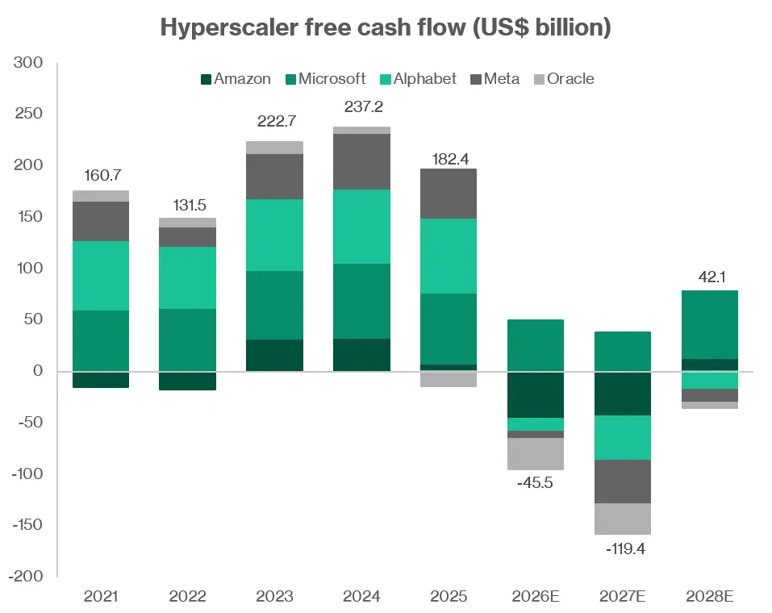
Negative free cash flow does not automatically indicate financial distress.
These companies still generate substantial operating cash flow and generally have strong balance sheets.
However, it means more of their AI infrastructure investment will need to be financed through debt or equity rather than internally generated cash.
Between 29 October and 4 November, five hyperscaler bond deals raised approximately US$67 billion.
Oracle also paired a US$10 billion bond sale with a US$10 billion equity offering.
The greater reliance on external financing makes borrowing costs increasingly important to the AI investment outlook.
Neoclouds face greater financing pressure
The financing challenge is even more pronounced among specialist AI cloud companies, sometimes called neoclouds.
Companies such as CoreWeave, Nebius and IREN provide GPU computing capacity to customers without having the same large, established businesses as Amazon, Microsoft and Alphabet.
As a result, they depend more heavily on external financing to build their infrastructure.
This model has come under pressure as borrowing costs have increased.
Shares of CoreWeave and Nebius have each fallen more than 50% over the past three months, while the yield on CoreWeave bonds issued in June has risen from around 9.6% to close to 15%.
Yet operating demand remains strong.
CoreWeave reported third-quarter revenue growth of 168%, while Nebius reported revenue growth of 571%.
This suggests the immediate concern is not whether customers want AI computing capacity. It is whether these companies can continue securing enough financing to build and operate it.
Why Nvidia's financing support matters
Nvidia has also become an important source of financial support for parts of the AI infrastructure ecosystem.
At the end of fiscal Q3, Nvidia had US$118 billion in total guarantees, including US$105 billion of credit support for a data centre campus leased to OpenAI.
Its neocloud-related commitments totalled US$32 billion, according to the supplied November input.
Following Nvidia's leadership change, investors have become more concerned about whether the company might reduce its support for customers.
Interim CEO Colette Kress indicated that Nvidia would continue supporting neocloud businesses, but would be more selective.
The company is prioritising customers that already have access to land, electricity, financing and contracted demand for computing capacity.
Nvidia also clarified that its guarantees apply only after customers have secured their own financing and completed the relevant facilities.
This suggests Nvidia is tightening its financing criteria rather than withdrawing from the market entirely.
For neoclouds, however, that distinction matters.
Companies with strong financial backing and committed customers may continue expanding, while weaker operators could face greater difficulty securing funding.
For Nvidia itself, tighter financing conditions among customers could eventually affect chip demand if projects are delayed.
We would become more concerned if hyperscaler operating cash flow slows, neocloud financing becomes more difficult, or infrastructure projects begin getting postponed because of funding constraints.
5. Credit spreads: Watch, worsening
Our fifth indicator examines the cost of borrowing for major AI-linked companies.
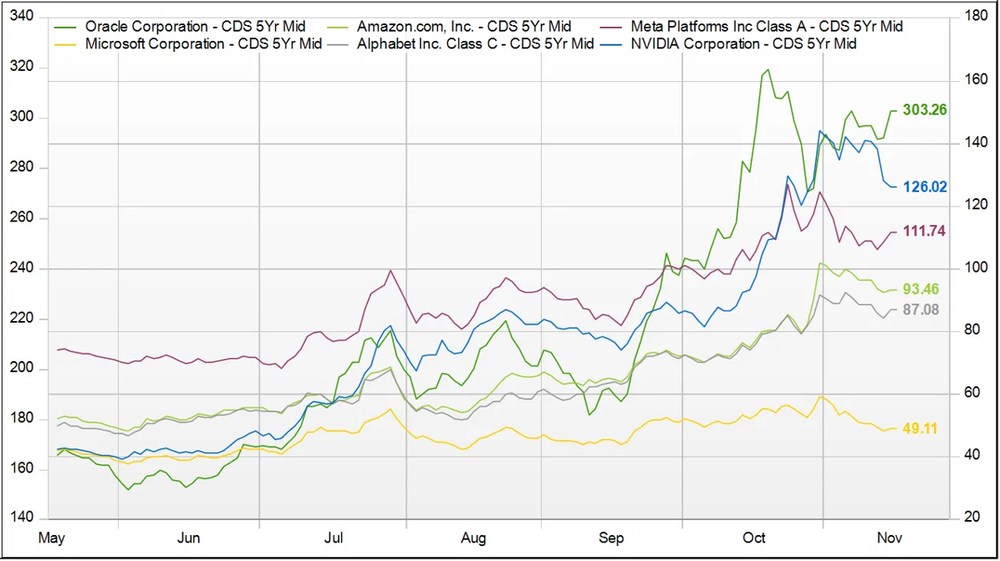
One measure we track is the five-year credit default swap (CDS) spread, which reflects the market cost of insuring debt against default.
Higher spreads generally indicate that investors are demanding more compensation for taking credit risk.
Borrowing costs have risen for several AI companies
Oracle has experienced the most significant increase in borrowing costs among the companies we track.
Its five-year CDS spread is close to the October peak of approximately 320 basis points.
Nvidia's spread has also risen sharply, reflecting growing attention to its financing exposure and other company-specific risks.
Microsoft remains an exception, with a relatively stable credit spread and positive free cash flow.
Why the difference between borrowers matters
The widening gap between companies suggests investors are becoming more selective about whom they are willing to finance.
Businesses with strong balance sheets and internally generated cash flow can generally borrow on lower borrowing costs.
Those with weaker cash flow or greater financing needs may face higher interest expenses, reducing the potential returns from new AI infrastructure investments.
Rising US government bond yields could add further pressure because corporate borrowing rates are generally priced above government bond yields.
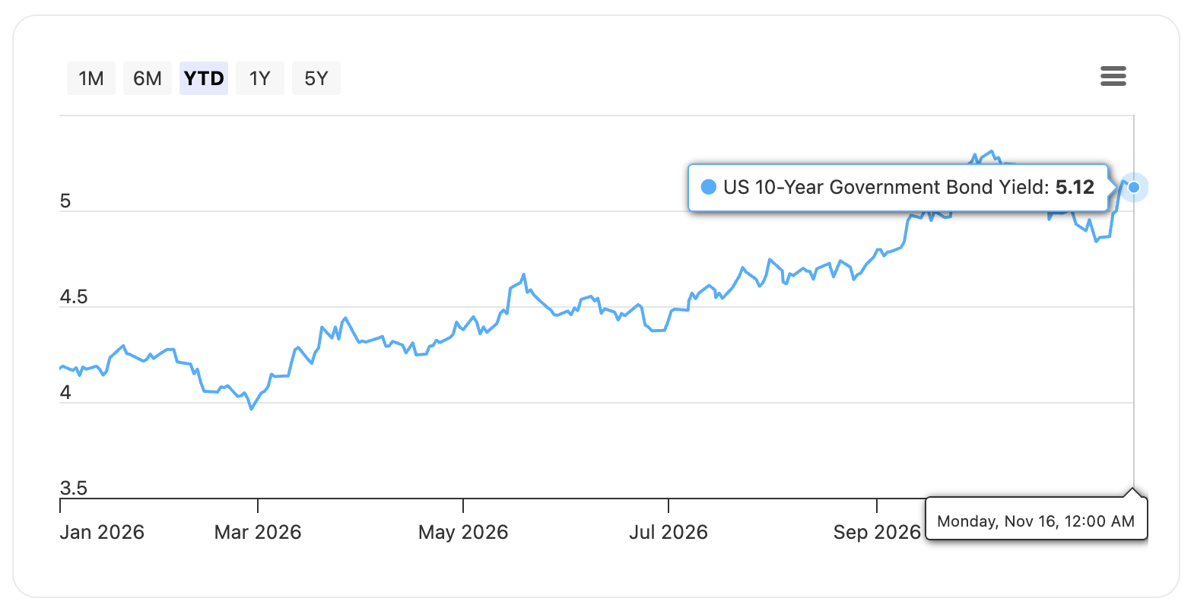
We are therefore paying more attention to whether credit spreads start widening across the financially stronger hyperscalers as well.
A sustained rise in borrowing costs for companies such as Microsoft, Amazon and Alphabet would be a more significant warning sign than pressure concentrated among more financially stretched borrowers.
What would Beansprout do?
The latest November data reinforces our view that AI demand remains strong, even though AI-related share prices have fallen sharply.
Business adoption continues to rise, cloud revenue growth has accelerated, and Nvidia and TSMC are still reporting strong demand for advanced semiconductors.
However, we would not interpret the recent sell-off as evidence that AI stocks have become attractively valued.
The more important development is that the cost of financing the industry's expansion is increasing.
Hyperscaler free cash flow has turned negative, neocloud companies are facing greater funding pressure, and credit spreads have widened for several AI-linked businesses.
We are also monitoring whether new export restrictions and political developments could slow data centre construction, particularly in Southeast Asia.
For us, this means remaining selective rather than turning negative on the long-term AI investment theme.
Within our Four Pots of Wealth framework, AI remains a theme we would consider under the Opportunity Pot.
We would focus on businesses with sustainable earnings growth, strong balance sheets and valuations that offer a reasonable trade-off between potential returns and risks.
We would be more cautious about companies whose growth depends heavily on continued access to borrowing, particularly when financing costs are increasing.
Given the volatility in AI-related stocks, we would also keep our exposure to the theme limited and avoid relying on leverage to fund investments.
For Singapore investors, the expanded US export controls are another reason to assess AI-related companies individually, rather than assuming every business exposed to data centre growth will benefit equally.
The key indicators we will continue monitoring are whether hyperscalers maintain their capital expenditure plans, whether financing conditions stabilise, and whether semiconductor orders remain strong.
If higher financing costs begin translating into delayed data centre projects, reduced spending guidance or weaker chip demand, we would become more cautious about the AI investment outlook.
For now, the underlying demand data remains supportive, but the risks surrounding how that growth is financed deserve closer attention.
Follow Beansprout on YouTube, Facebook and Instagram, and add Beansprout as your preferred source on Google so you never miss an update.
Read also
Gain financial insights in minutes
Subscribe to our free weekly newsletter for more insights to grow your wealth
Most Popular

Comments
0 comments