
Is the AI boom losing momentum? 5 indicators we're tracking: Beansprout AI Tracker
Stocks
By Gerald Wong, CFA • 25 Oct 2026
Why trust Beansprout? We’ve been awarded Best Investment Website at the SIAS Investors’ Choice Awards 2025

Make Beansprout your preferred source on Google
Add us on Google to see more of our insights in your search results
Can the AI boom continue or are we heading towards an AI bubble? We assess the AI investment outlook through five indicators, from adoption and Nvidia chip demand to tech spending, cash flow and borrowing costs.
What happened?
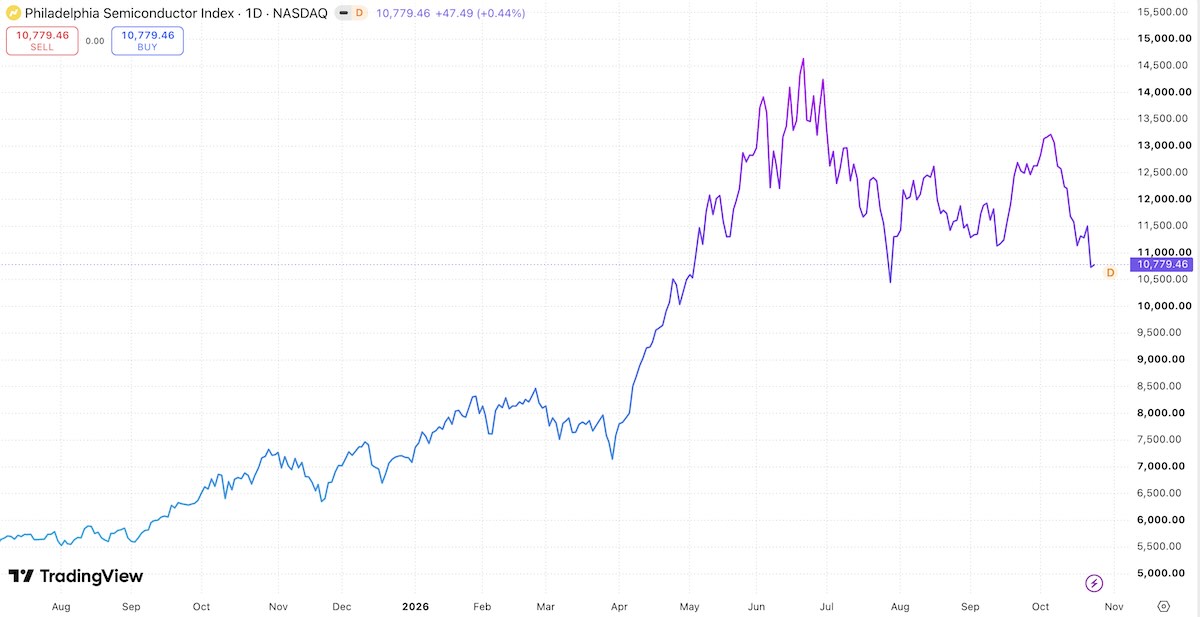
After years of driving markets higher, artificial intelligence (AI) stocks are facing a sharp pullback.
The Philadelphia Semiconductor Index, or SOX, has fallen about 26% from its June peak. The SOX tracks major semiconductor companies and is widely followed as a gauge of the chip sector.
The pullback has also been seen across popular AI related semiconductor stocks, with Micron, AMD and SK Hynix all trading well below their recent peaks.
Earlier, we examined whether the AI rally had gone too far, weighing the growth supporting the AI theme against warning signs that expectations may be running ahead of fundamentals.
The scale of AI investment raises an important question: Can the AI boom continue, and are companies generating sufficient returns from the money they are spending?
As global bond yields rise, higher financing costs could make new AI infrastructure projects harder to justify, even as growing adoption and demand for computing infrastructure support the longer-term opportunity.
Rather than focusing solely on whether AI stocks are rising or falling, we believe it is more useful to monitor whether the underlying fundamentals supporting the AI investment cycle remain healthy.
This is why we have developed the Beansprout AI Tracker, which brings together five indicators to assess the strength of the investment cycle and identify where risks may be building.
How we assess the AI investment outlook: Introducing the Beansprout AI Tracker
The Beansprout AI Tracker is our framework for assessing whether the AI investment cycle is strengthening or weakening.
We monitor five indicators:
- AI adoption and revenue
- Hyperscaler capital expenditure
- AI semiconductor demand
- Cash flow and financing
- Major US hyperscalers credit spreads
Together, these five indicators help us track the AI investment cycle, from adoption and infrastructure spending to the revenue and returns generated.
AI investment is also one of the five indicators in our broader Beansprout Investment Climate, reflecting its growing influence on economic activity and markets.
No single indicator tells the full story. Rising capital expenditure may be positive if demand and returns remain strong, but more concerning if revenue growth, cash flow or returns begin to weaken.
By looking at the indicators together, we aim to identify whether the AI investment environment remains supportive or is starting to deteriorate.
AI investment outlook: What is the Beansprout AI Tracker telling us now?
Based on our latest assessment, we continue to see AI as an important long-term investment theme.
AI adoption is expanding, while major technology companies remain committed to investing in the infrastructure needed to support future growth.
However, the investment cycle is entering a phase where the returns generated from AI spending are becoming increasingly important.
With capital expenditure reaching unprecedented levels and borrowing costs rising, we believe investors will pay closer attention to whether companies can turn their investments into sustainable revenue, free cash flow and profits.
Here is our current assessment of the five indicators, based on the evidence reviewed through September and our October investment outlook.
| Indicator | Our assessment | What we're watching |
| 1. AI adoption and revenue | Supportive | Whether AI adoption continues expanding and translates into growing revenue |
| 2. Hyperscaler capital expenditure | Supportive, but worth watching | Whether major technology companies maintain their spending plans |
| 3. AI semiconductor demand | Supportive, but worth watching | Whether Nvidia and TSMC continue reporting strong sales growth and guidance |
| 4. Cash flow and financing | Watch | Whether rising investment leads to deteriorating free cash flow or greater dependence on debt |
| 5. Major US hyperscalers credit spreads | Watch | Whether widening credit spreads increase borrowing costs |
Let's take a closer look at each indicator.
1. AI adoption and revenue: Are more businesses paying to use AI?
The first indicator we monitor is whether AI adoption is continuing to grow.
This matters because the long-term success of the AI investment cycle ultimately depends on whether businesses and consumers find sufficient value in using AI products and services.
There are encouraging signs.
As the chart below shows, the proportion of US businesses spending on AI models, subscriptions, tokens and APIs has increased significantly over the past few years.
Data from Ramp indicates that AI adoption among businesses has continued rising, with spending extending across providers such as OpenAI, Anthropic and Google.
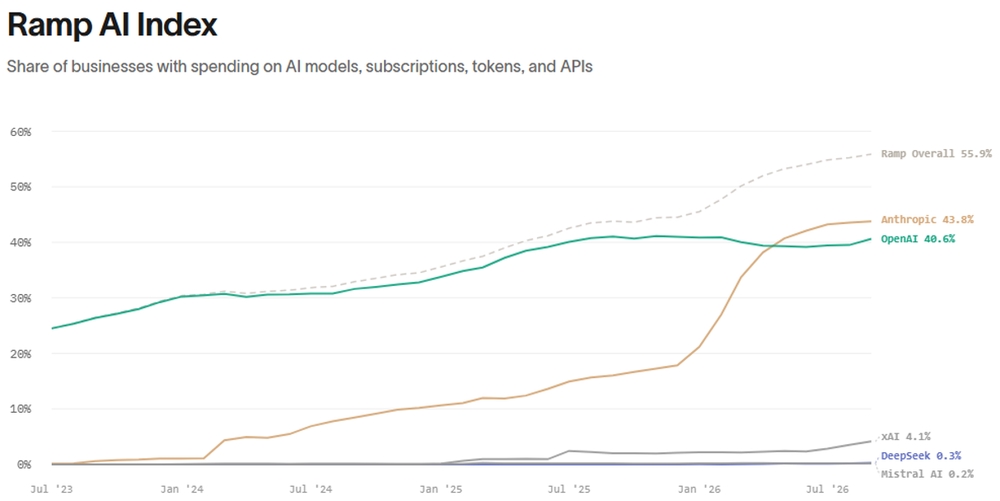
This suggests that AI is increasingly being used in actual business operations, rather than remaining a technology that companies are merely experimenting with.
However, growing adoption alone does not guarantee that AI companies will generate attractive returns.
The second consideration is whether this adoption translates into growing revenue.
Is AI adoption translating into higher revenue?
We are also monitoring revenue growth at major cloud providers, including Amazon Web Services (AWS), Microsoft Intelligent Cloud and Google Cloud.
These businesses provide much of the computing infrastructure supporting AI applications.
As the chart below shows, revenue across these major cloud businesses has increased significantly over the past several years.
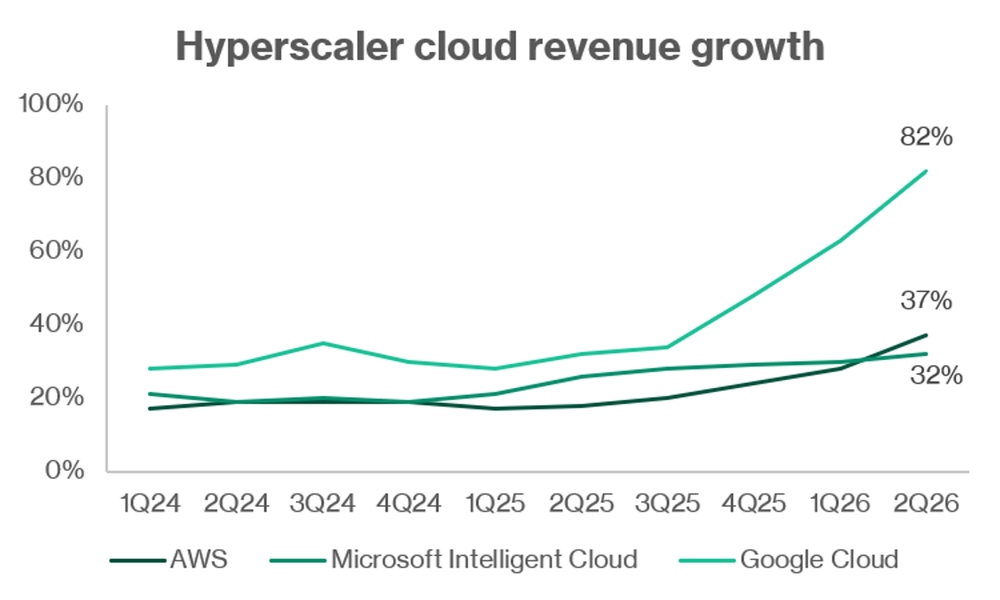
Importantly, cloud revenue includes services unrelated to AI.
Nevertheless, trends in cloud revenue can help us assess whether demand for computing infrastructure remains healthy.
We would become more cautious if AI adoption begins slowing, or if growing usage fails to translate into sustainable revenue growth.
For now, we believe increasing adoption and cloud revenue remain supportive of the longer-term AI investment outlook.
2. AI capital expenditure: Will the AI spending continue?
The second indicator we monitor is capital expenditure by major technology companies.
These companies, often referred to as hyperscalers, have been investing heavily in data centres, advanced semiconductors, networking equipment and other infrastructure required to support AI.
Their investment plans are particularly important because they account for a significant proportion of demand across the AI infrastructure supply chain.
We track the capital expenditure of five major companies: Microsoft, Alphabet, Amazon, Meta and Oracle.
AI infrastructure spending is expected to continue growing
As the chart below shows, combined capital expenditure among these companies has increased significantly.
According to FactSet estimates from September 2026, their combined capital expenditure was projected to increase from approximately US$412 billion in 2025 to US$806 billion in 2026.
Spending was forecast to rise further to approximately US 1.1 trillion in 2027 and US 1.3 trillion in 2028.
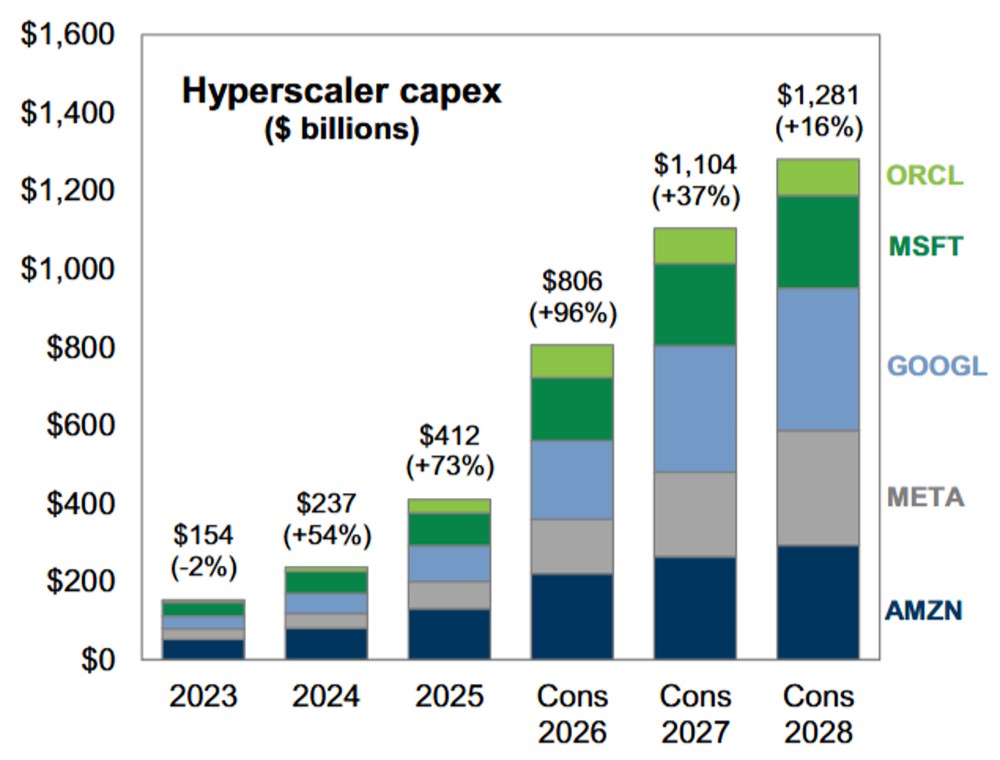
The figures represent total capital expenditure by the selected hyperscalers, rather than spending exclusively on AI.
While these forecasts suggest that investment will remain substantial, there is an important distinction between the amount of spending and its rate of growth.
Based on the September estimates, capital expenditure growth was expected to moderate from approximately 94% in 2026 to 34% in 2027 and 22% in 2028.
Slower growth does not necessarily indicate a deterioration in the investment outlook.
As the total amount being invested becomes larger, it is natural for percentage growth rates to moderate.
However, investors may become more cautious if hyperscalers begin reducing their spending forecasts because demand is weaker than expected.
This could affect companies across the AI supply chain, including semiconductor manufacturers, data centre operators and infrastructure providers.
What would concern us?
One of the clearest warning signs would be a sustained downward revision in capital expenditure forecasts.
For example, if several major hyperscalers begin reducing their spending plans or delaying data centre projects, this could suggest that the investment cycle is losing momentum.
Conversely, continued investment supported by healthy revenue growth would suggest that companies remain confident in longer-term demand.
3. AI semiconductor demand: What are Nvidia and TSMC telling us?
The third indicator we monitor is semiconductor demand.
While hyperscaler capital expenditure reflects how much major technology companies intend to invest, semiconductor sales provide another way to assess whether that investment is translating into actual orders.
We pay particular attention to Nvidia and TSMC.
Both are important participants in the AI semiconductor supply chain, but they provide different perspectives on demand.
Nvidia: Is demand for AI chips continuing to grow?
Nvidia has been one of the biggest beneficiaries of the AI infrastructure investment cycle.
Its data centre business supplies GPUs and related computing systems used in AI model training, inference and other demanding workloads.
As a result, Nvidia's quarterly sales and guidance provide an important indication of demand for AI computing infrastructure.
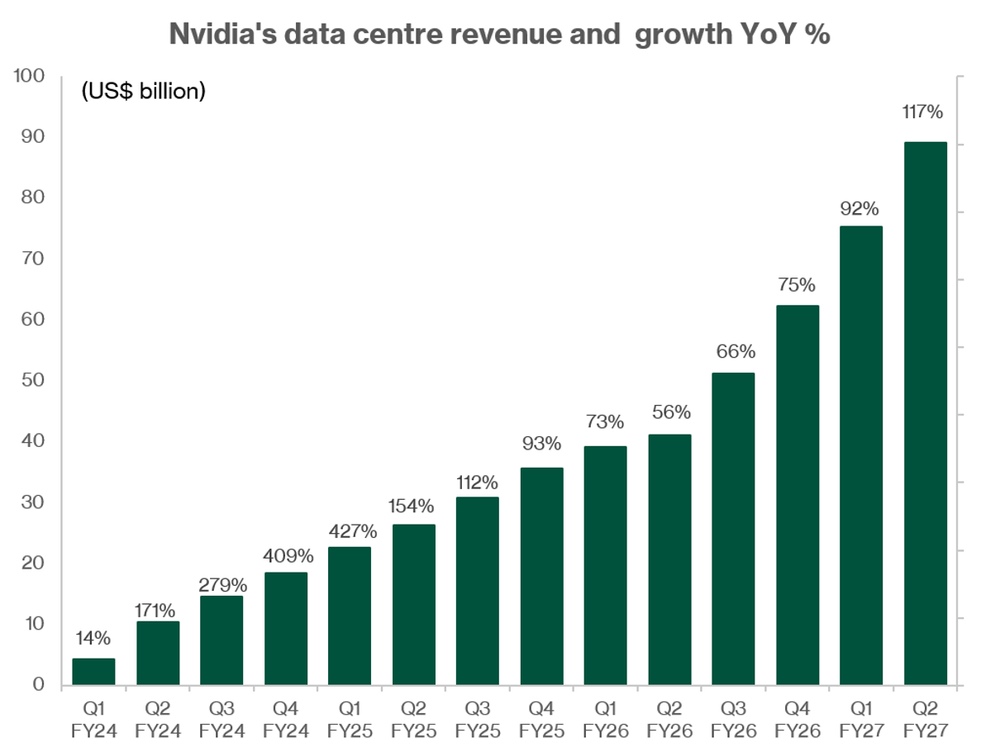
We would focus not just on whether Nvidia's revenue continues growing, but whether its growth and guidance remain consistent with market expectations.
For example, Nvidia could report another quarter of strong revenue growth, but investors may become more cautious if its forward guidance suggests demand is slowing faster than expected.
Conversely, stronger-than-expected sales and guidance would support the view that demand for AI infrastructure remains resilient.
TSMC: Can strong semiconductor growth be sustained?
We also monitor TSMC, which manufactures advanced semiconductors for Nvidia and other major technology companies.
TSMC provides another important perspective because its results reflect demand for semiconductor manufacturing capacity across multiple customers and end markets.
The key question is whether the company can sustain its strong revenue and earnings growth as its business becomes larger.
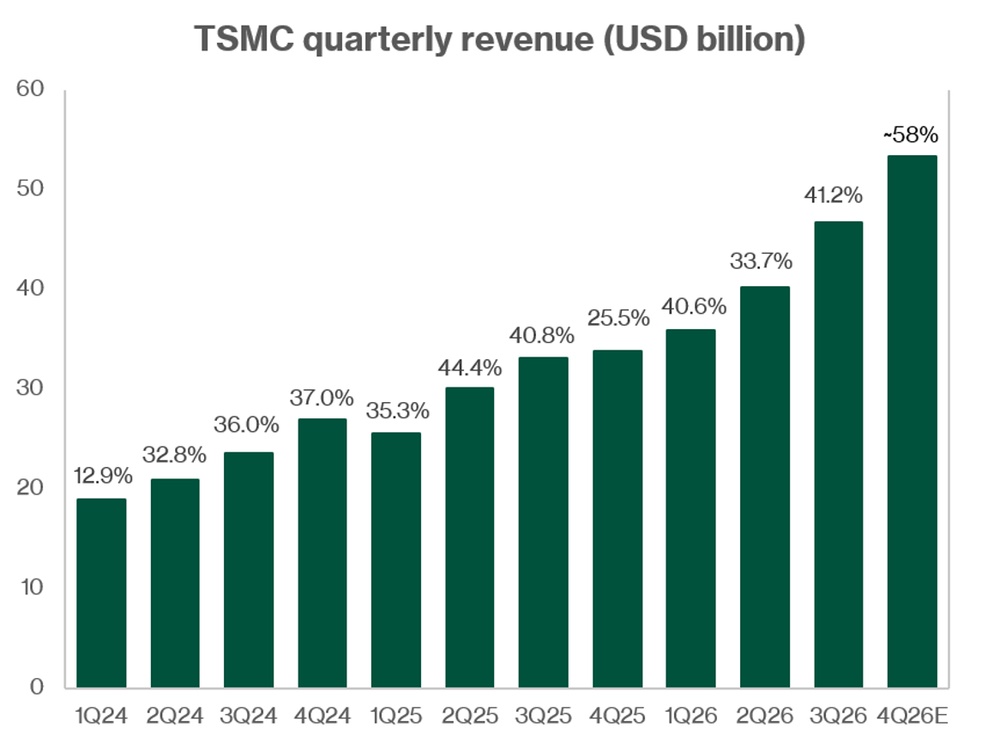
TSMC's monthly revenue announcements are particularly useful because they provide a relatively timely indication of semiconductor demand between quarterly earnings releases.
However, we would also look closely at management guidance to assess whether the company expects strong growth to continue.
Importantly, TSMC serves other industries beyond AI, including smartphones and consumer electronics.
We would therefore distinguish between broader semiconductor demand and the specific contribution from AI-related applications.
Why we monitor both companies
Nvidia and TSMC provide complementary perspectives on the AI investment cycle.
Nvidia offers a more direct indication of demand for AI computing infrastructure, while TSMC provides a broader view of demand for advanced semiconductor manufacturing.
We would become more cautious if both companies begin reporting weaker revenue growth or reducing their forward guidance.
This could suggest that demand across the AI infrastructure supply chain is starting to moderate.
For now, semiconductor earnings and guidance remain among the most important developments we are monitoring.
Related Links:
- TSMC raises capex plan to US$64 billion: What it signals about the AI cycle
- Nvidia’s AI boom is still accelerating. What it means for the AI theme and our stock picks.
4. Cash flow and financing: Can companies continue funding their AI investments?
The fourth indicator we monitor is whether major technology companies can sustainably fund their AI investments.
One important difference between the current AI boom and some previous technology investment cycles is the financial strength of the companies leading the investment.
Many of the largest hyperscalers generate substantial operating cash flows from established businesses such as advertising, software and cloud computing.
This gives them greater flexibility to fund long-term investments.
However, as the scale of AI infrastructure spending increases, financing requirements are also becoming more significant.
Rising investment is putting pressure on free cash flow
Free cash flow measures the cash a company generates after accounting for capital expenditure.
It is particularly important for assessing the AI investment cycle because companies need to spend heavily on infrastructure before they can generate the full benefits from these investments.
As the chart below shows, consensus forecasts from our September assessment indicated that aggregate hyperscaler free cash flow could turn negative in 2026 and 2027 before recovering in 2028.
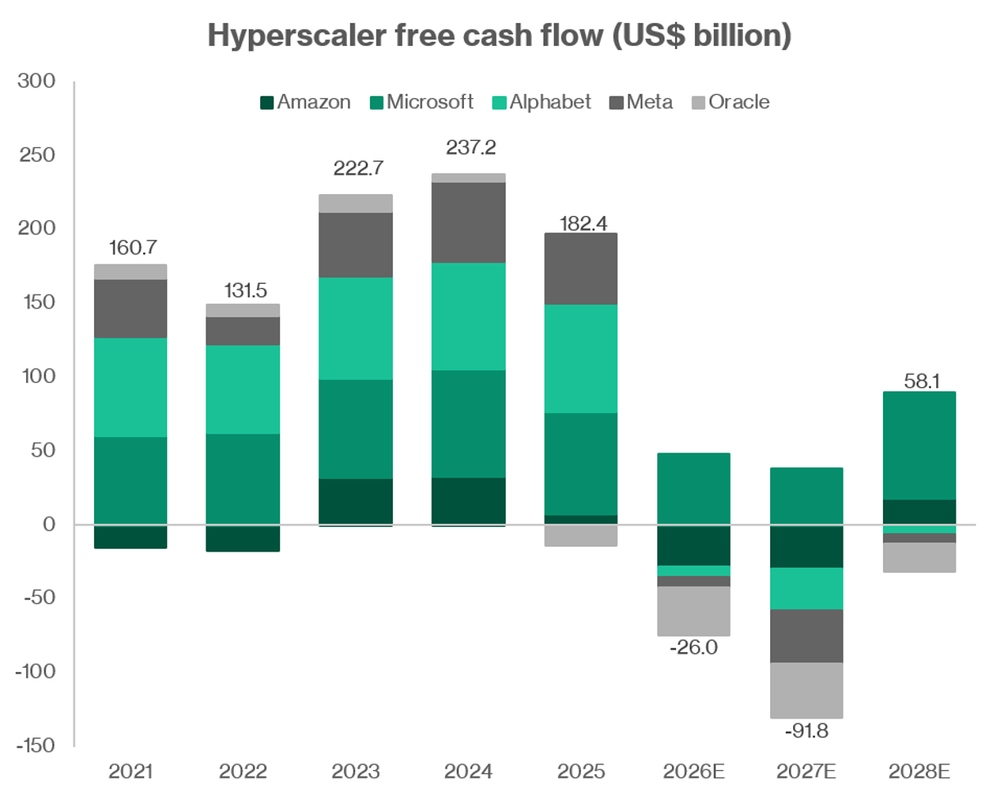
Negative free cash flow does not necessarily mean a company is facing financial difficulties.
A financially strong company may choose to invest heavily today because it expects the infrastructure to generate attractive returns over many years.
However, sustained negative free cash flow could become more concerning if revenue growth disappoints or companies become increasingly dependent on external financing.
5. Credit spreads: Is financing AI investment becoming more expensive?
The fifth indicator we monitor is the credit spreads of major US hyperscalers, which can provide an early warning sign of rising financial risks in the AI investment cycle.
As hyperscalers invest heavily in data centres, chips and other AI infrastructure, they are increasingly turning to debt to help finance their capital expenditure.
As the chart below shows, financing associated with hyperscalers has become a larger part of the US investment-grade corporate bond market.
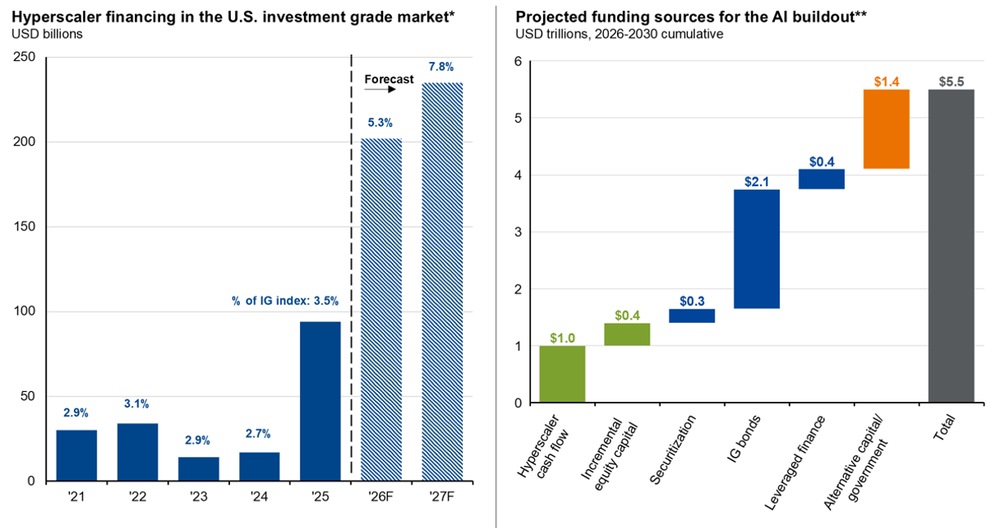
Borrowing is not necessarily a concern, especially for companies with strong balance sheets and substantial cash flows.
However, we are paying closer attention to their borrowing costs.
Credit spreads measure the additional yield investors demand for lending to a company compared with government bonds of similar maturity. Widening credit spreads can signal that investors are becoming more concerned about a company's financial risks.
Together with higher government bond yields, wider credit spreads would increase the cost of financing new AI infrastructure projects.
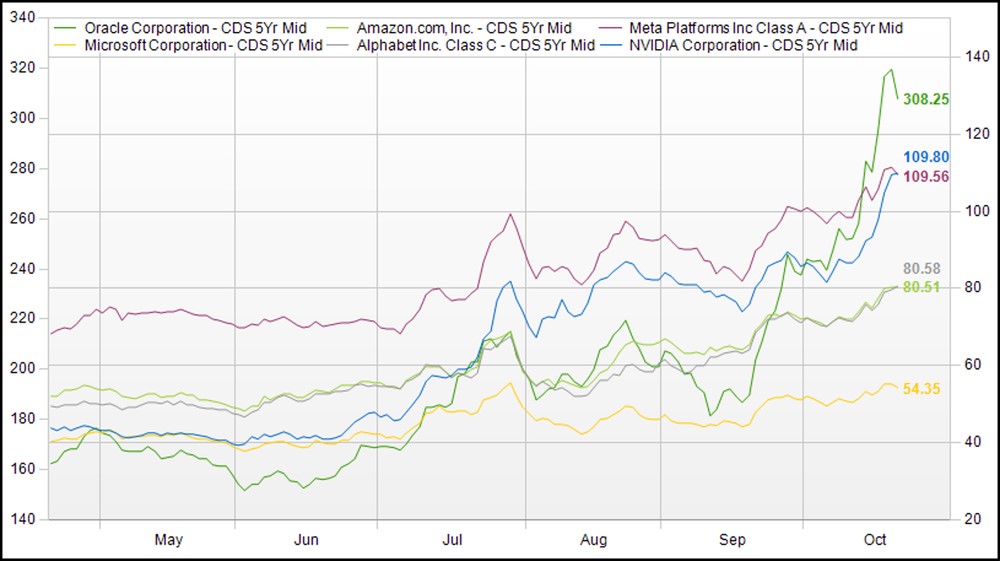
Higher financing costs can reduce the potential returns from these investments, making it harder for companies to justify further spending.
If borrowing costs continue rising, hyperscalers may eventually reassess their investment plans and slow capital expenditure growth. This could have implications for the broader AI supply chain.
We would therefore become more cautious if hyperscaler credit spreads widen significantly, particularly if this is accompanied by deteriorating cash flows or increasing debt levels.
What would Beansprout do?
For now, we continue to see AI as a supportive long term investment theme.
AI adoption is still growing, major technology companies remain committed to infrastructure spending, and demand for advanced semiconductors remains strong.
However, we believe the AI investment cycle is entering a different phase, especially as financing costs remain elevated. Our focus is increasingly on whether the returns being generated can justify the money being invested.
This means we are becoming more selective rather than turning negative on the theme.
Within our Four Pots of Wealth framework, we would consider AI a theme within the Opportunity Pot. This means limiting how much of the portfolio is allocated to the theme, rather than treating it as a core holding.
Within that allocation, we would focus on companies where AI related growth is supported by sustainable earnings and reasonable valuations.
In our Beansprout Pro research, we have identified Singapore listed companies with exposure to this theme and examined their growth prospects, valuations and key risks.
Our latest Opportunity Pot Model Portfolio update also shows how we size individual positions so that we can participate in the upside while limiting the impact if the investment case does not play out as expected.
We will continue to track these five indicators for signs that the AI investment cycle is strengthening or weakening, and become more cautious if several deteriorate together, such as slower AI adoption, lower capital spending, weaker semiconductor demand, or falling cash flow and returns.
For more analysis of AI-related companies and investment developments, explore our latest AI investing insights.
For those looking to understand the theme before deciding how to invest, our AI investing guide explains the key growth drivers and risks to watch.
To understand how companies across semiconductors, data centres and software fit together, read our guide to the AI value chain and the stocks powering it.
What are you watching most closely to assess whether the AI boom can continue: growing adoption, company earnings or the cost of funding new investments? Share your thoughts in the comments or our Beansprout Telegram community.
Follow Beansprout on Telegram, Youtube, Facebook and Instagram, and add Beansprout as your preferred source on Google so you never miss an update.
Read also
Gain financial insights in minutes
Subscribe to our free weekly newsletter for more insights to grow your wealth
Most Popular

Comments
0 comments