
Can AI continue to power the next phase of Asia's market rally? Fund manager shares what he's watching
ETFs
By Gerald Wong, CFA • 03 Sep 2026
Why trust Beansprout? We’ve been awarded Best Investment Website at the SIAS Investors’ Choice Awards 2025
'%3e%3cpath%20fill-rule='evenodd'%20clip-rule='evenodd'%20d='M17.64%209.20455C17.64%208.56637%2017.5827%207.95273%2017.4764%207.36364H9V10.845H13.8436C13.635%2011.97%2013.0009%2012.9232%2012.0477%2013.5614V15.8195H14.9564C16.6582%2014.2527%2017.64%2011.9455%2017.64%209.20455V9.20455Z'%20fill='%234285F4'/%3e%3cpath%20fill-rule='evenodd'%20clip-rule='evenodd'%20d='M9%2018C11.43%2018%2013.4673%2017.1941%2014.9564%2015.8195L12.0477%2013.5614C11.2418%2014.1014%2010.2109%2014.4205%209%2014.4205C6.65591%2014.4205%204.67182%2012.8373%203.96409%2010.71H0.957275V13.0418C2.43818%2015.9832%205.48182%2018%209%2018V18Z'%20fill='%2334A853'/%3e%3cpath%20fill-rule='evenodd'%20clip-rule='evenodd'%20d='M3.96409%2010.71C3.78409%2010.17%203.68182%209.59318%203.68182%209C3.68182%208.40682%203.78409%207.83%203.96409%207.29V4.95818H0.957273C0.347727%206.17318%200%207.54773%200%209C0%2010.4523%200.347727%2011.8268%200.957273%2013.0418L3.96409%2010.71V10.71Z'%20fill='%23FBBC05'/%3e%3cpath%20fill-rule='evenodd'%20clip-rule='evenodd'%20d='M9%203.57955C10.3214%203.57955%2011.5077%204.03364%2012.4405%204.92545L15.0218%202.34409C13.4632%200.891818%2011.4259%200%209%200C5.48182%200%202.43818%202.01682%200.957275%204.95818L3.96409%207.29C4.67182%205.16273%206.65591%203.57955%209%203.57955V3.57955Z'%20fill='%23EA4335'/%3e%3c/g%3e%3cdefs%3e%3cclipPath%20id='clip0_0_2849'%3e%3crect%20width='18'%20height='18'%20fill='white'/%3e%3c/clipPath%3e%3c/defs%3e%3c/svg%3e)
Make Beansprout your preferred source on Google
Add us on Google to see more of our insights in your search results
In this Kopi-Gao interview, fund manager Eric Khaw shares his investment outlook for Asia ex Japan ex China and the structural growth themes he is watching.

In this edition of Kopi-Gao: Generating Alpha with Top Fund Managers, we speak to Eric Khaw, Senior Portfolio Manager, at Amova Asset Management.
Eric specialises in Asia equities and has more than 12 years of investment experience.
Artificial intelligence (AI) has emerged as a major driver of Asian markets, particularly in Taiwan and South Korea.
But Eric believes the opportunity across Asia outside Japan and China goes beyond AI, with domestic growth, rising wealth, and supply chain diversification also creating opportunities across the region.
We sat down with Eric to understand what is driving the region today, how the investment case has changed, and the risks investors should keep in mind.
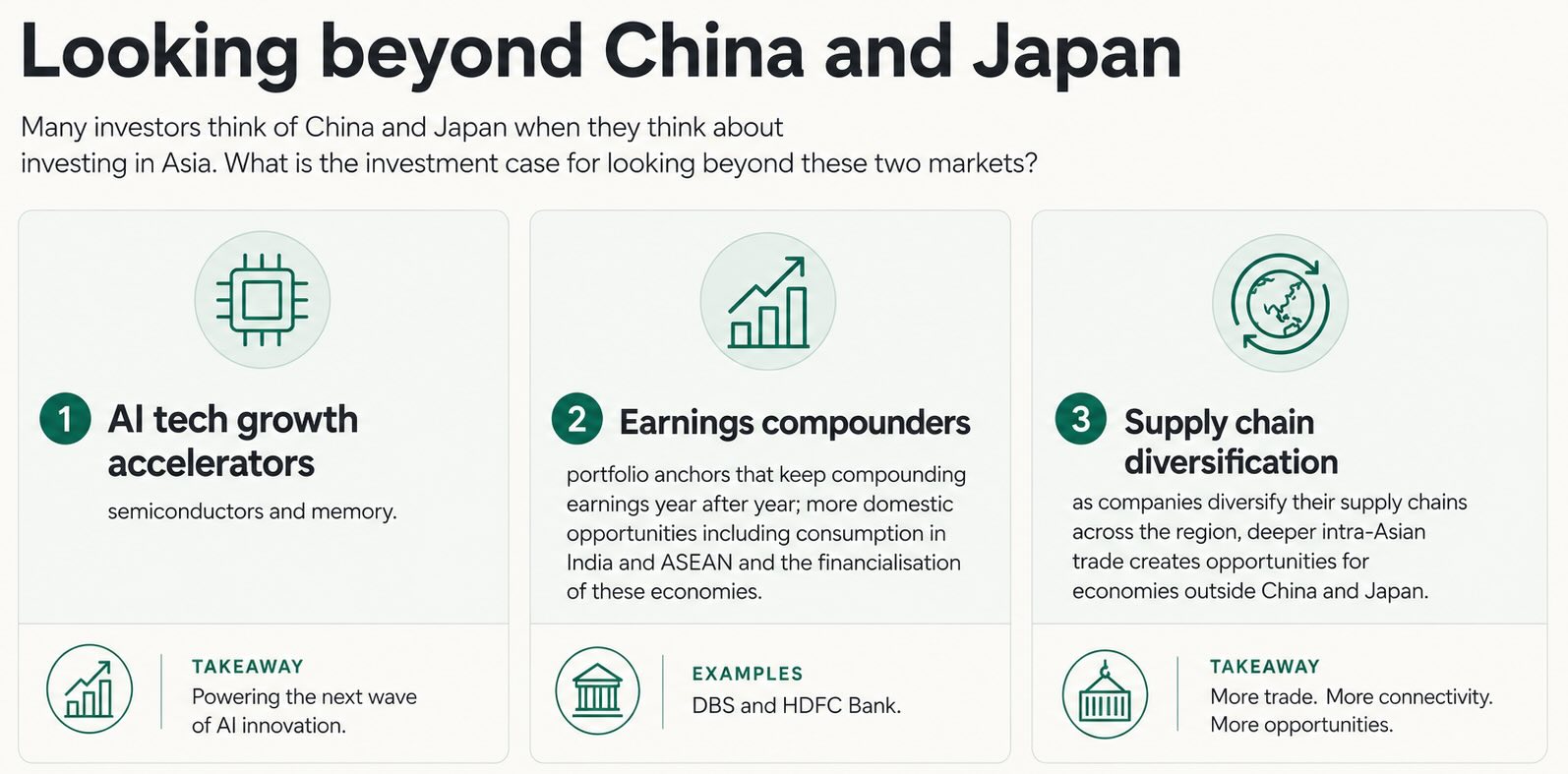
Many investors think of China and Japan when they think about investing in Asia. What is the investment case for looking beyond these two markets?
“When you talk about Asia, you can't get away from China. It's one of the world's superpowers,” Eric says.
But outside China and Japan, Eric sees three broad areas of opportunity.
“The first bucket is the AI tech growth accelerators, like semiconductors and memory.”
“The second is the compounders – the portfolio’s anchors that keep compounding earnings year after year. These tend to be more domestic, including consumption in India and ASEAN as well as the financialisation of these economies. Think of banks like DBS and HDFC Bank, which have been great earnings compounders over the years.”
“The third bucket ties everything together with supply chain diversification.”
As companies diversify their supply chains across the region, Eric also sees deeper intra-Asian trade creating opportunities for economies outside China and Japan.
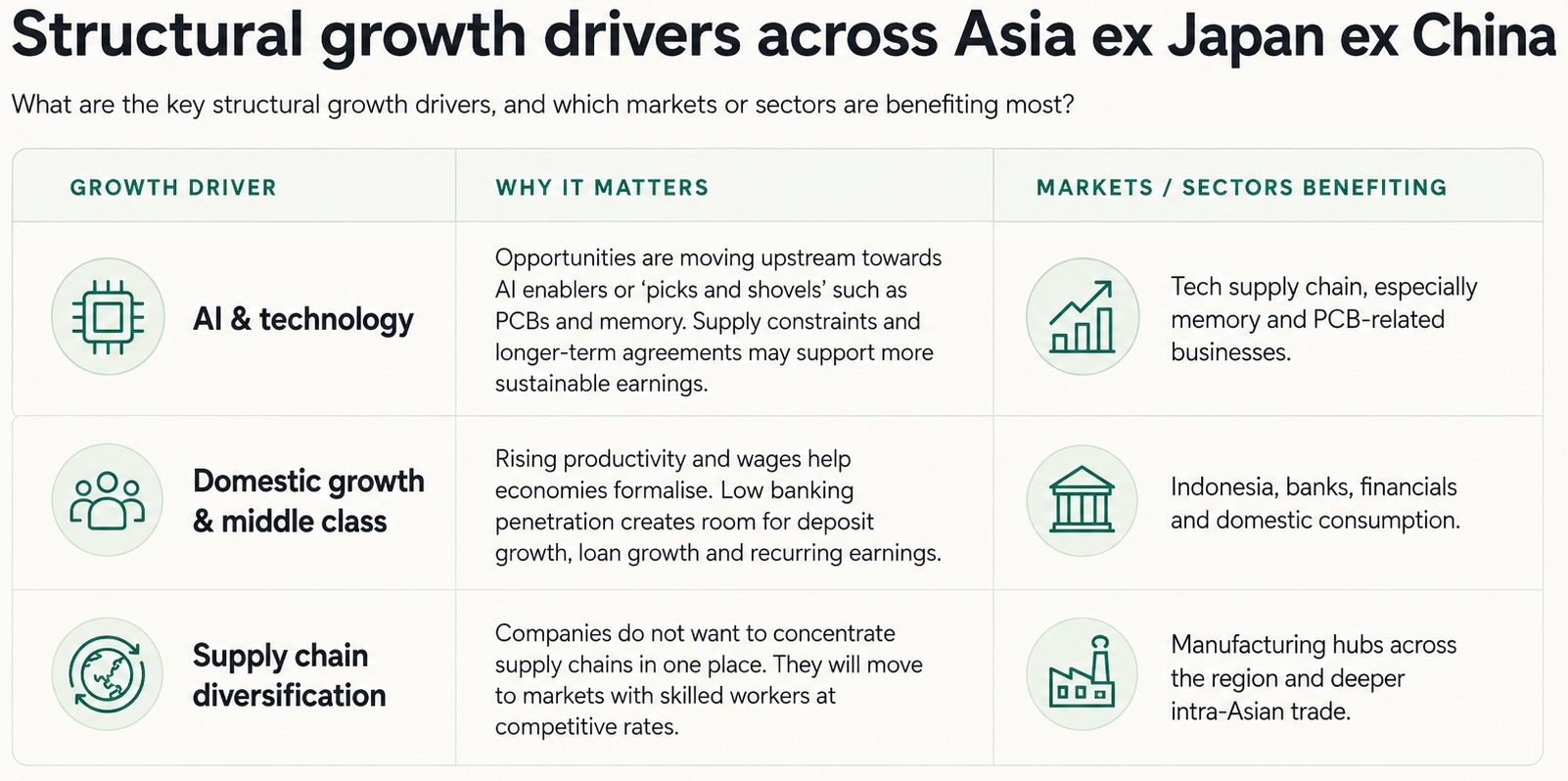
What are the key structural growth drivers across Asia ex Japan ex China, and which markets or sectors are benefiting most?
One major driver is AI and technology.
“The marginal investment opportunities have moved upstream towards the enablers of the tech. They are your picks and shovels, like PCBs (printed circuit boards) and memory,” Eric says.
He believes supply constraints in these parts of the AI supply chain are creating opportunities, while longer-term supply agreements could make earnings in areas such as memory more sustainable than investors previously expected.
“This cycle looks a lot more structural than past ones,” he says.
Another driver is the growth of domestic economies and the middle class. Eric points to markets such as Indonesia, where rising productivity and wages are helping economies formalise, while relatively low banking penetration creates room for financial institutions to grow.
“These regions tend to be underbanked, so banks have been able to reach more people, driving deposit growth and loan growth. This financialisation keeps churning out earnings year in, year out.”
Supply chain diversification is another source of growth.
“Companies don’t want to concentrate their supply chains anymore,” Eric says. “Wherever you’re able to get skilled workers at competitive rates, companies will want to move there.”
How has the investment case for Asia ex Japan ex China changed compared to five or ten years ago?
One major change has been the growth and deepening of domestic capital markets.
“Liquidity in this part of the world has improved a lot,” Eric says.
He points to India, where companies and domestic equity markets have grown in scale, supported by more active local investors channelling savings into equities.
Eric also believes the region is more resilient today than it was in the past.
“I think a lot of Asian economies have learned the hard way from the Asian financial crisis. We’ve come a long way in repairing fiscal balance sheets and getting better at budget management.”
Eric believes increased investment in renewable energy has helped some economies reduce their exposure to oil-price shocks.
“Obviously, when oil spikes, this region will still be hit, but compared to the past, they’re able to weather it a lot better.”
At the company level, Eric also sees earnings becoming more sustainable, pointing to Indian banks that have delivered earnings growth year after year since reforms.
Asia ex Japan ex China spans very different markets, from Taiwan and South Korea to India, Singapore and Southeast Asia. What are the common threads connecting them?
Despite the differences between these markets, Eric sees a few common themes.
“One common thread across all markets is that income growth and wealth creation is happening here,” he says.
Eric sees this particularly in markets such as South Korea and Taiwan, where he says the AI boom has supported parts of the technology sector and created broader spillover effects for household income, consumption and savings.
“Another thread is technology, which shows up everywhere.”
Eric points to India as an example. While its economy is at a very different stage of development from Taiwan or South Korea, technology is also driving significant corporate investment there.
“Even in India, tech is driving a lot of the corporate capital expenditure we're seeing, particularly spending on data centres and power infrastructure – not so different from global trends.”
“That said, India is still at around US$3,000 GDP per capita, so it has a long runway of growth ahead.”
What are the key risks investors should be aware of when investing in Asia ex Japan ex China?
While valuations may be a concern for investors after the region’s recent gains, Eric sees concentration as a more immediate risk.
“The bigger risk now is concentration, because tech, as a result of doing so well, has become a little outsized.”
He explains that this concentration was not necessarily intentional, but has emerged as technology companies outperformed over time.
However, Eric expects domestic growth themes and the “compounders” he highlighted earlier to play a greater role over time, potentially helping to broaden the sources of returns across the region.
There are also risks beyond market concentration.
“Singapore investors will be worried about FX because you get hit by things like geopolitical risk, where the Middle East affects a part of the world in an outsized manner.”
“There’s also regulatory risk from China, from the US, and even politics in some parts of South Asia as well. These are risks we grapple with on a daily basis.”
Eric believes diversification remains important when navigating these risks.
“Rather than being tied to one part of the tech cycle, which can be cyclical at times, you hold the whole tech supply chain alongside the compounders, which balances things out.”
Where are the opportunities across Asia ex Japan ex China today, and how much of the story is driven by AI?
For now, Eric says the “growth accelerators” are driving much of the region’s returns.
“One would be the growth accelerator that's firing and that's kind of the front and center of it, that's driving a lot of the returns.”
But he does not expect this to remain the only driver.
“It’s not always going to be that, which is why it’s good to have the earnings compounders bucket and also the supply chain diversification.”
Within technology, Eric believes opportunities have shifted further upstream in the AI supply chain.
“It’s not just TSMC. TSMC is kind of the downstream chip,” he says. “The marginal investment opportunities have moved upstream. So that’s actually where Taiwan and Korea shine in the picks and shovels.”
Through the Amova MSCI AC Asia ex Japan ex China Index ETF, investors can gain exposure to companies across different parts of Asia’s technology supply chain.
As at 31 July 2026, its largest holdings included TSMC, Samsung Electronics and SK Hynix, while MediaTek and Delta Electronics were also among its top 10 holdings. Other companies appearing in the ETF’s indicative holdings include Elite Material, Unimicron, Accton Technology, Yageo and ASE Technology.
The ETF is passively managed, so its holdings reflect the underlying index.
“These are areas that people don't really understand, but they're such critical parts of the AI supply chain and that's where it's booming.”
However, the investment story extends beyond AI.
“Despite all this AI thing, we are still very, very constructive on domestic economy growth in these regions.”
Eric points to India, where structural reforms and rising incomes continue to support domestic growth, alongside banks and consumer businesses that can benefit as economies become wealthier and more financially developed.
Learn more about the Amova MSCI AC Asia ex Japan ex China Index ETF here.
How should investors think about Asia ex Japan ex China within a broader global portfolio?
For investors who already own broad global equity ETFs, Eric believes Asia ex Japan ex China can provide exposure to parts of the market that may be less represented in broad global indices.
“You get the complement in that you get the picks and shovels which you don't get in global. They are much smaller representative within the global space,” he says.
In particular, Eric points to the region’s exposure to upstream parts of the technology and semiconductor supply chain.
“The tech exposure that you get through this ETF is different from like the S&P 500,” he says. “They don't really have the upstream tech that we have in this ETF. Theirs tend to be a bit more on the Magnificent 7, AI distributor side.”
The S&P 500’s technology exposure is tilted more towards large US designers and platform companies, while this ETF provides exposure to Asian semiconductor manufacturing, memory, and component suppliers.
For investors who already have exposure to China, Eric also sees Asia ex Japan ex China as a way of accessing other sources of Asian growth.
“You still want the growth in Asia, but you don't want the China property cycle risk. Or maybe you already have China and you want to have a bit more other things, then this can be a complement.”
At the same time, Eric cautions against focusing only on the biggest or most familiar names within the region.
He believes one of the less appreciated aspects of Asia ex Japan ex China is that economies and companies once seen as highly cyclical are becoming more structurally driven.
“The most misunderstood part is that people think that this part of the world is very cyclical, which they used to be, but that's structurally changing.”
He points to more sustainable earnings growth, stronger domestic economies and improvements in financial resilience as signs of this shift.
“Small countries in ASEAN are also becoming a lot more structural in their domestic growth. So they are not just exporters of soft commodities, hard commodities anymore. It's becoming a bona fide domestic economy of its own.”
For Eric, that means the opportunity across Asia ex Japan ex China is not just about participating in the current AI cycle, but gaining exposure to a broader set of structural growth themes across the region.
Learn more about the Amova MSCI AC Asia ex Japan ex China Index ETF here.
About Kopi-Gao: Generating Alpha with Top Fund Managers
Kopi-Gao is a regular column by Beansprout that features conversations with professional fund managers, offering a rare glimpse into the strategic thinking and personal philosophies that drive the world of investment. These interviews are aimed at providing insights and actionable knowledge for individuals looking to understand the art and science of successful fund management in today's ever-evolving financial landscape.
Join the Beansprout Telegram group for the latest insights on Singapore stocks, REITs, bonds and ETFs.
Read also
Gain financial insights in minutes
Subscribe to our free weekly newsletter for more insights to grow your wealth
Most Popular

Comments
0 comments