
kopi-C with CFO of NTT DC REIT: The investor who crossed to the other side of the table
Stocks
Powered by

By Julian Wong • 19 Aug 2026
Why trust Beansprout? We’ve been awarded Best Investment Website at the SIAS Investors’ Choice Awards 2025
'%3e%3cpath%20fill-rule='evenodd'%20clip-rule='evenodd'%20d='M17.64%209.20455C17.64%208.56637%2017.5827%207.95273%2017.4764%207.36364H9V10.845H13.8436C13.635%2011.97%2013.0009%2012.9232%2012.0477%2013.5614V15.8195H14.9564C16.6582%2014.2527%2017.64%2011.9455%2017.64%209.20455V9.20455Z'%20fill='%234285F4'/%3e%3cpath%20fill-rule='evenodd'%20clip-rule='evenodd'%20d='M9%2018C11.43%2018%2013.4673%2017.1941%2014.9564%2015.8195L12.0477%2013.5614C11.2418%2014.1014%2010.2109%2014.4205%209%2014.4205C6.65591%2014.4205%204.67182%2012.8373%203.96409%2010.71H0.957275V13.0418C2.43818%2015.9832%205.48182%2018%209%2018V18Z'%20fill='%2334A853'/%3e%3cpath%20fill-rule='evenodd'%20clip-rule='evenodd'%20d='M3.96409%2010.71C3.78409%2010.17%203.68182%209.59318%203.68182%209C3.68182%208.40682%203.78409%207.83%203.96409%207.29V4.95818H0.957273C0.347727%206.17318%200%207.54773%200%209C0%2010.4523%200.347727%2011.8268%200.957273%2013.0418L3.96409%2010.71V10.71Z'%20fill='%23FBBC05'/%3e%3cpath%20fill-rule='evenodd'%20clip-rule='evenodd'%20d='M9%203.57955C10.3214%203.57955%2011.5077%204.03364%2012.4405%204.92545L15.0218%202.34409C13.4632%200.891818%2011.4259%200%209%200C5.48182%200%202.43818%202.01682%200.957275%204.95818L3.96409%207.29C4.67182%205.16273%206.65591%203.57955%209%203.57955V3.57955Z'%20fill='%23EA4335'/%3e%3c/g%3e%3cdefs%3e%3cclipPath%20id='clip0_0_2849'%3e%3crect%20width='18'%20height='18'%20fill='white'/%3e%3c/clipPath%3e%3c/defs%3e%3c/svg%3e)
Make Beansprout your preferred source on Google
Add us on Google to see more of our insights in your search results
Masayuki Ozaki spent nearly two decades analysing and investing in REITs from the buyside before joining the Manager of NTT DC REIT as CFO. A year after listing, he explains how a business built on data centre power capacity has delivered so far, and where its next phase of growth could come from.
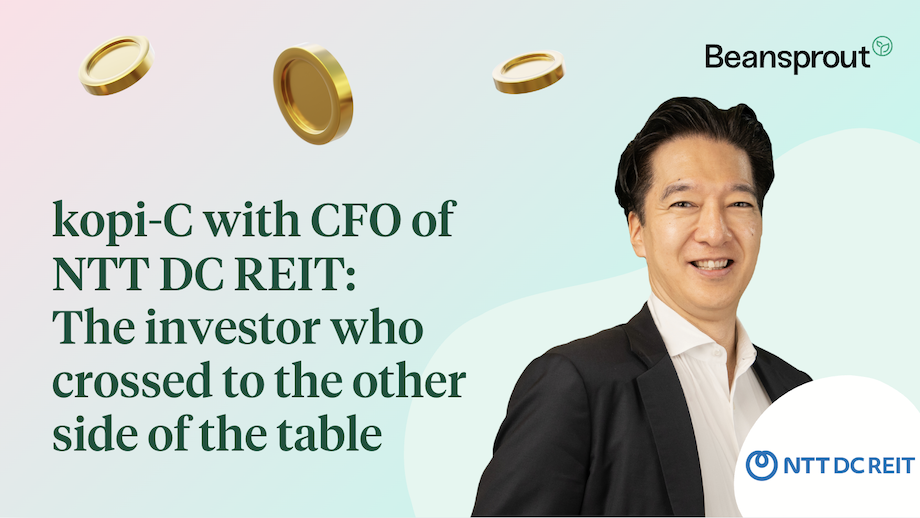
For nearly two decades, Masayuki Ozaki was a public equities investor at firms ranging from long-only generalist to dedicated property fund to pension fund, covering Asia-Pacific real estate and REIT markets. He has invested in the Singapore REIT market since 2013.
For most of his career, he was evaluating REITs from the outside with an investor lens.
In January 2025, he crossed over, joining NTT Limited to help take its data centre portfolio public. After NTT DC REIT’s listing, he was appointed Chief Financial Officer of its Manager.
“I like to think that I have a broad perspective on what different investor types will look at,” he shares—a perspective that now shapes how he runs the numbers and helps manage the REIT from the inside.
Selling capacity, not space
Listed on the Singapore Exchange in July 2025, NTT DC REIT was the largest REIT IPO in Singapore in more than a decade, raising close to S$1 billion.
As of today, its portfolio comprises six data centre assets: three in Northern California, one in Northern Virginia, one in Vienna, and one in Singapore—with a combined IT load of around 91 megawatts.
This specification is crucial to understanding NTT DC REIT’s model, especially for readers who might be new to the sector.
Ozaki offers a clarification about what a data centre REIT actually sells, emphasising that it is not floor space.
“In the data centre world, we go by power or capacity,” he says.
He breaks it down: the REIT owns the buildings and provides the cooling, power and security. It then leases contracted power capacity to its tenants. Rent is charged on that contracted capacity, rather than on how much a tenant actually uses. This gives the REIT contracted rental income from that capacity, with the REIT currently distributing 100% of its distributable income.
The backdrop, as he describes it, is an industry where demand runs ahead of supply. Global data centre vacancy remains low, and the binding constraint, he says, is power, which is scarce across most major markets.
Given this context, it is hard to avoid comparisons to the much discussed hyperscalers (the likes of Microsoft, Google and Amazon).
But Ozaki sees them as partners rather than rivals. Because their own requirements are so large that they cannot build everything themselves, they lease from third-party operators such as NTT.
He argues that the sector is less prone to oversupply than others. Unlike other forms of real estate, large hyperscale data centres are typically not built speculatively and leased out to whoever comes along.
Operators work closely with hyperscalers during development, because different customers have different design and technical requirements, meaning that significant capacity tends to be pre-leased.
Reading the challenges ahead
Asked directly whether the talk of an AI spending bubble worries him, Ozaki says the REIT has not seen any slowdown in demand from hyperscalers. Against this backdrop of sustained demand, the REIT’s Sponsor is looking to accelerate its development pipeline rather than slow it down.
For NTT DC REIT, one way that tight supply-demand conditions can translate into organic growth is through rental reversions. One of the clearest data points in the REIT’s FY25/26 results came from Singapore.
The major tenant, NTT Singapore, at its SG1 asset renewed its lease for three years at a rent 23% higher than before, with a further 5% step-up each year.
Ozaki cautions against assuming that the uplift can be replicated across every renewal, noting that each lease has different base rents and terms.
In SG1’s case, he says that the magnitude of the reversion reflected the lease’s previous rental level, as well as support from the Sponsor, with the agreed rent at the higher end of prevailing market level. The renewal covers 31% of the Singapore asset’s capacity, with the higher rent contributing to the REIT’s revenue from the start of the financial year.
Rental growth, however, is only one part of NTT DC REIT’s growth strategy. The other key driver is the substantial pipeline of quality assets from its Sponsor.
NTT’s data centre arm is one of the world’s largest developers and operators, and the REIT is designed as what Ozaki calls a “capital recycling vehicle”: the Sponsor sells stabilised assets into the REIT, recoups its capital, then reinvests it into new development.
In turn, the REIT gains access to a pipeline of stabilised high-quality assets.
Against the REIT’s roughly 91 megawatts of capacity, he puts the Sponsor’s operational pipeline at around 1.6 gigawatts.
Yet the thread Ozaki keeps returning to is the apparent gap between what the REIT has delivered and how the market has valued it. The portfolio is close to fully occupied—in the mid-to-high 90s—and recorded a 13.4% rental reversion in its latest business update for 1Q FY26/27.
These, he says, point to the strength of the REIT’s operating performance. And he is also mindful that their projected yield, set at 7.5% at listing and now closer to 8%, is one some investors read as a warning about asset quality.
This is a reading he firmly disputes.
Ozaki believes that the elevated yield reflects unfamiliarity: two-thirds of the portfolio sits in markets—Sacramento and Vienna among them—that Singapore investors are unfamiliar with. Furthermore, the REIT has only a few quarters of listed track record behind it.
Quality markets and sticky tenants
When discussing individual markets, he is matter of fact. Sacramento, he shares, is a secondary spillover market from Silicon Valley with a latency advantage—one tenant runs autonomous driving workloads from there—along with stable cash flows at higher yields.
Vienna, he points out, has become one of Europe’s fastest-growing data centre markets as tier-one hubs such as Frankfurt and Amsterdam are experiencing severe supply constraints, and has been the best-performing asset in the portfolio.
As for Northern Virginia, he calls it the best data centre market in the world, while acknowledging the community pushback that has become a frequent topic at industry conferences.
On tenant concentration—the largest tenant contributes around 31% of rental income—Ozaki points to long leases with built-in escalations, an absence of break clauses, and substantial remaining terms, with the top tenant having seven years left.
He also notes that, unlike an office relocation, moving critical workloads between data centres can be costly and operationally complex, often requiring tenants to install and run parallel systems during migration.
Track record over headlines
Since listing, Ozaki says management has focused on addressing feedback raised by investors.
Following the renewal of NTT Singapore’s lease, which was previously below market rents, attention has shifted to a proposed change to the management fee structure. Subject to Unitholders’ approval, the proposed change is intended to further strengthen the alignment of the Manager’s interest with those of Unitholders.
The proposed change also reflects views raised by investors, Ozaki says, highlighting it as an example of how the Manager and Sponsor proactively respond to market feedback.
Looking out three to five years, Ozaki describes a flywheel: internal growth from rental reversions, with potential for larger step changes when long dated hyperscale leases mature; external growth from acquiring the Sponsor’s pipeline once the unit price supports equity raising; and finally, as the REIT grows, greater liquidity and the prospect of index inclusion.
What keeps him up at night, he says, is less of any single shock than the interest-rate environment and the speed at which data-centre demand evolves, which can leave assets obsolete.
The right response, in his view, is to keep acquiring newer, future-proofed assets from the Sponsor and, potentially swap older ones back.
His closing message to investors is one that he repeats consistently.
“Look at our track record,” Ozaki says—the occupancy remains high, the reversions are solid, and the steps taken to address investors’ feedback—rather than the headline anxieties about an AI bubble or an unfamiliar market.
About NTT DC REIT
NTT DC REIT is a Singapore-listed real estate investment trust that focuses on investing in stabilised, income-producing data centre assets located globally that support the digital economy.
Its portfolio comprises six carrier-neutral, Tier III-equivalent assets located across the United States (Northern Virginia and Northern California), Austria (Vienna) and Singapore. The portfolio has a design IT load of approximately 90.7 megawatts, with an optimal mix of hyperscale and colocation customers.
The sponsor of NTT DC REIT is NTT Limited, which is part of the NTT Group, a major global IT services and telecommunications group with a leading global data centre business.
For more information on NTT DC REIT, please visit www.nttdcreit.com.
About kopi-C: the Company brew
kopi-C is a regular column by SGX Research in collaboration with Beansprout, Singapore’s trusted investment intelligence platform which helps everyday investors build the knowledge and confidence to make decisions that matter. kopi-C features C-level executives of leading companies listed on SGX. These interviews are profiles of senior management aimed at helping investors better understand the individuals who run these corporations.
Read also
Gain financial insights in minutes
Subscribe to our free weekly newsletter for more insights to grow your wealth
Most Popular

Comments
0 comments