
3 SGX ETFs to gain exposure to Asia ex-China growth
ETFs
Powered by

By Gerald Wong, CFA • 07 May 2026
Why trust Beansprout? We’ve been awarded Best Investment Website at the SIAS Investors’ Choice Awards 2025
'%3e%3cpath%20fill-rule='evenodd'%20clip-rule='evenodd'%20d='M17.64%209.20455C17.64%208.56637%2017.5827%207.95273%2017.4764%207.36364H9V10.845H13.8436C13.635%2011.97%2013.0009%2012.9232%2012.0477%2013.5614V15.8195H14.9564C16.6582%2014.2527%2017.64%2011.9455%2017.64%209.20455V9.20455Z'%20fill='%234285F4'/%3e%3cpath%20fill-rule='evenodd'%20clip-rule='evenodd'%20d='M9%2018C11.43%2018%2013.4673%2017.1941%2014.9564%2015.8195L12.0477%2013.5614C11.2418%2014.1014%2010.2109%2014.4205%209%2014.4205C6.65591%2014.4205%204.67182%2012.8373%203.96409%2010.71H0.957275V13.0418C2.43818%2015.9832%205.48182%2018%209%2018V18Z'%20fill='%2334A853'/%3e%3cpath%20fill-rule='evenodd'%20clip-rule='evenodd'%20d='M3.96409%2010.71C3.78409%2010.17%203.68182%209.59318%203.68182%209C3.68182%208.40682%203.78409%207.83%203.96409%207.29V4.95818H0.957273C0.347727%206.17318%200%207.54773%200%209C0%2010.4523%200.347727%2011.8268%200.957273%2013.0418L3.96409%2010.71V10.71Z'%20fill='%23FBBC05'/%3e%3cpath%20fill-rule='evenodd'%20clip-rule='evenodd'%20d='M9%203.57955C10.3214%203.57955%2011.5077%204.03364%2012.4405%204.92545L15.0218%202.34409C13.4632%200.891818%2011.4259%200%209%200C5.48182%200%202.43818%202.01682%200.957275%204.95818L3.96409%207.29C4.67182%205.16273%206.65591%203.57955%209%203.57955V3.57955Z'%20fill='%23EA4335'/%3e%3c/g%3e%3cdefs%3e%3cclipPath%20id='clip0_0_2849'%3e%3crect%20width='18'%20height='18'%20fill='white'/%3e%3c/clipPath%3e%3c/defs%3e%3c/svg%3e)
Make Beansprout your preferred source on Google
Add us on Google to see more of our insights in your search results
Discover 3 SGX-listed ETFs that offer Singapore investors access to Japan, India, and the broader Asian market.

This post was created in partnership with SGX. All views and opinions expressed in this article are Beansprout's objective and professional opinions.
What happened?
Asia is not just a China story.
Earlier, we looked at why China A-shares are worth considering and how SGX ETFs can offer investors access to China’s domestic market.
We have also shared SGX ETFs that allow investors to tap into Asia’s growth, from broad regional exposure to specific market themes.
While China remains an important market, investors who already have China exposure may want to diversify into other parts of Asia.
Asia ex-China offers exposure to different growth drivers, including Japan’s corporate reforms and India’s domestic consumption to Taiwan and South Korea’s role in the global semiconductor supply chain.
In this article, I look at three SGX ETFs that provide a convenient way to access Japan, India and the rest of Asia, each with a different focus and a different role in a portfolio.
Why Asia ex-China markets are worth considering now
#1 - Japan, Korea and Singapore are becoming more shareholder-friendly
One reason to look at Asia ex-China is that several markets are becoming more focused on shareholder returns.
Japan is the clearest example, with the Tokyo Stock Exchange encouraging companies to improve capital efficiency, return on equity and shareholder value.
This has led more companies to review how they use cash, whether through higher dividends, share buybacks or reducing cross-shareholdings.
South Korea is also moving in a similar direction through its Corporate Value-up Programme, which aims to encourage listed companies to improve capital efficiency and set clearer shareholder return targets.
This shows that policymakers are trying to narrow the valuation discount that Korean equities have traded at for many years.
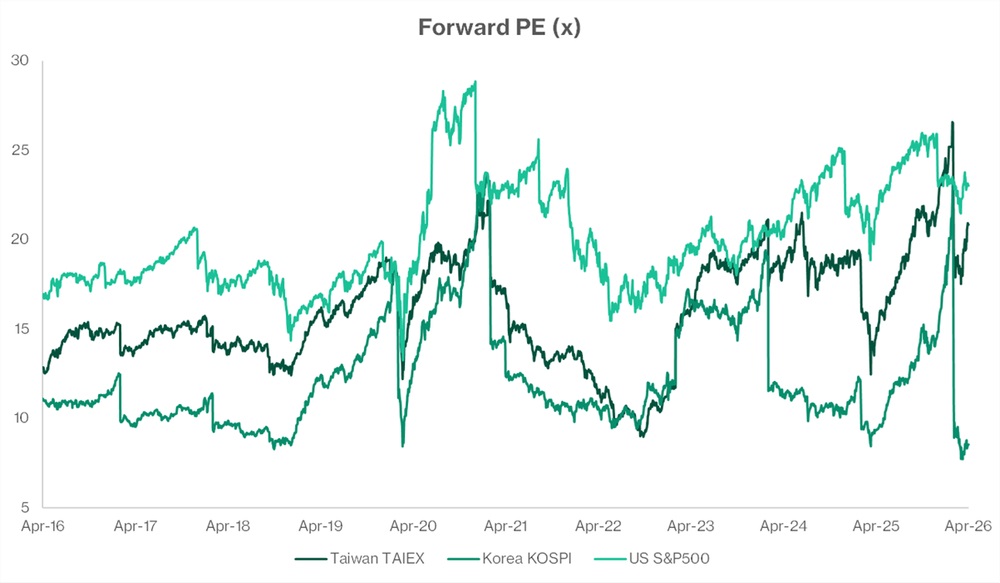
Singapore is part of this trend too, with continued focus on corporate governance, dividend transparency and the quality of listed companies.
Put together, Asia ex-China is not just a growth story, but also a shareholder return story where reforms may encourage companies to use capital more efficiently.
#2 - India and ASEAN offer long-term domestic growth potential
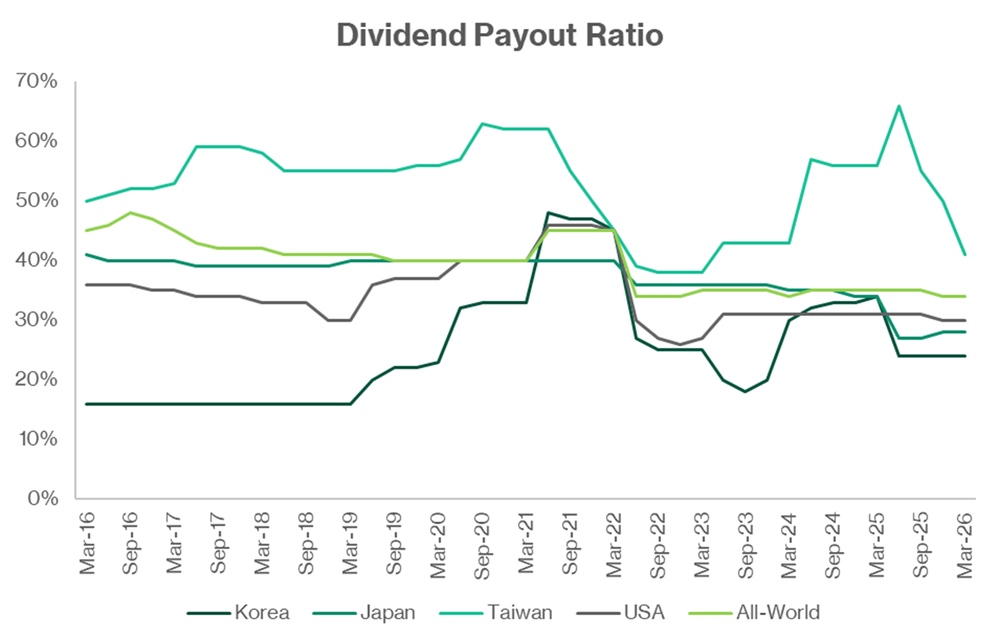
India and parts of Southeast Asia are still at an earlier stage of economic development than more mature markets, which gives them a different type of growth opportunity.
India’s long-term story is supported by a large working-age population, urbanisation and rising consumption across areas such as financial services, retail, healthcare, travel and digital services.
Its listed market also includes banks, consumer businesses, industrial companies and infrastructure-related names that may benefit from domestic demand growth.
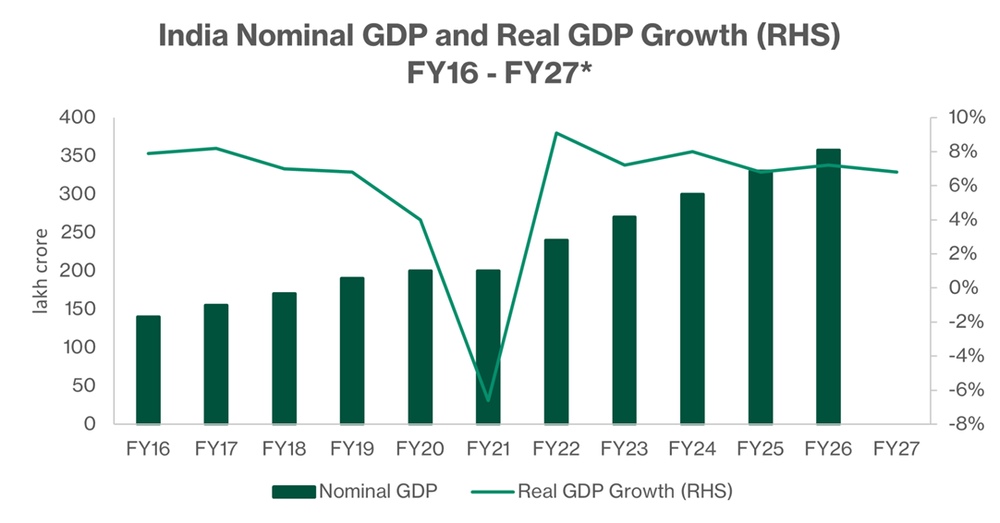
ASEAN offers a similar, though more varied, opportunity, with markets such as Vietnam, Indonesia, Malaysia, Thailand and the Philippines supported by demographics, urbanisation and increasing digital adoption.
#3 - Taiwan and South Korea are key technology hubs
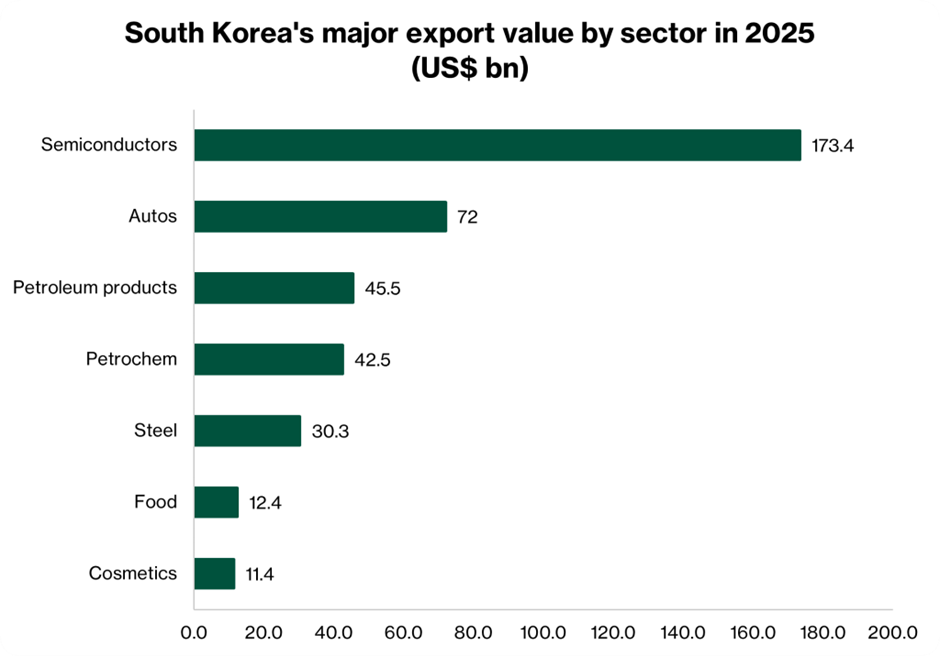
Asia ex-China also gives investors exposure to important technology supply chains, with Taiwan home to TSMC and South Korea home to Samsung Electronics and SK Hynix.
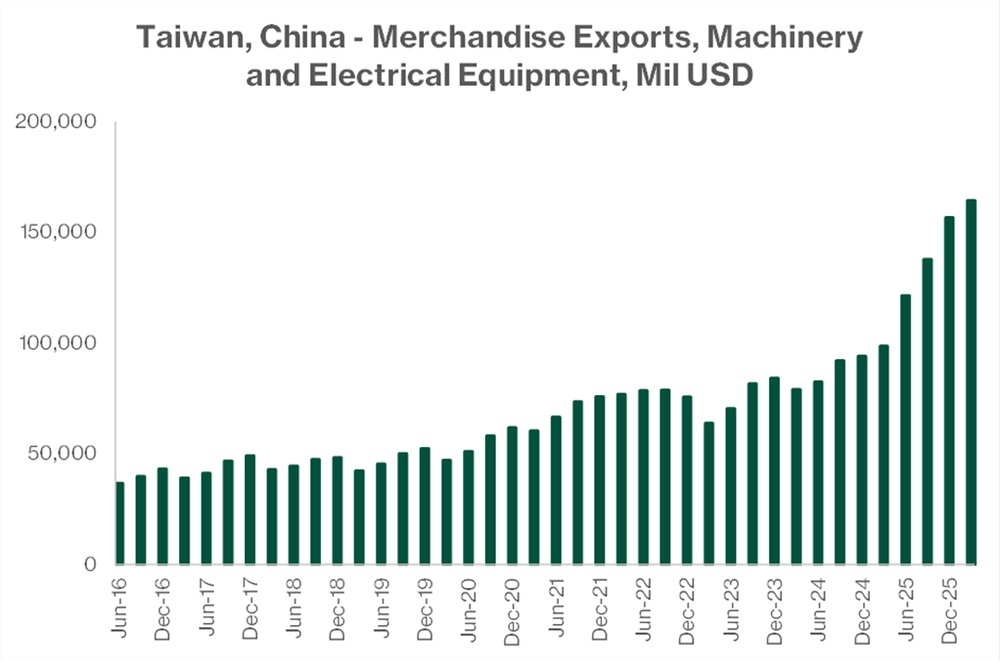
As demand for AI, cloud computing and high-performance computing grows, some Asia ex-China ETFs may carry more technology and semiconductor exposure than investors expect.
When the cycle is strong, these markets may benefit significantly.
#4 - Asia ex-China as beneficiaries of global supply chain shift
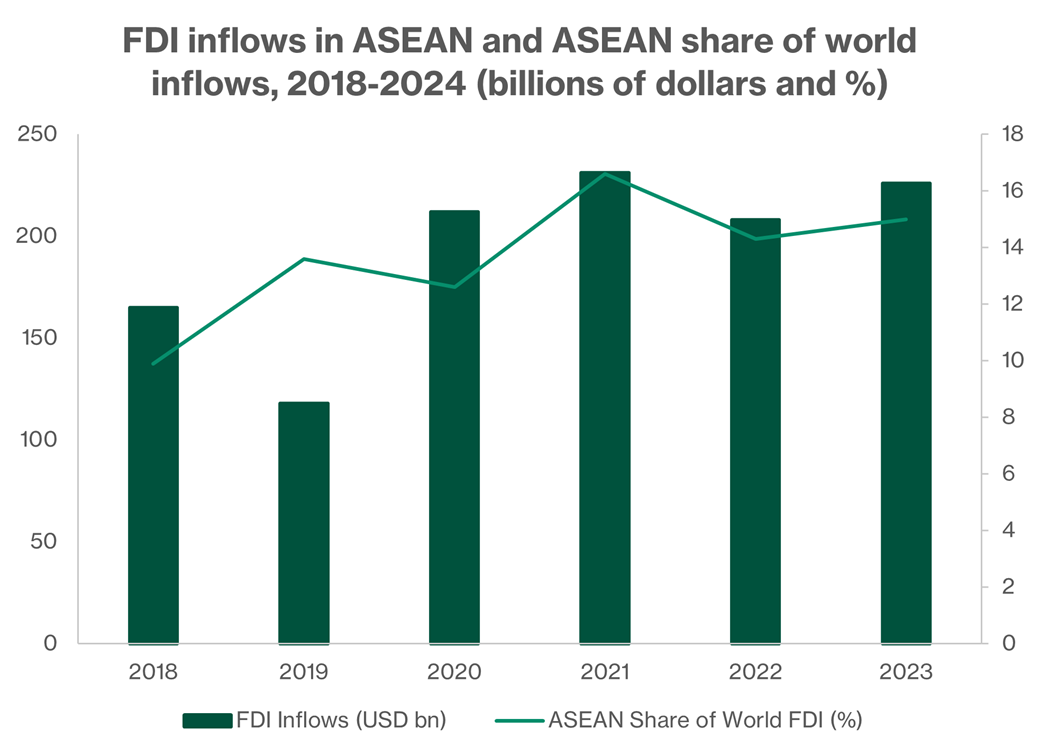
Asia ex-China may also benefit from the “China+1” strategy, as companies diversify production into markets such as Vietnam, India, Malaysia, Thailand and Indonesia.
This could create opportunities beyond export-oriented companies, including industrial landlords, logistics providers, banks and consumer businesses that benefit from higher investment and job creation.
3 SGX ETFs to gain exposure to Asia ex-China
#1 - Lion-Nomura Japan Active ETF (SGX: JJJ / JUS) for Japan exposure
For investors looking to add Japan exposure through SGX, the Lion-Nomura Japan Active ETF (SGX: JJJ / JUS) is the only Japan-focused ETF listed in Singapore.
The fund seeks long-term capital growth through an actively managed portfolio of Japanese equities. Its reference benchmark is the Tokyo Stock Price Index, or TOPIX, which tracks a broad range of companies listed in Japan.
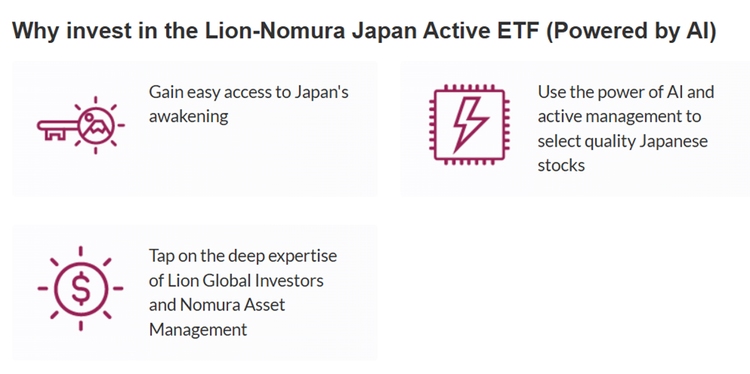
The Lion-Nomura Japan Active ETF is also Singapore’s first actively managed ETF and first AI-powered ETF. It is managed by Lion Global Investors, with Nomura Asset Management as investment adviser.
On SGX, the ETF is available in Singapore dollars under JJJ and US dollars under JUS.
As of 31 March 2026, the ETF had a fund size of S$65.66 million. Its management fee is currently 0.70% p.a., with a maximum management fee of 0.99% p.a. Based on the SGX ETF Screener, its total expense ratio is 0.98% p.a.
What makes the Lion-Nomura Japan Active ETF different from many ETFs is that it does not simply track a fixed index.
Its AI models are refreshed monthly and evaluate hundreds of factors to help select Japanese equities from a universe of the top 1,000 stocks listed on the Tokyo Stock Exchange and Nagoya Exchange by traded value.
As of 31 March 2026, its top holdings included ORIX Corporation, ENEOS Holdings, SMC Corporation, Sompo Holdings, Marubeni Corporation and Advantest Corporation.
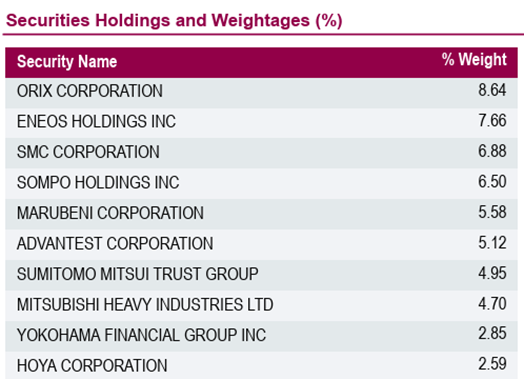
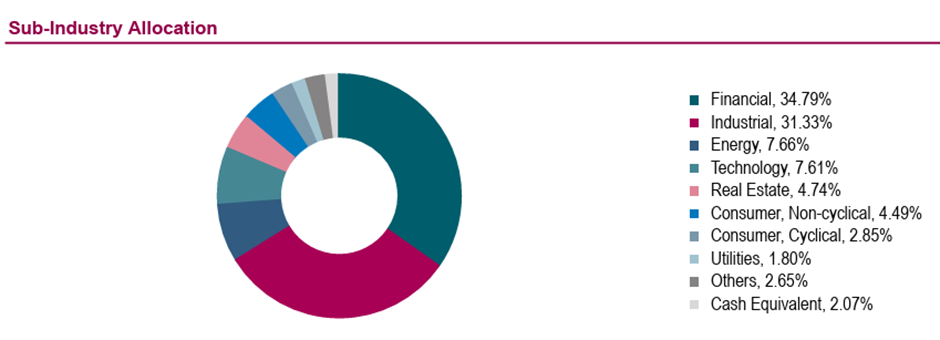
The fund was most heavily weighted towards financials and industrials, which made up 34.79% and 31.33% of the portfolio respectively.
Performance has been strong so far. As of 31 March 2026, the ETF delivered a 1-year NAV return of 23.1% in SGD, compared with 18.7% for TOPIX. Since inception, the fund has returned 13.8% annualised, compared with 10.3% for TOPIX.
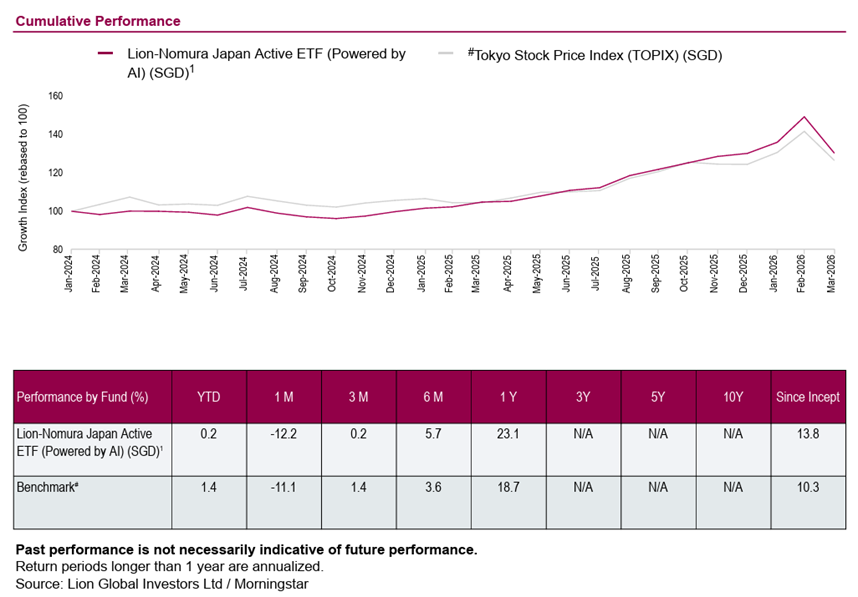
The investment case rests on Japan’s corporate reform story.
As more Japanese companies focus on capital efficiency, shareholder returns and better balance sheet use, an active ETF may be able to select companies that are better positioned for these changes.
As an actively managed strategy, do note that the ETF’s performance may diverge from the broader Japan market, and returns may also be affected by movements between the Japanese yen and the Singapore dollar. It also has a relatively short track record of just over two years.
#2 - iShares MSCI India Climate Transition ETF (SGX: QK9 / I98) for India exposure
For investors who want exposure to India’s growth story, the iShares MSCI India Climate Transition ETF (SGX: QK9 / I98) is one of the most established India-focused ETFs listed on SGX.
The ETF has been available in Singapore since June 2006 and is managed by BlackRock.
It seeks to track the MSCI India ESG Enhanced Focus CTB Select Index, which means it is not a plain-vanilla India ETF.
The fund still provides exposure to large and mid-sized Indian companies, but with a climate transition and environmental, social and governance overlay. In practice, this means some companies may be underweighted or excluded based on climate and ESG-related metrics.
On SGX, the ETF is available in Singapore dollars under QK9 and US dollars under I98.
As of 31 March 2026, the ETF had net assets of US$53.81 million and 144 holdings. Its annual management fee is 0.65% p.a., while its total expense ratio is 0.64% p.a. based on the SGX ETF Screener.
Its top five holdings were Reliance Industries, HDFC Bank, ICICI Bank, Infosys and Mahindra & Mahindra. The top 10 holdings made up 39.31% of the portfolio.
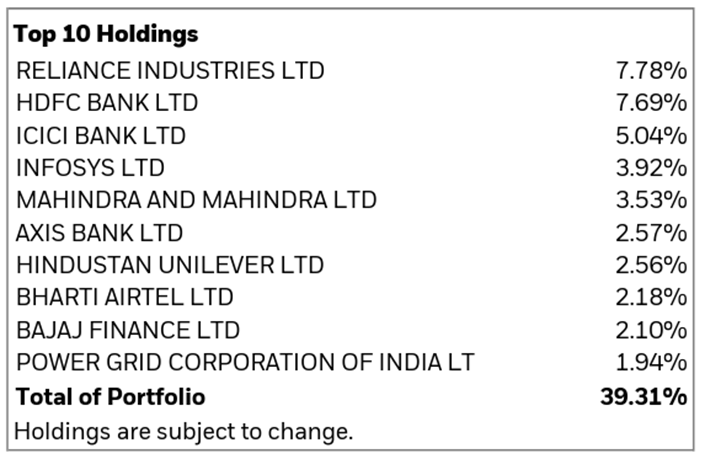
The portfolio covers financial services, energy, technology, and consumer companies, reflecting the breadth of India's listed equity market.
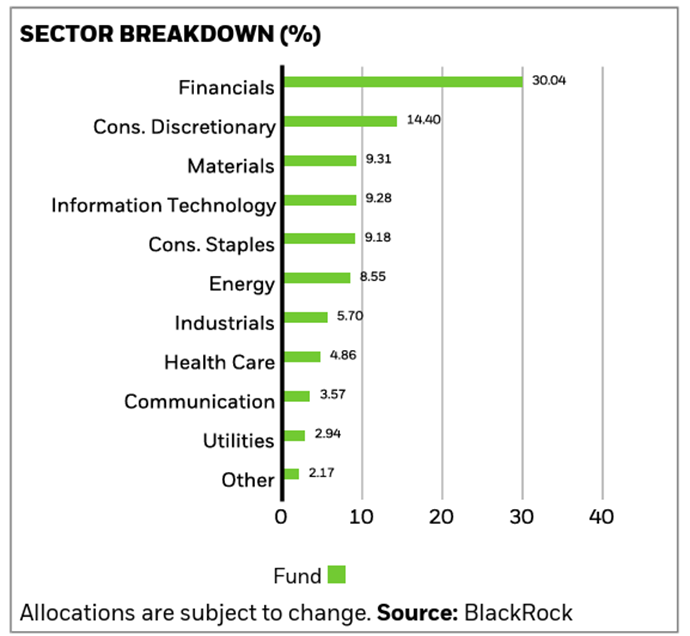
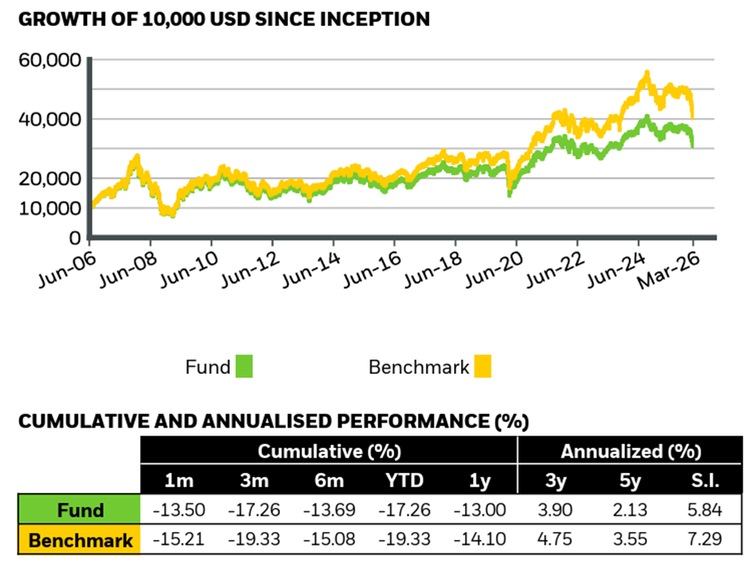
Recent performance has been weaker. As of 31 March 2026, the fund was down 13.0% over one year, although it still delivered annualised returns of 3.9% over three years and 5.84% since inception.
This is a useful reminder that India’s long-term growth story can still come with sharp short-term swings.
The longer-term case for India rests on demographics, digitisation and domestic consumption growth. India’s infrastructure push and expanding financial services sector may also create additional growth avenues.
When considering this ETF, investors should take into account single‑country exposure, emerging market volatility, currency risk, and the implications of the fund’s climate transition overlay.
#3 - Amova MSCI AC Asia ex Japan ex China Index ETF (SGX: A93 / A94) for broad Asia exposure
For investors looking to access the rest of Asia in one instrument, the Amova MSCI AC Asia ex Japan ex China Index ETF (SGX: A93 / 93U) provides a broader regional option.
The ETF seeks to track the MSCI AC Asia ex Japan ex China Index, which covers large and mid-cap companies across developed and emerging Asian markets, excluding Japan and China.
The SGD class was listed on SGX on 2 April 2025 under A93, while the USD class was listed on 26 September 2025 under 93U.
As of 31 March 2026, the ETF had a fund size of S$78.59 million. Its management fee is 0.50% p.a., while its total expense ratio is capped at 0.60% p.a.
The ETF is heavily exposed to Asia’s technology supply chain.
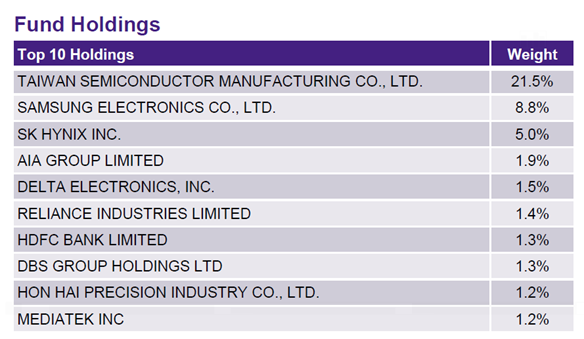
As of 31 March 2026, its largest holding was Taiwan Semiconductor Manufacturing Company, or TSMC, at 21.5% of the portfolio. Other major holdings included Samsung Electronics, SK Hynix, AIA Group, Delta Electronics, Reliance Industries, HDFC Bank, DBS Group, Hon Hai Precision and MediaTek.
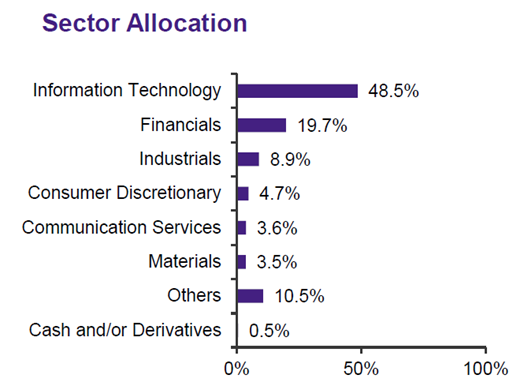
Information technology made up 48.5% of the ETF, while financials accounted for 19.7%.
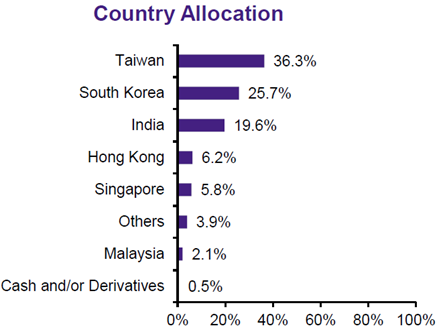
Geographically, Taiwan was the largest market exposure at 36.3%, followed by South Korea at 25.7% and India at 19.6%.
This gives investors access to several Asian growth engines in one ETF. However, the fund is not evenly spread across the region, as its performance may be heavily influenced by Taiwan, South Korea and the semiconductor cycle.
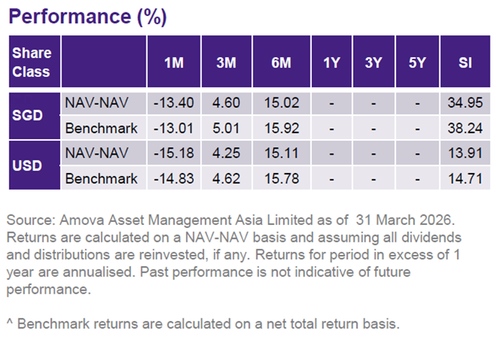
As of 31 March 2026, the SGD class recorded a since-inception NAV return of 34.95%, compared with 38.24% for its benchmark. Over six months, the SGD class returned 15.02%.
The short-term volatility is also worth noting. The ETF fell 13.40% over one month in March 2026.
For investors already exposed to China and Japan, this ETF may help fill the remaining Asia allocation. Nonetheless, investors should take note of its heavy sector exposure to technology and single country exposure to Taiwan and South Korea.
How do these 3 Asia ex-China SGX ETFs compare?
Among the three, the iShares MSCI India Climate Transition ETF (SGX: QK9 / I98) has the longest track record, having been available in Singapore since 2006. The Lion-Nomura Japan Active ETF (SGX: JJJ / JUS) was listed in January 2024, while the Amova MSCI AC Asia ex Japan ex China Index ETF (SGX: A93 / 93U) was listed in April 2025.
On cost, the Amova MSCI AC Asia ex Japan ex China Index ETF has the lowest total expense ratio at 0.60% p.a., followed by the iShares MSCI India Climate Transition ETF at 0.64% p.a. and the Lion-Nomura Japan Active ETF at 0.98% p.a. The higher cost for the Lion-Nomura Japan Active ETF reflects its active management approach.
All three ETFs are geared more towards growth than income, as none currently provide regular cash distributions.
| SGX ETF | Lion-Nomura Japan Active ETF (JJJ / JUS) | iShares MSCI India Climate Transition ETF (QK9 / I98) | Amova MSCI AC Asia ex Japan ex China Index ETF (A93 / A94) |
| SGX tickers | JJJ (SGD), JUS (USD) | QK9 (SGD), I98 (USD) | A93 (SGD), A94 (USD) |
| Main exposure | Japan equities (active) | India equities (climate overlay) | Asia ex Japan ex China (broad regional) |
| Management approach | Actively managed, AI-driven | Passive index tracking | Passive index tracking |
| Benchmark / index | TOPIX reference benchmark | MSCI India ESG Enhanced Focus CTB Select Net Index | MSCI AC Asia ex Japan ex China Index |
| SGX listing date | 31-Jan-24 | 15-Jun-06 | 2-Apr-25 |
| Fund size | S$65.66 million | US$53.81 million | S$78.59 million |
| Total expense ratio | 0.98% p.a.* | 0.64% p.a.* | 0.60% p.a.* |
| Distribution | Accumulating | Accumulating | Accumulating |
| Distribution frequency | None | None | None |
| Source: Respective fund factsheets as of 31 March 2026. *Taken from SGX ETF Screener. | |||
Key risks in Asia ex-China Investing
Asia ex‑China offers access to a broad mix of markets, spanning developed economies such as Japan, Singapore and Hong Kong; technology‑focused markets like Taiwan and South Korea; and emerging markets including India and Southeast Asia.
However, returns can vary significantly across countries and over time, and investments may be subject to risks such as emerging market volatility.
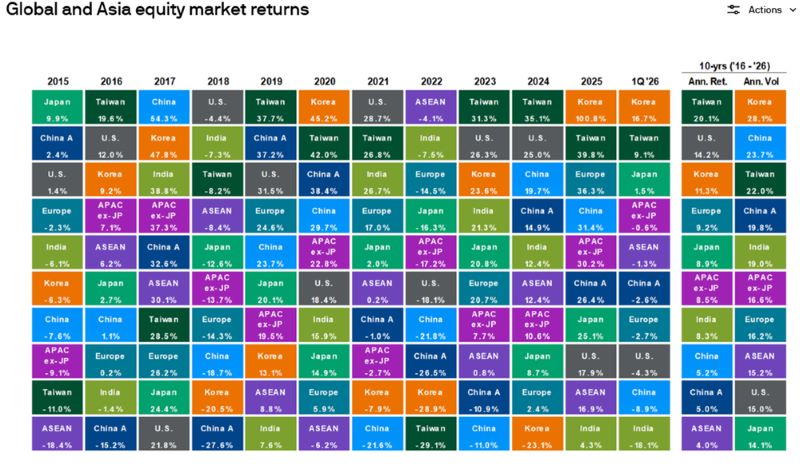
#1 - Market leadership can change quickly
Asia ex-China markets can be volatile, with leadership often rotating between India, Japan, Taiwan, South Korea and other parts of the region.
This is why investors should be careful about chasing the strongest recent performer, as a market that leads in one period can lag in the next.
#2 - Broad Asia exposure may still be concentrated
Asia ex-China may sound diversified, but the actual ETF exposure can still be concentrated in a few countries or sectors, such as Taiwan, South Korea, India and technology stocks.
This may deliver tailwind to your investment portfolio when the AI and semiconductor cycle is strong, but it can also hurt when technology sentiment weakens.
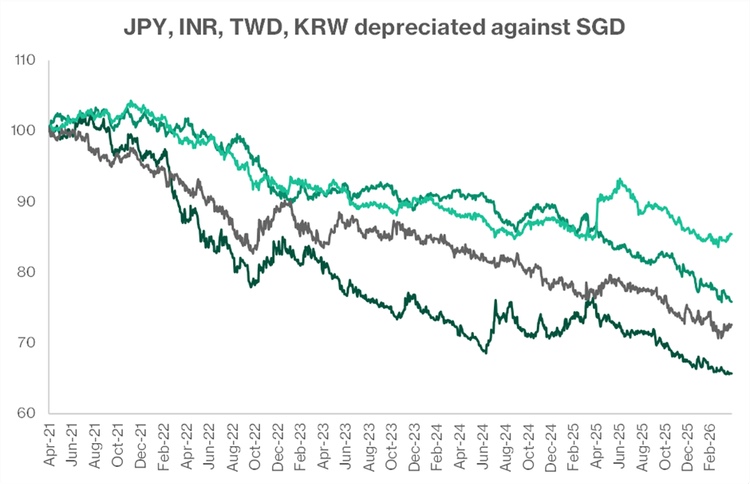
#3 - Currency movements can affect returns
Even if an ETF trades in Singapore dollars on SGX, the underlying investments may still be exposed to currencies such as the Japanese yen, Indian rupee, Taiwan dollar, Korean won or Hong Kong dollar.
While SGD trading counters of locally listed ETFs offer the ease of purchase, the investments underlying currency movements can affect final returns.
#4 - Emerging markets can be more sensitive to global flows
India and Southeast Asia may offer stronger long-term growth potential, but they can also be more sensitive to foreign fund flows, inflation, interest rates, currency movements and political developments.
When global investors become more cautious, money can move out of emerging markets quickly, leading to sharper market swings.
What would Beansprout do?
In my view, these ETFs may be considered as part of the growth pot within a long-term portfolio to complement the core portfolio.
At Beansprout, our house view is to build a globally diversified portfolio, with Singapore at its core. For the growth pot, I would start with broad global exposure and add targeted regional exposure such as Japan, India or Asia ex-China in a more tactical manner.
For investors who want one broad Asia ex-China ETF, the Amova MSCI AC Asia ex Japan ex China Index ETF (SGX: A93/A94) offers the widest regional coverage among the three.
It gives investors exposure to Taiwan, South Korea, India and parts of Southeast Asia, but I would be mindful that its returns may still be heavily influenced by technology and semiconductor stocks.
For Japan exposure, the Lion-Nomura Japan Active ETF (SGX: JJJ / JUS) gives access to an actively managed portfolio of Japanese equities. The Japan reform story is interesting, but the ETF has a shorter track record, and its active approach may perform differently from the broader Japan market.
For India exposure, the iShares MSCI India Climate Transition ETF (SGX: QK9 / I98) is the most established SGX-listed option among the three. India’s long-term growth story remains attractive, but I would weigh this against its recent market weakness, currency risk and climate transition overlay.
Overall, Asia ex‑China is more suited for investors seeking long‑term growth potential rather than a low‑risk allocation.
Used thoughtfully, these ETFs may help strengthen diversification in a growth portfolio, with careful sizing alongside existing exposure to Singapore, China, the US, and global equity markets.
Which part of Asia ex-China are you most interested in? Share with us in the comments below or in our Telegram group!
You can find out more about these and other SGX-listed ETFs on the SGX ETF screener page. If you are considering where to buy them, you may also want to check out our review of the best stock trading platforms in Singapore and the latest broker promotions below.
Are there any ongoing broker promotions when I invest in SGX ETFs?
Several brokers and platforms offer promotions to incentivize ETF investments:
| Broker | Promotion Description |
| iFast FSMOne |
|
| Phillip Securities |
|
| *Terms and conditions of participating brokers apply. Please refer to their website for more details. | |
Enjoyed this insight? Follow Beansprout on Telegram, Youtube, Facebook and Instagram, and add Beansprout as your preferred source on Google so you never miss an update.
Disclaimer
This advertisement has not been reviewed by the Monetary Authority of Singapore.
Any information provided in this article is meant purely for informational and investor education purposes and should not be relied upon as financial or investment advice, or advice on corporate finance.
This article is not and does not constitute or form part of any offer, recommendation, invitation or solicitation to purchase any financial product or subscribe or enter any transaction. This article also does not take into account your personal circumstances, e.g. investment objectives, financial situation or particular needs and shall not constitute financial advice. You should consult your own independent financial, accounting, tax, legal or other competent professional advisors.
The information provided in this article are on an “as is” and “as available” basis without warranty of any kind, whether express or implied. Beansprout does not recommend any particular course of action in relation to any investment product or class of investment products. No information is presented with the intention to induce any person to buy, sell, or hold a particular investment product or class of investment products.
Read also
Gain financial insights in minutes
Subscribe to our free weekly newsletter for more insights to grow your wealth
Most Popular

Comments
0 comments