
Why Singapore stocks are still worth looking at in 2026

Insights

Stocks

By Gerald Wong, CFA • 26 Apr 2026

Why trust Beansprout? We’ve been awarded Best Investment Website at the SIAS Investors’ Choice Awards 2025

Google Preferred Source
Comments

Singapore stocks hit a record high as the STI crosses 5,000. Here’s why blue chip stocks and opportunities beyond them may still be worth looking at in 2026.
singapore blue chip stocks april 2026
In this article

What happened?

Singapore stocks recently hit a new record high.

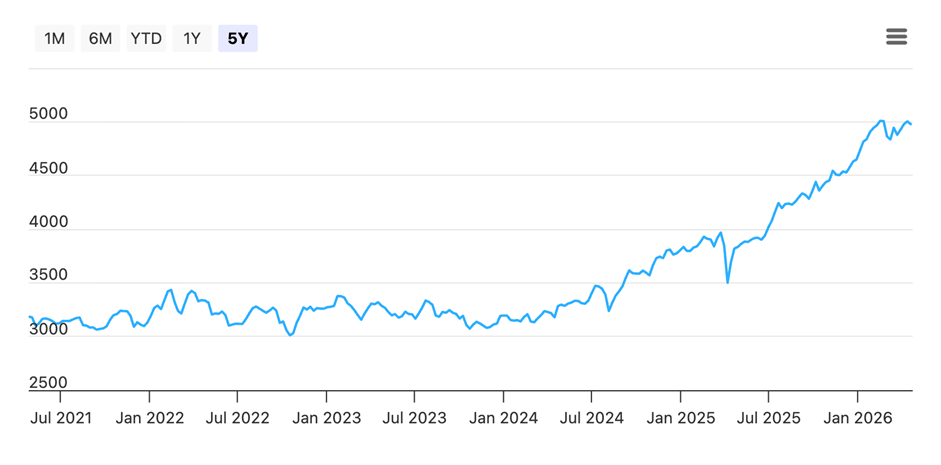
The benchmark Straits Times Index (STI) crossed the 5,000 mark for the first time in 2026.

According to SGX, the STI delivered a 29% price return over the 12 months to 9 April 2026.

This suggests that investors continue to see Singapore as a relatively stable market during uncertain periods.

For many investors, Singapore blue chip stocks such as DBS, UOB and OCBC, as well as Singapore REITs, have traditionally been seen as income plays.

However, the market may now offer more than just dividends, supported by stronger company earnings, efforts to improve shareholder returns, and long-term growth areas such as data centres, infrastructure and wealth management.

In this article, we look at key drivers behind Singapore stocks, what they could mean for Singapore blue chip stocks, and whether the rally could extend to the broader market.
Straits Times Index STI steady upward trend

5 key drivers for the Singapore blue chip stocks

These are some of the key reasons why we think Singapore equities are still worth watching closely in 2026:

  • EQDP - The MAS policy catalyst
  • S$30 Million Value Unlock Programme
  • Singapore as a Geopolitical Safe Haven
  • Resilient Singapore Dollar
  • Structural thematic drivers in the Singapore economy

#1 – EQDP - The MAS policy catalyst

One of the clearest near- to medium-term catalysts is the MAS Equity Market Development Programme (EQDP).

Expanded programme boosts assets and allocations
Source : MAS, April 2026

The MAS Equity Market Development Programme (EQDP), expanded to S$6.5 billion in Budget 2026 from the original S$5 billion, is one of the largest policy efforts to support Singapore’s stock market in recent years. 

About S$3.95 billion has already been allocated across nine asset managers, including BlackRock, Manulife, Lion Global and Fullerton, with the remaining ~S$2.55 billion yet to be deployed.

This means there is still a meaningful pool of capital that could flow into Singapore equities over time, providing a potential demand tailwind.

This could benefit Singapore blue chip stocks, as well as Singapore small- and mid-cap stocks.

#2 – S$30 Million Value Unlock Programme

Liquidity alone is not enough if companies are not communicating clearly with investors or allocating capital well. 

That is where the MAS-SGX Value Unlock Programme becomes relevant.

Coordinated strategy targets market valuation gap
Source : MAS, April 2026

The MAS-SGX Value Unlock Programme provides grants and advisory support to help listed companies improve investor engagement, strengthen capital allocation discipline, and communicate their strategy more clearly to the market. 

The initiative aims to help companies narrow the valuation gap by building stronger governance, better disclosure, and a clearer focus on shareholder returns.

It complements the broader EQDP, which injects institutional liquidity into the market, while Value Unlock works on the supply side by helping listed companies become more investable — particularly in the small- and mid-cap space.

#3 – Singapore as a Geopolitical Safe Haven

Geopolitical tensions, especially the US-China rivalry, have strengthened Singapore’s role as a safe-haven for global wealth. 

A clear example is the sharp rise in single-family offices, which increased from 1,400 in 2023 to over 2,000 by end-2024, a 43% jump in just one year. 

This growing pool of capital supports Singapore banks through higher wealth management fees and deepens the domestic capital base available for equities and private market investments, reinforcing Singapore’s appeal as a trusted place to preserve and grow wealth.

Singapore family offices rise sharply

#4 – Resilient Singapore Dollar

The Singapore dollar has stayed notably steady against the US dollar and other major currencies, which stands out in a world where exchange rates can move sharply in short periods. 

US Dollar Singapore Dollar shows volatility
Source : Trading Economics, April 2026

The Singapore dollar has remained relatively steady compared with many other currencies, even during periods of global market volatility. 

As of 23 March 2026, the SGD had strengthened by about 3.0% against the US dollar over the past 12 months.

A key reason is Singapore’s exchange rate policy. Unlike many central banks that focus mainly on interest rates, the Monetary Authority of Singapore manages the Singapore dollar against a basket of currencies from Singapore’s major trading partners. 

This helps keep imported inflation under control and supports confidence in the currency.

The Singapore dollar is also supported by Singapore’s strong fundamentals, large reserves and reputation as a stable financial hub. 

Continued inflows into wealth management, business activity and financial markets also help support demand for Singapore dollar assets.

For investors, this stability matters. It can reduce the risk that returns are eroded by sharp currency swings, while helping local investors preserve purchasing power over time.

#5 – Structural thematic drivers in the Singapore economy

Beyond valuation and policy support, Singapore’s stock market is currently being supported by three key structural themes that reinforce each other.

First is AI and data centres. Singapore has become a major regional tech hub, with global players like Microsoft, Google, and AWS continuing to invest heavily in data centre and cloud capacity.

Second is energy and food security. As a highly import-dependent economy, Singapore is working to strengthen resilience by diversifying energy sources, expanding storage, and investing in cleaner and more stable supply systems.

Third is government spending. With a record S$154.7 billion Budget, ongoing investment in infrastructure such as airports, rail networks, healthcare, and housing continues to provide steady economic support.

What ties these themes together is how they feed into one another. 

More AI drives higher demand for infrastructure and power. More infrastructure spending increases energy needs. Stronger energy and food security supports a more stable environment for businesses to grow.

For investors, this creates opportunities across multiple parts of the market — from REITs and banks to utilities, construction, and logistics — all benefiting from the same long-term structural backdrop.

Is the valuation of Singapore blue chip stocks still attractive? 

Even after the recent rally, STI valuations still look reasonable. 

The index is trading at a P/E ratio of about 17x, so valuations do not appear stretched especially when compared to the region.

STI price to earnings below global benchmarks

Dividend yields are also attractive at around 4.5%, underpinned by strong payouts from the banks and telecom stocks.

Singapore indices offer higher dividend yields overall
Source: Bloomberg, as of 8 April 2026

Most investors see Singapore equities as a mature, defensive market that mainly offers an income/dividend story. 

We believe, however, that Singapore is attractive not only for yield but also because policy‑driven initiatives and clear thematic opportunities are emerging in the market.

What would Beansprout do?

We continue to see Singapore stocks as a core part of a globally diversified portfolio.

Apart from being defensive, the market also offers dividend income, relatively resilient companies, and exposure to long-term growth areas such as data centres, infrastructure and wealth management.

That said, we would stay selective. After the strong rally, not every stock will offer the same opportunity. 

We would focus on companies with resilient earnings, strong balance sheets, and sustainable dividends.

Overall, we would continue to hold Singapore stocks for the long term, while staying disciplined, diversified and clear about why we own each stock.

If you are looking for more stock ideas to capture market opportunities, you can explore our high conviction ideas here.

Beansprout webinar: How I invest with clarity (6 May)

If you’ve been wanting to unlock the next step in your investing journey, or to grow more confident in your portfolio allocation strategy, this session is for you.

As a team with over 50 years of combined institutional investment experience across Asia Pacific, US, and global markets, formerly of Nomura Asset Management, Banque Pictet, Capital Group, and Fullerton Fund Management, we know what it takes to invest with discipline and purpose.

In this webinar, we'll walk you through the investment framework the Beansprout team uses, covering everything from building a safety buffer to growing long-term wealth, generating passive income, and capturing high-conviction opportunities.

If you're ready to move beyond the basics and take a more structured approach to your portfolio, this session will give you the clarity and confidence to do just that.

Register for free here. 

beansprout_x_cmc_event_may_2026_38c316092d

If you prefer broad exposure to blue chips without picking individual names, you can also learn more about the Straits Times Index (STI) here.

If you would like to look for other Singapore stocks beyond blue chips, you can learn more about the Next50 index here. 

Check out Beansprout's guide to the best stock trading platforms in Singapore with the latest promotions to invest in the Singapore market. 

Enjoyed this insight? Follow Beansprout on TelegramYoutubeFacebook and Instagram, and add Beansprout as your preferred source on Google so you never miss an update.

Read also

Most Popular

Gain financial insights in minutes

Subscribe to our free weekly newsletter for more insights to grow your wealth

chatbubble
Comments

0 comments