
Can SIA maintain its 4.8% dividend yield? First quarterly loss since 2022
Stocks
By Goh Lay Peng • 29 Jul 2026
Why trust Beansprout? We’ve been awarded Best Investment Website at the SIAS Investors’ Choice Awards 2025
'%3e%3cpath%20fill-rule='evenodd'%20clip-rule='evenodd'%20d='M17.64%209.20455C17.64%208.56637%2017.5827%207.95273%2017.4764%207.36364H9V10.845H13.8436C13.635%2011.97%2013.0009%2012.9232%2012.0477%2013.5614V15.8195H14.9564C16.6582%2014.2527%2017.64%2011.9455%2017.64%209.20455V9.20455Z'%20fill='%234285F4'/%3e%3cpath%20fill-rule='evenodd'%20clip-rule='evenodd'%20d='M9%2018C11.43%2018%2013.4673%2017.1941%2014.9564%2015.8195L12.0477%2013.5614C11.2418%2014.1014%2010.2109%2014.4205%209%2014.4205C6.65591%2014.4205%204.67182%2012.8373%203.96409%2010.71H0.957275V13.0418C2.43818%2015.9832%205.48182%2018%209%2018V18Z'%20fill='%2334A853'/%3e%3cpath%20fill-rule='evenodd'%20clip-rule='evenodd'%20d='M3.96409%2010.71C3.78409%2010.17%203.68182%209.59318%203.68182%209C3.68182%208.40682%203.78409%207.83%203.96409%207.29V4.95818H0.957273C0.347727%206.17318%200%207.54773%200%209C0%2010.4523%200.347727%2011.8268%200.957273%2013.0418L3.96409%2010.71V10.71Z'%20fill='%23FBBC05'/%3e%3cpath%20fill-rule='evenodd'%20clip-rule='evenodd'%20d='M9%203.57955C10.3214%203.57955%2011.5077%204.03364%2012.4405%204.92545L15.0218%202.34409C13.4632%200.891818%2011.4259%200%209%200C5.48182%200%202.43818%202.01682%200.957275%204.95818L3.96409%207.29C4.67182%205.16273%206.65591%203.57955%209%203.57955V3.57955Z'%20fill='%23EA4335'/%3e%3c/g%3e%3cdefs%3e%3cclipPath%20id='clip0_0_2849'%3e%3crect%20width='18'%20height='18'%20fill='white'/%3e%3c/clipPath%3e%3c/defs%3e%3c/svg%3e)
Make Beansprout your preferred source on Google
Add us on Google to see more of our insights in your search results
SIA slipped into the red as fuel costs rose. We examine what the weaker results could mean for its 4.8% dividend yield and outlook.

What happened?
Singapore Airlines (SIA)'s earnings and dividends are back in investor focus.
This came after the SIA reported a net loss in its most recent quarterly results, its first quarterly net loss since 2022.
Earlier, we shared that SIA is one of the Singapore blue chip stocks with a dividend yield still above 4%, even as Singapore stocks have soared to new highs in recent months.
I have seen discussion in the Beansprout community about whether SIA's share price looks attractive, and if its dividend yield can be maintained.
In this article, I will dive deeper into SIA's latest earnings, and put it through Beansprout's income pot screening framework to find out if the stock still look attractive for income investors.
5 things you need to know about SIA's 1Q FY2026/27 results
SIA announced its earnings for the first quarter of FY2026/27, for the three months ended 30 June 2026. Key highlights include:
- Revenue rose 19.3% year-on-year to a record S$5,714 million, with passenger yields up 12.0% and cargo revenue up 33.5%.
- Total expenditure rose 27.9% year-on-year to S$5,609M
- Net fuel cost jumped 78.5% year-on-year to S$2,253 million.
- Operating profit fell 73.8% year-on-year to S$106 million
- Share of losses from Air India widened by S$42 million.
- Net loss of S$76 million from a S$186 million profit a year ago
- Balance sheet remains strong, with cash reserves up S$1.17 billion to S$9.10 billion and debt-equity ratio at 0.65x.
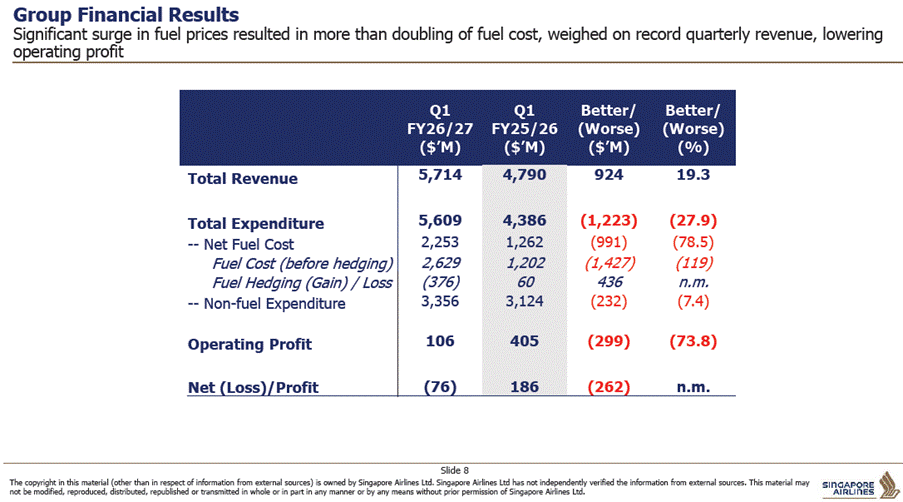
#1 - Revenue hit a quarterly record, but fuel costs rose even faster
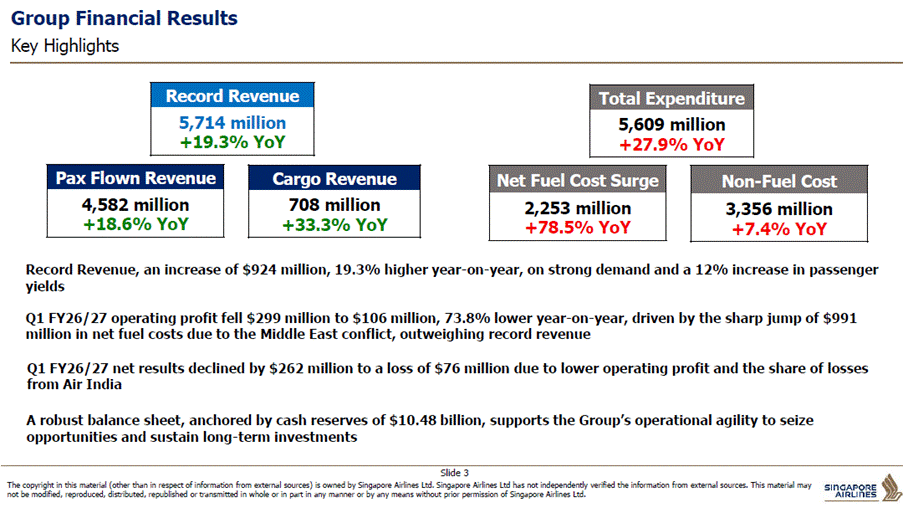
SIA’s revenue reached a quarterly record of S$5.71 billion in 1QFY2026/27, up 19.3% year-on-year.
This was supported by an 18.6% increase in passenger revenue and a 33.5% jump in cargo revenue.
However, costs rose even faster.
Total expenditure increased 27.9% to S$5.61 billion, mainly due to higher fuel costs.
Gross fuel cost, before hedging, more than doubled, rising 118.7% year-on-year.
This reflected the lagged impact of higher jet fuel prices following the Middle East conflict.
SIA’s fuel hedges helped cushion part of the impact, with a hedging gain of S$376 million compared with a S$60 million loss a year ago.
Even so, net fuel cost still rose 78.5% to S$2.25 billion.
Source: Company data, SIA 1Q FY26/27 earnings release
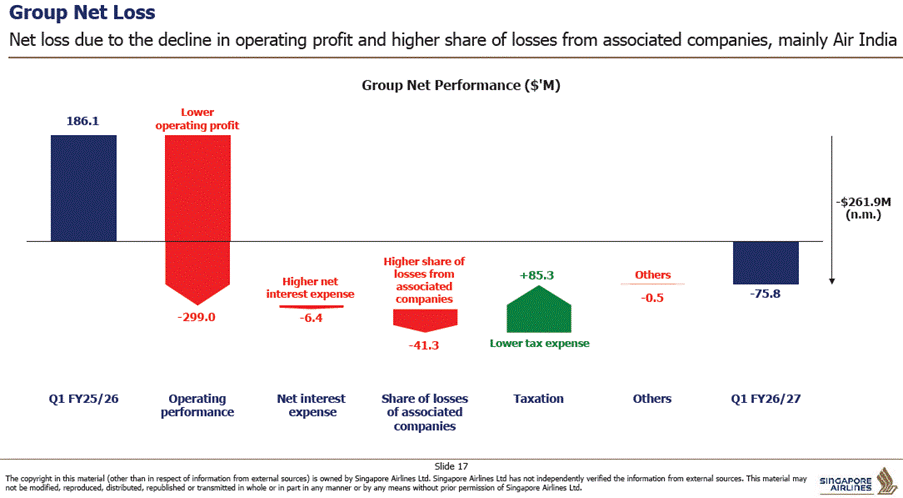
SIA posted net loss due to the significantly lower operating profit. Operating profit fell S$299 million during the quarter.
In addition, SIA recorded a higher share of losses from Air India, at -S$42 million.
Source: Company data, SIA 1Q FY26/27 earnings release
#2 - Underlying travel demand stayed resilient
Underlying travel demand remained resilient despite the sharp increase in fuel costs.
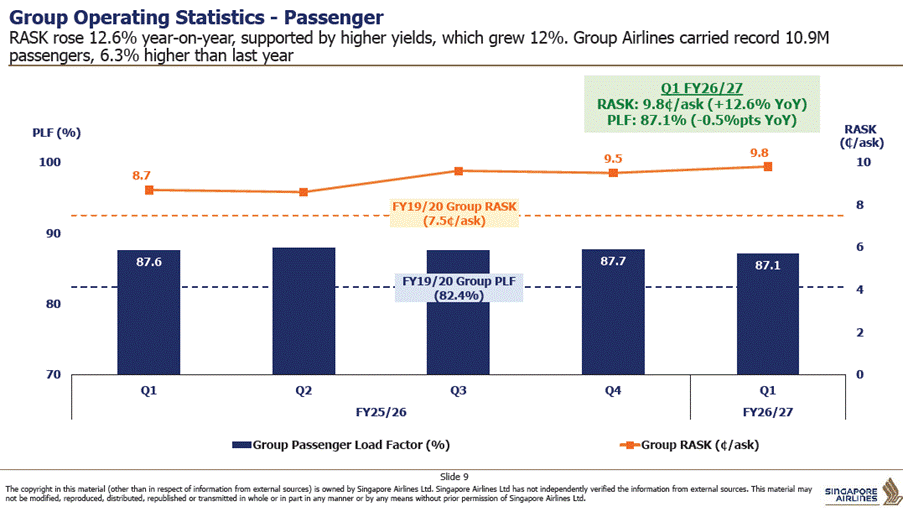
SIA and Scoot carried a record 10.9 million passengers during the quarter, up 6.3% year-on-year.
Passenger yields also improved, rising 12.0% to 11.2 cents per revenue passenger-kilometre.
The group’s passenger load factor stayed high at 87.1%, only slightly below the level recorded a year ago.
This was because capacity growth of 5.9% modestly outpaced traffic growth of 5.3%.
Source: Company data, SIA 1Q FY26/27 earnings release
#3 - Cargo had a strong quarter too
Cargo was another bright spot for SIA.
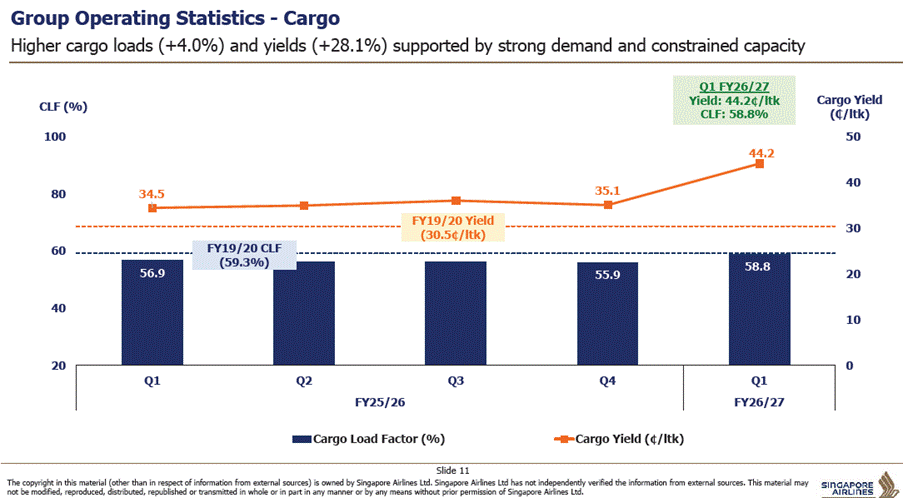
Cargo revenue rose 33.5% year-on-year to S$708 million.
This was driven mainly by stronger pricing, with cargo yields rising 28.1%.
Cargo load factor also improved by 1.9 percentage points to 58.8%.
Beansprout thinks resilient cargo demand may be supported by semiconductor and data centre-related shipments.
This ties in with the broader AI supply chain theme we have been tracking, where demand for chips, servers and related equipment continues to support logistics flows.
Source: Company data, SIA 1Q FY26/27 earnings release
#4 - The balance sheet remains one of the strongest in the airline industry
SIA’s balance sheet remains a key strength.
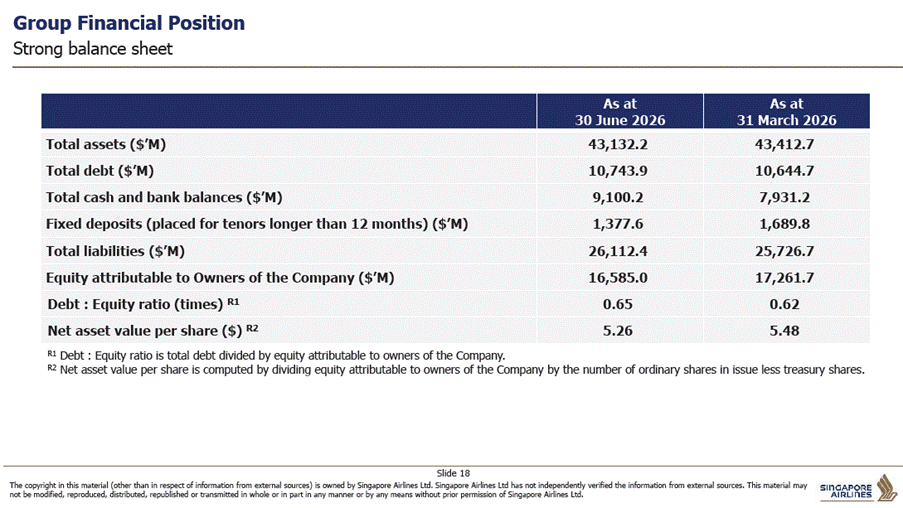
Cash and bank balances rose by S$1.17 billion to S$9.10 billion, supported by S$1.36 billion of net operating cash flow during the quarter.
The group also holds S$1.38 billion in longer-tenor fixed deposits and has access to S$3.24 billion in undrawn committed credit lines.
This gives SIA significant liquidity to manage fuel volatility, geopolitical disruptions and fleet investment needs.
Total debt rose modestly after a CNY1.50 billion bond issuance.
This nudged the debt-to-equity ratio up from 0.62 times to 0.65 times.
Total debt of S$10.7 billion less cash of S$9.1 billion leaves net debt of S$1.6 billion against equity of S$16.6 billion.
With a net debt-to-equity ratio of 0.1x, SIA has one of the strongest balance sheets in the global airline industry.
Source: Company data, SIA 1Q FY26/27 earnings release
#5 - Cautious outlook
Management warned that fare and cargo rate adjustments have not fully offset the impact of significantly higher fuel prices.
A prolonged Middle East conflict could also weigh on supply chains, travel sentiment and broader macro conditions.
SIA on Beansprout's Income Pot framework
Check | SIA |
| EPS growth | ❌ Fail — EPS growth turned negative in FY25/26 and 1QFY26/27 |
| Net debt to equity | ✅ Pass — Net debt to equity at 0.1x as at 30 Jun 2026 |
| Dividend Payout ratio | ✅ Pass — Consistently maintain above 40% in the recent three years |
| Positive free cash flow | ✅ Pass – Consistently positive in the last five years |
| Dividend yield | ✅ Pass — FY25/26 Ordinary and Special Dividend per share totalled S$0.37, equivalent to dividend yield 4.8% |
| Overall | 4/5 checks |
Based on Beansprout’s income pot stock screening framework, SIA passes four of our five checks.
The one clear weakness is earnings growth.
SIA’s EPS growth has turned negative, with FY2025/26 net profit already down sharply from the previous year.
The latest 1QFY2026/27 results added to the concern, as SIA swung to a net loss of S$76 million due to sharply higher fuel costs and wider losses from Air India.
The balance sheet remains a key strength.
Net debt stood at about S$1.6 billion against equity of S$16.6 billion as at 30 June 2026, implying a net debt-to-equity ratio of around 0.1 times.
This is low by global airline standards, and gives SIA more room to absorb fuel volatility and geopolitical disruptions.
The dividend payout ratio also passes our framework.
Based on historical FY2025/26 dividend of S$0.27 against EPS of S$0.38 implies a payout ratio of about 71%, above our 40% baseline. That said, dividend per share will decline if the current financial year’s profit falls.
Free cash flow has also remained positive.
In 1QFY2026/27, SIA generated S$1.36 billion of operating cash flow against S$0.55 billion of capex.
That said, free cash flow can be lumpy given SIA’s capital-intensive fleet cycle, with 62 aircraft still on order.
Dividend yield is attractive.
Based on the FY2025/26 ordinary and special dividend of S$0.37, SIA offers a dividend yield of about 4.8%.
This is about 2.7 percentage points above the current Singapore Savings Bond yield of around 2.1%.
Overall, SIA screens well on balance sheet strength, dividend payout, free cash flow and yield but does not pass the earnings growth check.
For income investors, this means SIA’s dividend remains supported for now, but the key risk is whether higher fuel costs and Air India losses continue to weigh on profits.
What would Beansprout do?
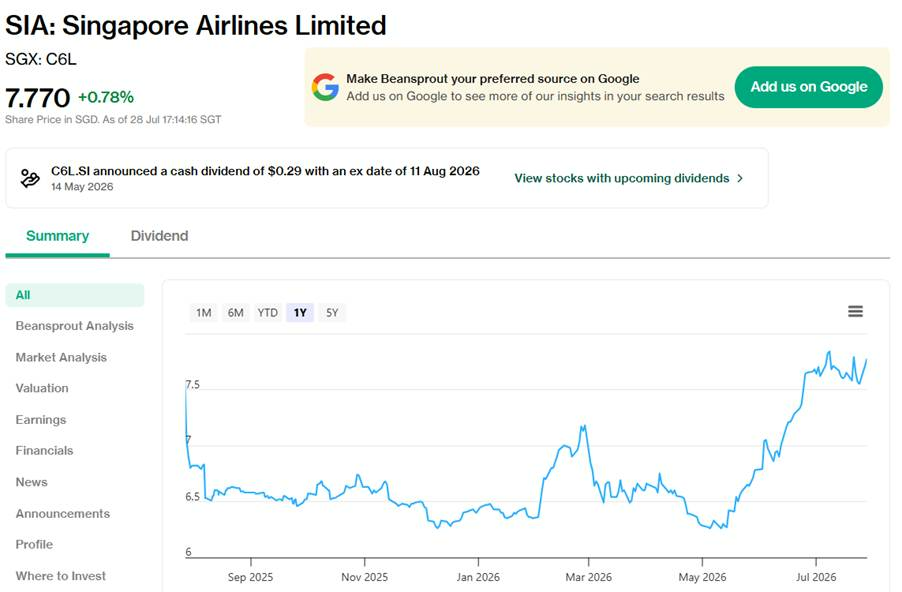
Despite the slight correction in its share price after the results, SIA's share price has still done well so far this year.
SIA's share price has increased by 21.4% year-to-date, in line with the the Straits Times Index (STI) which has risen by 20.9% over this period.
On valuations, SIA currently trades at 1.4x price-to-book, above its historical average.
If I am considering SIA for my income pot within Beansprout's four pots of wealth, I would do a quick check using Beansprout’s income pot stock screening framework
SIA clears four of the five financial health checks. Its balance sheet remains strong, cash generation is solid, and management has maintained its dividend despite weaker profitability.
However, the earnings growth miss is important. FY2025/26 net profit fell sharply, and SIA has now reported a quarterly net loss in 1QFY2026/27.
The biggest swing factor is fuel. Passenger demand, yields, load factors and cargo revenue all held up well, suggesting that the core business remains resilient. The issue is whether elevated fuel costs, linked to the Middle East conflict, persist for longer than expected.
For income-focused investors, SIA’s dividend yield of about 4.8% may appear attractive. However, that yield is now being tested by a tougher operating environment, which is causing its earnings to decline.
We would want to see fuel costs normalise and earnings recover to consider SIA as a dependable income holding.
Related links:
Join the Beansprout Telegram group get the latest insights on Singapore REITs, stocks, bonds, and ETFs.
Read also
Gain financial insights in minutes
Subscribe to our free weekly newsletter for more insights to grow your wealth
Most Popular

Comments
0 comments