
How SIA’s 5.8% dividend yield may be affected by Air India’s capital raising
Stocks
By Goh Lay Peng • 21 Apr 2026
Why trust Beansprout? We’ve been awarded Best Investment Website at the SIAS Investors’ Choice Awards 2025
'%3e%3cpath%20fill-rule='evenodd'%20clip-rule='evenodd'%20d='M17.64%209.20455C17.64%208.56637%2017.5827%207.95273%2017.4764%207.36364H9V10.845H13.8436C13.635%2011.97%2013.0009%2012.9232%2012.0477%2013.5614V15.8195H14.9564C16.6582%2014.2527%2017.64%2011.9455%2017.64%209.20455V9.20455Z'%20fill='%234285F4'/%3e%3cpath%20fill-rule='evenodd'%20clip-rule='evenodd'%20d='M9%2018C11.43%2018%2013.4673%2017.1941%2014.9564%2015.8195L12.0477%2013.5614C11.2418%2014.1014%2010.2109%2014.4205%209%2014.4205C6.65591%2014.4205%204.67182%2012.8373%203.96409%2010.71H0.957275V13.0418C2.43818%2015.9832%205.48182%2018%209%2018V18Z'%20fill='%2334A853'/%3e%3cpath%20fill-rule='evenodd'%20clip-rule='evenodd'%20d='M3.96409%2010.71C3.78409%2010.17%203.68182%209.59318%203.68182%209C3.68182%208.40682%203.78409%207.83%203.96409%207.29V4.95818H0.957273C0.347727%206.17318%200%207.54773%200%209C0%2010.4523%200.347727%2011.8268%200.957273%2013.0418L3.96409%2010.71V10.71Z'%20fill='%23FBBC05'/%3e%3cpath%20fill-rule='evenodd'%20clip-rule='evenodd'%20d='M9%203.57955C10.3214%203.57955%2011.5077%204.03364%2012.4405%204.92545L15.0218%202.34409C13.4632%200.891818%2011.4259%200%209%200C5.48182%200%202.43818%202.01682%200.957275%204.95818L3.96409%207.29C4.67182%205.16273%206.65591%203.57955%209%203.57955V3.57955Z'%20fill='%23EA4335'/%3e%3c/g%3e%3cdefs%3e%3cclipPath%20id='clip0_0_2849'%3e%3crect%20width='18'%20height='18'%20fill='white'/%3e%3c/clipPath%3e%3c/defs%3e%3c/svg%3e)
Make Beansprout your preferred source on Google
Add us on Google to see more of our insights in your search results
Singapore Airline (SIA) may need to inject more capital into Air India. We look at what this could mean for SIA’s dividend.

What happened?
I came across an interesting discussion on SIA’s dividends recently.
After we compared OCBC’s dividend yield with DBS and UOB's dividend yield, I saw a comment in the Beansprout community about SIA’s dividend yield.
SIA’s ability to maintain its dividends has come into focus after the recent headlines that SIA’s dividend capacity may be impacted if it injects more than expected funds into Air India.
Air India, which is partly owned by SIA, recently announced a larger than expected annual loss of S$3 billion.
With the special dividend that was paid out by SIA recently, many investors are naturally worried about what this may mean for its future payouts.
In this article, we look at what Air India’s capital raising could mean for SIA shareholders and its dividends.
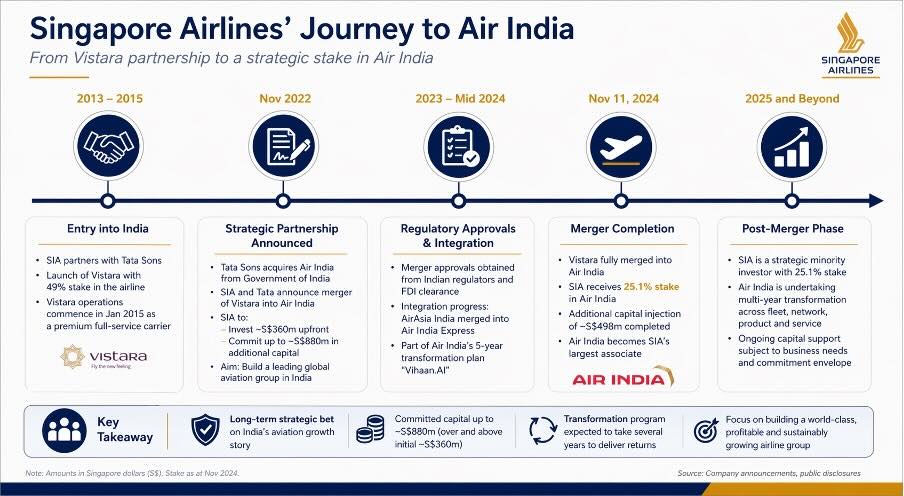
SIA has a 25.1% stake in Air India, which saw significant losses
Singapore Airlines (SIA) owns a 25.1% stake in Air India after the completion of the Air India-Vistara merger in November 2024. The remaining 74.9% stake is owned by Tata Sons
For the financial year ended March 2026, Air India reportedly posted a record loss of about S$3 billion, according to Bloomberg
This was significantly worse than earlier internal estimates of around S$2.0 billion.
The weaker performance was linked to several setbacks, including the closure of Pakistani airspace, higher fuel costs following tensions in the Middle East, the fatal Flight 171 crash in June 2025, and the resignation of CEO Campbell Wilson.
Earlier, we have already seen the losses from Air India impacting SIA’s profits.
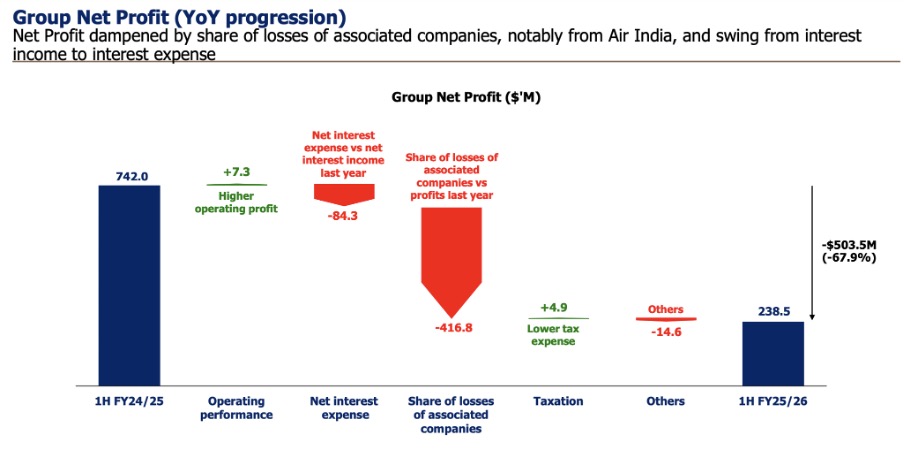
For the first half of fiscal year 2025/26 or six months ending September 2025, SIA’s group net profit fell by 68% year-on-year.
A significant portion of the profit decline was due to a larger share of losses of associated companies compared to the previous year, notably from Air India.
Air India reported to raise around S$1.5 billion from shareholders
According to Bloomberg, Air India is looking to raise at least INR 100 billion (around S$1.5 billion) from its shareholders to support operations and future growth.
In other words, SIA and Tata Group may have to inject fresh capital into Air India.
Based on Singapore Airlines’ 25.1% stake, SIA’s share of the funding would be about S$360 million.
The key point for investors is that this does not appear to be an entirely new funding burden.
SIA had already committed to putting in additional capital previously
When the Vistara-Air India merger was announced, SIA had already committed up to about S$880 million in additional capital.
After the S$498 million injected in November 2024, there is still about S$382 million of that commitment left.
This means SIA’s potential contribution to the latest fund raising could still fall within what management had already set aside earlier.
In other words, SIA may need to deploy more capital, but the amount does not appear to go beyond the original commitment made during the merger.
Will Singapore Airline (SIA) dividend be affected by Air India’s capital raising?
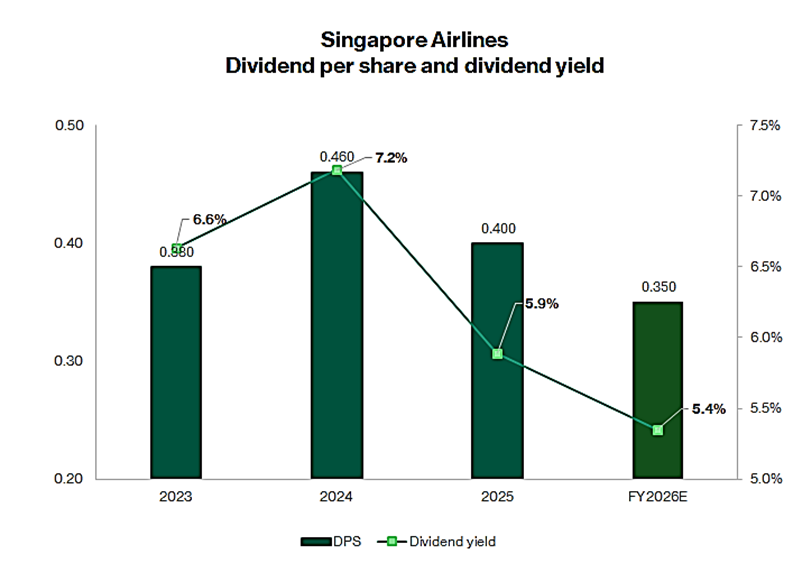
SIA paid a dividend of S$0.40 in the previous fiscal year. This would represent a dividend yield of 5.8%, based on the closing price on 20 April 2026.
At its first half fiscal year 25/26 results for the six months ending September 2025, SIA announced total dividends of 8 cents.
This would comprise an interim dividend per share of 5 cents and a special dividend per share of 3 cents.
This would represent a decline in the dividends compared to the ordinary interim dividend of 10 cents paid out in the previous fiscal year.
The special dividend of 3 cents is part of a three-year special dividend plan of 10 cents per share annually., which works out to about S$900 million in total.
Based on consensus estimates, SIA’s FY2026 dividend is expected to be at 35 cents per share.
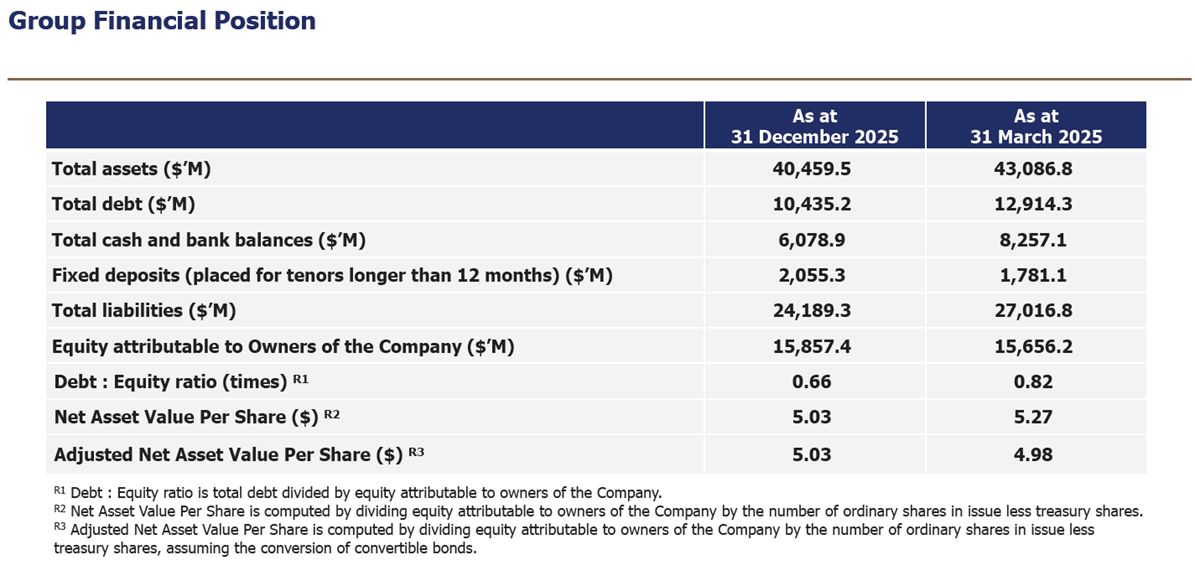
SIA has cash reserves of about S$6.08 billion as of 31 December 2025.
Hence, the potential contribution of S$360 million towards Air India appears manageable relative to its current cash position.
In addition, SIA’s committed special dividends of 10 cents per share annually would amount to about S$900 million in total.
After the 8 cents already paid as at 31 December 2025, the remaining 27 cents would require about S$804 million if paid as expected.
What this means for investors is that, despite the additional capital injection into Air India, SIA still has sufficient financial flexibility to support both its investment commitments and its planned dividends.
Key issue for SIA is what comes next for Air India
However, the bigger issue for investors may be what comes next.
Air India’s losses are unlikely to ease quickly, given its ongoing restructuring and the reputational challenges it still faces. This means there is a possibility that SIA may need to inject more capital over time, beyond the current round.
That could eventually lead investors to question how comfortably SIA can continue balancing support for Air India with its dividend commitments.
SIA has increasingly been seen by some investors as an income stock. Any future move to reduce or pause dividends in order to fund Air India would likely weigh on sentiment and the share price.
So while the immediate impact on dividends appears manageable, Air India may still remain a longer term overhang for SIA shareholders.
SIA may also be impacted by surge in oil prices
Apart from the losses from Air India, another drag to Singapore AIrlines’ earnings may come from higher oil prices.
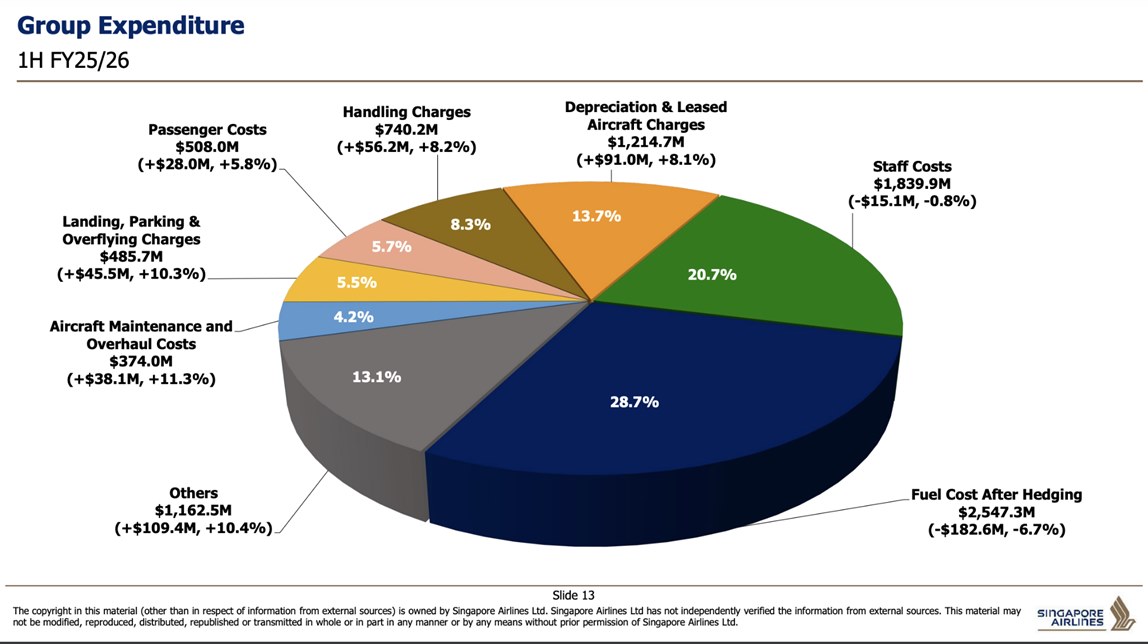
As we can see from the breakdown of SIA’s group expenditure below, fuel cost after hedging represents about 29% of SIA’s total group expenditure in the first half of fiscal year 25/26.
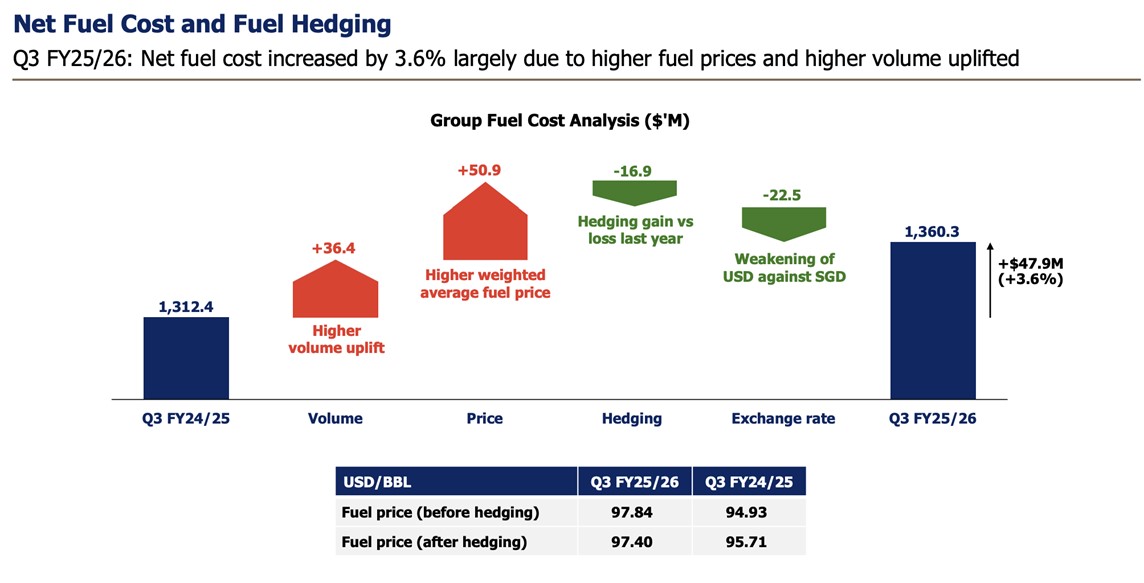
Already, SIA’s net fuel cost increased by 3.6% year-on-year in the third quarter of FY25/26, largely due to higher fuel prices and higher volume.
According to SIA, its average fuel price after hedging was at US$97.4 in 3Q FY25/26, compared to US$95.71 in the previous year.
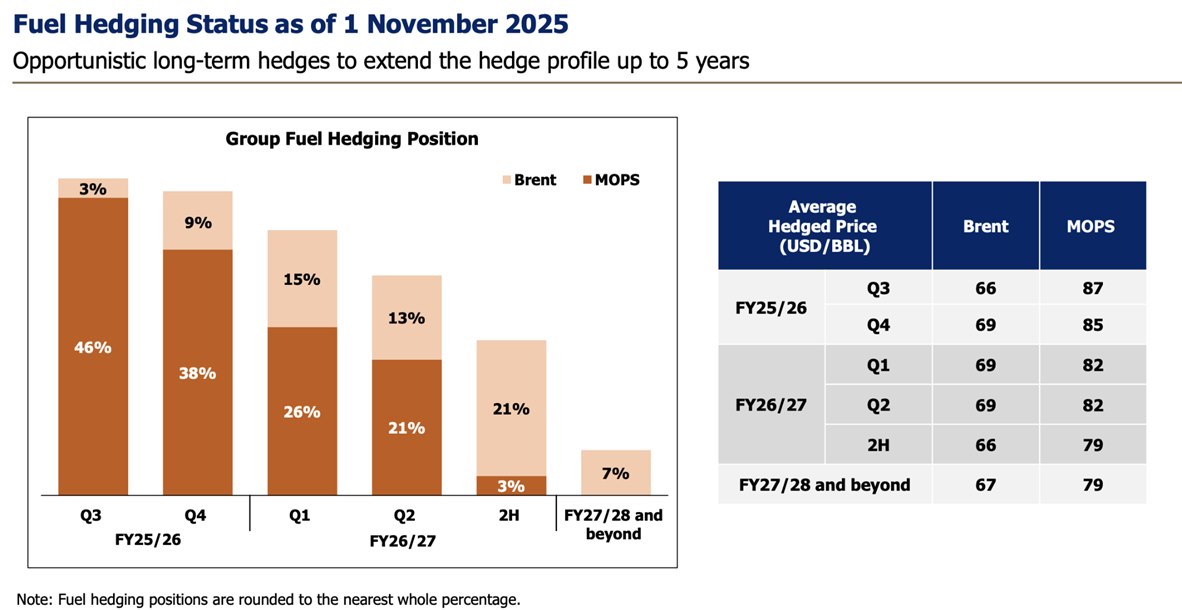
This is mitigated by how SIA has been opportunistic in going into long term hedges to reduce the impact of fuel cost movements on its profit.
As of 1 November 2025, it has entered into hedges for 47% of its fuel needs in the fourth quarter of fiscal year 2025/26, at an average hedged price of US$69/bbl for Brent and US$87/bbl for MOPS.
What would Beansprout do?
SIA has increasingly been seen by some investors as an income stock.
Any future move to reduce or pause dividends in order to fund Air India would likely weigh on sentiment and the share price.
However, the current proposed Air India capital injection on its own is unlikely to force a dividend cut.
This is because SIA has a cash reserve currently that exceeds the potential cash injection, and the capital injection may be part of what has already been previously committed.
However, while SIA offers a FY2026E dividend yield of about 5.4% based on the closing price on 20 April 2026, we would be watchful about whether the current payout can remain untouched over a longer period.
The bigger risk is whether this becomes a recurring issue. Air India’s losses have deepened, and there remains a chance that SIA may need to inject more capital if the turnaround takes longer than expected.
In addition, the broader airline backdrop also looks tougher with higher fuel prices and rising operating costs.
Because of that, we would watch three things closely: whether SIA’s contribution stays within its original commitment, whether Air India’s operating performance begins to improve, and whether management signals any change to its dividend stance.
SIA’s FY2025/26 results on 14 May 2026 should offer clearer visibility on Air India’s equity-accounted losses and whether any further capital commitments may be needed.
For now, I would think about how I can build a more diversified Income Pot beyond SIA, so that my portfolio is not too reliant on any single dividend stock. Explore how to build a more diversified Income Pot here.
Do you own SIA for dividends, or are you watching how the Air India situation develops? Share with us in the comments below or in our Telegram group!
Planning to invest in SIA or other Singapore dividend stocks? Compare the best Singapore brokers to find the right trading platform, and see the latest promotions and sign-up rewards available.
Follow Beansprout on Youtube, Facebook and Instagram, and add Beansprout as your preferred source on Google so you never miss an update.
Read also
Gain financial insights in minutes
Subscribe to our free weekly newsletter for more insights to grow your wealth
Most Popular

Comments
0 comments