
StarHub and M1 to merge: 6 things investors need to know
Stocks
By Ng Hui Min • 24 Nov 2026
Why trust Beansprout? We’ve been awarded Best Investment Website at the SIAS Investors’ Choice Awards
StarHub and M1 are set to merge in an all-share deal. Here are six things investors need to know about the merger, potential cost savings and implications for StarHub and Keppel shareholders.
What happened?
StarHub and M1 are set to merge.
StarHub (SGX: CC3) and Keppel (SGX: BN4) announced on 24 November 2026 that StarHub will acquire M1 through an all-share transaction.
The proposed merger would reduce the number of mobile network operators in Singapore from four to three.
We have been following developments at M1 closely, having previously discussed Keppel's proposed sale of M1 to Simba Telecom and what it could mean for its dividends.
However, the earlier transaction, which was announced in August 2025, was terminated in May 2026.
In our review of Keppel's first-half 2026 results, we also looked at Keppel's ongoing efforts to monetise its non-core assets.
With the latest proposed StarHub-M1 merger, Keppel has found another way to exit its telecommunications business over time.
Here are six things we would look at to understand what the merger means for StarHub and Keppel shareholders.
6 things to know about the StarHub-M1 merger
#1 – StarHub will acquire M1 in an all-share deal
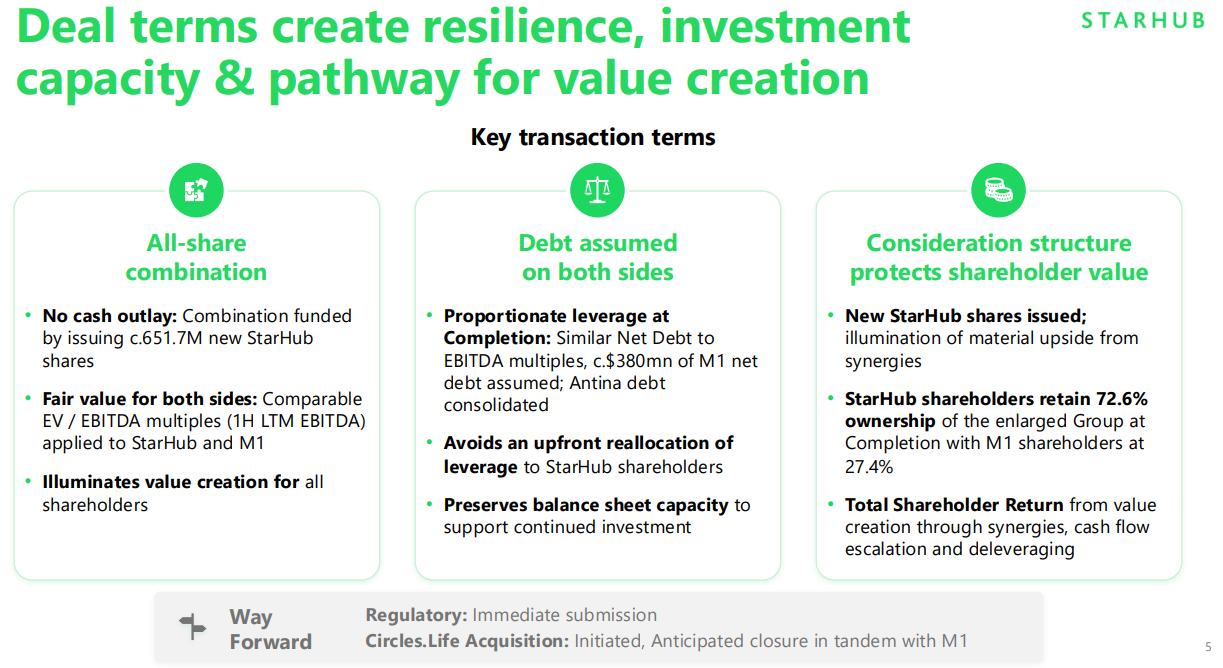
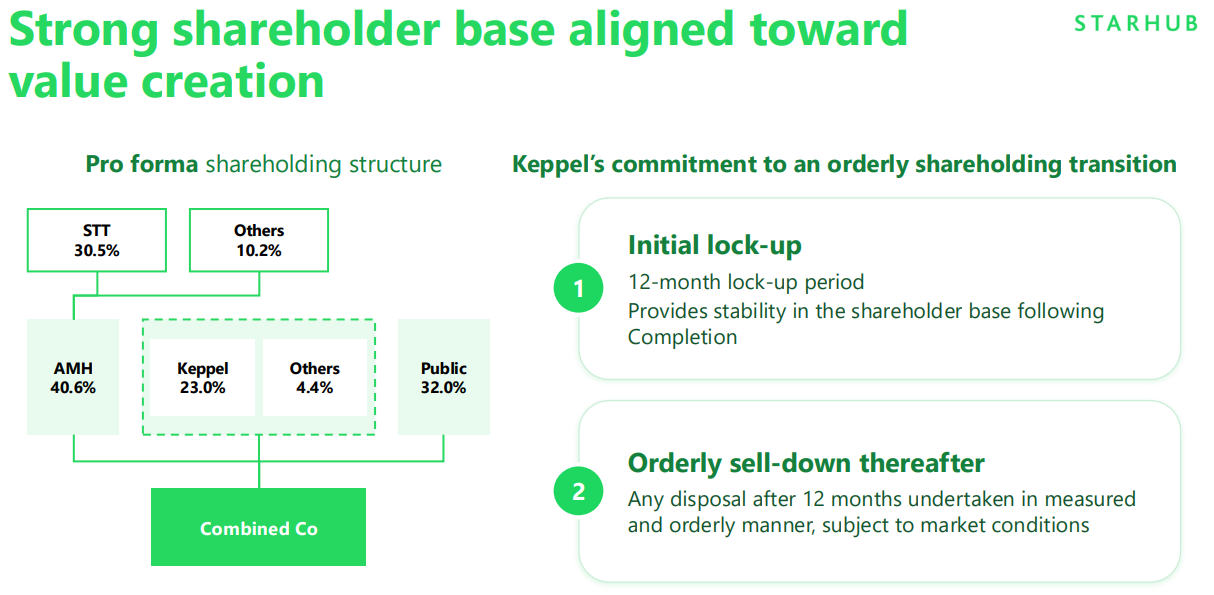
Under the proposed merger, StarHub will issue about 651.7 million new shares to M1's existing shareholders.
This means that StarHub will not have to pay cash for the initial share consideration. Instead, M1's shareholders will collectively own about 27.4% of the enlarged StarHub.
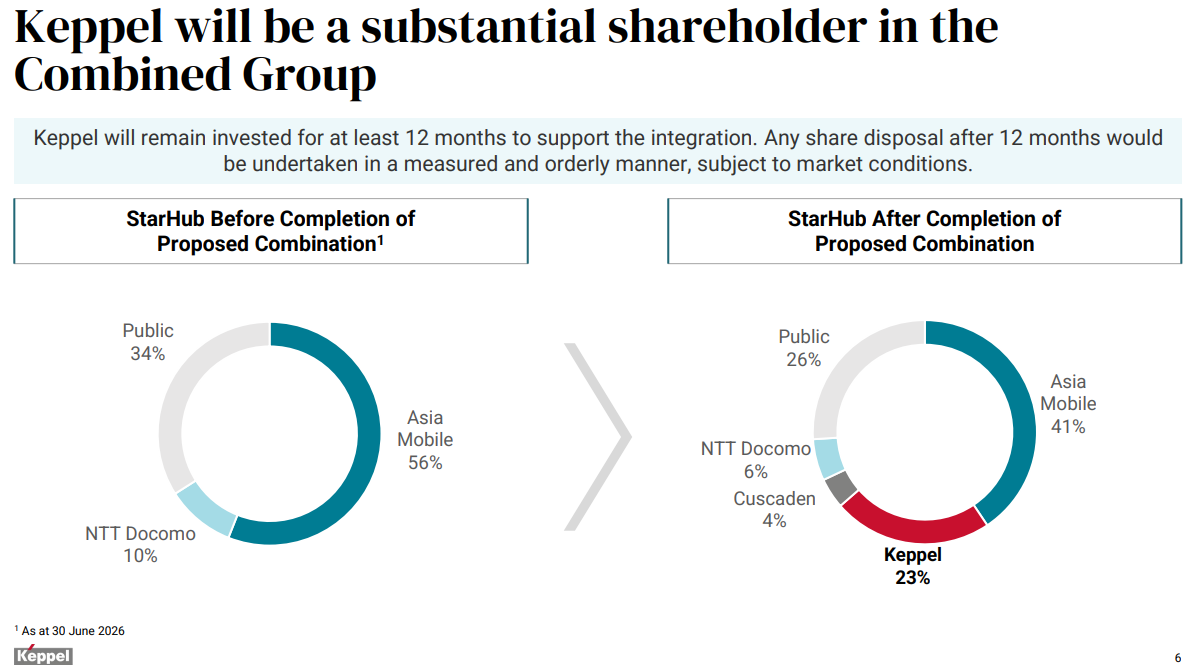
Keppel will have an effective interest in approximately 546.5 million StarHub shares, equivalent to a 23% stake in the enlarged group.
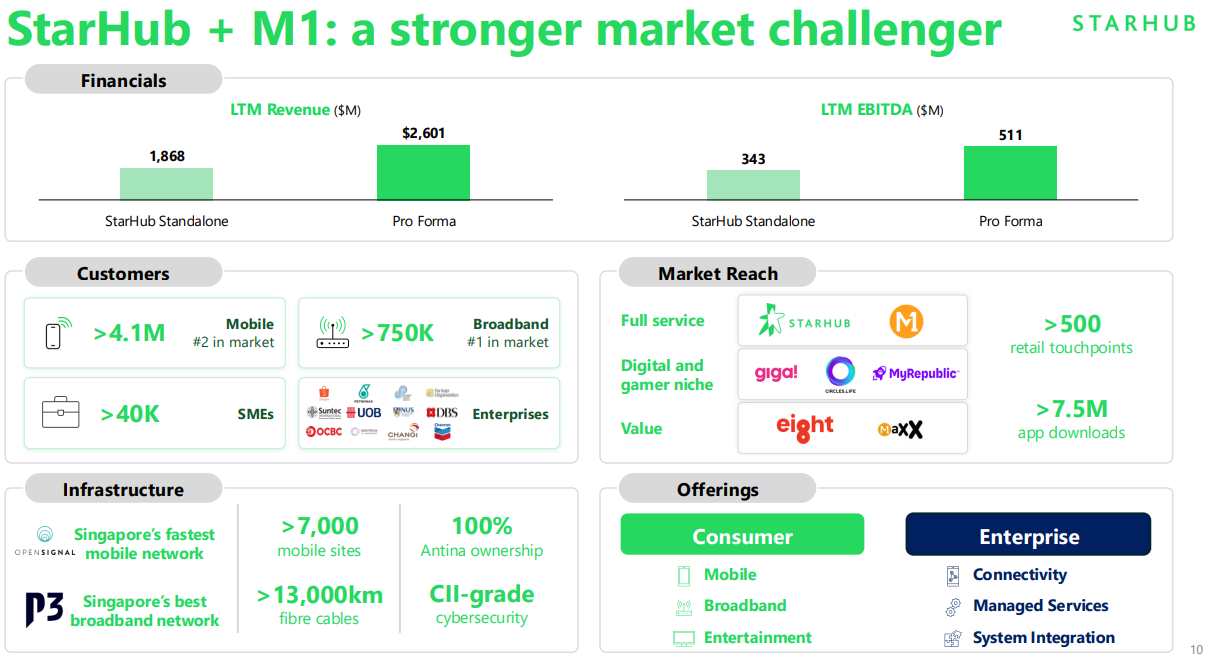
Together with the acquisitions of Circles.Life's digital telecommunications business and MyRepublic Mobile, the enlarged group will serve over 4.1 million mobile customers.
This would make StarHub Singapore's second-largest mobile operator, with a subscriber market share of about 41%, and the largest residential broadband provider.
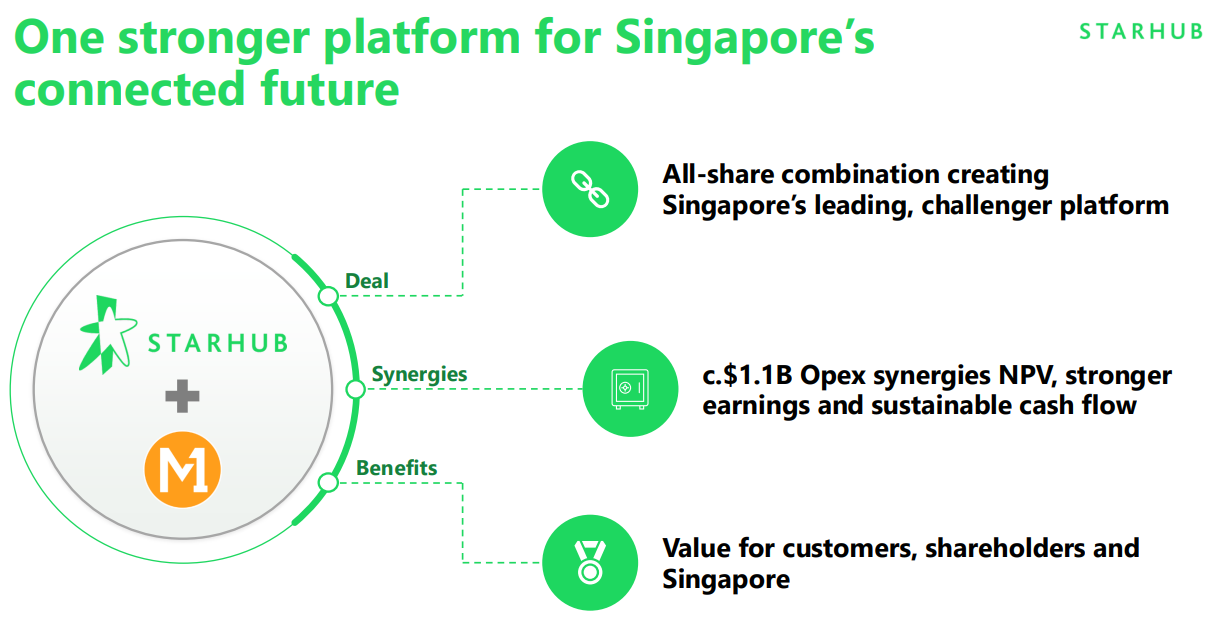
The enlarged group's pro forma revenue for the 12 months to June 2026 would be around S$2.6 billion, compared with StarHub's standalone revenue of S$1.87 billion.
Its earnings before interest, tax, depreciation and amortisation (EBITDA) would also increase from S$343 million to S$511 million on a pro forma basis.
#2 – M1's implied valuation ranges from S$1.06 billion to S$1.36 billion under different assumptions
One of the figures that stands out from the announcement is the implied enterprise value of M1 of S$1.36 billion.
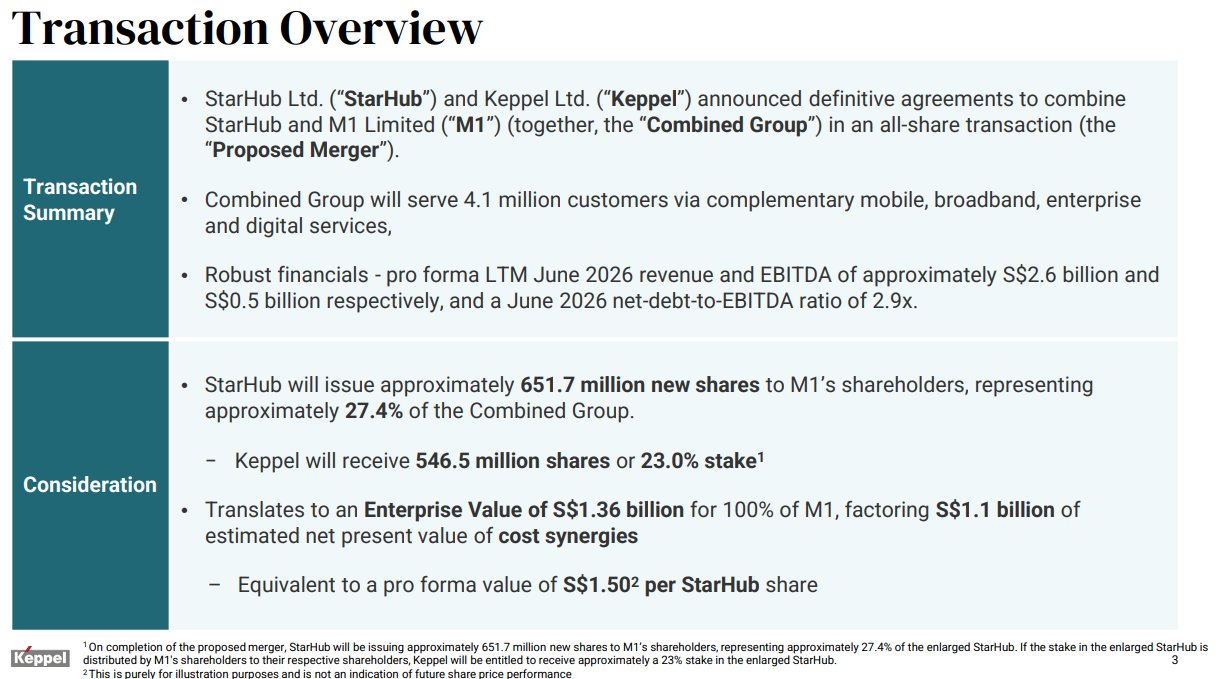
However, this assumes a value of S$1.50 per StarHub share after taking into account the full estimated value of the merger synergies.
Based on StarHub's 15-day volume-weighted average price (VWAP) of S$1.04, the new shares issued to M1 shareholders would be worth about S$677.7 million.
After including M1's net debt of S$380 million, StarHub's presentation puts M1's implied enterprise value at approximately S$1.06 billion.
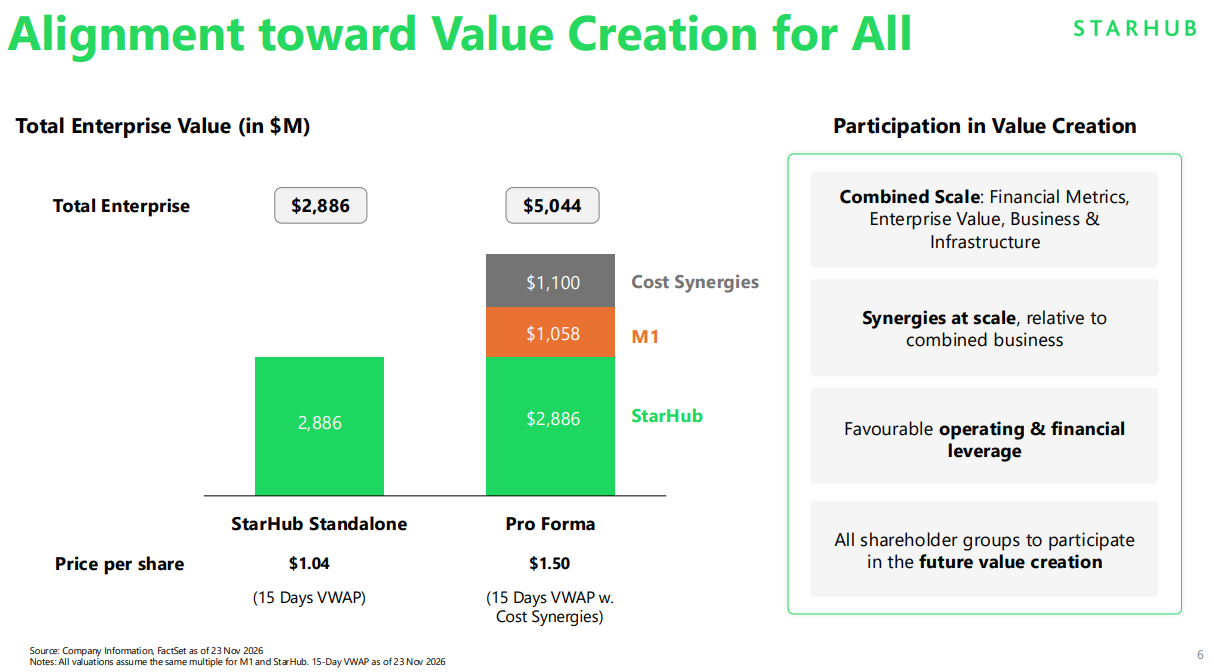
The distinction matters because part of the higher valuation comes from cost savings that have yet to be realised.
The S$1.50 pro forma share value should therefore not be seen as a target price for StarHub.
The number of shares issued may also change before the merger is completed, depending on the audited financial year 2026 (FY2026) EBITDA of both companies.
The agreement also sets net debt limits of S$380 million for M1 and S$1.09 billion for StarHub, with cash adjustments after completion for any difference.
#3 – The merger could generate S$110 million in annual cost savings
One of the main reasons for the merger is the potential to reduce operating costs.
StarHub expects to achieve annual run-rate operating cost savings of S$40 million by 2028, rising to S$110 million by 2030.
These savings are expected to come from areas such as network infrastructure, information technology (IT) systems, commercial activities and operations.
To put this into perspective, the S$110 million in annual savings represents more than 20% of the enlarged group's pro forma EBITDA of S$511 million.
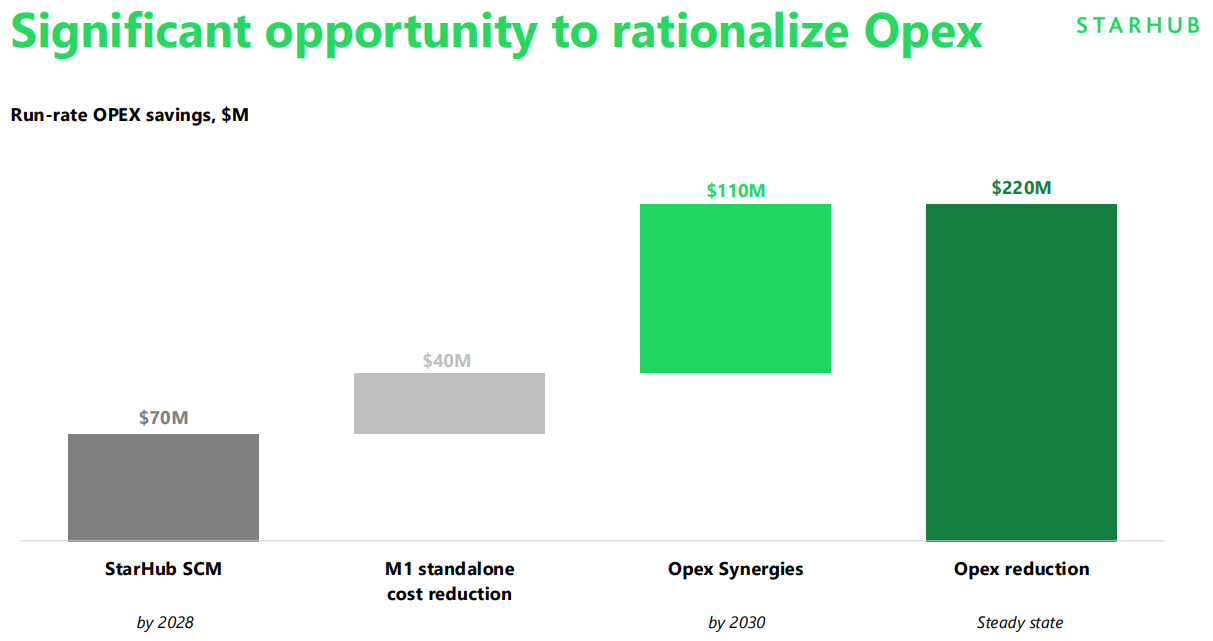
Management estimates that these cost savings are worth S$1.1 billion in net present value. There could also be savings from lower capital expenditure, although these have not been quantified.
The merger would bring Antina, the existing network joint venture between StarHub and M1, fully under the enlarged group's ownership. This could allow the group to make more efficient use of its network infrastructure and spectrum.
Beyond cost savings, the merger could also change the competitive landscape of Singapore's telecommunications industry.
StarHub Chief Executive Officer Nikhil Eapen highlighted the challenges of sustaining infrastructure investments with four mobile network operators competing in a mature market.
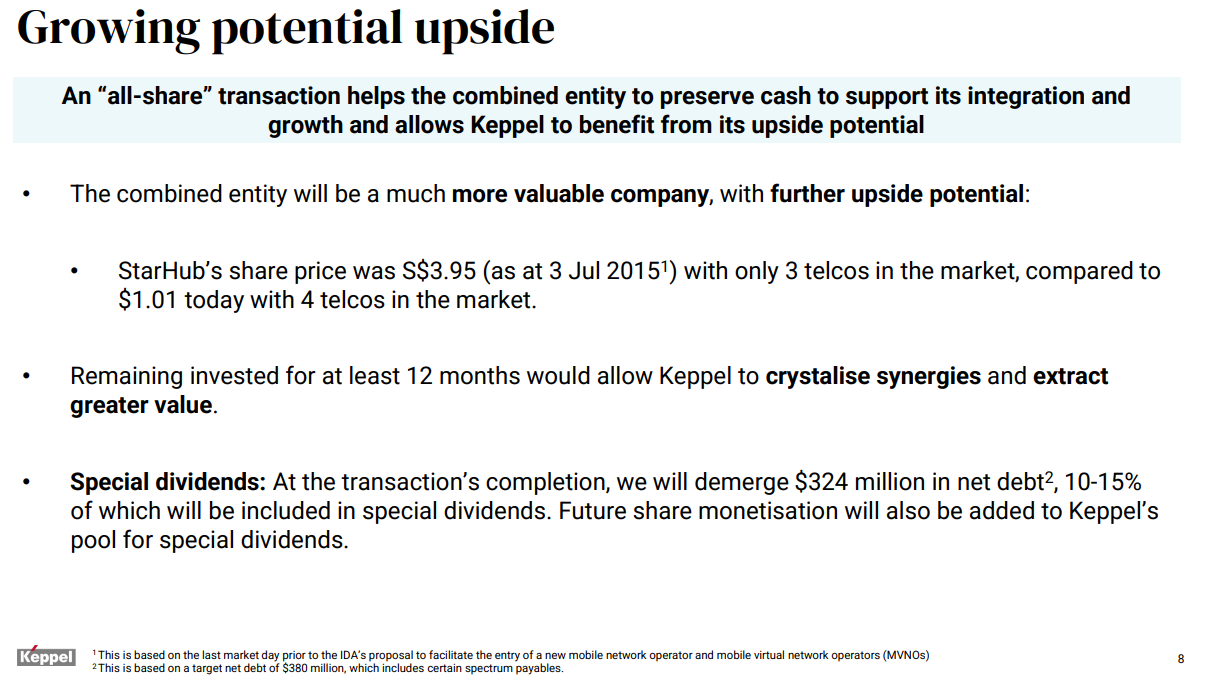
Keppel also highlighted in its presentation that StarHub's share price was S$3.95 in July 2015, before Singapore invited a fourth mobile network operator into the market. This compares with its VWAP of S$1.01 on 23 November 2026.
With fewer mobile network operators, competitive pressures could ease over time, although this does not necessarily mean that telecommunications companies will be able to raise prices.
Any potential revenue benefits from the merger have not been included in management's S$1.1 billion synergy estimate.
#4 – StarHub intends to maintain its 6-cent dividend in 2027
For StarHub shareholders, the key question is whether the additional earnings and cost savings will be sufficient to offset the dilution from the issuance of new shares.
Following the merger, existing StarHub shareholders will collectively own about 72.6% of the enlarged group.
Despite the increase in the number of shares, the proposed merger is expected to lead to a slight improvement in StarHub's earnings per share (EPS) even before synergies.
On a pro forma FY2025 basis, basic EPS would increase from 4.5 cents to 4.6 cents, although M1 recorded a net loss of S$9.2 million in the first half of 2026.
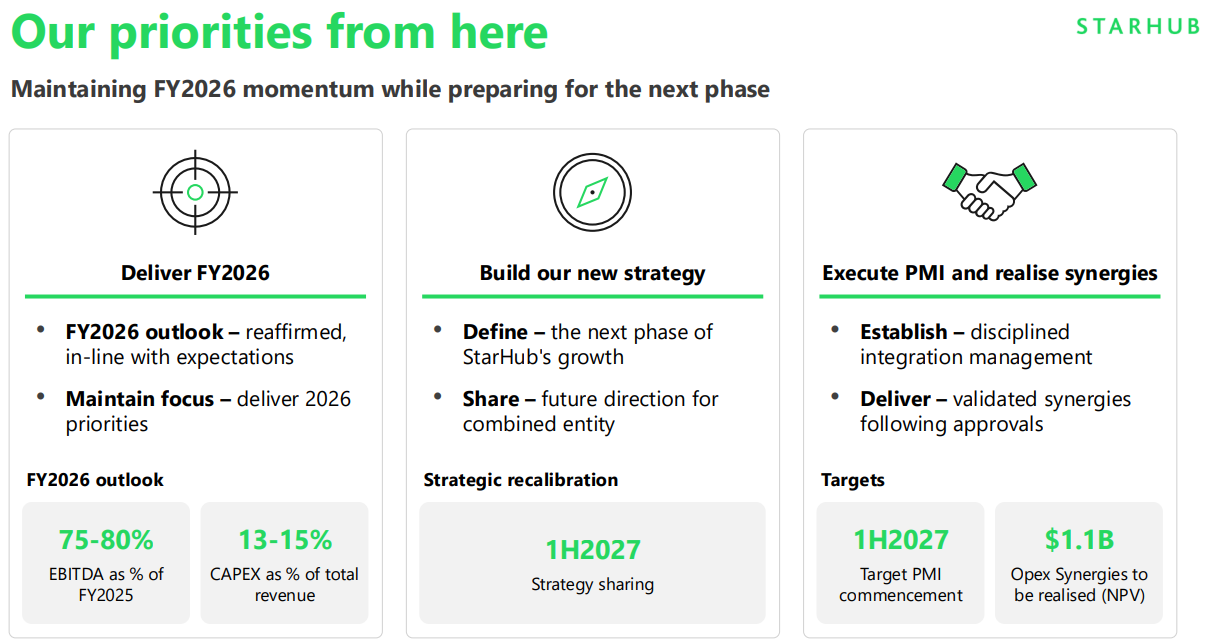
Management expects the transaction to improve its financial metrics within one to two years.
For income investors, StarHub has also provided some indication of what to expect for its dividend.
StarHub intends to maintain a distribution of 6 cents per share for 2027 as it integrates the businesses.
Based on StarHub's VWAP of S$1.01 on 23 November 2026, this would represent an indicative dividend yield of about 5.9%, if the intended distribution is paid in full.
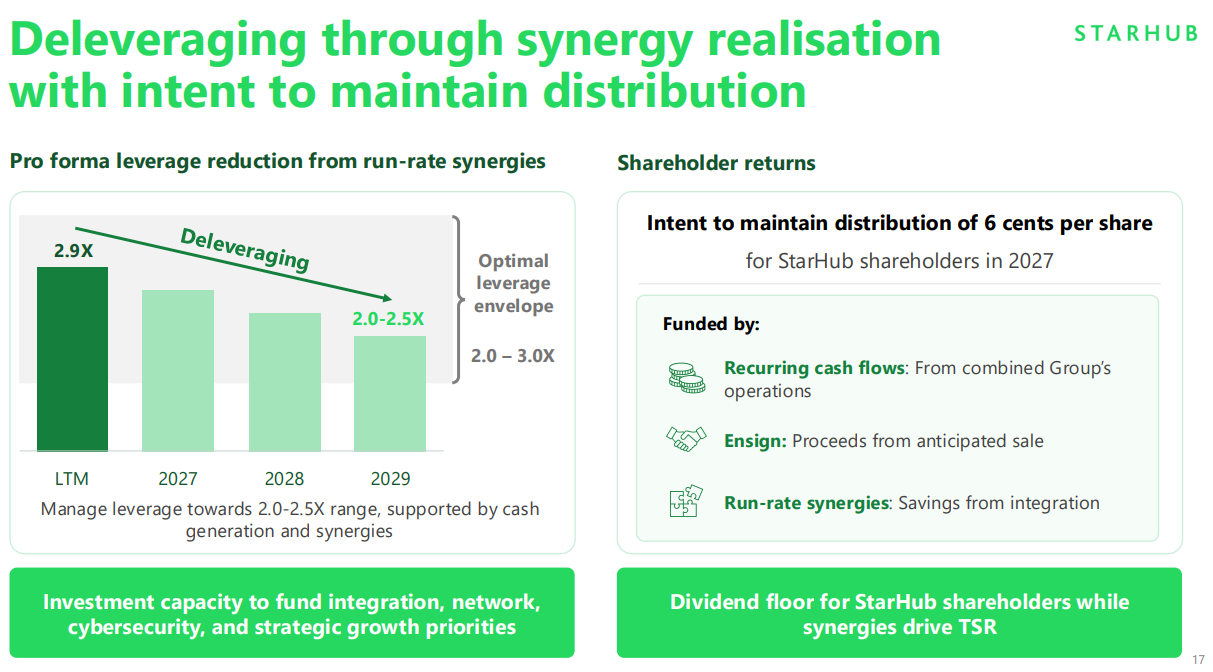
However, the distribution is expected to be supported by a combination of group cash flow, merger synergies and proceeds from the anticipated sale of Ensign.
We would therefore need to distinguish between the company's ability to maintain its dividend during the integration period and its ability to sustain the dividend from recurring cash flow over the longer term.
StarHub also expects to reduce the enlarged group's net debt to EBITDA ratio from 2.9 times to between 2.0 and 2.5 times as the synergies are realised.
#5 – Keppel could unlock more capital for special dividends
For Keppel, the proposed merger represents another step in its strategy of monetising non-core assets and becoming a more asset-light global asset manager.
Instead of holding an unlisted investment in M1, Keppel will have an effective 23% stake in the enlarged StarHub that it could monetise over time.
The transaction could contribute to Keppel's special-dividend pool in two stages.
Stage 1: Upon completion of the merger
Keppel would deconsolidate M1 and around S$324 million of net debt.
Based on the allocation of 10% to 15% of this amount, around S$32 million to S$49 million could be added to Keppel's special-dividend pool.
Stage 2: Eventual monetisation of StarHub shares
Proceeds from the eventual monetisation of Keppel's StarHub shares are also expected to contribute to the special-dividend pool.
However, Keppel has committed to holding its StarHub shares for at least 12 months after the completion of the merger.
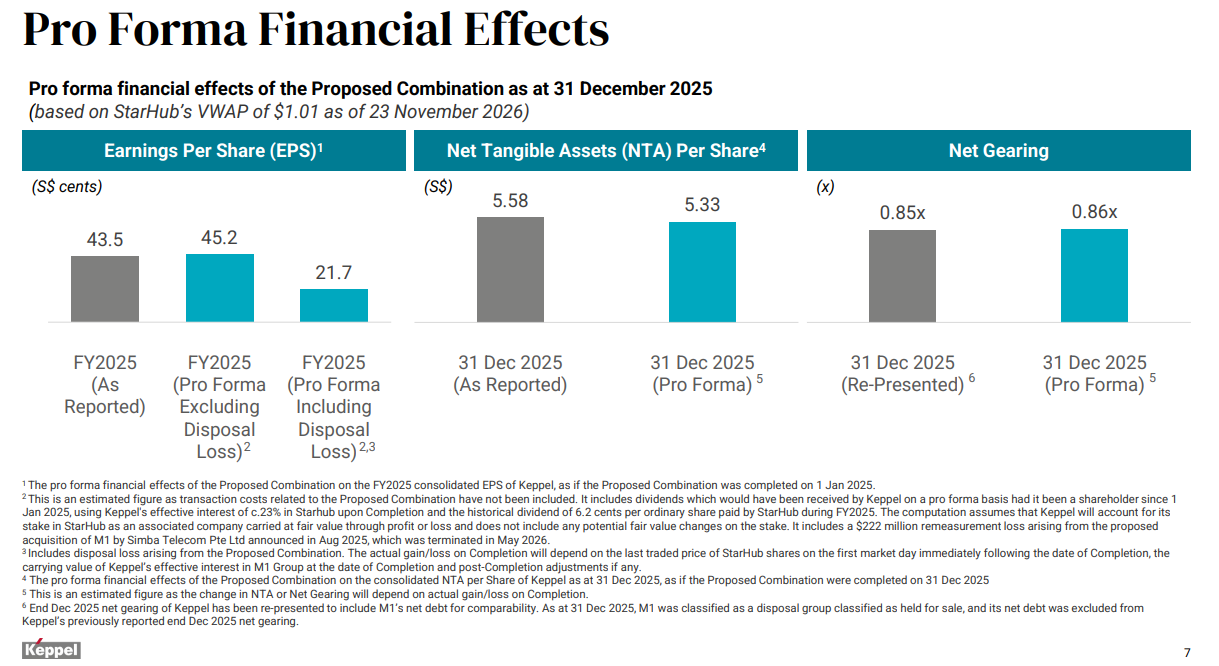
There will also be a one-off accounting impact from the transaction.
Based on StarHub's VWAP of S$1.01, Keppel estimates that it would recognise an illustrative non-cash accounting loss of S$375 million.
The estimated accounting loss would be lower at S$107 million if StarHub shares were valued at S$1.50.
Even after accounting for the illustrative loss, Keppel expects its cumulative gains from non-core asset monetisation since October 2020 to amount to around S$4.1 billion.
While the transaction will have a negative one-off impact on Keppel's reported earnings, the accounting loss does not represent an equivalent cash outflow.
The amount of capital Keppel can eventually unlock for special dividends will depend on StarHub's share price and when Keppel is able to monetise its stake.
#6 – The merger is subject to regulatory and shareholder approvals
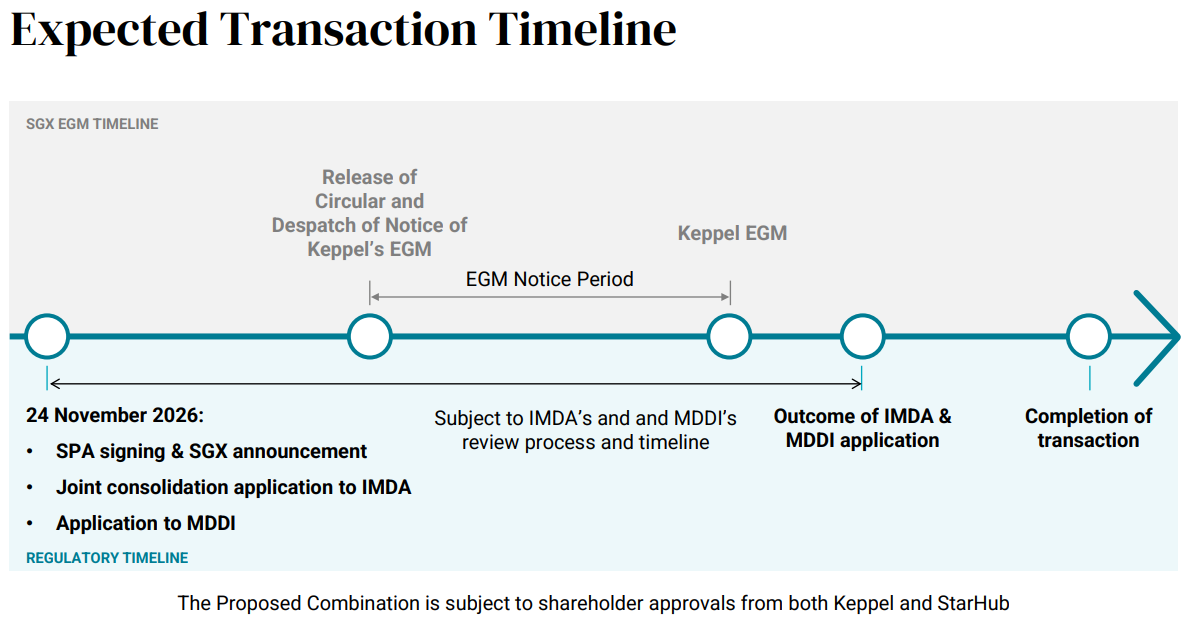
The StarHub-M1 merger is targeted for completion in the first half of 2027.
The transaction has a long-stop date of 24 May 2027, which may be extended to 26 July 2027 under the conditions of the agreement.
The deal requires approval from the Infocomm Media Development Authority (IMDA) and the Ministry of Digital Development and Information (MDDI), as well as shareholder approval at separate extraordinary general meetings (EGMs) for StarHub and Keppel.
As Temasek has interests on both sides of the transaction, the merger constitutes an interested person transaction for StarHub.
Temasek and its associates, including Asia Mobile Holdings, will abstain from voting at StarHub's EGM. This gives minority shareholders an important role in determining whether the transaction proceeds.
StarHub has appointed Evercore as its independent financial adviser (IFA), whose opinion will be included in the shareholder circular.
Beyond obtaining the necessary approvals, there are several risks that investors will need to watch.
- Regulatory risk: Approval conditions arising from the reduction in mobile network operators from four to three could affect the expected benefits of the merger.
- Integration risk: Combining the networks, IT systems and operations of StarHub and M1 could take longer or cost more than expected, particularly with the acquisition of Circles.Life taking place concurrently.
- Changes to deal terms: The number of consideration shares may be adjusted based on audited FY2026 EBITDA, with termination rights arising if the adjustment mechanism is triggered.
- Potential selling pressure: Keppel's 23% effective stake in StarHub could become a source of selling pressure following the initial 12-month holding period.
- Dividend sustainability: StarHub's intended 6-cent distribution covers 2027 and is partly supported by proceeds from the anticipated sale of Ensign.
What would Beansprout do?
We see the proposed StarHub-M1 merger as a potentially positive development for Singapore's telecommunications industry, which has faced intense competition over the past decade.
However, we would differentiate the investment implications for StarHub and Keppel.
For StarHub, the merger could provide a path towards improving its profitability through lower operating costs and potentially easing competitive pressures.
For our Income Pot, the intended 6-cent distribution in 2027 provides some indication of near-term income, representing an indicative dividend yield of about 5.9% based on StarHub's share price of S$1.01 on 23 November 2026.
However, we would pay more attention to whether the enlarged group's recurring free cash flow can sustain its dividends beyond 2027, without relying on asset disposal proceeds.
We would also be cautious about using the S$1.50 pro forma share value to assess potential upside, given the uncertainties surrounding regulatory approval, integration and the delivery of cost savings.
For Keppel, we see the merger as another step in its transformation into a global asset manager, with an additional avenue to unlock capital for potential special dividends.
Beyond special dividends, we would continue to focus on Keppel's ability to grow its recurring earnings and asset management fees, while monetising its remaining non-core assets.
For now, we would watch the regulatory outcome and the independent financial adviser's assessment of the deal, followed by early signs of whether StarHub can deliver the targeted cost savings.
These would help us better assess whether the proposed merger can translate into sustainable earnings and dividends for shareholders over the longer term.
To find out which Singapore stocks we would hold in a portfolio, you can also see how we would invest S$100,000 in Singapore stocks today.
If you are looking for greater clarity on the markets and the investment decisions that matter, explore Beansprout Pro for our latest views, portfolio thinking and the reasoning behind each opportunity.
If you are considering investing in Singapore stocks, compare the best Singapore brokerage accounts to find a platform that fits your needs.
What do you think about the StarHub and M1 merger? Share your thoughts with us in the Beansprout Telegram community.
Enjoyed this insight? Follow Beansprout on Telegram, Youtube, Facebook and Instagram, and add Beansprout as your preferred source on Google so you never miss an update.
Read also
Gain financial insights in minutes
Subscribe to our free weekly newsletter for more insights to grow your wealth
Most Popular

Comments
0 comments