
Keppel’s M1-Simba deal falls through. What happens to dividends?
Stocks
By Ng Hui Min • 27 May 2026
Why trust Beansprout? We’ve been awarded Best Investment Website at the SIAS Investors’ Choice Awards 2025
'%3e%3cpath%20fill-rule='evenodd'%20clip-rule='evenodd'%20d='M17.64%209.20455C17.64%208.56637%2017.5827%207.95273%2017.4764%207.36364H9V10.845H13.8436C13.635%2011.97%2013.0009%2012.9232%2012.0477%2013.5614V15.8195H14.9564C16.6582%2014.2527%2017.64%2011.9455%2017.64%209.20455V9.20455Z'%20fill='%234285F4'/%3e%3cpath%20fill-rule='evenodd'%20clip-rule='evenodd'%20d='M9%2018C11.43%2018%2013.4673%2017.1941%2014.9564%2015.8195L12.0477%2013.5614C11.2418%2014.1014%2010.2109%2014.4205%209%2014.4205C6.65591%2014.4205%204.67182%2012.8373%203.96409%2010.71H0.957275V13.0418C2.43818%2015.9832%205.48182%2018%209%2018V18Z'%20fill='%2334A853'/%3e%3cpath%20fill-rule='evenodd'%20clip-rule='evenodd'%20d='M3.96409%2010.71C3.78409%2010.17%203.68182%209.59318%203.68182%209C3.68182%208.40682%203.78409%207.83%203.96409%207.29V4.95818H0.957273C0.347727%206.17318%200%207.54773%200%209C0%2010.4523%200.347727%2011.8268%200.957273%2013.0418L3.96409%2010.71V10.71Z'%20fill='%23FBBC05'/%3e%3cpath%20fill-rule='evenodd'%20clip-rule='evenodd'%20d='M9%203.57955C10.3214%203.57955%2011.5077%204.03364%2012.4405%204.92545L15.0218%202.34409C13.4632%200.891818%2011.4259%200%209%200C5.48182%200%202.43818%202.01682%200.957275%204.95818L3.96409%207.29C4.67182%205.16273%206.65591%203.57955%209%203.57955V3.57955Z'%20fill='%23EA4335'/%3e%3c/g%3e%3cdefs%3e%3cclipPath%20id='clip0_0_2849'%3e%3crect%20width='18'%20height='18'%20fill='white'/%3e%3c/clipPath%3e%3c/defs%3e%3c/svg%3e)
Make Beansprout your preferred source on Google
Add us on Google to see more of our insights in your search results
Keppel’s M1 deal has fallen through. We look at what it means for dividends, asset sales and key watch points for investors.
What happened?
Keppel's proposed sale of M1 to Simba has fallen through.
Keppel had previously announced the sale of M1 to Simba for S$1.43 billion.
We had earlier highlighted Keppel one of the best-performing Singapore blue chip stocks in February and also one of the blue chips which raised dividends in 2025, supported by active capital recycling efforts, with the M1 divestment forming part of that strategy.
However, on 18 May, the Infocomm Media Development Authority (IMDA) suspended its review of the deal while investigating whether Simba had used radio frequencies it was not authorised to use. Since IMDA approval was a condition for the sale, Keppel allowed the agreement to lapse on its long-stop date of 21 May.
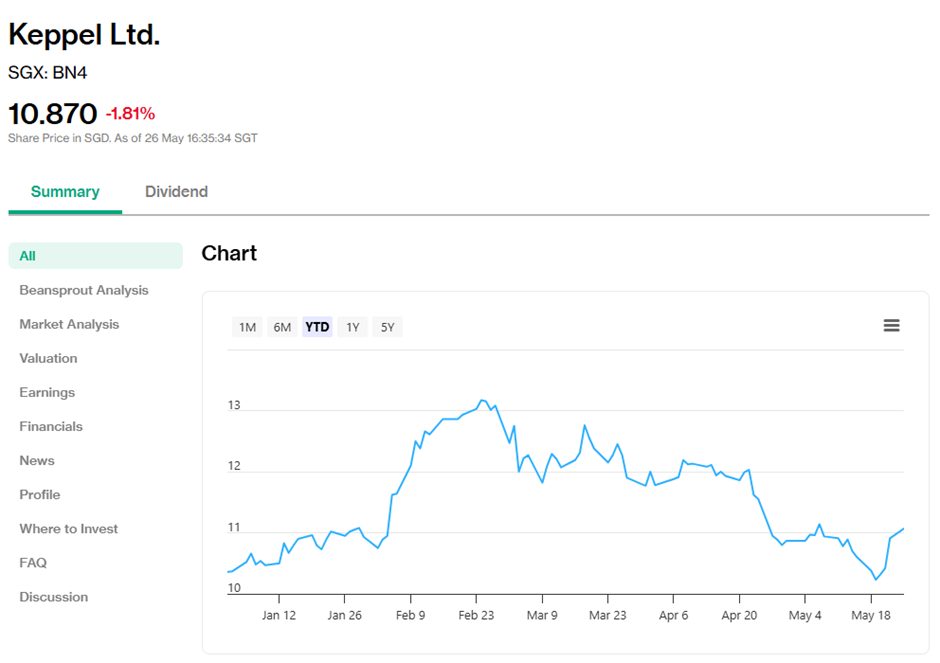
Keppel shares fell as much as 9.5% intraday on 18 May before closing 2.1% lower at S$10.38, and since rebounded 10.2% to S$11.10 on 25 May, from its low of S$10.07 on 18 May.
I saw some discussion in the Beansprout community about what the termination of the M1 divestment means for Keppel, and whether it affects the outlook for future special dividends.
In this article, we look at what this means for Keppel's capital recycling plans, where future special dividends could come from, and what investors may watch next.
Keppel's M1-Simba deal falls through - What investors need to know
#1 - The special dividends may be delayed, not cancelled
The most direct impact for shareholders is the loss of the estimated 7 to 11 cents per share in special dividends that could have come from the S$1 billion cash proceeds from the M1 sale.
Keppel CEO Loh addressed this directly at the briefing, saying the special dividends "have not gone away, they have just been deferred."
Keppel's policy is to distribute 10% to 15% of proceeds from monetising non-core assets as special dividends.
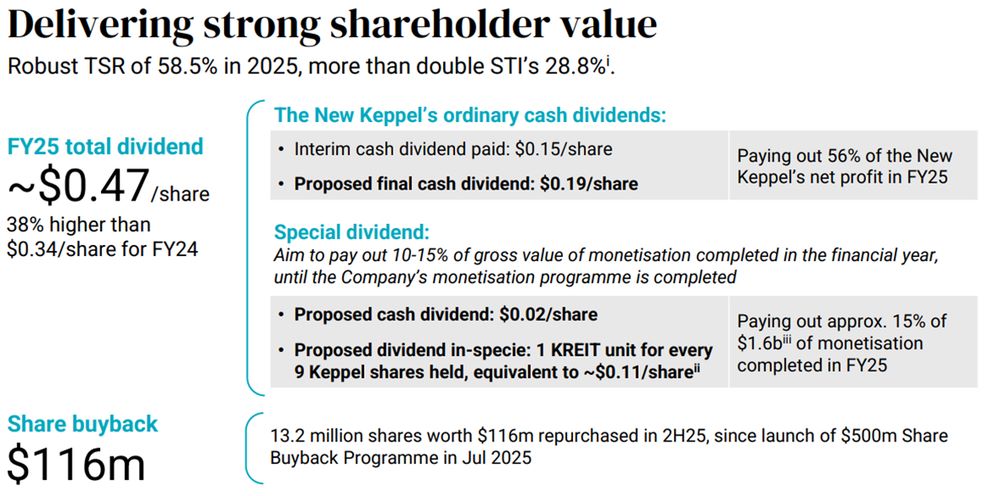
This means that if Keppel sells other assets this year, shareholders may still receive a special dividend, just from a different source.
It is also important to separate Keppel’s special dividend from its ordinary dividend.
A special dividend is usually a one-off payout linked to events such as asset sales. An ordinary dividend is the recurring dividend shareholders receive from the business.
Loh noted that the "New Keppel" has been paying ordinary dividends in the range of 33 to 35 cents per share a year on a recurring basis.
For FY2025, Keppel paid total ordinary dividends of 36 cents per share, comprising a 15-cent interim dividend and a 21-cent final dividend, with the most recent payment made on 8 May 2026.
In other words, Keppel’s ordinary dividend remains the recurring income base, while any special dividend is potential upside from successful asset monetisation.
#2 - Keppel still has other assets to monetise for future capital returns
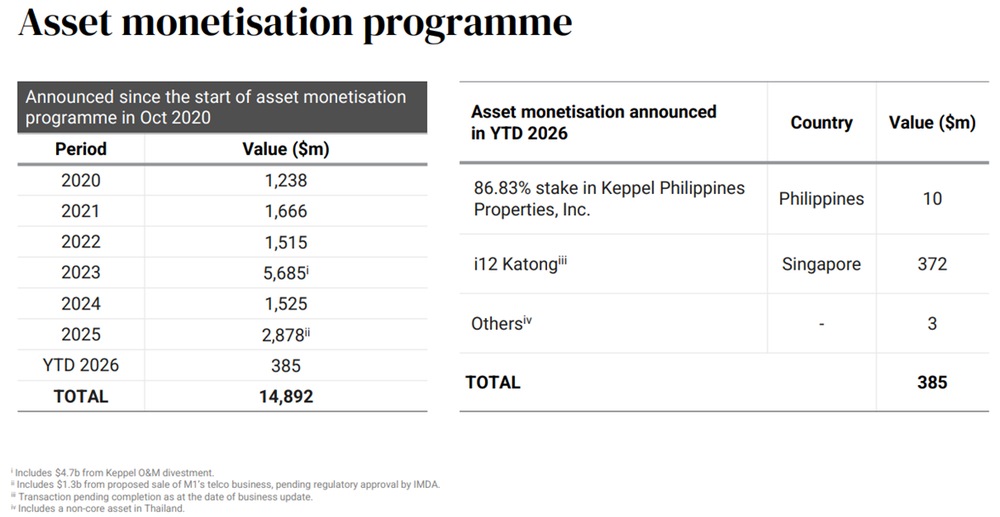
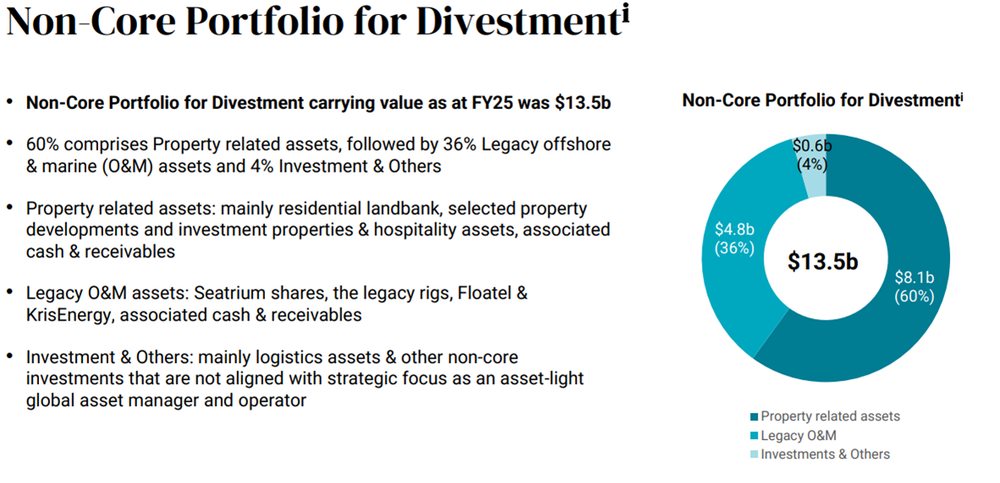
Keppel has kept its 2026 target of monetising S$2 billion to S$3 billion of non-core assets.
With the M1 sale no longer expected this year, management plans to bring forward other asset sales to fill the gap.
Keppel CFO Kevin Chng shared that about S$300 million to S$400 million has already been booked in monetisation so far this year, leaving another S$1.6 billion to S$2.6 billion to go.
Two areas are in focus.
The first is legacy oil rigs from Keppel's former offshore and marine business. CEO Loh noted that market conditions for offshore rigs have improved, making this a more meaningful monetisation opportunity.
The second is real estate, including Keppel South Central and Keppel Bay Plot 6. Keppel South Central could be sold once leasing improves further, while Keppel Bay Plot 6 is expected to be launched around mid-2026.
Keppel has also sold Keppel Merlimau Cogen to Keppel Infrastructure Trust for proceeds of about S$126 million.
However, one nuance is that Merlimau Cogen is considered a "New Keppel" asset rather than a non-core asset, so gains from the sale would flow through ordinary dividends instead of the 10% to 15% special dividend formula.
#3 — Keppel still plans to sell M1 after a 90-day turnaround plan
Keppel still intends to sell M1 eventually.
In the meantime, management is rolling out a 90-day "Plan B" to strengthen the business before a future sale.
CEO Loh said M1 had been in "a bit of a stasis" while the Simba deal was pending, as Keppel could not fully pursue its own efficiency initiatives during that period.
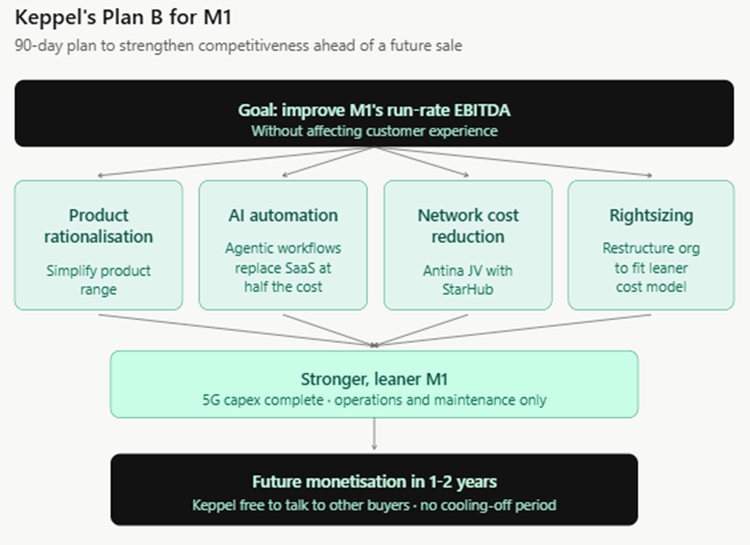
The new plan focuses on four areas.
First, Keppel wants to simplify M1’s product range.
Second, it plans to use artificial intelligence (AI) to reduce operating costs.
Third, it is looking to lower network costs through closer collaboration with the Antina joint venture.
Fourth, Keppel plans to rightsize the organisation.
One example shared was the use of agentic AI workflows to replace some SaaS (software-as-a-service)-based CRM (customer relationship management) and campaign management tools at less than half the cost.
Another point to note is that with M1's 5G network now fully deployed, management said no further major 5G deployment capex is required, with future spending focused on operations and maintenance.
The goal is to make M1 more attractive to buyers, with a potential sale targeted over the next one to two years.
Management also said no impairment is expected from the deal collapse, Cuscaden Peak, the minority shareholder in M1, remains supportive of the Plan B, and Keppel is not currently considering legal action against Simba's parent, Tuas.
#4 — Keppel share buybacks increased as the M1 deal fell through
Keppel continued buying back its own shares.
In the four trading days from 18 to 21 May, when the M1 deal unravelled, Keppel bought back 1.9 million shares for about S$19.6 million.
The largest purchase was on 18 May, the day IMDA suspended its review, when Keppel bought back 600,000 shares.
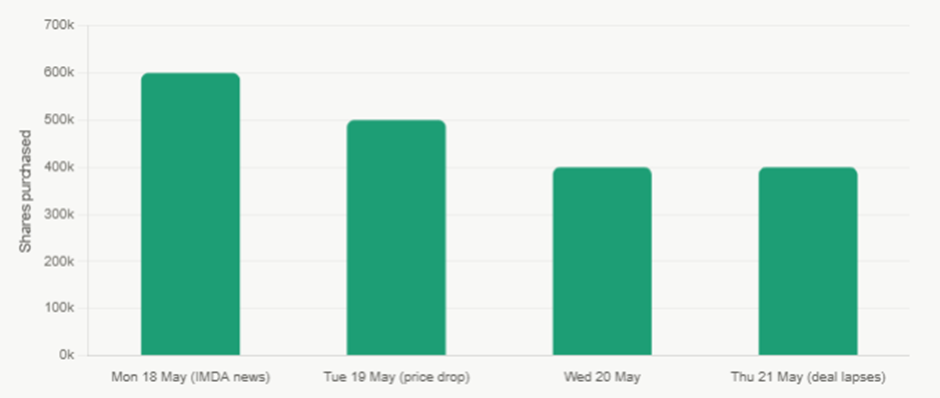
Share buybacks are worth watching because they reduce the number of shares in circulation. This means each remaining share represents a slightly larger ownership stake in the company.
This is part of Keppel's broader S$500 million share buyback programme, which was launched alongside its 1H 2025 results.
What Keppel shareholders should consider
There are a few things Keppel shareholders may want to watch from here.
First, the 7 to 11 cents per share special dividend linked to the M1 sale may not arrive this year. This is dependent on Keppel being able to find a future buyer at an acceptable price.
Whether shareholders receive a special dividend will now depend on Keppel’s ability to monetise other non-core assets.
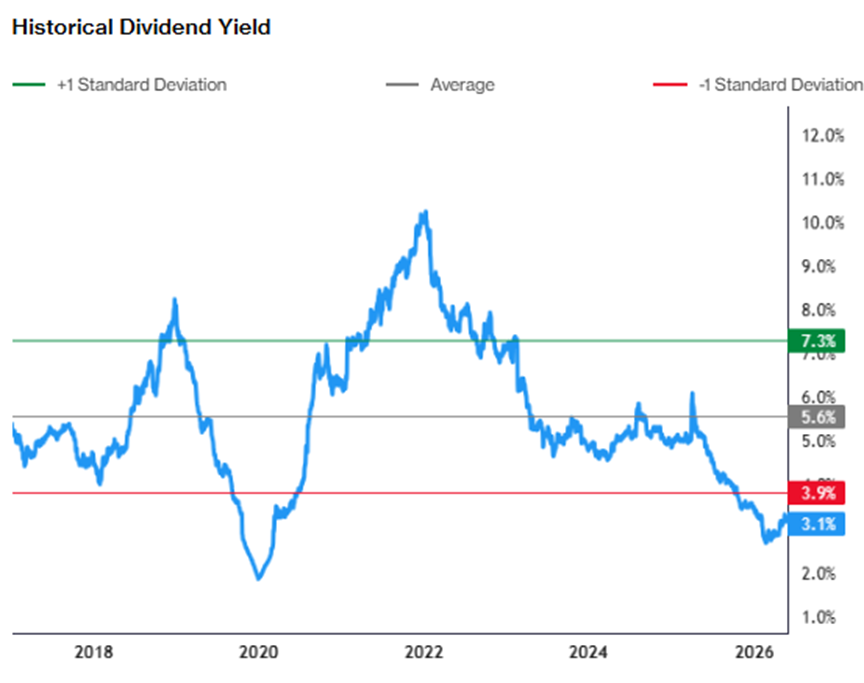
Second, Keppel's current dividend yield of about 3.1% is below its historical average of around 5.6%.
Third, moving M1 back into the "Non-Core Portfolio for Divestment" does not change the New Keppel earnings story, but it does increase the amount of non-core assets that still need to be monetised.
Finally, it remains to be seen how the regulatory review process may influence future M&A (mergers and acquisitions) activity in Singapore's telecom sector.
What would Beansprout do?
A lot of the recent discussion around Keppel has focused on the missed M1 special dividend.
In my view, investors may want to look beyond this single catalyst and ask whether Keppel's broader income story remains intact.
On this front, the underlying business has continued to improve, with the "New Keppel" core business delivering a return on equity (ROE) of 18.7% in FY2025, ahead of its Vision 2030 target of 15%.
This was supported by its shift towards an asset-light model, S$95 billion in funds under management, and a 21% increase in recurring income to S$941 million.
This gives us more comfort that Keppel's ordinary dividend is increasingly supported by recurring earnings, rather than one-off asset sales alone.
The balance sheet also looks healthier, with New Keppel's net debt to EBITDA (earnings before interest, taxes, depreciation, and amortisation) improving to 2.0 times at end-2025 from 2.3 times a year earlier.
At the same time, Keppel still has a sizeable S$13.5 billion non-core portfolio to monetise by 2030, which could provide further room for capital returns over time.
Overall, we would treat Keppel's ordinary dividend as the base case, while any future special dividend from M1 or other asset sales may be seen as potential upside rather than something to rely on.
That said, income investors may note that Keppel's current dividend yield of about 3.1% is below its historical average of around 5.6%.
Earlier, we shared that Singapore should remain a core part of a portfolio, supported by the market's relative resilience, dividend support, and safe haven appeal.
This income portfolio would consist of Singapore blue chip stocks beyond Singapore REITs to allow us to build our diversified income. Explore how to build a more diversified Income Pot here.
You can also screen for Singapore stocks which offer a high dividend yield here.
If you prefer broad exposure to blue chips without picking individual names, you can also learn more about the Straits Times Index (STI).
Are you looking at any Singapore blue chip dividend stocks? Share your thoughts with us in the comments below or in our Telegram group!
Planning to invest in Singapore blue chip stocks? Check out Beansprout's guide to the best stock trading platforms in Singapore with the latest promotions to invest in the Singapore market and see the latest promotions and sign-up rewards available.
Enjoyed this insight? Follow Beansprout on Telegram, Youtube, Facebook and Instagram, and add Beansprout as your preferred source on Google so you never miss an update.
Read also
Gain financial insights in minutes
Subscribe to our free weekly newsletter for more insights to grow your wealth
Most Popular

Comments
0 comments