
Keppel 1H26 net profit fell 59% year-on-year, but “New Keppel” 1H26 profit rose 25%. What investors should watch
Stocks
By Gerald Wong, CFA • 31 Jul 2026
Global Wealth Technology Pte. Ltd. is regulated by the Monetary Authority of Singapore (MAS) as a licensed Financial Adviser.
'%3e%3cpath%20fill-rule='evenodd'%20clip-rule='evenodd'%20d='M17.64%209.20455C17.64%208.56637%2017.5827%207.95273%2017.4764%207.36364H9V10.845H13.8436C13.635%2011.97%2013.0009%2012.9232%2012.0477%2013.5614V15.8195H14.9564C16.6582%2014.2527%2017.64%2011.9455%2017.64%209.20455V9.20455Z'%20fill='%234285F4'/%3e%3cpath%20fill-rule='evenodd'%20clip-rule='evenodd'%20d='M9%2018C11.43%2018%2013.4673%2017.1941%2014.9564%2015.8195L12.0477%2013.5614C11.2418%2014.1014%2010.2109%2014.4205%209%2014.4205C6.65591%2014.4205%204.67182%2012.8373%203.96409%2010.71H0.957275V13.0418C2.43818%2015.9832%205.48182%2018%209%2018V18Z'%20fill='%2334A853'/%3e%3cpath%20fill-rule='evenodd'%20clip-rule='evenodd'%20d='M3.96409%2010.71C3.78409%2010.17%203.68182%209.59318%203.68182%209C3.68182%208.40682%203.78409%207.83%203.96409%207.29V4.95818H0.957273C0.347727%206.17318%200%207.54773%200%209C0%2010.4523%200.347727%2011.8268%200.957273%2013.0418L3.96409%2010.71V10.71Z'%20fill='%23FBBC05'/%3e%3cpath%20fill-rule='evenodd'%20clip-rule='evenodd'%20d='M9%203.57955C10.3214%203.57955%2011.5077%204.03364%2012.4405%204.92545L15.0218%202.34409C13.4632%200.891818%2011.4259%200%209%200C5.48182%200%202.43818%202.01682%200.957275%204.95818L3.96409%207.29C4.67182%205.16273%206.65591%203.57955%209%203.57955V3.57955Z'%20fill='%23EA4335'/%3e%3c/g%3e%3cdefs%3e%3cclipPath%20id='clip0_0_2849'%3e%3crect%20width='18'%20height='18'%20fill='white'/%3e%3c/clipPath%3e%3c/defs%3e%3c/svg%3e)
Make Beansprout your preferred source on Google
Add us on Google to see more of our insights in your search results
Keppel reported 1H2026 net profit which fell 59% year-on-year, but the core “New Keppel” business delivered a net profit growth of 25%. Here’s what investors should watch next.
What happened?
Keppel has reported its latest earnings.
Earlier this month, I compared Keppel and Sembcorp Industries after both stocks pulled back, and looked at how they fared under Beansprout’s Opportunity Pot framework.
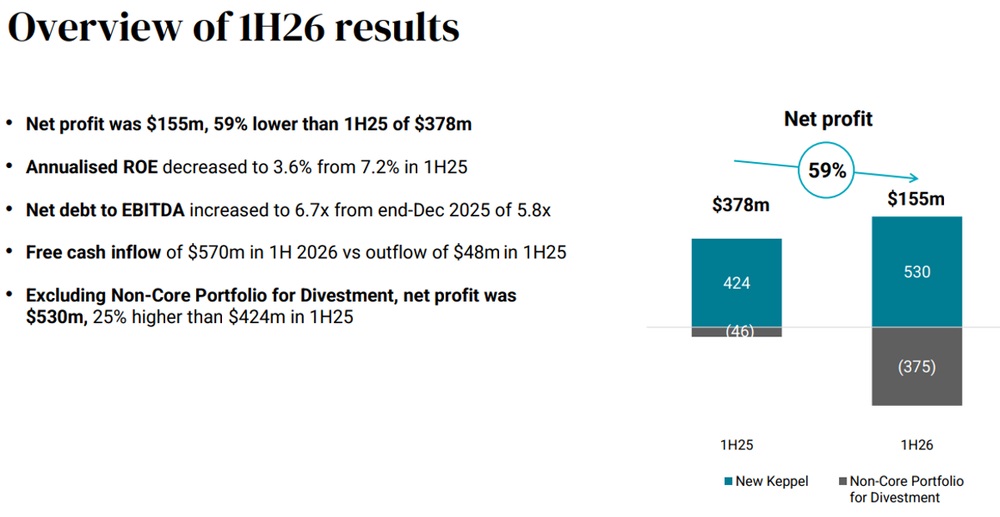
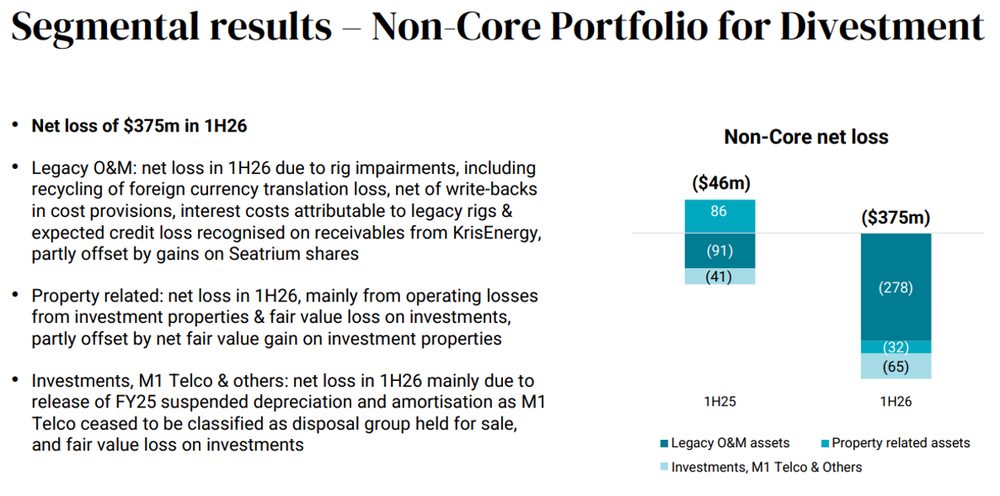
Keppel has since reported a 59% year-on-year decline in 1H2026 net profit to S$155 million, mainly due to a S$375 million loss from its Non-Core Portfolio.
However, the performance of its core business was much stronger. “New Keppel” grew net profit by 25% to S$530 million, while recurring income rose 13% to S$467 million.
This contrast has sparked discussion in the Beansprout community about whether investors should focus on the weaker headline numbers or the stronger growth from New Keppel.
In this article, I look at Keppel’s latest earnings, what investors should watch in 2H2026, and how the stock fares under Beansprout’s Opportunity Pot screening framework.
5 things you need to know about Keppel's 1H2026 results
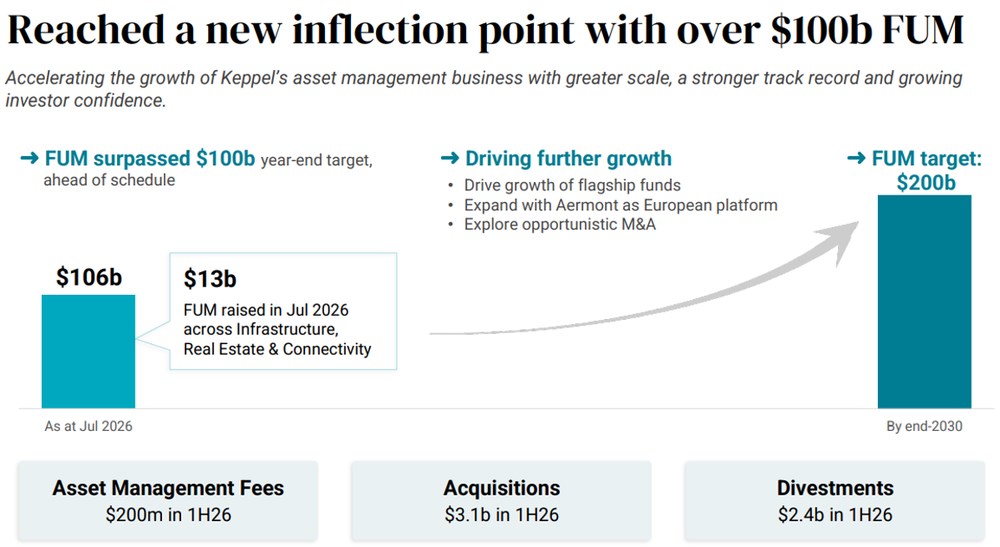
#1 - Funds under management (FUM) crossed S$106 billion, beating the 2026 target early
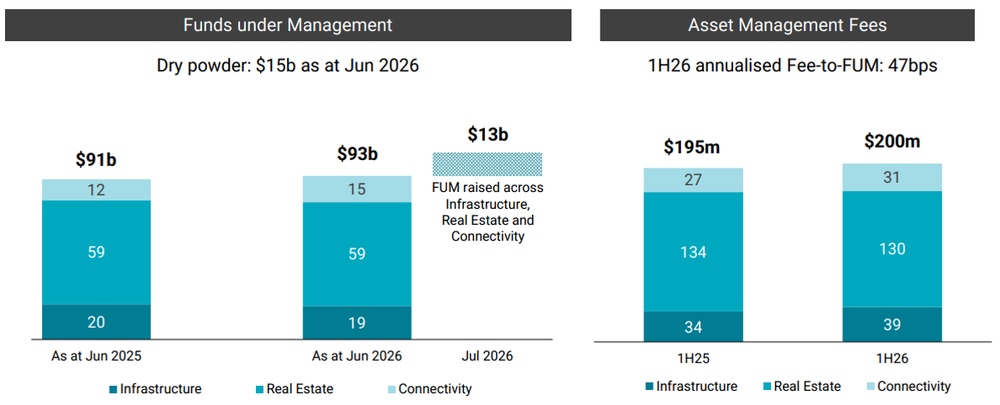
Keppel’s Funds Under Management reached S$106 billion as at end-July 2026. This means the group has already surpassed its S$100 billion FUM target for 2026, ahead of schedule. The increase was helped by about S$13 billion of fundraising added since end-June.
Management pointed to strong demand for infrastructure and digital infrastructure funds. This included a roughly S$3.3 billion allocation from a sovereign wealth fund into Keppel’s data centre and infrastructure platforms.
#2 - The Apollo rig deal creates a clearer exit path for legacy offshore assets
Keppel’s new rig monetisation deal with Apollo gives the group a clearer and faster path to exit its legacy offshore assets.
Under the arrangement, Keppel will contribute six operational rigs in kind, while Apollo will inject about US$478 million, or around S$611 million, in cash for its 50% share. The remaining four rigs are expected to be transferred into the fund progressively from 2027 to 2028.
Keppel recognised a S$165 million impairment on the underlying rig assets as part of the restructuring. This weighed on headline earnings, but it also helps reset the carrying value of the rigs and accelerates the clean-up of Keppel’s Non-Core Portfolio.
Management also noted that rig charter enquiries have picked up over the past four quarters, and that market fundamentals for the fleet are improving.
#3 — Infrastructure and Connectivity carried earnings growth, while Real Estate lagged
Keppel’s segment performance was mixed in 1H2026.
Infrastructure was the main earnings driver, with net profit rising 55% to S$538 million. This was supported by gains from partial stake sales in Keppel Merlimau Cogen and 800 Super Holdings, as well as the first contribution from the newly operational Keppel Sakra Cogen Plant.
Connectivity also performed strongly, with net profit growing 54% to S$77 million. This was helped by gains from Bifrost cable fibre pair commitments.
Real Estate was the weak spot, posting a net loss of S$19 million. However, this was mainly due to a S$51 million accounting loss from the dividend in-specie of Keppel REIT units. Excluding this one-off item, Real Estate would have remained profitable, with net profit of about S$32 million.
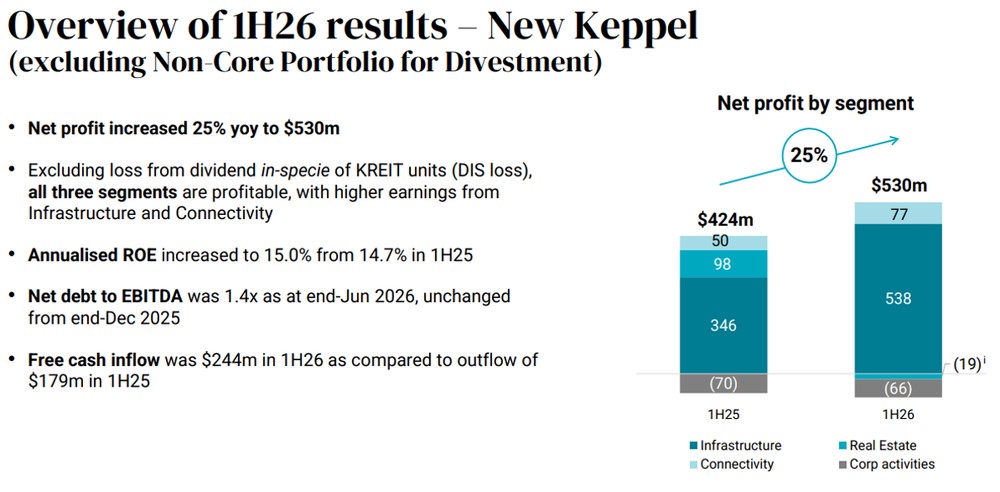
Note: Includes loss from DIS of KREIT units of $51m
#4 — Free cash flow improved sharply, but group leverage also crept up
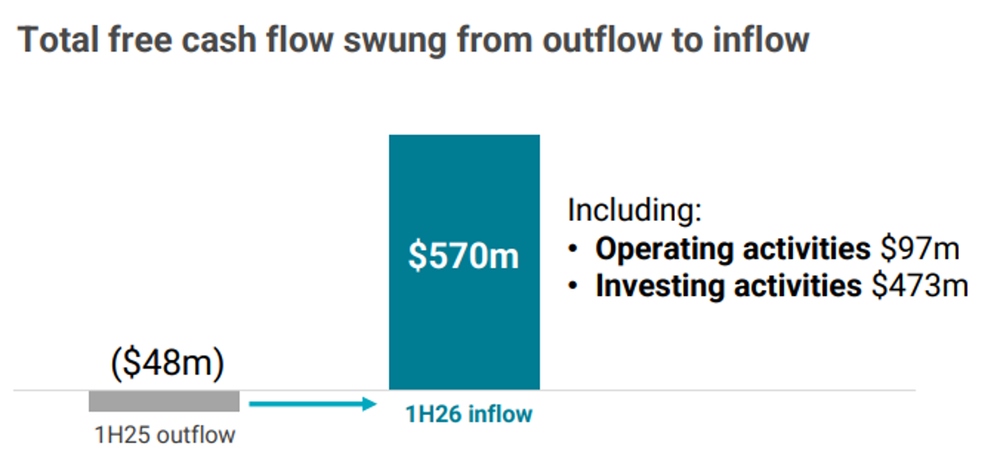
Keppel’s free cash flow improved meaningfully in 1H2026. Free cash inflow was S$570 million, compared with an outflow of S$48 million a year ago. This was supported by higher divestment proceeds, in line with Keppel’s ongoing asset monetisation strategy.
However, group leverage also edged higher. Group net gearing rose to 84%, from 82% at end-2025. This was because dividend payments, share buybacks and continued investments in associated companies and joint ventures exceeded operating cash inflows.
Group net debt to EBITDA also rose to 6.7 times, from 5.8 times, while annualised ROE fell to 3.6%, from 7.2%.
Both metrics were dragged down by losses from the Non-Core Portfolio.
The picture looks different for “New Keppel”. New Keppel’s net debt to EBITDA remained steady at 1.4 times, while annualised ROE improved to 15.0%, from 14.7%. This reinforces management’s message that New Keppel and the legacy non-core portfolio are increasingly telling two different stories.
The core business is generating stronger returns and remains reasonably geared, while the headline group numbers are still weighed down by legacy assets.
#5 — Dividend held steady, buyback programme continues
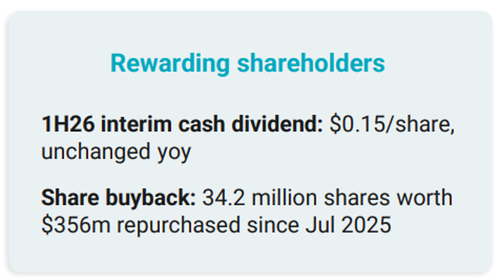
Keppel declared an interim cash dividend of 15.0 cents per share, unchanged from a year ago.
The dividend will be paid on 21 August 2026.
This suggests that the Board is keeping the ordinary payout steady despite weaker headline earnings.
Keppel’s share buyback programme also remains active.
Since July 2025, the group has repurchased 34.2 million shares for S$356 million under its S$500 million buyback programme.
Management indicated that there is still capacity left under the current programme before it considers any potential upsize.
However, future capital returns will depend on how quickly asset monetisation proceeds are realised, and whether New Keppel’s earnings growth can offset the remaining drag from the Non-Core Portfolio.
What to watch for in 2H2026
#1 — Fee income has yet to fully catch up with the July fundraising.
Keppel’s FUM reached S$106 billion as at end-July, but about S$13.5 billion of that was raised only in July. This means the associated management fees will only start contributing from 2H2026 onwards. Roughly 45% of the July fundraise relates to the M1-linked fund.
Another S$3.3 billion came from a sovereign wealth fund investor, allocated across Keppel’s data centre and infrastructure platforms.
If these funds are deployed and fee-bearing as expected, recurring income could receive a further uplift in the second half.
#2 — A decision on two new subsea cable systems is expected by year-end.
Following the full commercialisation of Bifrost, Keppel is now exploring its next phase of connectivity growth.
The group is in discussions with joint-build partners and is selecting landing sites for two possible new subsea cable systems. These would link Singapore to the Middle East and Singapore to Japan. A decision is targeted by end-2026.
Keppel also expects to recognise a gain in 2H2026 when the fifth committed Bifrost fibre pair is handed over to its customer.
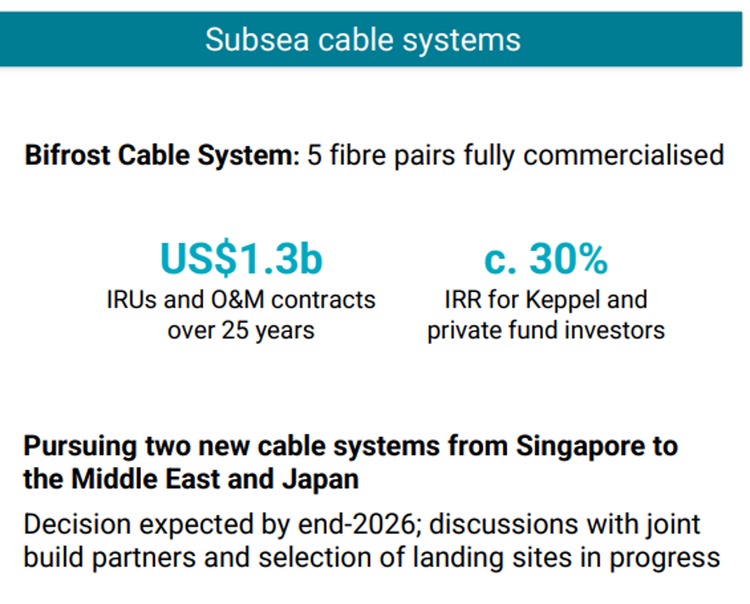
If the new projects proceed, they could add to Keppel’s recurring digital infrastructure platform and strengthen its role in regional connectivity infrastructure.
#3 — Whether M1 talks translate into an actual consolidation deal
M1 remains another key item to watch. Management said regulatory concerns were not the reason the earlier Simba transaction fell through.
It also made clear that any future deal needs to be one that can actually complete, rather than repeat the earlier outcome.
We would watch for signs of renewed M&A discussions, as well as continued progress on cost savings.
Keppel is targeting S$70 million of annual cost savings by 2028. So far, S$4 million has been achieved year-to-date, with S$10 million targeted by end-2026.
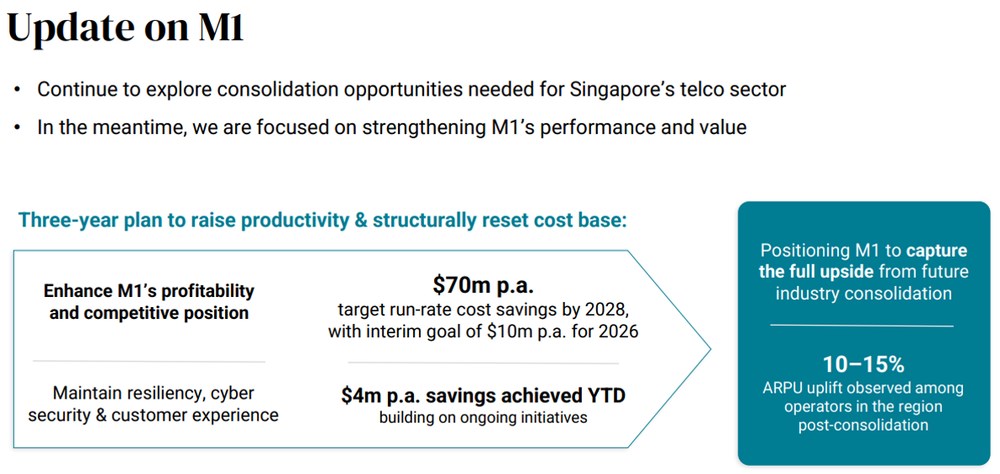
A successful deal could accelerate Keppel’s non-core exit, while steady cost savings would help reduce the earnings drag even if consolidation takes longer.
#4 — Completion pace of the remaining four legacy rigs
The completion and monetisation pace of the remaining four legacy rigs is another key watch item.
These rigs are expected to be progressively completed and potentially divested into the Keppel Offshore Fund between 2027 and 2028. If completed as planned, they could unlock a further S$1.3 billion in cash for Keppel.
This would help accelerate the group’s exit from its legacy offshore assets and reduce the drag from the Non-Core Portfolio.
However, there is still some valuation risk.
Management noted that further impairments cannot be ruled out, as rig values are reassessed every six months. The offset is that charter enquiries have improved, and rig market fundamentals appear to be turning more supportive.
#5 — Aermont’s second acquisition tranche in 2028
Aermont is another item to watch beyond the near-term results.
Keppel has a further tranche of consideration due for its Aermont Capital stake in 2028. Management said this could be funded using cash, treasury shares or new share issuance.
The exact funding mix matters. If Keppel uses mostly cash, the impact on shareholders would likely be less dilutive, but it could affect balance sheet flexibility. If treasury shares or new shares are used, there could be some dilution depending on the final structure and share price at the time.
#6 — Progress towards the S$200 billion FUM target by 2030
Keppel’s longer-term transformation still depends on two big milestones. The first is growing Funds Under Management from S$106 billion today to S$200 billion by 2030. The second is substantially monetising the remaining Non-Core Portfolio over the same period.
Both targets matter because they define whether Keppel can complete its shift into a more asset-light manager and operator.
A larger FUM base should support higher recurring fee income, while a smaller non-core portfolio should reduce earnings volatility and capital drag.
How does Keppel fare on our Opportunity Pot screener?
Based on Beansprout’s opportunity pot stock screening framework, Keppel passes one of our three checks.
Keppel is flagged as “Watch” for revenue and earnings, and also for returns. Its balance sheet is the only clear “Pass”.
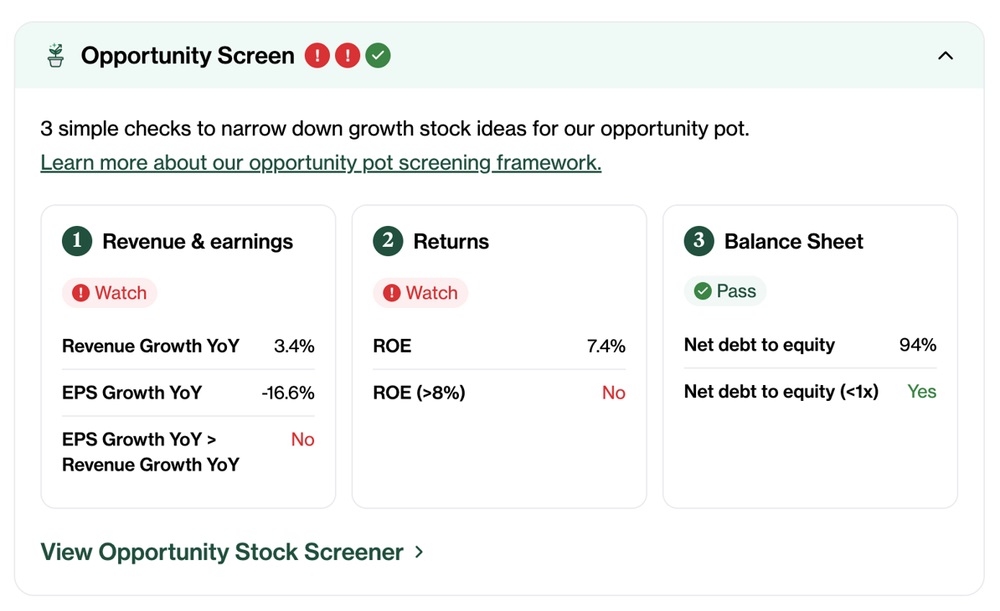
Revenue grew 3.4% year-on-year, while EPS fell 16.6%. This means earnings growth trailed revenue growth for the period.
ROE also came in at 7.4%, below our 8% threshold.
The balance sheet, however, remains healthy. Keppel’s net debt to equity stood at 94%, within our sub-1.0 times threshold.
The reason Keppel does not screen better is that the group-level numbers are still weighed down by the Non-Core Portfolio.
This portfolio recorded a S$375 million net loss, mainly from legacy assets that management is actively working to monetise or exit.
In other words, the screener is capturing the drag from Keppel’s old business, not just the performance of New Keppel.
This is why we think investors should look beyond the blended group-level numbers and focus on New Keppel’s own metrics.
On that basis, the picture looks stronger.
New Keppel’s annualised ROE improved to 15.0% in 1H26, from 14.7% in 1H25, comfortably above our 8% threshold.
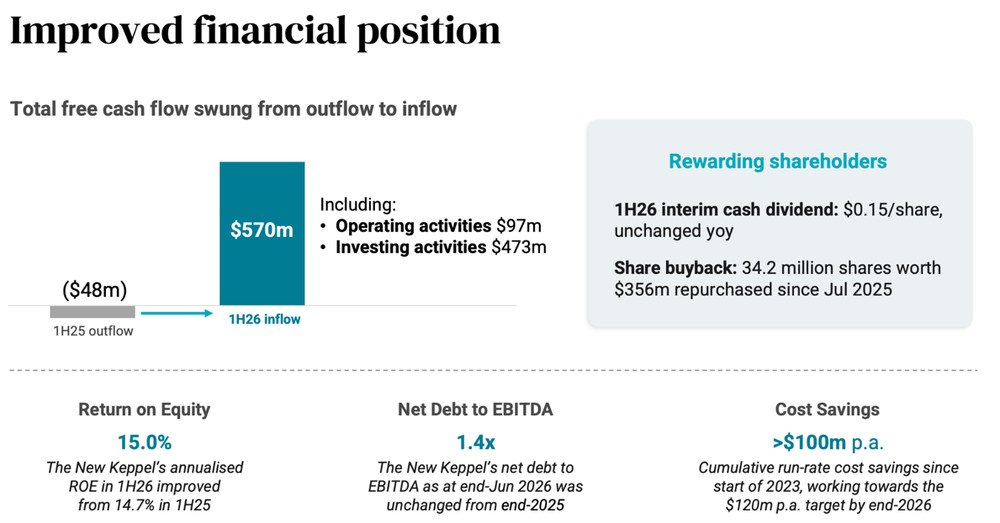
Overall, Keppel’s group-level screener results understate the quality of the underlying business.
I would treat New Keppel’s revenue growth, earnings, ROE and gearing metrics as the more meaningful indicators of Keppel’s fundamentals.
As the Non-Core Portfolio shrinks, I would expect Keppel’s headline screener readings to improve over time.
What would Beansprout do?
Keppel’s latest results reinforce why I would look beyond its headline profit.
If I am considering Keppel for my Opportunity Pot within Beansprout's four pots of wealth, I would start with a quick check using our Opportunity Pot stock screening framework.
At the group level, Keppel passes only one of our three Opportunity Pot checks, as weaker EPS growth and a lower ROE continue to reflect the drag from its Non-Core Portfolio.
However, Keppel’s core “New Keppel” business delivered a strong 1H2026 performance, with net profit rising 25% year on year to S$530 million, recurring income growing 13% and annualised ROE reaching 15.0%.
This suggests that the core business continues to move in the right direction, even though the progress is not yet fully reflected in Keppel’s consolidated figures.
Keppel’s share price has risen 19.2% year-to-date and 9.7% since it was added to our model portfolio on 30 June 2026.
At S$11.48, Keppel was trading at a price-to-earnings ratio of about 21.3 times, above its historical average of 9.5 times.
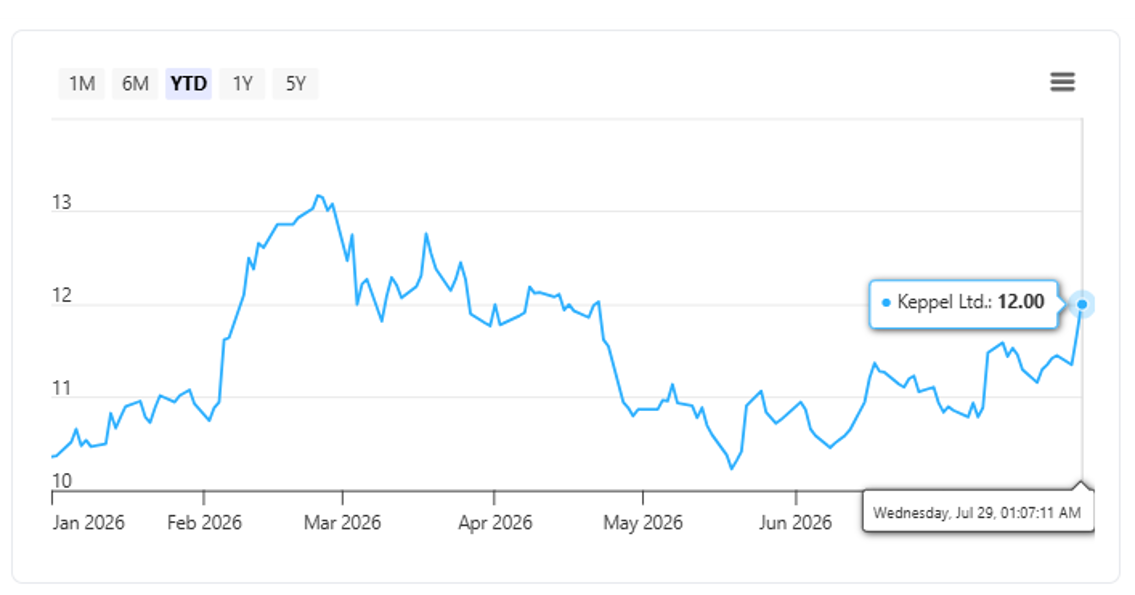
After this strong run, some consolidation or a pullback would be healthy and could offer investors a better entry point, rather than indicate weaker fundamentals.
We are keeping Keppel in our model portfolio, while watching whether the newly raised funds translate into higher recurring fee income and whether the Apollo transaction delivers the expected cash proceeds.
Our focus remains on the recurring income and Sponsor Stakes and Co-Investments earnings generated by New Keppel, rather than the group’s headline numbers, which may remain volatile as the legacy rigs are monetised through 2028.
I would also monitor further impairments and group leverage, as the pace of exiting the Non-Core Portfolio will determine how quickly Keppel’s headline earnings and screener readings improve.
For now, the investment case remains dependent on New Keppel sustaining its growth while the drag from legacy assets continues to shrink.
Related links:
To find other Singapore stocks that meet Beansprout’s three Opportunity Pot checks, you can use our Opportunity Stock Screener here and learn more about our key market growth themes here.
If you are looking for greater clarity on the markets and the investment decisions that matter, explore Beansprout Pro for our latest views, portfolio thinking and the reasoning behind each opportunity.
Are you invested in Keppel? Share your thoughts with us in the comments below or in the Beansprout Telegram community.
Planning to invest in Keppel? Compare the best Singapore brokers to find the right trading platform, and see the latest promotions and sign-up rewards available.
Follow Beansprout on YouTube, Facebook and Instagram, and add Beansprout as your preferred source on Google so you never miss an update.
Read also
Gain financial insights in minutes
Subscribe to our free weekly newsletter for more insights to grow your wealth
Most Popular

Comments
0 comments